TailVille
1. Overview
Floating on its back with a clam on its chest and a rock in its paws, the sea otter has charmed people around the world. It is the heaviest member of the weasel family and one of the very few carnivorous mammals that spends almost its entire life at sea.
Sea otters live along the cold coasts of the North Pacific, from northern Japan and Kamchatka through the Aleutian Islands and Alaska down to California. Unlike seals and whales, they have no thick blubber. Instead they rely on the densest fur of any animal to keep warm in frigid water, and that fur nearly drove them to extinction. Hunted relentlessly for pelts in the eighteenth and nineteenth centuries, they dwindled to perhaps one or two thousand animals.
Ecologists hold up the sea otter as a classic keystone species. By eating sea urchins, otters keep urchins from mowing down kelp forests, which in turn shelter a huge variety of fish and other marine life. One small predator shapes an entire underwater forest.
Protection has brought sea otters back in parts of their range, but the species is still listed as Endangered by the IUCN.
2. Name and classification
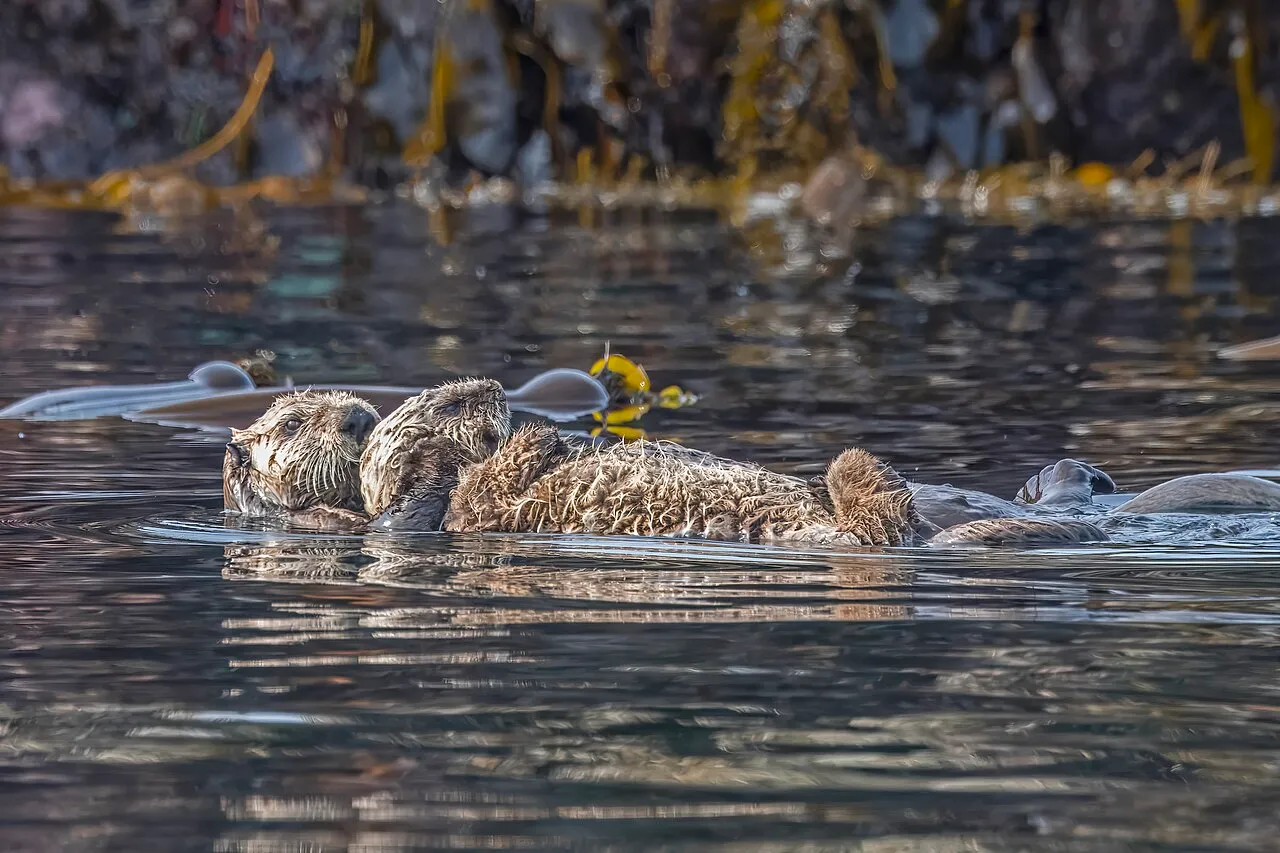
The scientific name is Enhydra lutris. Enhydra comes from Greek for in the water, and lutris is Latin for otter, so the name means something like the otter that lives in water.
Sea otters belong to the otter subfamily, Lutrinae, of the weasel family, Mustelidae. Relatives include the Eurasian otter, the Asian small-clawed otter, the giant otter of South America and the marine otter of Chile and Peru, which also lives along coasts. The sea otter is the only living member of its genus.
The Korean name haedal means sea otter. It is often confused with seals and fur seals, which belong to a completely different group, the pinnipeds.
2.1. Subspecies
Three subspecies are recognized. The Asian or Russian sea otter, E. l. lutris, lives in the Kuril Islands, Kamchatka, the Commander Islands and parts of eastern Hokkaido; it is the largest, with a broad skull. The northern sea otter, E. l. kenyoni, ranges from the Aleutians and southern Alaska to British Columbia and Washington State. The southern or California sea otter, E. l. nereis, lives along the central California coast and has a longer snout and smaller teeth. The southern subspecies was thought to have been wiped out until a small group was rediscovered near Big Sur in 1938.
3. Evolution
Otters split from other mustelids roughly ten million years ago. Some lineages adapted to life along rivers and lakes, and the sea otter line went further than any other into the ocean.
A close extinct relative, Enhydritherium, lived several million years ago in Europe and North America and had rounded, crushing teeth similar to the sea otter's, suited to breaking hard-shelled prey. Fossils of the genus Enhydra itself come from North Pacific deposits around one to three million years old, including an extinct species with even larger teeth than the modern sea otter.
Compared with whales or seals, sea otters have been marine for only a short time. That is why they still rely on fur rather than blubber and retain dexterous forepaws. If whales show the end point of 50 million years of marine adaptation, sea otters offer a glimpse of an early stage.
4. Range and habitat
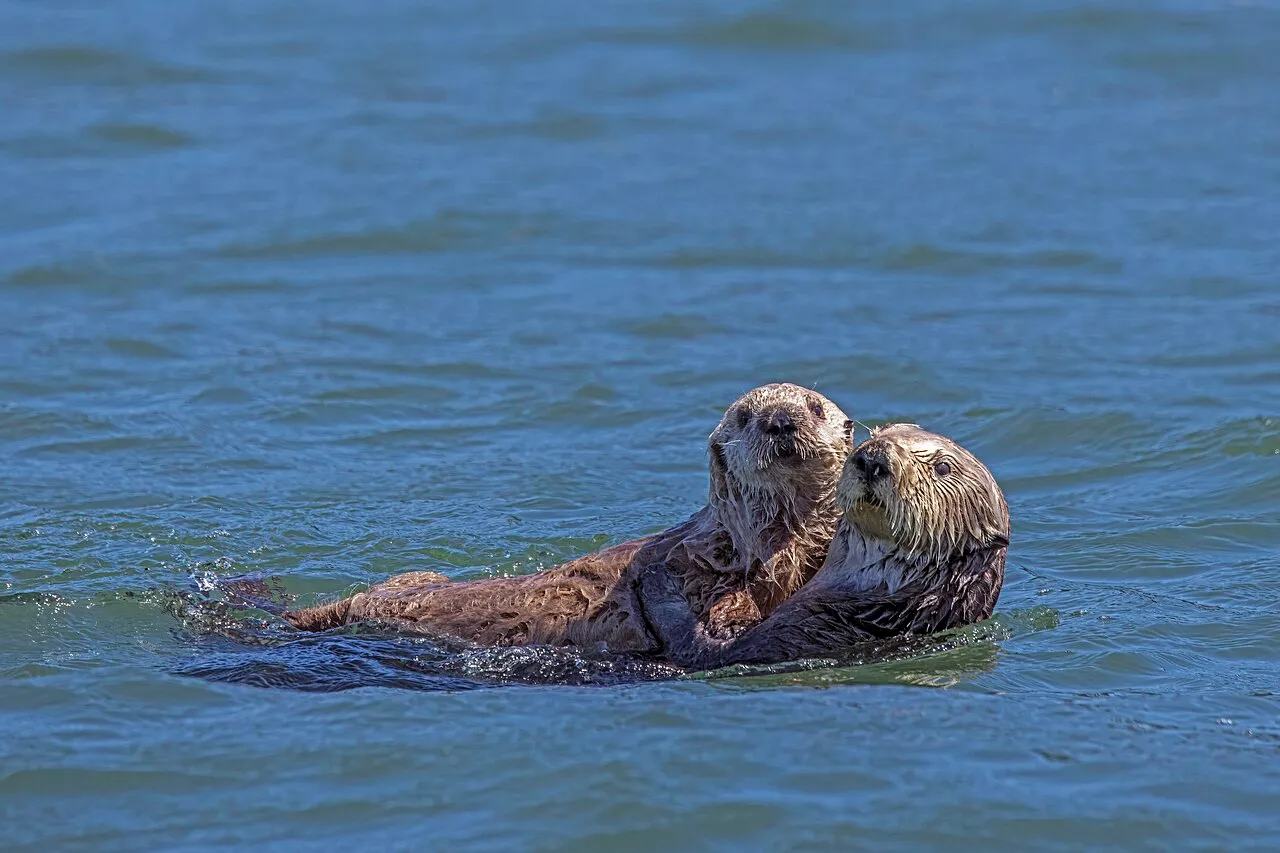
Before the fur trade, sea otters lived around the entire arc of the North Pacific rim, from Hokkaido and the Russian Far East through the Aleutians and Alaska to Baja California. Hunting wiped them out across most of that range. Today they live in Alaska and Russia, British Columbia and Washington State, and central California. Populations in Canada and the north-western United States descend from otters relocated from Alaska in the 1960s and 1970s. Reintroduction is being discussed for places such as Oregon, where sea otters have not returned.
Sea otters usually stay within one or two kilometres of shore in water less than about 40 metres deep, since they must dive to the seabed to feed. They favour rocky coasts with kelp forests but also use sandy or muddy bays and estuaries. When resting, they often wrap themselves in kelp to avoid drifting.
They rarely come ashore, although Alaskan otters haul out on rocks and beaches more often than California otters do.
5. Physical characteristics
The sea otter is the heaviest mustelid but small for a marine mammal.
| Feature | Males | Females |
|---|---|---|
| Length including tail | about 1.2 to 1.5 m | about 1 to 1.4 m |
| Weight | about 22 to 45 kg | about 14 to 33 kg |
| Tail | about 25 to 37 cm | similar |
| Newborn | about 1.4 to 2.3 kg | - |
| Diving depth | usually 5 to 30 m, maximum around 100 m | same |
The body is cylindrical, and the short, flattened tail acts as a rudder and paddle. The hind feet are large, webbed and flipper-like and provide most of the swimming power. The forepaws are short and round, with rough pads and retractable claws that grip food and stones. A loose pouch of skin under each foreleg stores prey and a favourite rock during dives.
Unlike most carnivores, sea otters have broad, flat, rounded molars for crushing shells. They have only four lower incisors, rather than the six typical of carnivores.
5.1. The densest fur on Earth
Sea otter fur is estimated at around 100,000 to 140,000 hairs per square centimetre, the densest of any animal. For comparison, an entire human head carries roughly 100,000 hairs.
The coat has long, stiff guard hairs over short, soft underfur. Air trapped in the underfur keeps water from reaching the skin. For this insulation to work, the fur must stay clean and fluffed, so otters spend hours a day grooming, twisting, rubbing and blowing air into their coats. If oil soaks the fur, the insulation fails and the otter can die of hypothermia.
The fur is dark brown, and the head and neck often turn grizzled grey with age.
5.2. A high-speed metabolism
Fur alone is not enough in cold water, so sea otters generate a great deal of internal heat. Their resting metabolic rate is often quoted as two to three times that of similar-sized land mammals, and research suggests their muscles deliberately leak energy as heat. The cost is an enormous appetite: about 20 to 25 percent of body weight in food every day. Their kidneys are also unusually large, allowing them to drink seawater.
6. Behaviour and ecology
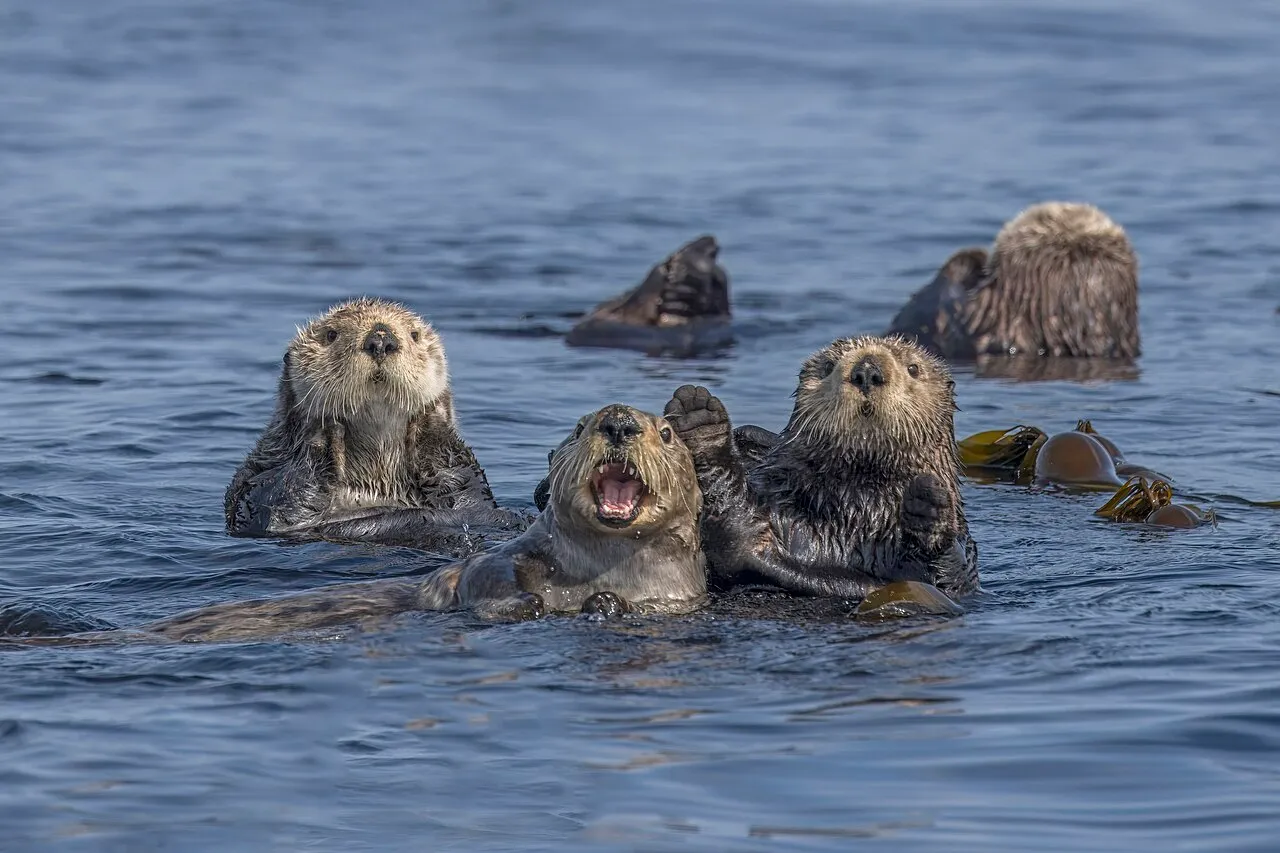
Charles J. Sharp · CC BY-SA 4.0
A sea otter's day is mostly divided between foraging, grooming and resting. Feeding often peaks around dawn and dusk, with rest periods spent floating on the back, but in food-poor areas otters must forage around the clock.
Males and females tend to group separately. Resting groups are called rafts, and male rafts can number in the hundreds. Females and pups gather elsewhere. Some adult males defend territories in areas used by females during the breeding season.
While sleeping, sea otters often wrap themselves in kelp so they do not drift away. Viral videos of otters holding paws were mostly filmed in captivity; in the wild, kelp wrapping is far more common, though mothers and pups do stay in close contact.
Sea otters tend to stay within a limited home range, but young males may travel tens of kilometres and act as pioneers when populations expand into new areas.
7. Diet and feeding
Sea otters mainly eat bottom-dwelling invertebrates: sea urchins, abalone, clams, mussels, crabs, snails, sea cucumbers, sea stars and octopuses. Some populations also eat fish, and a few Alaskan otters have been recorded catching seabirds.
An otter dives to the bottom, feels through crevices with its sensitive forepaws, tucks prey into its underarm pouches and surfaces to eat while floating on its back, using its chest as a table. Dives usually last one to two minutes, occasionally four or five.
Individual diets vary a lot. Long-term studies in California show that some otters specialize in urchins, others in crabs or snails, and these preferences tend to pass from mother to pup. When food is plentiful, most otters eat the same favourite prey; when it becomes scarce, individuals diversify into different specialties, reducing competition.
7.1. Tool use
Sea otters are among the few non-primate mammals that use tools. They place a flat stone on the chest and pound shellfish against it, or use a rock to hammer abalone off the seabed. A favourite stone may be carried in the underarm pouch and used repeatedly. Bottles and other shells sometimes serve as substitutes.
Tool use varies between individuals. Otters that eat hard-shelled snails and clams use stones more often than urchin specialists, and females use tools more than males, probably because tools help smaller animals crack hard prey without damaging their teeth. Researchers have even used archaeological methods to study wear on coastal rocks that otters have used as anvils.
8. Reproduction and life cycle
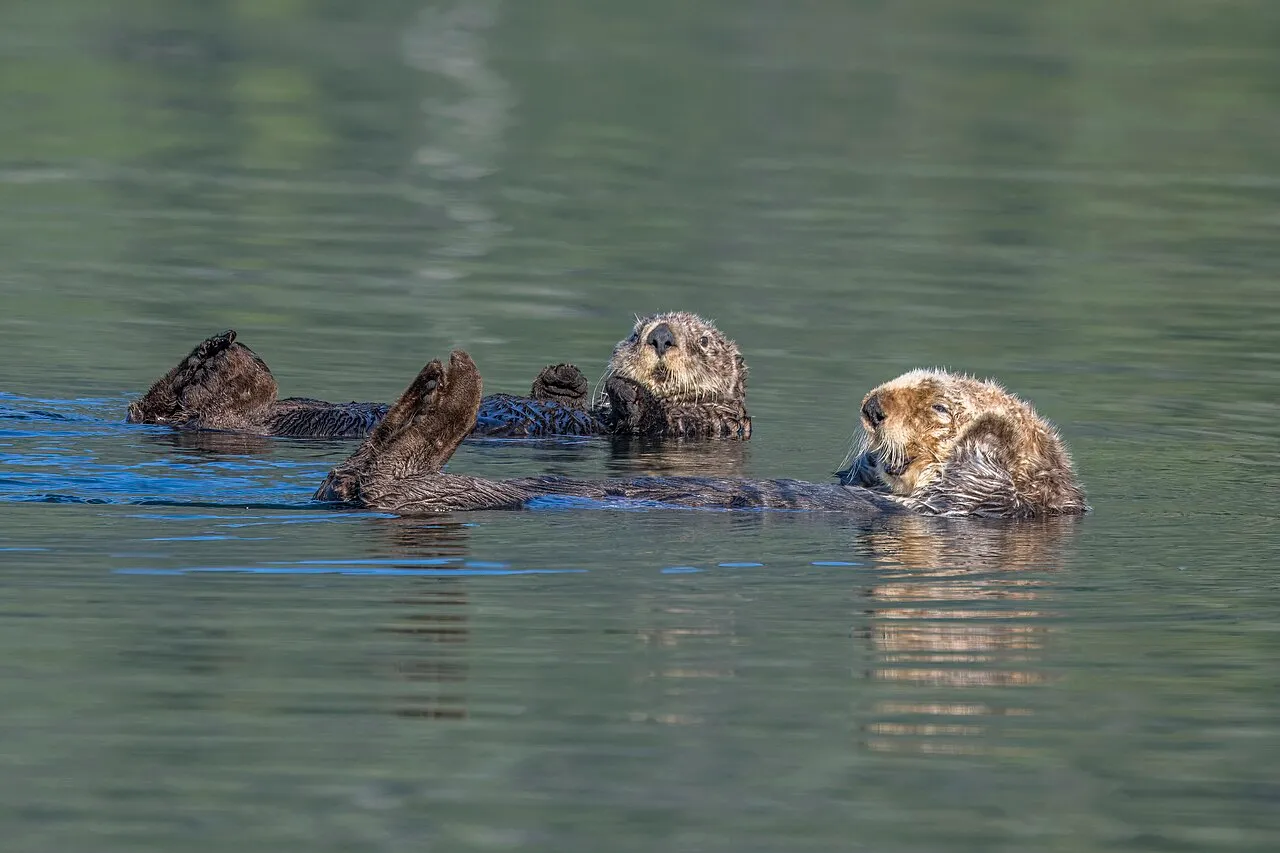
Charles J. Sharp · CC BY-SA 4.0
Sea otters can breed year-round, though births peak in certain seasons depending on location. During mating, the male grips the female's nose with his teeth, often leaving scars that researchers use as a sign of recent breeding.
Sea otters have delayed implantation: the fertilized embryo waits for months before attaching to the uterus. Total time from mating to birth is about six to eight months, while active fetal growth may take only four to five. A single pup is usually born in the water.
| Stage | Period | What happens |
|---|---|---|
| Newborn | 0 to 1 month | Fur so buoyant the pup cannot dive; rides on mother's chest |
| Learning | 1 to 3 months | Learns to swim, dive and groom; tastes solid food |
| Dependent | 3 to 6 months | Begins foraging but still shares mother's catches |
| Independence | around 6 months | Separates from mother |
| Maturity | females about 3 to 4 years, males 5 to 6 | Males often breed successfully later |
Raising a pup is exhausting, since a mother must find food for two. In California, researchers have described end-lactation syndrome, in which mothers become emaciated or ill around the time their pups wean. When a mother dives, she may leave her pup floating or wrapped in kelp, often squealing loudly until she returns.
Males typically live 10 to 15 years and females 15 to 20.
9. Intelligence, communication and special abilities
Sea otters are capable problem-solvers. Beyond tool use, captive otters quickly learn to open latched puzzle boxes, and in the wild, mothers pass foraging choices and techniques to their pups in a form of cultural learning.
They have a varied vocal repertoire: piercing screams from pups calling their mothers, soft coos of contentment, hisses and growls when threatened. Mothers and pups appear to recognize each other's voices.
Touch is a special strength. The forepaws and whiskers are densely packed with nerve endings, allowing otters to find prey by feel in dark, murky water. Experiments have shown they can discriminate very fine differences in texture by touch alone. Their underwater hearing is less acute than one might expect, so they rely more on touch and vision than sound.
10. Predators and survival
Predators vary by region. In California the main threat is the great white shark. Sharks often seem to bite otters exploratively, perhaps mistaking them for seals, and even a single bite can be fatal. Shark bites have become a leading cause of death and a major brake on recovery along parts of the California coast.
In Alaska and the Aleutian Islands, orcas are the concern. One influential hypothesis holds that when seal and sea lion numbers fell in the 1990s, some orcas switched to eating sea otters, causing a steep otter decline. Urchins then multiplied and stripped kelp forests, a dramatic chain reaction across the ecosystem.
Bald eagles sometimes snatch young pups, and otters that haul out on land can fall prey to brown bears or coyotes. When threatened, otters dive or retreat deep into kelp beds.
11. Relationship with humans
Indigenous peoples of the North Pacific hunted sea otters for fur and meat for thousands of years. The turning point came in 1741, when a Russian expedition explored the Bering Sea and brought back sea otter pelts that sold for spectacular prices in China, igniting what became known as the great fur trade.
For roughly 170 years, Russian, British, American and Spanish hunters and traders pursued sea otters across the North Pacific. Russian traders forced Aleut and other Indigenous hunters into service, causing great suffering in their communities. Sea otter pelts were so valuable they were called soft gold, and they were a major motive for Russia's colonization of Alaska.
By the early twentieth century only around one to two thousand sea otters survived, in perhaps a dozen scattered colonies. The 1911 North Pacific Fur Seal Convention between the United States, Britain (for Canada), Russia and Japan also banned hunting sea otters, marking the start of their recovery.
That recovery has created new conflicts. Sea otters eat abalone, urchins and crabs that people also harvest, and fishers have blamed otters for declining shellfisheries in California and south-eastern Alaska, although overfishing also played a role. Economists, on the other hand, point to the value otters create by restoring kelp forests that support fisheries, tourism and carbon storage.
12. Conservation status
The sea otter is listed as Endangered on the IUCN Red List. The global population is often estimated at roughly 100,000 to 150,000, though figures vary considerably by source and survey year. The listing reflects the large share of the historical range still unoccupied and severe declines in some regions.
| Region | Approximate situation (estimates vary) |
|---|---|
| Alaska | Largest population; south-western stock fell sharply from the 1990s |
| Russia and Japan | Kurils, Kamchatka and Commander Islands, likely tens of thousands |
| British Columbia and Washington | Steady growth after reintroduction |
| California | Stalled around 3,000; shark bites a major factor |
Main threats include:
- Oil spills: the 1989 Exxon Valdez spill is estimated to have killed thousands of sea otters, and local populations took decades to recover. Oil destroys the insulating power of fur.
- Disease and parasites: Toxoplasma, a parasite shed in cat faeces and carried to the sea in runoff, is a significant cause of death in California otters.
- Harmful algal blooms, whose toxins accumulate in shellfish.
- Increased predation by orcas and great white sharks in some areas.
- Conflict with fisheries, entanglement and coastal pollution.
The southern sea otter and the south-western Alaska population of northern sea otters are listed as threatened under the US Endangered Species Act. In CITES, the southern subspecies is on Appendix I and other sea otters on Appendix II.
13. In zoos and aquariums
Sea otters are among the most popular aquarium animals but among the hardest to keep. They need fresh seafood equal to nearly a quarter of their body weight every day and constantly clean, cold seawater; even slightly dirty water can foul the fur and compromise insulation.
Japan once kept more sea otters than any other country, with well over a hundred in aquariums in the 1990s. As the United States and Russia restricted exports of wild otters and captive breeding proved difficult, numbers fell to just a handful, illustrating how hard it is to sustain a captive population.
Aquariums can also play a positive role. One aquarium in California has long run a surrogacy programme in which captive female otters raise stranded orphan pups, which are then released into the wild. Studies indicate that these released otters have contributed to the recovery of a local population.
Sea otters are never suitable as pets. The otters seen in otter cafes and pet videos are usually Asian small-clawed otters, which have suffered so badly from poaching and illegal trade that they were moved to CITES Appendix I in 2019, banning commercial trade.
14. In culture
Sea otters are stars of the internet age. Clips of otters holding paws, cracking shellfish on their chests or grooming have drawn tens of millions of views. Sea otter characters are popular in Japanese manga and merchandise, and plush otters lying belly-up are a staple of gift shops.
In Indigenous cultures of the North Pacific, sea otters appear in stories and art. Some legends describe otters as people who went to live in the sea, and sea otter imagery appears in Alaska Native and First Nations carvings.
Recently a California sea otter made headlines for repeatedly commandeering surfers' boards. The footage delighted viewers, but experts warned that habituated otters can become dangerous and that approaching sea otters can count as illegal harassment under US law. Behind every cute clip is a reminder to keep a respectful distance from wild animals.
15. Trivia
- Sea otters can close their nostrils and ears underwater.
- Newborn pups have so much air trapped in their fur that they bob like corks and cannot dive.
- After eating, sea otters roll in the water to rinse food scraps from their fur, since clean fur is a matter of life and death.
- Observers have reported that individual otters may favour one paw, a little like being left- or right-handed.
- Eating lots of purple sea urchins can stain an otter's bones and teeth purple.
- Studies estimating the carbon stored in kelp forests suggest that sea otters, by protecting kelp, may have a meaningful climate effect.
- The California population rediscovered in 1938 is thought to have numbered only around 50 animals.
Wild animals are not pets. Catching, trading or keeping them is illegal in most places. If you find an injured wild animal, call your local wildlife rescue centre.
FAQ
How is a sea otter different from a river otter?
Both are otters, but sea otters live almost entirely at sea, float on their backs and weigh tens of kilograms. River otters live in rivers and lakes, swim belly-down and are much smaller.
Do sea otters really hold hands while sleeping?
The famous hand-holding videos were mostly filmed in captivity. Wild sea otters more often wrap themselves in kelp to avoid drifting, and mothers and pups rest in close contact.
Can sea otters be kept as pets?
No. Sea otters are endangered and their trade is regulated. Even the small-clawed otters seen in otter cafes were moved to CITES Appendix I in 2019 because of poaching.
Photo credits
Photos are freely licensed images from Wikimedia Commons. Authors and licenses are listed below.
- Sea Otter (Enhydra lutris) (25169790524) crop.jpg — Marshal Hedin from San Diego · CC BY-SA 2.0
- Northern sea otter (Enhydra lutris kenyoni) female and pup Tofino.jpg — Charles J. Sharp · CC BY-SA 4.0
- Northern sea otter (Enhydra lutris kenyoni) female with pup Quatsino.jpg — Charles J. Sharp · CC BY-SA 4.0
- Northern sea otters (Enhydra lutris kenyoni) Tofino.jpg — Charles J. Sharp · CC BY-SA 4.0
- Northern sea otters (Enhydra lutris kenyoni) Tofino 2.jpg — Charles J. Sharp · CC BY-SA 4.0