TailVille
1. Overview
The African bush elephant (Loxodonta africana) is the largest land animal alive. Adult bulls can stand more than 3 metres at the shoulder and weigh up to 6 tonnes or more. It is also called the African savanna elephant and is now recognised as a separate species from the African forest elephant of Central and West African rainforests. In this article, 'African elephant' means the bush elephant unless stated otherwise.
Elephants are much more than big. They live in families led by an experienced matriarch, remember water holes and the voices of companions for decades, and communicate with low rumbles that travel kilometres, mostly below the range of human hearing. By toppling trees, digging for water and dispersing seeds, they reshape the savanna, earning the title of ecosystem engineers.
Poaching for ivory and habitat loss have devastated African elephants over the past century. In 2021 the IUCN listed the bush elephant as Endangered and the forest elephant as Critically Endangered. Protecting elephants means protecting entire ecosystems.
2. Name and classification
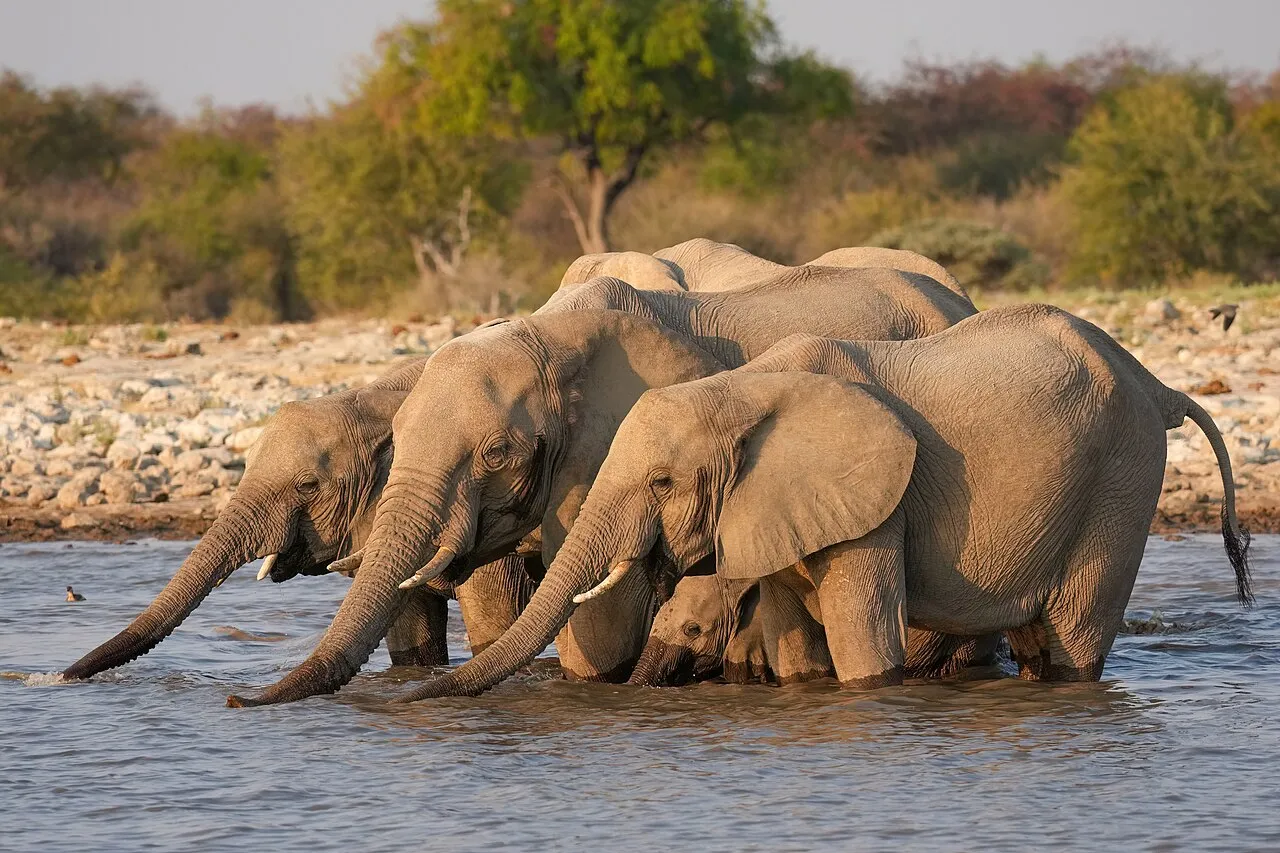
Giles Laurent · CC BY-SA 4.0
The genus name Loxodonta means 'slanting tooth' in Greek, referring to the lozenge-shaped ridges on the grinding surface of African elephant molars. Asian elephant molars instead have narrow, parallel bands. The English word elephant comes from Greek elephas, which originally seems to have referred to ivory.
The Korean word kokkiri is commonly explained as 'the long-nosed one', combining ko (nose) with an old word for length. The Chinese character for elephant, 象, began as a pictogram of the animal and is also used in words meaning shape or image, such as 'phenomenon' and 'symbol'.
2.1. The three living elephants
African elephants were long treated as a single species, but accumulating genetic evidence has established the bush and forest elephants as separate species, with some studies dating their split to several million years ago. Hybrids do occur where their ranges meet.
| Species | Range | Shoulder height (bulls) | Features |
|---|---|---|---|
| African bush elephant | East and southern African savannas | about 3–4 m | Largest; big, pointed ears; outward-curving tusks |
| African forest elephant | Central and West African rainforest | about 2.4–3 m | Smaller, rounded ears; straight, downward tusks |
| Asian elephant | India, Sri Lanka, Southeast Asia | about 2.5–3.2 m | Small ears, rounded back; most females lack tusks |
Remarkably, the elephant's closest living relatives are the sea cows (dugongs and manatees) and the small, rodent-like hyraxes. All belong to Afrotheria, a group of mammals that originated in Africa.
3. Evolution
The story of the Proboscidea, the order that includes elephants, began in Africa around 60 million years ago. One of the earliest known members, Eritherium, weighed just a few kilograms and looked nothing like a modern elephant. Later, around 37 million years ago, Moeritherium appears to have lived a semi-aquatic, hippo-like life.
Over time proboscideans grew larger, their trunks lengthened and their incisors became tusks. Shovel-tusked Platybelodon, Deinotherium with downward-curving lower tusks and shaggy mastodons spread out of Africa into Eurasia and the Americas. At their peak, proboscideans lived on every continent except Antarctica and Australia.
The modern elephant family arose in Africa roughly 7 to 5 million years ago, splitting into the African elephant line, the Asian elephant line and the mammoth line. Surprisingly, woolly mammoths were closer to Asian elephants than to African ones. Most mammoths vanished around 10,000 years ago, but a small population survived on Wrangel Island off northern Siberia until about 4,000 years ago, meaning mammoths were still alive when the pyramids of Egypt were being built.
Europe was once home to the straight-tusked elephant, considerably larger than today's African elephant, while Mediterranean islands produced dwarf elephants scarcely a metre tall, a classic example of island dwarfism in places where food is limited.
4. Range and habitat
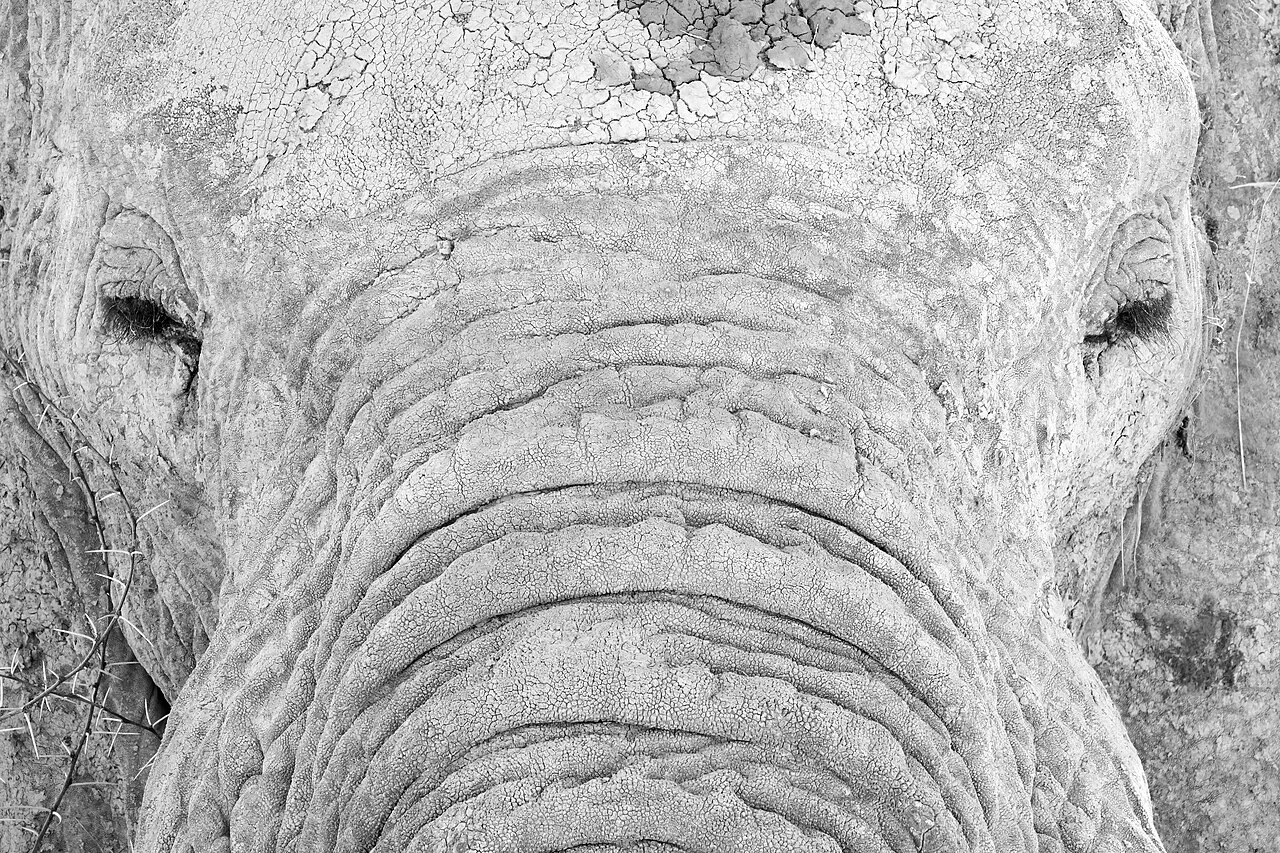
African bush elephants live in around 30 countries south of the Sahara. Southern Africa holds the largest numbers. Botswana alone has roughly 130,000, more than any other country, and the Kavango–Zambezi Transfrontier Conservation Area spanning Botswana, Zimbabwe, Zambia, Namibia and Angola is thought to hold close to half of Africa's elephants. Tanzania and Kenya are key strongholds in East Africa.
Elephants are highly adaptable. Beyond savanna and grassland they inhabit bush, riverine woodland, swamps, montane forest and even deserts. The desert-adapted elephants of north-western Namibia walk dozens of kilometres a day between water sources and can go several days without drinking. Elephants of the Gourma region in Mali make an annual circuit of hundreds of kilometres through the Sahel. Elephant signs have even been found above 4,000 metres on the slopes of Kilimanjaro.
Elephants once ranged across almost the entire continent, from the Mediterranean coast to the Cape of Good Hope. North African elephants disappeared after Roman times, and most West African populations are now small and isolated. Today elephants are concentrated in and around protected areas, and keeping cross-border migration routes open is a major conservation challenge.
5. Body
Massive pillar-like legs support the elephant's bulk. A thick pad of fatty tissue in each foot spreads the load, so a six-tonne animal walks surprisingly quietly. There are five toes, mostly buried in the foot. Elephants cannot gallop or jump, but a fast walk can reach around 25 km/h.
| Measurement | Bull | Cow |
|---|---|---|
| Shoulder height | about 3–4 m | about 2.2–2.7 m |
| Weight | about 4–7 t | about 2–3.5 t |
| Body length (excluding trunk) | about 6–7.5 m | about 5–6 m |
| Tusk weight (each) | usually 20–45 kg, sometimes much more | much lighter than bulls' |
The largest elephant reliably recorded was a bull shot in Angola in the 1950s, estimated at about 4 metres at the shoulder and roughly 10 tonnes. Its mounted skin is displayed at the Smithsonian's National Museum of Natural History in Washington, D.C.
5.1. The trunk
The trunk is a fusion of the upper lip and nose, made entirely of muscle with no bone. It contains tens of thousands of muscle units, allowing it to bend, stretch and twist in every direction. An African elephant's trunk ends in two finger-like tips, one above and one below, delicate enough to pick up a single fruit or a tuft of grass.
The trunk is used for breathing and smelling, plucking food, sucking up water and squirting it into the mouth, dusting and showering, caressing companions and threatening rivals. One study found that an elephant can draw up around 8–10 litres of water at a time, and the trunk can lift loads of several hundred kilograms. When crossing deep water, elephants use it as a snorkel. Young calves take months to master their trunks and can be seen tripping over or flapping them about.
5.2. Tusks, teeth, ears and skin
Tusks are upper incisors that grow throughout life. About a third of each tusk is embedded in the skull and contains a pulp cavity with nerves and blood vessels, so removing a tusk seriously injures or kills the elephant. Elephants use tusks for digging, stripping bark, fighting and moving objects, and, much like human handedness, they favour one tusk, which wears down faster.
Molars are replaced six times over a lifetime, each new tooth moving forward from the back of the jaw like a conveyor belt. Once the sixth set wears out, an old elephant can no longer chew properly and may starve.
The huge ears are radiators as much as hearing organs. A dense network of blood vessels on the back of each ear sheds heat when the elephant flaps them, which is why savanna-dwelling African elephants have much larger ears than Asian elephants. The skin is 2–3 cm thick in places yet sensitive to insect bites and sunburn, so elephants protect it with mud baths and dust. Its deep wrinkles and cracks hold moisture, helping with cooling.
6. Behaviour and ecology
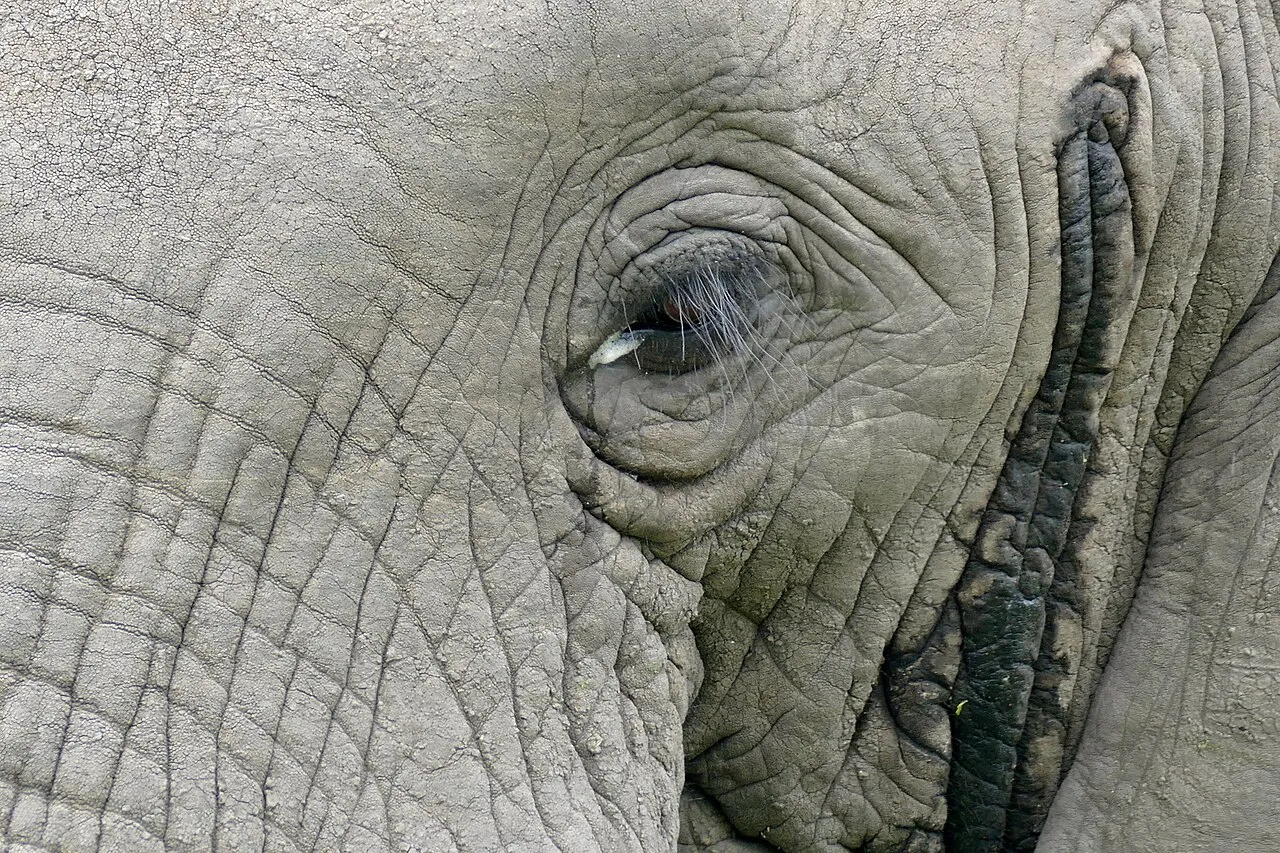
Bernard DUPONT from FRANCE · CC BY-SA 2.0
Elephants spend most of their time, up to 16–18 hours a day, feeding. They sleep remarkably little: a study tracking wild elephants recorded an average of only about two hours a day, among the least of any mammal. They usually doze standing up and lie down for deeper sleep only when they feel safe.
Daily travel ranges from a few kilometres to several dozen depending on food and water. In the dry season elephants trek long distances to rivers and water holes; in the wet season they spread out to feed on fresh growth. An elephant drinks around 100–200 litres of water a day and, when surface water runs out, digs into dry riverbeds with its tusks and feet to reach groundwater, creating wells other animals depend on too.
6.1. Families and matriarchs
The core of elephant society is the family unit: mothers, daughters, sisters and their calves, typically around ten animals, led by the oldest and most experienced female, the matriarch. She remembers where to find water in droughts, which animals and which people are dangerous, and leads the family accordingly. Research in Kenya's Amboseli found that families with older matriarchs judged the threat of lion roars more accurately and responded more appropriately.
Related families form larger kin groups, and in the dry season hundreds of elephants may gather in one area. Males leave their families at around 10–15 years old and live alone or in loose bachelor groups. Young bulls learn from older ones: in a well-known case in South Africa, orphaned young males moved to a reserve without adult bulls began attacking rhinos, and the behaviour subsided after older bulls were introduced.
6.2. Musth
Adult bulls enter a periodic state called musth lasting weeks to months each year. Testosterone levels soar, a thick secretion streams from the temporal glands between eye and ear, urine dribbles constantly and the bull gives off a strong odour. Bulls in musth are highly aggressive, fight rivals fiercely and roam widely in search of receptive females, who tend to prefer older bulls in musth as mates.
7. Diet and feeding
Elephants are strict herbivores. An adult eats roughly 100–300 kg of plant matter a day. In the wet season they graze mainly on grass; in the dry season they turn to leaves, twigs, bark, roots and fruit. Acacia, mopane and baobab are favourites, and elephants gouge baobab trunks with their tusks to reach the moist, fibrous interior.
Elephant digestion is surprisingly inefficient, with close to half of what they eat passing through undigested. A single elephant can produce close to 100 kg of dung a day, which feeds and shelters dung beetles and countless other insects, while the seeds inside are carried far and germinate. Some tree species appear to germinate better after passing through an elephant's gut.
Elephants also eat soil to obtain minerals. In Kitum Cave on Mount Elgon in Kenya, elephants have been observed walking deep into the darkness at night to scrape salt-rich rock with their tusks, and some suggest generations of elephants have gradually enlarged the cave.
Feeding elephants reshape the savanna. Knocking down trees and opening up thickets turns woodland into grassland, creating grazing for zebras and wildebeest. But when elephants are confined to small reserves at high density, they can strip so many trees that other species lose their habitat.
8. Reproduction and life cycle
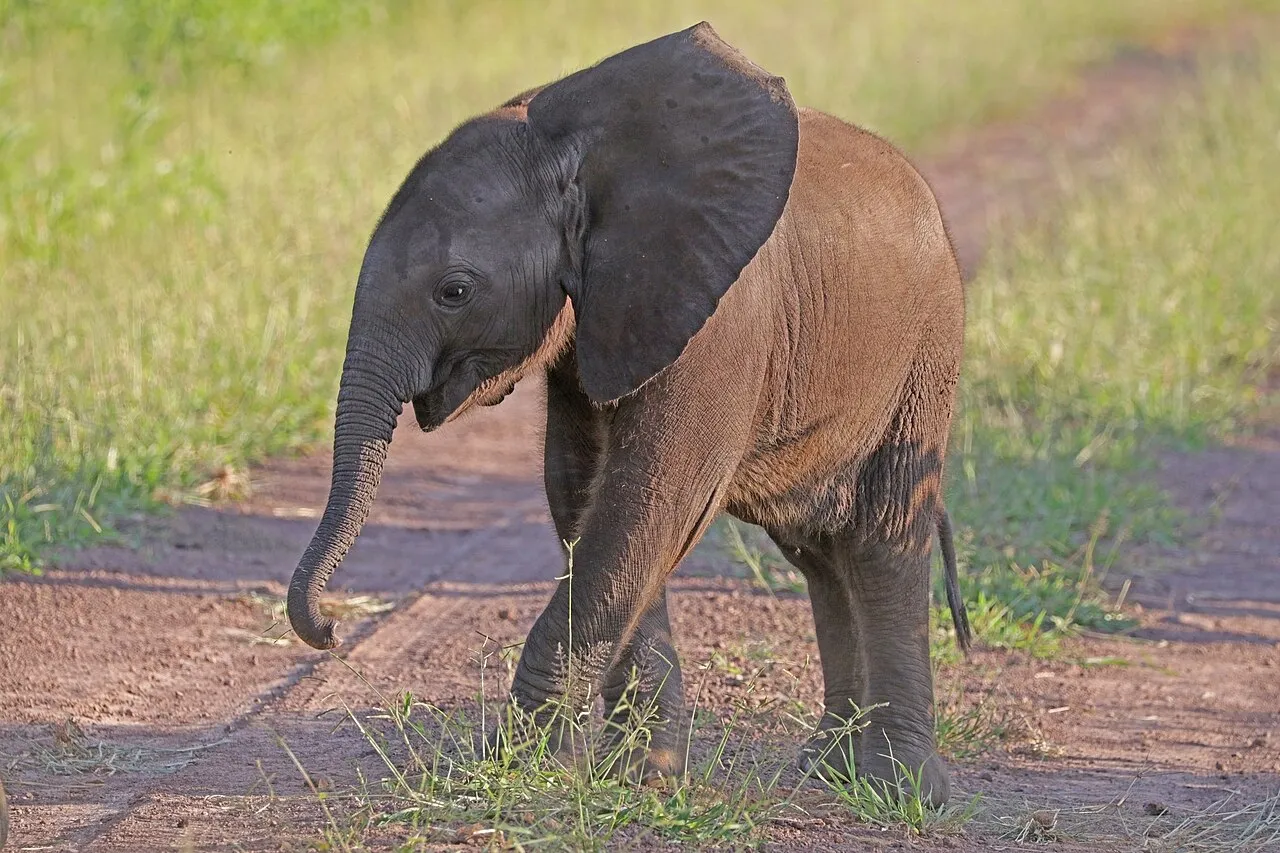
Charles J. Sharp · CC BY-SA 4.0
Elephants have the longest pregnancy of any land animal: about 22 months, nearly two years. A single calf is the norm and twins are very rare. Newborns stand about 90 cm at the shoulder and weigh around 90–120 kg. Within an hour or so they are on their feet, and within days they can keep up with the herd.
Calves are cared for not just by their mothers but by aunts, sisters and cousins. These helpers, called allomothers, guard calves, haul them out of mud and gain practice for raising their own young. When danger threatens, the family forms a defensive ring with the calves in the middle.
| Stage | Age | What happens |
|---|---|---|
| Newborn | 0–3 months | Milk only; clumsy with its trunk |
| Infant | 3 months–2 years | Starts eating plants while still nursing |
| Weaning | usually 2–4 years | Often fully weaned when a sibling is born |
| Juvenile | 5–15 years | Males leave the family at about 10–15 |
| First breeding | Females 10–12, males late 20s | Males breed late because of competition |
| Old age | 50+ years | Weakens once the last molars wear out |
Females typically give birth every four to five years, so a cow may raise only seven or eight calves in her lifetime. This slow reproduction is why elephant populations take so long to recover from poaching. Wild elephants commonly live 50–70 years, accumulating knowledge that makes older individuals vital to their groups.
9. Intelligence, communication and special abilities
An elephant's brain weighs around 5 kg, the heaviest of any land animal, with a well-developed hippocampus and cortex. The saying that elephants never forget has real substance: they remember the voices and scents of companions they have not met for decades and the locations of distant water sources. During a severe drought in Tanzania, families led by older matriarchs who had lived through an earlier drought travelled to far-off water and survived at higher rates.
Elephants communicate with a wide repertoire. Loud trumpets signal excitement or alarm, but most everyday communication happens through low rumbles, much of it infrasound below 20 Hz that travels several kilometres. Elephants are thought to sense these vibrations through their feet and trunk tip as well as their ears. A recent study in Kenya made headlines by suggesting elephants address each other with individual-specific calls, something like names.
Elephants are among the few animals that recognise themselves in a mirror; Asian elephants at a US zoo touched marks painted on their foreheads while watching their reflections. They also use tools, scratching themselves with sticks, swatting flies with branches and, reportedly, plugging water holes with chewed bark.
Their response to death is famous. Elephants linger over dead companions, touching and smelling the body, and years later may stop to examine bones and tusks at the spot. Experiments suggest they show more interest in elephant remains than in those of other species.
10. Predators and survival
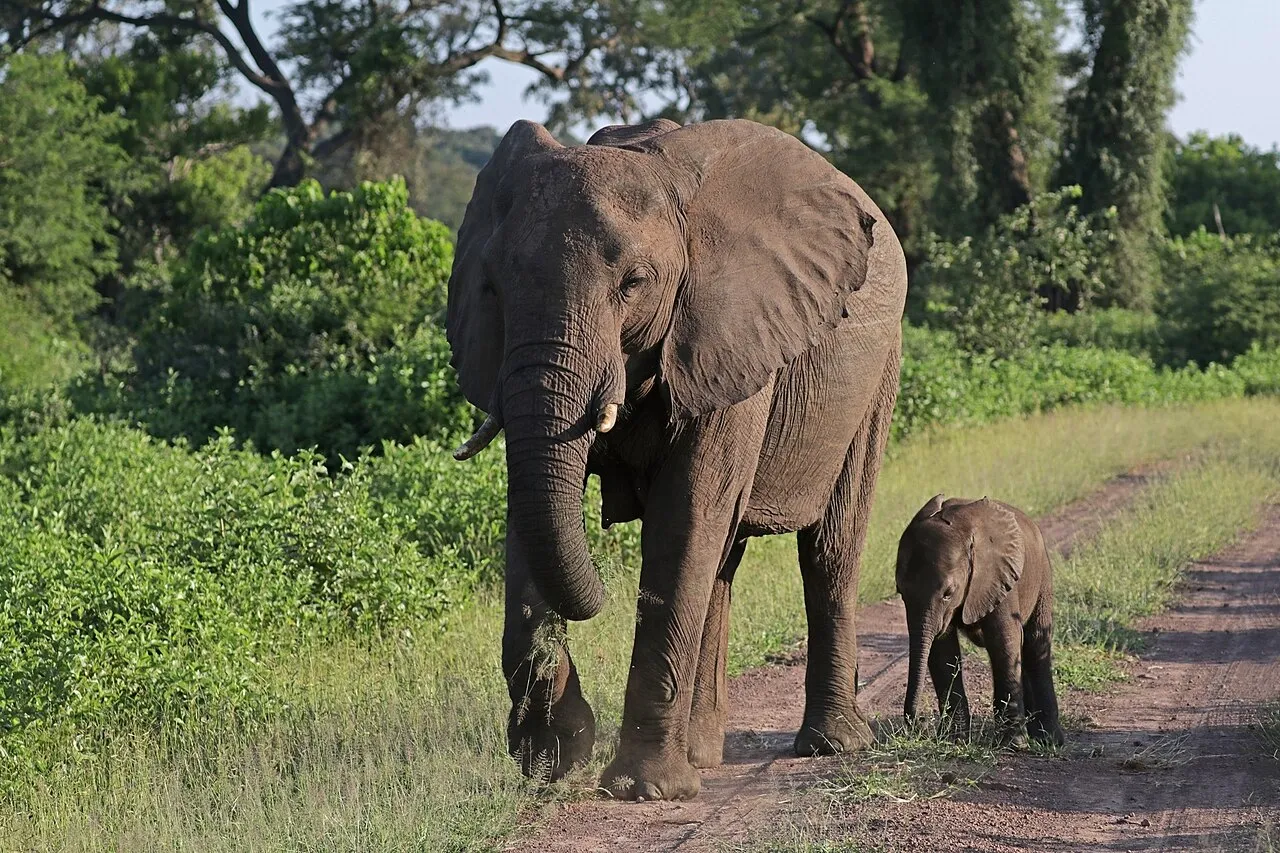
Almost nothing can attack a healthy adult elephant. When threatened, an elephant spreads its ears, raises its head to look even bigger, kicks dust and trumpets, and charges if necessary. Most of these are mock charges, but a real charge is something even lions avoid.
Calves and young elephants can fall to lions, hyenas and crocodiles. In Botswana's Chobe and Savuti regions, large lion prides have been filmed hunting juvenile and subadult elephants at night, and weakened elephants become more vulnerable during droughts.
In nature, drought and starvation kill more elephants than predators do, with calves and the elderly the first to succumb. In 2020 more than 300 elephants died mysteriously around Botswana's Okavango Delta; toxins from cyanobacteria blooming in water holes were later identified as the likely cause. Anthrax outbreaks also cause occasional die-offs. Today, though, the greatest threat to elephants by far is humans.
11. Relationship with humans
Humans and elephants go back hundreds of thousands of years. Early humans hunted or scavenged elephants and mammoths, and some Ice Age people built shelters from mammoth bones. Ivory was prized from the start; Palaeolithic Europeans carved figurines from mammoth tusks tens of thousands of years ago.
The classic example of tamed African elephants is ancient Carthage. In 218 BC Hannibal led war elephants across the Alps to attack Rome, probably using a now-extinct small North African elephant. Unlike Asian elephants, however, African bush elephants have almost no tradition of large-scale domestication for work; an attempt to train forest elephants in the Belgian Congo in the early 20th century did not last.
The modern ivory trade was a catastrophe. In the 19th and early 20th centuries vast quantities of ivory went into piano keys, billiard balls, combs and jewellery, costing hundreds of thousands of elephants. Soaring ivory prices in the 1970s and 1980s fuelled a poaching explosion that is estimated to have nearly halved Africa's elephants in about a decade. In 1989 CITES banned the international ivory trade.
Human–elephant conflict is now a serious issue. An elephant herd can destroy a family's maize crop in one night, and elephants seeking water sometimes injure or kill people in villages, provoking retaliation. Beehive fences, which exploit elephants' strong dislike of bees, have proved effective in Kenya and elsewhere, as have chilli fences and chilli smoke.
In Korea, the Annals of the Joseon Dynasty record that Japan presented an elephant to King Taejong in 1411. It ate enormous amounts of food and trampled a man to death, and was eventually exiled to an island in Jeolla Province. This was almost certainly an Asian elephant.
12. Conservation
In 2021 the IUCN assessed the two African elephant species separately for the first time: the bush elephant as Endangered and the forest elephant as Critically Endangered. Bush elephants are estimated to have declined by at least 60% over about 50 years, and forest elephants by more than 86% over about 30 years. The Great Elephant Census, an aerial survey published in 2016, counted roughly 350,000 savanna elephants, and the two species together are commonly estimated at a little over 400,000. Estimates of several million in the early 20th century are often cited.
Poaching surged again from the late 2000s into the early 2010s as Asian demand for ivory rose, with some estimates exceeding 20,000 elephants killed per year. Since China closed its domestic ivory market at the end of 2017 and enforcement tightened elsewhere, continent-wide poaching rates have gradually declined, though the picture varies greatly by region and large ivory seizures continue.
The main threats are:
- Poaching and illegal ivory trade
- Habitat loss and severed migration routes as farmland and human populations expand
- Human–elephant conflict and retaliatory killing
- Worsening droughts linked to climate change
Conservation measures include armed ranger patrols, GPS collars to track movements, transboundary conservation areas and community conservancies that share tourism income with local people. Orphan elephant rescue centres, such as those near Nairobi, raise calves whose mothers were poached and return them to the wild. Meanwhile, some southern African countries with large elephant populations argue for selling ivory stockpiles and allowing regulated hunting, putting them at odds with much of the international community.
African elephants are listed on CITES Appendix I, except for the populations of Botswana, Namibia, South Africa and Zimbabwe, which are on Appendix II. South Korea, like most countries, strictly restricts trade in elephants and ivory under its wildlife law.
13. In zoos
Elephants are zoo favourites and also at the centre of debates over captivity. An animal that walks dozens of kilometres a day and lives in a complex society of many relatives often develops problems in a small enclosure with few companions: repetitive swaying and pacing, foot disease, arthritis and obesity. Several studies have found that captive elephants tend to have shorter lives than wild ones.
Some zoos have stopped keeping elephants altogether and moved them to large sanctuaries. Others have upgraded to multi-hectare yards with sand floors, pools, scattered and hidden food and larger social groups. Many facilities have also moved from 'free contact', where keepers share space with elephants and control them with hooks, to 'protected contact', where training happens through a barrier using rewards.
Elephant rides and shows at tourist venues draw criticism too, particularly in Asia, where harsh methods used to break young elephants have been exposed. Observation-only sanctuaries have emerged as an alternative, though some places that call themselves sanctuaries still offer hands-on encounters, so visitors should look carefully.
14. Elephants in culture
Across cultures elephants symbolise wisdom, strength and good fortune. In Hinduism, the elephant-headed Ganesha, god of wisdom and new beginnings, is one of the most beloved deities. Buddhist tradition holds that Queen Maya dreamed of a white elephant entering her side before conceiving the Buddha, and in Thailand white elephants were royal emblems. Many African peoples tell of elephants as wise leaders or beings linked to ancestral spirits.
The parable of the blind men and the elephant, in which each man touches a different part and insists the animal is like a pillar, a snake or a fan, is a classic lesson about mistaking a part for the whole.
In popular culture, Disney's Dumbo flies on his enormous ears, while Babar the Elephant, Colonel Hathi of The Jungle Book and Dr. Seuss's Horton are enduring favourites. In Saint-Exupéry's The Little Prince, a drawing of a boa constrictor that has swallowed an elephant is famously mistaken by grown-ups for a hat. English gives us 'the elephant in the room' for an obvious problem nobody mentions and 'white elephant' for a costly, useless possession.
Elephants also serve as national and political symbols: Côte d'Ivoire's football team is nicknamed Les Éléphants, and the elephant is the emblem of the US Republican Party. In Korean, 'a biscuit for an elephant' describes a ridiculously small amount, and a children's song about 'Uncle Elephant' whose nose is his hand has been sung for generations.
15. Trivia
- The idea that elephants fear mice has little evidence behind it, though elephants have been seen startled by small animals moving suddenly near their feet.
- Elephants are among the few mammals that cannot jump; at least one foot is always on the ground.
- They are strong swimmers and have been recorded swimming several kilometres with their trunks raised like snorkels.
- Tuskless females have become far more common in heavily poached populations. A study in Mozambique's Gorongosa National Park found that ivory poaching during the civil war strongly favoured the survival of tuskless females.
- An elephant's heart weighs around 20 kg and beats roughly 30 times a minute, about half the human rate.
- Elephant dung is turned into paper in places such as Sri Lanka and Thailand, thanks to its high fibre content.
- Elephants rarely develop cancer, and research suggests one reason is that they carry many extra copies of the tumour-suppressing gene TP53.
Wild animals are not pets. Catching, trading or keeping them is illegal in most places. If you find an injured wild animal, call your local wildlife rescue centre.
FAQ
How is it different from the Asian elephant?
African bush elephants have huge ears, a dipped back, tusks in both sexes and two finger-like tips on the trunk. Asian elephants have smaller ears, a rounded back and a single trunk tip.
Is the forest elephant the same species?
They used to be lumped together, but the forest elephant of Central and West Africa is now treated as its own species. In 2021 the IUCN listed the bush elephant as Endangered and the forest elephant as Critically Endangered.
Do elephants really mourn their dead?
Elephants have repeatedly been seen lingering over, sniffing and touching the bones and tusks of dead elephants. Whether this equals human grief is debated, but they clearly show unusual interest in death.
Photo credits
Photos are freely licensed images from Wikimedia Commons. Authors and licenses are listed below.
- 178 Male African bush elephant in Etosha National Park Photo by Giles Laurent.jpg — Giles Laurent · CC BY-SA 4.0
- 079 Herd of African bush elephants drinking in Etosha National Park Photo by Giles Laurent.jpg — Giles Laurent · CC BY-SA 4.0
- 101 African bush elephant face close-up in Etosha National Park Photo by Giles Laurent.jpg — Giles Laurent · CC BY-SA 4.0
- African Elephant (Loxodonta africana) eye close-up showing the Musth gland opening (16689303126).jpg — Bernard DUPONT from FRANCE · CC BY-SA 2.0
- African bush elephant (Loxodonta africana) baby 6 weeks.jpg — Charles J. Sharp · CC BY-SA 4.0
- African bush elephants (Loxodonta africana) female with six-week-old baby.jpg — Charles J. Sharp · CC BY-SA 4.0