TailVille
1. Overview
The tiger (Panthera tigris) is the largest and heaviest cat alive today. Its orange coat slashed with black vertical stripes is instantly recognisable, and those stripes break up its outline among tall grass and forest shadows. Unlike the sociable lion, the tiger is a solitary ruler of large territories and a stealthy ambush hunter that relies on getting close before a single explosive attack.
Tigers are found only in Asia. They once ranged from eastern Turkey and the Caspian Sea across Siberia and Korea to the Indonesian island of Bali, but in roughly a century they have lost more than 90% of their historic range. Wild tigers now live in scattered pockets of India, Nepal, Bhutan, Bangladesh, the Russian Far East, north-eastern China, Thailand, Malaysia and Sumatra, and the species is listed as Endangered on the IUCN Red List.
For Koreans the tiger is far more than a wild animal. It appears in the Dangun founding myth, countless folk tales, folk paintings and proverbs, and was revered as the messenger of mountain spirits and a guardian against evil. The mascots of the 1988 Seoul Olympics (Hodori) and the 2018 PyeongChang Winter Olympics (Soohorang) were both tigers. Yet wild tigers effectively vanished from the Korean peninsula in the first half of the 20th century. This article looks at the tiger's biology and behaviour, and at its long and complicated history with people.
2. Name and classification
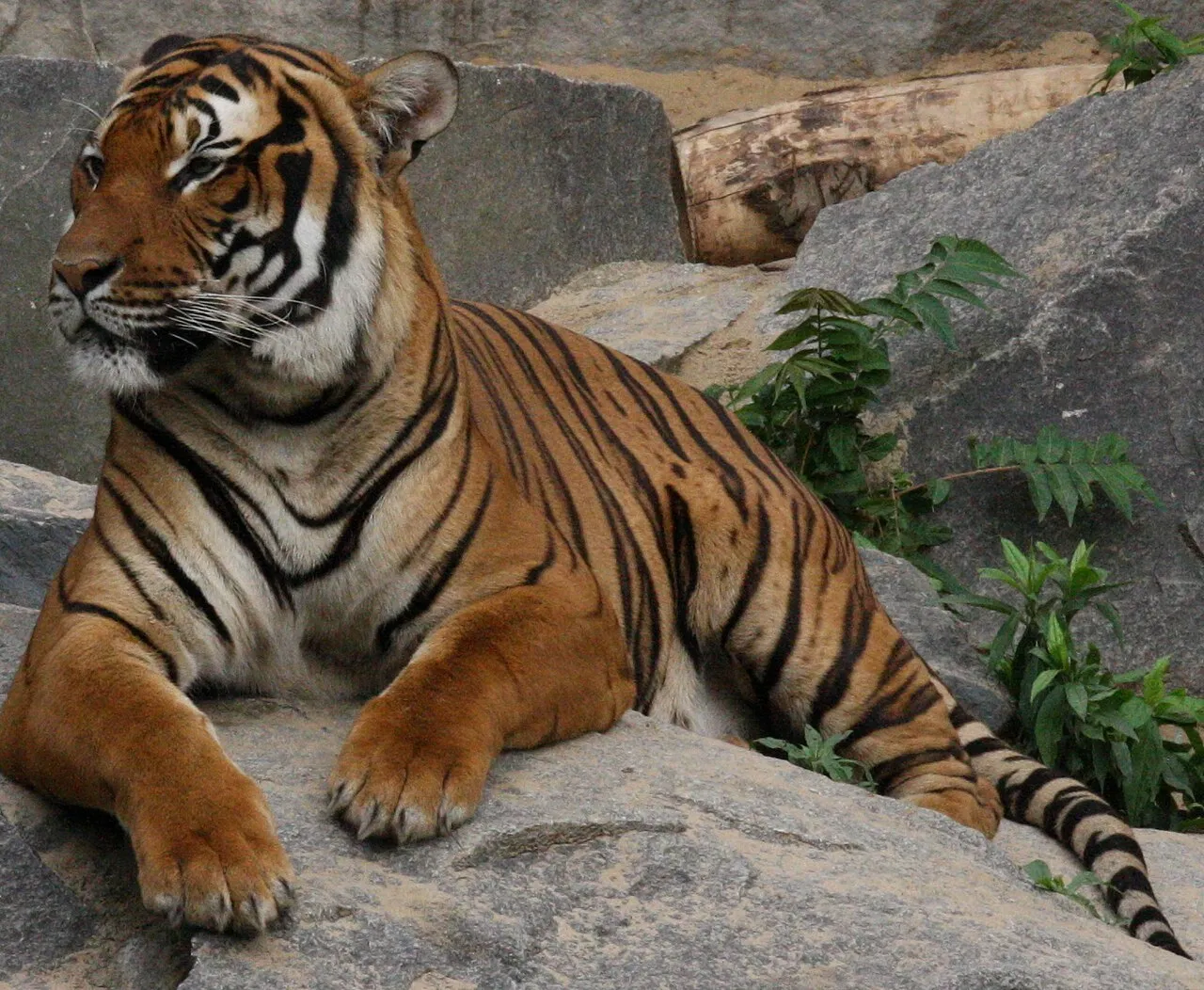
Meine Mutter (Erlaubnis liegt vor) · CC BY-SA 4.0
The species name tigris comes from Greek, and is commonly traced back to an Old Persian word meaning 'arrow' or 'sharp', perhaps referring to the animal's speed. The River Tigris is often said to share the same root. The English word reached us through Latin and Old French.
The Korean word horangi is popularly explained as combining the characters for tiger (虎, ho) and wolf (狼, rang), suggesting a term that once covered both predators before narrowing to the tiger alone. The native Korean word is beom, which was the more common name in older texts and survives in many proverbs and songs.
2.1. Subspecies
Tigers were long divided into nine subspecies. In 2017 the IUCN Cat Specialist Group proposed just two: a mainland tiger (P. t. tigris) and a Sunda Islands tiger (P. t. sondaica). A whole-genome study published in 2018, however, found support for six distinct living subspecies, so classifications still differ between sources. Conservationists continue to use the traditional regional names.
| Traditional name | Range | Status |
|---|---|---|
| Bengal tiger | India, Nepal, Bangladesh, Bhutan | By far the most numerous |
| Amur (Siberian) tiger | Russian Far East, NE China | Same lineage as Korea's former tigers |
| Indochinese tiger | Thailand, Myanmar and nearby | Lost from several countries |
| Malayan tiger | Malay Peninsula | Very few remain |
| Sumatran tiger | Sumatra | Smallest living form |
| South China tiger | Southern China | Probably extinct in the wild |
| Caspian tiger | Central Asia, Iran, Turkey | Extinct by the late 20th century |
| Javan tiger | Java | Extinct around the 1970s–80s |
| Bali tiger | Bali | Extinct around the 1940s |
Korea's tigers are generally considered part of the Amur population, and genetic work has shown that the extinct Caspian tiger was remarkably close to the Amur tiger.
3. Evolution
Tigers branched off relatively early within Panthera, and their closest living relative is thought to be the snow leopard, with the split estimated at very roughly two to three million years ago. Fossils around two million years old from China, assigned to Panthera zdanskyi, are sometimes proposed as an early tiger relative, although their status is debated. Tiger fossils also come from Pleistocene sites in Java, China and Siberia.
Intriguingly, living tigers carry relatively little genetic diversity. Genetic studies suggest their most recent common ancestor lived only around 100,000 years ago. Some researchers have speculated that the colossal eruption of Sumatra's Toba volcano about 74,000 years ago caused a population crash followed by re-expansion, but this idea remains unproven.
During glacial periods, low sea levels connected Sumatra, Java and Bali to mainland Asia, letting tigers walk to what are now islands. When the seas rose again, island populations were cut off and evolved into smaller forms. Tiger fossils have been found in Sri Lanka and Borneo, though neither has tigers today.
4. Range and habitat
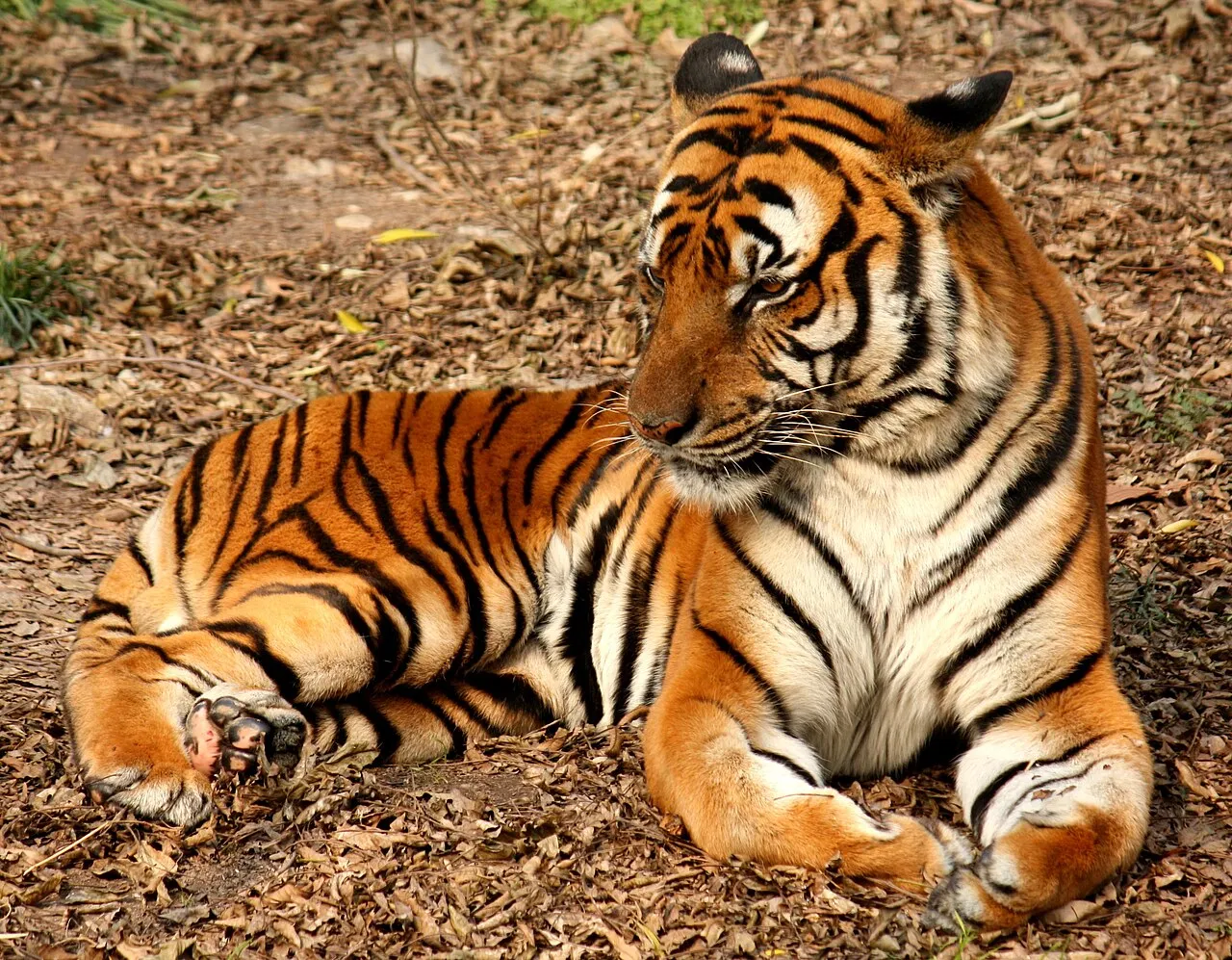
J. Patrick Fischer · CC BY-SA 3.0
Tigers are astonishingly adaptable. They inhabit tropical and subtropical forests and tall grasslands in India and Nepal, the Sundarbans mangrove swamps shared by India and Bangladesh, Southeast Asian rainforests, and the snowy mixed forests of the Russian Far East. What they all need is dense cover, water and large prey such as deer and wild pigs.
Roughly three-quarters of the world's wild tigers now live in India, which has designated more than 50 tiger reserves since launching Project Tiger in 1973. A few hundred Amur tigers inhabit Primorye and Khabarovsk in Russia, and they have been expanding into Jilin and Heilongjiang in north-eastern China.
Southeast Asia is another story. Cambodia declared its tigers functionally extinct around 2016, and Laos and Vietnam are believed to have no breeding populations left. The South China tiger has not been confirmed in the wild for decades. Some analyses suggest tigers now occupy only around 5–7% of their historic range.
On the Korean peninsula tigers were once common in mountains nationwide; Joseon-era records even describe tigers entering the walls of Seoul. Intensive tiger-hunting policies in late Joseon, a Japanese colonial campaign to exterminate 'harmful beasts' and widespread deforestation drove them to collapse, and there is no confirmed record in South Korea after a tiger killed in the 1920s.
5. Body
Tigers have long, supple bodies, massively muscled forelimbs, a large head and a short neck. Amur tigers are large, with long, pale winter coats suited to the cold, while Sumatran tigers are small, short-haired and densely striped. Males are much larger than females.
| Measurement | Male | Female |
|---|---|---|
| Head and body | about 1.9–2.9 m | about 1.5–2.0 m |
| Tail | about 0.8–1.1 m | about 0.8–1 m |
| Weight (Bengal, Amur) | about 180–300 kg | about 100–170 kg |
| Weight (Sumatran) | about 100–140 kg | about 65–110 kg |
The Amur tiger is often called the largest, but recent measurements of wild animals show well-fed Bengal males matching or exceeding them. Some historical giant records lack reliable methods and should be treated with caution.
5.1. Stripes and coat
A tiger's stripes are present on its skin as well as its fur, so the pattern remains visible even on shaved skin. Every tiger has a unique pattern, and the left and right sides differ. Researchers identify individuals and estimate populations by comparing stripe patterns in camera-trap photos.
Orange looks loud to us, but deer, the tiger's main prey, have limited ability to tell red from green. To a deer, an orange tiger probably blends in with green vegetation. On the backs of the ears are white spots on black, which may help cubs follow their mother or serve as signals to other tigers.
White tigers carry a rare recessive variant in Bengal tigers that reduces orange pigment while leaving the stripes. The last confirmed wild white tiger was captured in India in the 1950s, and most captive white tigers descend from inbreeding of its line. Nearly stripeless white tigers and 'golden tabby' tigers are likewise colour variants produced in captivity.
5.2. Skeleton and weapons
The tiger's canines protrude 6–7 cm and reach close to 10 cm including the root, the largest of any living cat. Its broad, heavy forepaws can knock large prey off its feet, and its claws, up to around 10 cm long, stay sharp by being retracted while walking. The hind legs are longer than the forelegs, allowing powerful leaps.
Tigers are thought to see roughly six times better than humans in dim light, and their hearing picks up faint prey sounds. Smell is used less for hunting than for reading other tigers' scent marks.
6. Behaviour and ecology
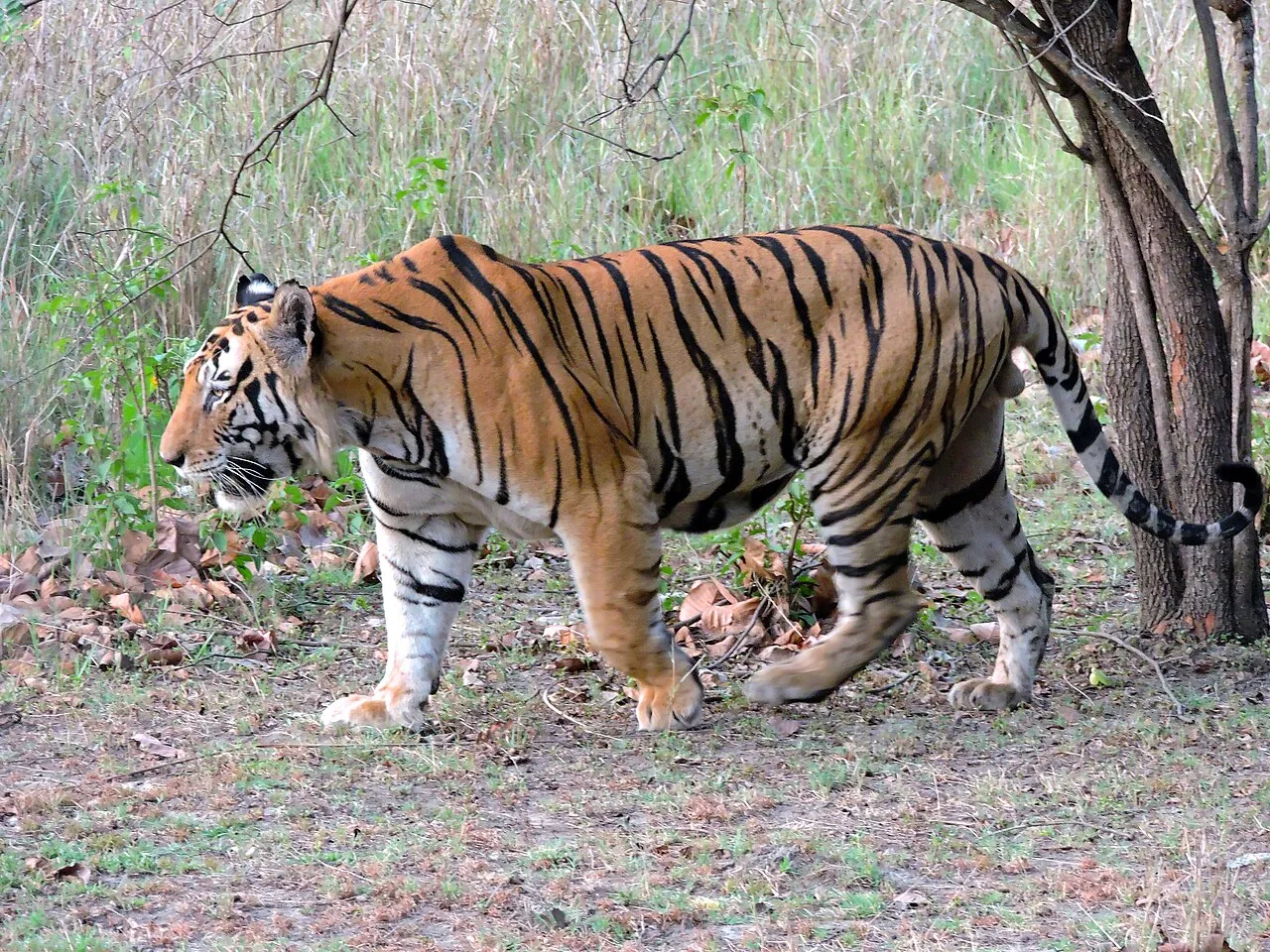
Seemaleena · CC BY-SA 4.0
Adult tigers are solitary except when mating or when a mother is raising cubs. Each holds a territory, and a male's range typically overlaps those of several females. Territory size depends on prey density: a female in a rich Indian reserve may use around 20 km², while a male in the prey-poor Russian Far East can range over more than 1,000 km².
Tigers mark territory by spraying urine on tree trunks, raking bark with their claws, scraping the ground and leaving droppings along trails. These marks warn rivals and also advertise a female's breeding condition. Neighbours mostly avoid direct encounters by reading each other's marks; serious fights usually involve young males seeking a territory of their own.
Unlike most cats, tigers love water. In hot regions they wallow in pools and rivers at midday, and they are strong swimmers, crossing wide rivers and swimming between islands. Tigers in the Sundarbans routinely swim tidal mangrove channels. They are most active from dusk to dawn and may walk 10–20 km or more in a night.
7. Diet and feeding
Tigers mainly hunt large hoofed animals weighing over 50 kg. In India their staples are sambar, chital, wild boar, water buffalo and gaur; in the Russian Far East, red deer, wild boar and roe deer dominate. When large prey is scarce they eat monkeys, peafowl, fish and even frogs, and Amur tigers occasionally kill Asiatic black bears and brown bears. Rarely, tigers take young elephants or rhinos.
Hunting is all about stealth. A tiger stalks low, paying attention to the wind, edging closer over minutes or hours before charging from 10–20 metres. Its top speed is around 50–65 km/h. Small prey is killed with a bite to the back of the neck that severs the spine; large prey is gripped by the throat until it suffocates. Success rates are low, with estimates often around one success in ten to twenty attempts.
After a kill, the tiger drags its prey to cover, sometimes hauling a carcass of more than 200 kg for dozens of metres. It can eat 30–40 kg at once, returns to large kills over several days and may cover the remains with leaves or soil. A tiger needs roughly 50 large prey animals a year, which is why protecting tigers starts with protecting the forests and prey populations they depend on.
8. Reproduction and life cycle
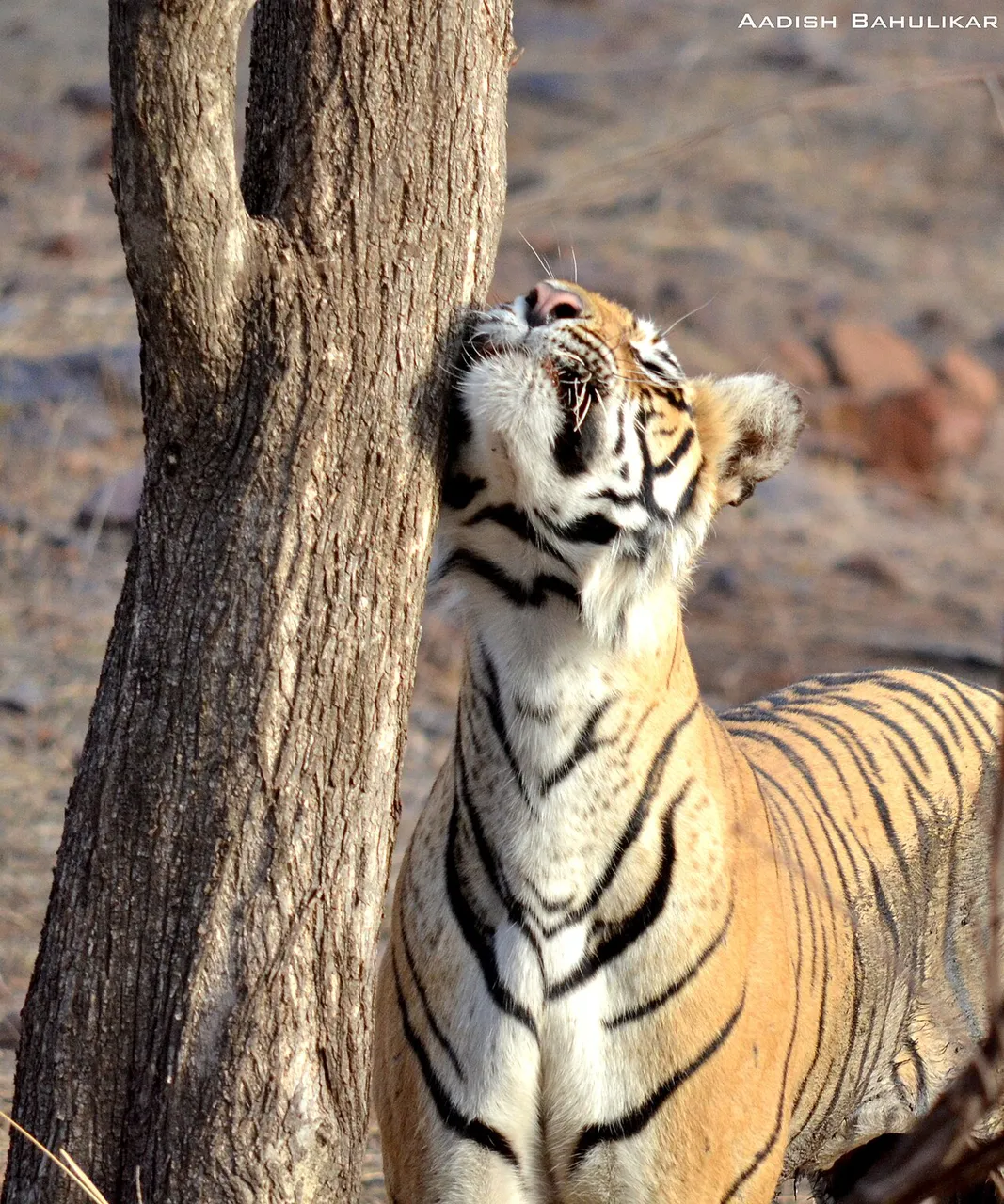
Aadishbahulikar18 · CC BY-SA 4.0
Tigers can breed year-round, though in some regions most mating happens between winter and spring. A female in oestrus advertises with scent marks and calls. The pair spend a few days together, mating repeatedly, and then part ways; the female raises the cubs entirely on her own.
Gestation lasts about 100–110 days. In a cave, rock crevice or dense thicket she gives birth to usually two to four cubs, occasionally up to six or seven. Newborns weigh about 0.8–1.6 kg and are blind. Because the mother must leave them alone to hunt, cubs are vulnerable to leopards, dholes and male tigers during this period.
| Stage | Age | What happens |
|---|---|---|
| Newborn | 0–2 weeks | Eyes closed, hidden in a den |
| Den period | Up to 2 months | Milk only; mother moves dens often |
| Following mother | 2–6 months | Starts eating meat from her kills |
| Learning to hunt | 6 months–1.5 years | Watches and attempts hunts |
| Independence | 1.5–2.5 years | Leaves to find its own range |
| First breeding | Females 3–4 yrs, males 4–5 yrs | Needs a territory to breed |
Nearly half of cubs are thought to die in their first year. Young females often settle near their mother's range, while young males disperse much farther, sometimes hundreds of kilometres. Wild tigers usually live 10–15 years; in zoos they may pass 20.
9. Intelligence, communication and special abilities
Though solitary, tigers have a rich communication repertoire. Their roar carries several kilometres and is used to advertise territory and find mates. At close quarters they produce a soft, puffing snort called chuffing, a friendly greeting heard between mothers and cubs or courting pairs. Tigers can roar but, unlike house cats, cannot purr continuously.
Research suggests tiger roars contain low-frequency components near the limit of human hearing that travel well through forest. Claims that these sounds 'paralyse' listeners are popular but not well established.
Tigers have excellent spatial memory, keeping track of trails, water sources and prey hotspots across huge ranges. In the Russian Far East, there are accounts of tigers apparently targeting specific hunters who had wounded them. In the Sundarbans, villagers once wore face masks on the backs of their heads, on the theory that tigers prefer to attack from behind; some reports claimed fewer attacks as a result.
10. Predators and survival
No animal routinely hunts adult tigers; as apex predators, their greatest threat is people. Tigers can still be killed or badly injured by other animals: enraged gaur and buffalo sometimes gore them, wild boar tusks inflict deep wounds, and in rare cases packs of dholes have overwhelmed a tiger. In the Russian Far East tigers and brown bears compete over carcasses, and each has been recorded killing and eating the other.
Cubs face many more dangers, from leopards, dholes, pythons and crocodiles to, above all, unrelated male tigers, which may kill cubs after taking over a territory.
Porcupines are a surprising hazard. Quills embedded in a tiger's face or paws can leave it unable to hunt normally, pushing it towards livestock or people. Many tigers that became notorious man-eaters were old or injured.
11. Relationship with humans
Across Asia the tiger has been both feared and revered: a deadly threat to villagers and also a sacred guardian of the forest. In India the goddess Durga rides a tiger, and in China the White Tiger is one of the Four Symbols, guarding the west.
Conflict has been constant. In 19th- and 20th-century India and Nepal, notorious man-eaters killed hundreds of people, and the books of hunters such as Jim Corbett made their stories famous. People collecting honey or fishing in the Sundarbans are still attacked every year. In colonial times and after independence, royal and aristocratic tiger hunts were wildly popular, with some individuals boasting of hundreds of kills.
In Korean history tiger attacks were so common that they had their own word, hohwan. The Annals of the Joseon Dynasty record countless people taken by tigers, and the court maintained special tiger-hunting soldiers. During the Japanese colonial period tigers and leopards were systematically exterminated as 'harmful beasts', sometimes in showy organised hunts, and Korea's tigers disappeared rapidly.
Today the biggest threats are poaching and illegal trade. Tiger bone is used in traditional medicine, skins as décor, teeth and claws as amulets. International trade is banned, yet black-market demand persists, and there are concerns that tigers from commercial 'tiger farms' in some countries feed these markets.
12. Conservation
The tiger is listed as Endangered by the IUCN. A commonly quoted estimate puts the early-20th-century wild population at around 100,000, but by 2010 it had fallen to an all-time low of roughly 3,200. At a summit in St Petersburg that year, which happened to be a Year of the Tiger, the 13 tiger-range countries pledged to double wild tiger numbers by 2022, a goal known as TX2.
Some countries made striking progress. India's 2022 survey estimated around 3,000–3,900 tigers (a mean of about 3,600), and Nepal reported about 355 in 2022, nearly triple its 2009 figure. Amur tigers in Russia also recovered to several hundred. In its 2022 assessment the IUCN estimated about 3,700–5,500 wild tigers globally, a figure that reflects better survey methods as well as real increases. In much of Southeast Asia, however, tigers are gone or on the brink.
The main threats are:
- Poaching and illegal trade in body parts
- Habitat destruction and fragmentation from farms, plantations, roads and mines
- Overhunting of prey species
- Retaliatory killing after livestock losses or attacks on people
- Inbreeding and disease in small, isolated populations
Conservation work includes expanding protected areas, creating wildlife corridors between reserves, camera-trap monitoring and ranger patrols against poaching, and compensation and alternative livelihoods for local communities. Kazakhstan has launched a project to reintroduce tigers, using Amur tigers, to former Caspian tiger habitat.
The tiger is on CITES Appendix I, which bans commercial international trade. In South Korea it is legally protected as Class I Endangered Wildlife.
13. In zoos
There are thought to be far more tigers in captivity worldwide than in the wild. In the United States, private ownership and roadside zoos long allowed thousands of tigers to be kept with little oversight, until the Big Cat Public Safety Act of 2022 sharply restricted private ownership and cub petting. The documentary series Tiger King brought wide attention to the problem.
Accredited zoos run studbook programmes to maintain genetically diverse populations of pure subspecies such as Amur and Sumatran tigers. Generic mixed-subspecies tigers and inbred white tigers have no conservation value, and responsible zoos avoid breeding them. Returning captive tigers to the wild is extremely difficult because they lack hunting skills and fear of people.
Tigers are wide-ranging patrollers and readily develop pacing in small enclosures. Good facilities provide pools for swimming, varied terrain, scent enrichment and hidden food to encourage natural searching behaviour.
14. Tigers in culture
In Korean culture the tiger is a star. In the Dangun myth, a tiger and a bear both wished to become human, but only the bear endured the trial of living in a cave on mugwort and garlic. In the folk tale of the brother and sister who became the sun and moon, a tiger tricks their mother with the line 'give me a rice cake and I won't eat you', while in another story a tiger flees in terror from a dried persimmon it mistakes for something fiercer than itself. Korean tigers are frightening, but also foolish and oddly endearing.
Late Joseon folk paintings often pair a tiger with a magpie under a pine tree: the tiger wards off evil and the magpie brings good news. These tigers tend to look comical rather than fierce and remain hugely popular. Families once pasted tiger pictures on their gates at New Year to keep misfortune away.
Koreans like to say the peninsula is shaped like a tiger rearing up and roaring towards the continent, an image promoted by writers such as Choe Nam-seon in response to a colonial-era comparison of Korea to a rabbit. The tiger also features in Olympic mascots, the emblem of the national football team and the Kia Tigers baseball club, and the hit 2020s song 'Tiger Is Coming' (Beom Naeryeo-onda) drew on a passage from traditional pansori.
Worldwide, tigers are beloved characters: Shere Khan in Kipling's The Jungle Book, Tigger in Winnie-the-Pooh, Tony the Tiger on cereal boxes and Richard Parker in Life of Pi. William Blake's poem 'The Tyger' is among the most quoted in English. The tiger is a national animal of India, Bangladesh, Malaysia and South Korea, and the third sign of the East Asian zodiac.
Korean proverbs about tigers are everywhere: speak of the tiger and it appears (the local version of 'speak of the devil'); keep your wits about you even in a tiger's den; a tiger leaves its skin and a person leaves a name; and in a valley without tigers, the rabbit plays king. Rain falling from a sunny sky is said to mean a tiger is getting married.
15. Trivia
- The markings on a tiger's forehead are often said to resemble the Chinese character 王 (king), reinforcing its title as king of the mountains.
- Amur tigers grow a winter coat far longer and denser than their summer one and carry a layer of belly fat that helps them survive temperatures below −30 °C.
- Some historic photographs and specimens of Korean tigers, taken during the colonial era, are kept in museums in Japan and Britain.
- International Tiger Day has been held every 29 July since 2010.
- Littermates have completely different stripe patterns, and a mother tells her cubs apart by scent as well as sight.
- A tiger can eat around a fifth of its body weight in a single meal and then fast for days.
- Tigers occasionally imitate the calls of sambar deer, according to some field observers, though whether this is deliberate mimicry is debated.
Wild animals are not pets. Catching, trading or keeping them is illegal in most places. If you find an injured wild animal, call your local wildlife rescue centre.
FAQ
Are there still wild tigers in Korea?
No confirmed wild tiger has been recorded in South Korea since around the 1920s. Amur tigers roam the China–Russia border near North Korea, but no resident population is thought to remain on the peninsula.
Is the white tiger a separate species?
No. It is a rare pigment gene variant found in Bengal tigers. Captive white tigers are mostly produced by inbreeding, often causing crossed eyes and skeletal problems, so conservationists criticise breeding them.
Are tiger numbers increasing?
Around 2022–2023, wild tigers were estimated at roughly 3,700–5,500. Numbers have grown in India, Nepal and Russia thanks to protection, but tigers are effectively gone from Cambodia, Laos and Vietnam.
Photo credits
Photos are freely licensed images from Wikimedia Commons. Authors and licenses are listed below.
- Bengal tiger (Panthera tigris tigris) female 3 crop.jpg — Charles J. Sharp · CC BY-SA 4.0
- 2012-09-15 Tierpark Berlin 26 (cropped).jpg — Meine Mutter (Erlaubnis liegt vor) · CC BY-SA 4.0
- 2012 Suedchinesischer Tiger.JPG — J. Patrick Fischer · CC BY-SA 3.0
- Adult male Royal Bengal tiger.jpg — Seemaleena · CC BY-SA 4.0
- Bijili (A tiger in Ranthambore National Park, 2016) 1.jpg — Aadishbahulikar18 · CC BY-SA 4.0