TailVille
1. Overview
On the red sands of southern Africa, a small animal stands bolt upright on its hind legs, scanning the horizon. The meerkat, a member of the mongoose family, is famous for this sentinel pose. Weighing less than a kilogram, meerkats live in groups of up to several dozen, foraging, babysitting and watching for danger together in deserts and dry grasslands.
Meerkat groups are deeply cooperative. While one animal keeps watch from a high point, the others dig for food, and pups are raised not only by their parents but by older siblings and other helpers. Beneath this cooperation lies a ruthless power structure: usually only the dominant female breeds, and she may kill the pups of subordinate females or drive them out of the group.
Thanks to a research project in the Kalahari that has run for more than thirty years, meerkats are among the best-studied wild mammals on Earth. Documentary series based on that research, and a famous animated character, have made them hugely popular. That popularity has fuelled trade in meerkats as pets and cafe animals, even though these highly social wild animals are poorly suited to life in a human home.
2. Name and classification
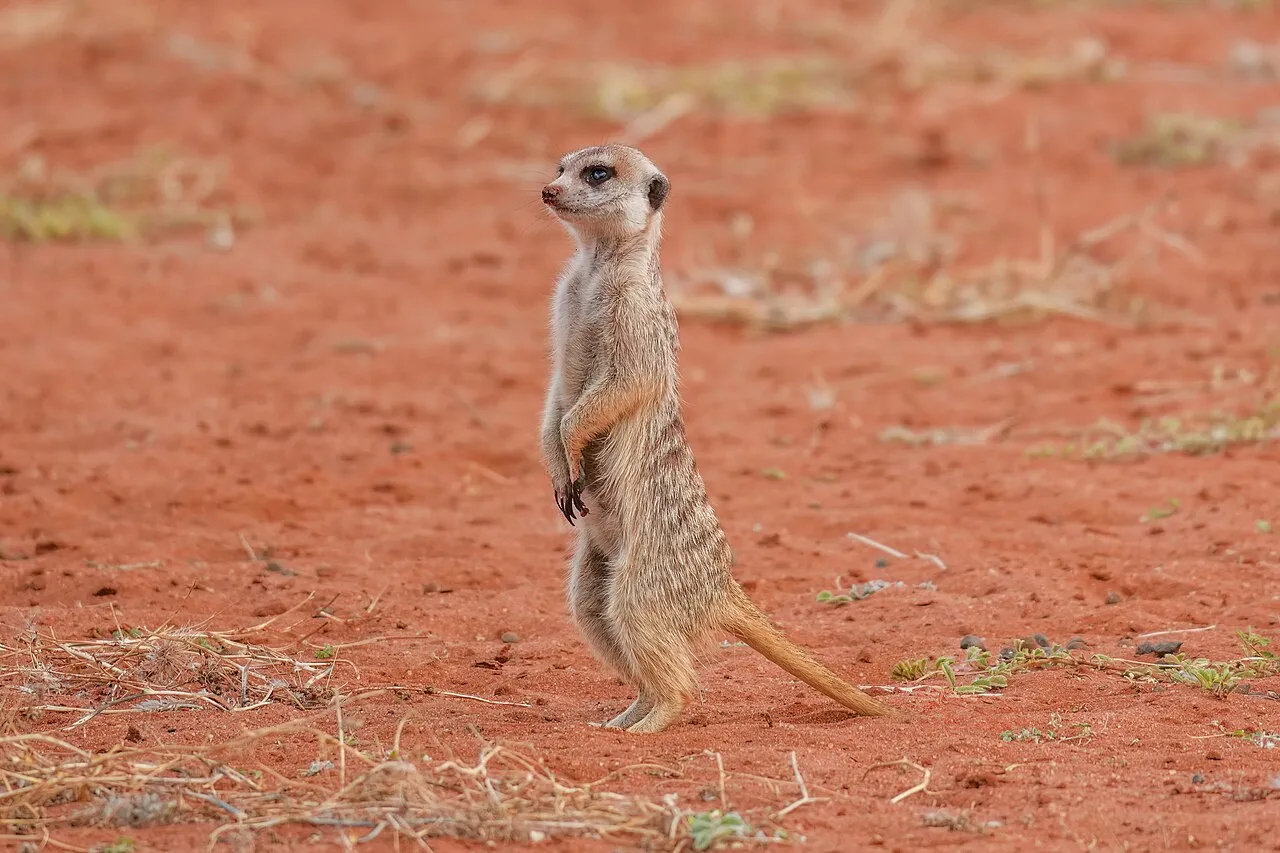
Giles Laurent · CC BY-SA 4.0
The scientific name is Suricata suricatta, a tautonym in which the genus and species names are identical. The origin of suricata is uncertain; it may come from a local African word or an early French name.
Meerkat comes from Afrikaans, borrowed from Dutch, where it literally means lake cat. In Dutch the word originally referred to a kind of monkey, and Dutch-speaking settlers in southern Africa later applied it to this small mongoose. Despite the name, meerkats are not cats.
Meerkats belong to the mongoose family, Herpestidae, within the cat-like branch of carnivores, Feliformia. That puts them closer to cats, hyenas and civets than to dogs. The meerkat is the only living species in its genus; its closest relatives include other social African mongooses such as the yellow mongoose, banded mongoose and dwarf mongoose.
2.1. Subspecies
Three subspecies are usually recognized, though differences are slight and opinions vary: S. s. suricatta in southern South Africa, southern Botswana and southern Namibia; S. s. majoriae in central and northern Namibia and south-western Botswana; and S. s. iona in south-western Angola. Coat colour varies by region, with animals in the arid south-west tending to be paler and more yellow.
3. Evolution
Within the cat-like carnivores, mongooses are thought to be most closely related to hyenas, with the two families splitting somewhere around 20 to 30 million years ago. Early mongooses ranged across Asia and Africa and later diversified especially in Africa.
Fossils resembling modern meerkats have been found in South African cave deposits a few million years old, indicating that meerkats have lived in roughly the same region for a long time, although precise dates and species boundaries need further study.
Intriguingly, group living seems to have evolved more than once within the mongoose family. Meerkats, banded mongooses and dwarf mongooses are all social, but they may have developed their sociality independently. In open habitats with few hiding places and many predators, many eyes are better than two.
4. Range and habitat
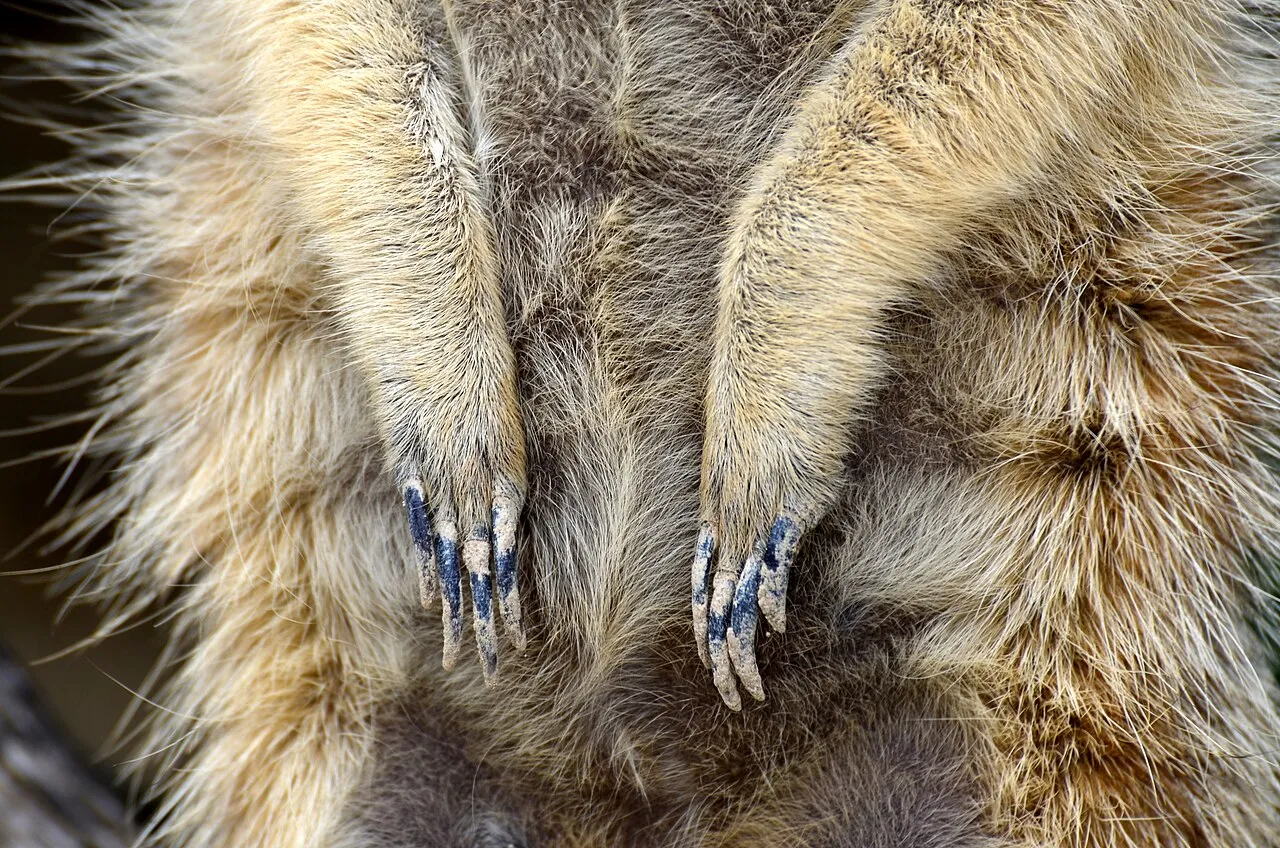
Roland zh · CC BY-SA 3.0
Meerkats live only in southern Africa: South Africa, Botswana, Namibia, south-western Angola and possibly a small part of Lesotho. The core of their range lies in arid regions such as the Kalahari, Namaqualand and the Karoo.
They are often called desert animals, but they mostly live in semi-arid savanna, dry grassland and flat ground between dunes, with scattered grasses and shrubs. Ground that is too rocky is hard to dig, and vegetation that is too dense hides predators, so meerkats favour firm soil and open views.
A group typically defends a territory of a few square kilometres and uses several burrow systems within it, rotating between them. Each burrow has multiple entrances and tunnels reaching one to two metres deep. Underground it stays cooler by day and warmer by night than the surface, sheltering meerkats from the desert's big temperature swings. Meerkats dig their own burrows but also share or take over those dug by ground squirrels.
5. Physical characteristics
Meerkats have slender bodies, small heads and pointed snouts.
| Feature | Typical value |
|---|---|
| Head and body | about 25 to 35 cm |
| Tail | about 17 to 25 cm |
| Weight | about 0.6 to 1 kg, adults averaging around 0.7 kg |
| Newborn | about 25 to 35 g |
| Vision | wide field of view; spots raptors at great distance |
The coat is greyish or tawny brown with dark bands across the back, and band patterns vary enough between individuals to help with identification. The thin tail has a black tip and acts as a tripod leg when the animal stands upright.
The belly has sparse fur over dark skin. On cold mornings meerkats stand facing the sun to warm this dark patch, an important start to the day in a desert where nights can approach freezing.
Dark patches around the eyes are thought to reduce glare, and a nictitating membrane protects the eyes from sand while digging. The small ears can close to keep out soil, and the forefeet carry curved claws nearly two centimetres long for rapid digging.
6. Behaviour and ecology
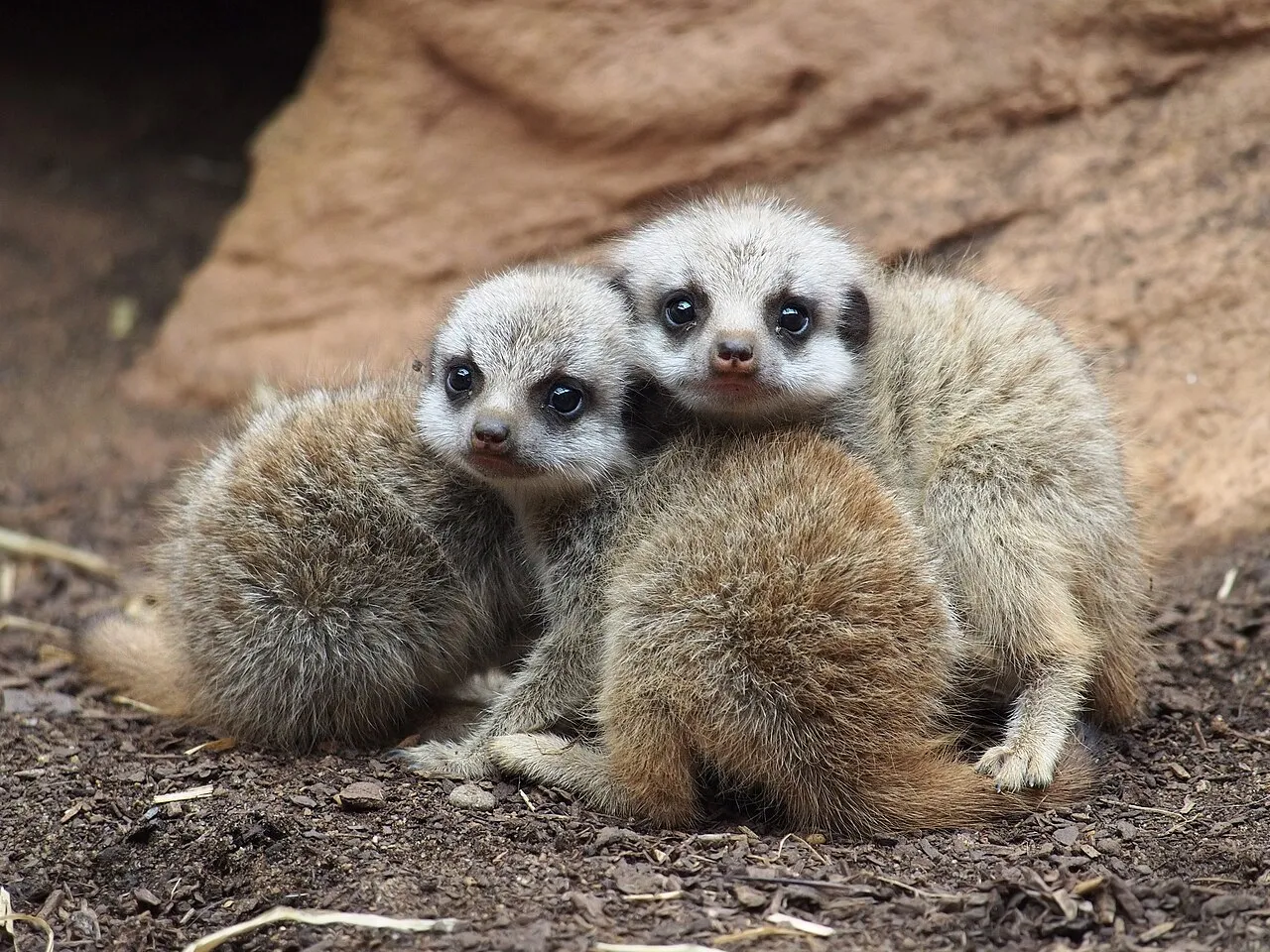
Francis C. Franklin · CC BY-SA 3.0
Meerkats are active by day. At sunrise they emerge to sunbathe, then forage together once warm. They rest in shade or underground during the hottest hours, forage again in the afternoon and return to a burrow before dusk.
Groups usually contain 10 to 30 animals and occasionally 40 to 50. At the centre is a dominant breeding pair, while most other members are their offspring or males who immigrated from other groups. The dominant female is typically the largest and most assertive animal and often decides where the group moves and sleeps.
6.1. Sentinels and cooperation
The meerkat's most famous behaviour is sentinel duty. While the group forages, one animal climbs onto a mound, rock or bush and watches for minutes at a time. Even when nothing is wrong, it gives a quiet watchman's song, allowing the others to keep their heads down and focus on digging.
Sentinel behaviour was once considered selfless, but research suggests a more nuanced picture. Meerkats tend to stand guard when they have already eaten well, and a sentinel is the first to spot danger and the first to bolt. Self-interest and group benefit overlap.
Pup care is also shared. After a litter is born, some group members stay at the burrow as babysitters, and once the pups emerge, helpers share food with them. Some subordinate females even lactate and nurse the dominant female's pups without having bred themselves.
6.2. Warfare between groups
Meerkats are fiercely hostile to other groups. When groups meet at a territorial boundary, members raise their tails, fluff their fur and bounce forward together in a war dance. If intimidation fails, fights break out, and adults or pups may be killed.
A 2016 study in Nature comparing more than a thousand mammal species found that meerkats had one of the highest rates of death at the hands of their own species, with estimates around one in five deaths. That figure includes both intergroup fights and infanticide within groups. Behind the cute image, meerkat society is rough.
7. Diet and feeding
Meerkats are mainly insectivores. Beetles and their larvae, caterpillars, termites, grasshoppers and crickets make up much of the diet, along with spiders, scorpions, centipedes, small lizards, snakes, small birds and eggs, and small rodents. They also eat juicy roots, tubers and desert melons, which provide valuable water in a dry environment.
They forage with noses to the ground, sniffing for buried prey, then dig furiously with their forefeet. A meerkat is said to be able to move its own weight in soil in seconds. Because most prey hides underground, digging fills several hours of each day.
Scorpions are the most famous item on the menu. Meerkats are thought to have some resistance to scorpion venom, but they are not fully immune, so they usually bite off or rub away the stinger before eating. Groups will also mob and sometimes kill venomous snakes.
7.1. Teaching pups
A 2006 study made headlines by showing that meerkats teach their pups to handle prey. Helpers give very young pups dead scorpions, older pups live scorpions with the sting removed, and still older pups intact live scorpions, matching difficulty to each pup's age and skill.
Researchers argued that this meets the formal criteria for teaching, since the helpers pay a cost to help pups learn. It was one of the first experimental demonstrations of teaching in a non-human mammal.
8. Reproduction and life cycle
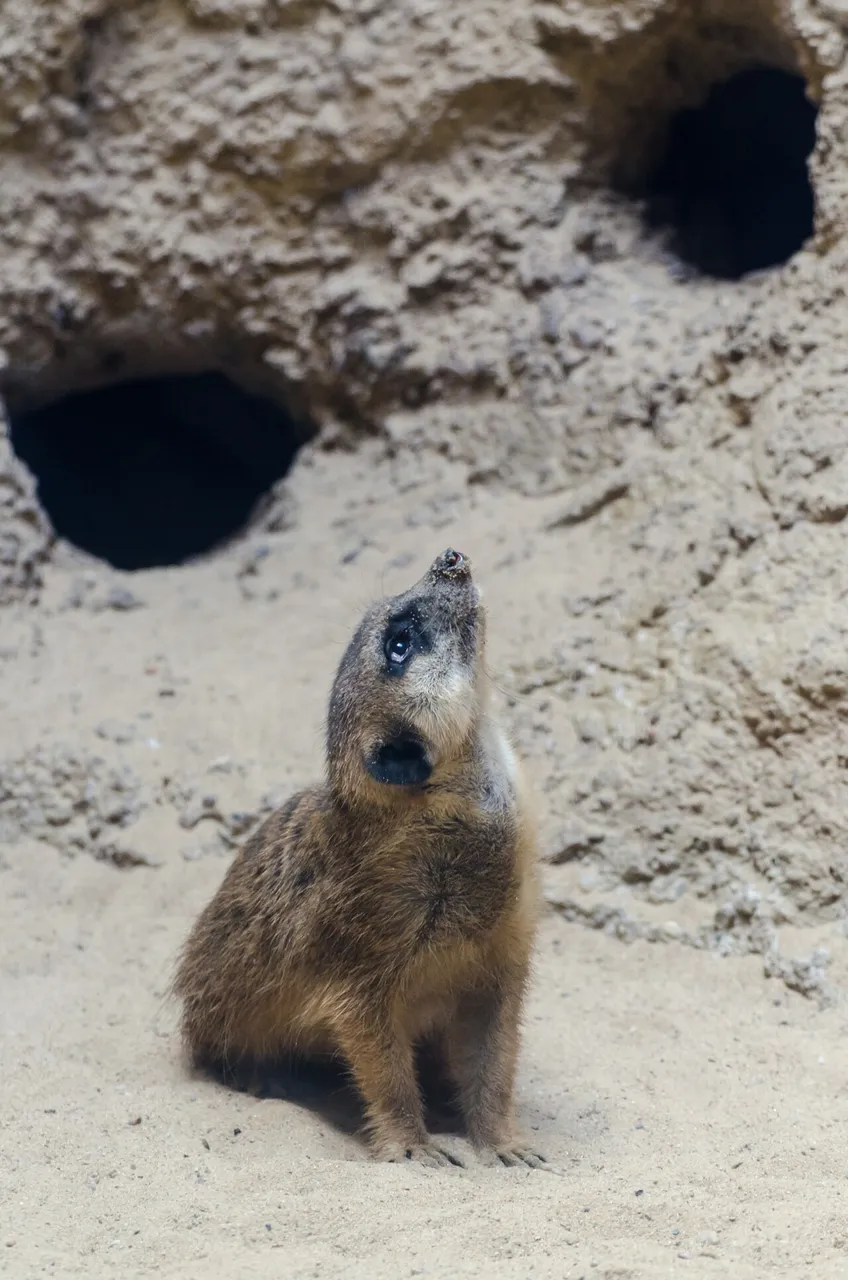
The dominant female produces most of the pups in a group, more than 80 percent in some studies. The dominant male fathers most of them, although subordinate females sometimes mate secretly with roving males from other groups.
Gestation lasts about 60 to 70 days, and litters usually contain three to five pups, occasionally up to seven. In good conditions a female can breed three or four times a year. Breeding booms after rain brings abundant prey and collapses during drought.
| Stage | Age | What happens |
|---|---|---|
| Newborn | 0 to 3 weeks | Born with eyes and ears closed; guarded underground by babysitters |
| First outings | about 3 to 4 weeks | Emerges and starts following the group |
| Provisioned | 1 to 3 months | Fed by helpers while learning to forage |
| Independent foraging | from about 3 months | Finds its own food |
| Maturity | about 1 year | Subordinates have few chances to breed |
When a subordinate female becomes pregnant, the dominant female often harasses her and evicts her from the group; the stress can cause her to miscarry. If a subordinate gives birth first while the dominant female is pregnant, the dominant may kill those pups. Males usually leave their birth group at two to four years old to seek breeding opportunities elsewhere.
In the wild most meerkats live only a few years, with a maximum of around ten, because of predators, fights and drought. In captivity they can reach 12 to 14 years.
9. Intelligence, communication and special abilities
Meerkats have a rich vocal repertoire, with more than thirty call types described. Soft contact calls keep foragers in touch, pups beg loudly for food, sentinels give their reassuring watchman's song, and a range of alarm calls warns of danger.
The alarm calls are remarkably specific. Meerkats give different calls for aerial predators, such as eagles, and terrestrial predators, such as jackals, and the calls also encode urgency. An aerial alarm sends the group diving into the nearest bolt-hole; a terrestrial alarm makes them bunch together and move off watchfully. A call for snakes has the opposite effect, drawing the group together to mob the snake with fluffed fur and lunges. Encoding both predator type and urgency is of great interest to researchers studying the origins of language.
Meerkats also eavesdrop on the alarm calls of birds, and at least one bird has learned to exploit this. The fork-tailed drongo of southern Africa sometimes mimics meerkat alarm calls, causing meerkats to drop their food and flee, and then swoops in to steal it.
Meerkats have excellent daytime vision and spot high-flying raptors long before a human would. Their keen sense of smell detects prey buried in the soil and distinguishes group members from strangers.
10. Predators and survival
Small size makes meerkats prey for many animals. Raptors such as martial eagles, tawny eagles, goshawks and eagle-owls are the greatest threat. On the ground, jackals, African wildcats, caracals and large snakes such as Cape cobras and puff adders take meerkats, and pups are especially vulnerable, including to rival meerkat groups.
The survival strategy is spot, warn and hide. Sentinels detect danger early, alarm calls broadcast the threat, and the group vanishes into one of the many bolt-holes scattered across its territory, which can number in the hundreds.
With nowhere to run, meerkats bunch together, fluff their fur, arch their backs and bare their teeth to look like one large, menacing animal. Adults may cover pups with their bodies when a raptor approaches.
Drought is another major threat. Without rain, insect prey declines, leading to starvation and breeding failure, and whole groups can disappear. Tuberculosis outbreaks have also caused groups to collapse in the Kalahari.
11. Relationship with humans
Meerkats were familiar neighbours to Indigenous peoples of southern Africa and later to settlers. In some areas they were welcomed for eating insects and snakes, and folk stories describe them as guardians of villages and livestock.
At the same time, meerkats were considered rabies carriers, and in the mid-twentieth century South Africa ran large-scale campaigns to exterminate mongooses, including meerkats, using poison and burrow gassing. Today their role in rabies transmission is generally considered minor.
Science changed the relationship most. A long-term project begun in 1993 on a reserve in South Africa's Kalahari has followed thousands of individually known meerkats in dozens of groups. Researchers habituated the animals over years so that they could be observed at close range, weighed on scales and followed all day. The project has produced hundreds of studies on cooperative breeding, teaching, alarm calls, stress and ageing.
Today, ecotourists can watch habituated meerkat groups up close in the Kalahari, Namibia and elsewhere. Such tourism can support local economies and conservation, but crowds can disturb the animals, so limits on group size and distance are important.
12. Conservation status
The meerkat is listed as Least Concern by the IUCN. It has a wide range, is fairly common both inside and outside protected areas, and there is no evidence of major population decline. No precise global count exists, but densities range from a few to perhaps a dozen or more animals per square kilometre depending on habitat.
There are still concerns:
- Climate change: long-term data from the Kalahari show that hotter, drier conditions slow meerkat growth, reduce breeding and lead to more group extinctions. Meerkats have become an indicator of how climate change affects desert mammals.
- Habitat change from overgrazing and conversion to farmland in parts of the range.
- Disease, notably tuberculosis, which has devastated some groups.
- The pet trade, which exports wild-caught and captive-bred meerkats abroad.
Meerkats are not listed on CITES. In Korea they have no special protected status, but laws revised in 2023 generally prohibit exhibiting live wild animals at facilities not licensed as zoos or aquariums, so so-called wildlife cafes are being phased out after a grace period.
13. In zoos, and the pet trade
Meerkats are popular zoo animals because visitors can easily watch groups foraging, playing and standing guard. Good exhibits provide deep soil for digging, raised lookout points, heat lamps for basking, and live insects hidden in the substrate to satisfy foraging instincts.
Meerkat social tensions persist in captivity. Dominance disputes can lead to injuries or evictions, so keepers must manage group composition carefully. Meerkats also react to anything overhead, so frequent birds of prey or drones can cause stress.
Meerkats make poor pets:
- They are intensely social and suffer when kept alone or in pairs.
- They dig and chew constantly, which does not suit indoor life.
- They scent-mark with glands and are hard to toilet-train.
- They can be aggressive toward strangers and other pets, and bites can be deep.
- They can carry rabies, parasites and other diseases transmissible to people.
- Demand for exotic pets drives wild capture and poor-quality breeding operations.
Meerkats have been widely traded for homes and animal cafes in Japan, parts of the Middle East and Korea, and animals handled constantly in cramped spaces often show signs of stress such as hair loss, aggression and repetitive behaviour. The best way to enjoy meerkats is to watch them living in groups in the wild or in a well-designed zoo.
14. In culture
Global stardom came in 1994 with a wisecracking meerkat in a Disney animated film who, with his warthog friend, sang about having no worries. For many people this character was their first meerkat. Real meerkats, of course, do not befriend warthogs and almost never live alone.
A British documentary series that began in 2005 followed real meerkat groups from the Kalahari research project as if they were characters in a soap opera, with deaths of matriarchs, power struggles and wars between groups. It introduced millions of viewers to the complexity of meerkat society.
In the UK, a price comparison website built a hugely successful advertising campaign around an aristocratic meerkat character with a Russian accent, based on the pun between compare the market and compare the meerkat. The character spawned toys, books and catchphrases.
The upright, head-swivelling meerkat pose has also become a universal visual joke for anyone craning to see what is going on, from office workers peering over cubicle walls to crowds at a sports match.
15. Trivia
- A group of meerkats is called a mob, gang or clan.
- Standing upright, a meerkat is only about 30 cm tall, yet it can spot a raptor hundreds of metres away.
- Kalahari researchers trained meerkats to step onto electronic scales voluntarily, rewarding them with crumbs of boiled egg or drops of water, so that body weights could be recorded daily.
- Females that become dominant undergo a growth spurt, getting larger than their rivals, which helps them hold their position.
- Meerkats rarely drink and get most of their water from food.
- Meerkats sometimes share burrow systems with yellow mongooses and ground squirrels.
- A meerkat's tail helps it balance when standing, but it cannot grasp objects.
Wild animals are not pets. Catching, trading or keeping them is illegal in most places. If you find an injured wild animal, call your local wildlife rescue centre.
FAQ
Is the meerkat a kind of cat?
No. The name comes from Dutch for lake cat, but meerkats are mongooses. They belong to the cat-like branch of carnivores, so they are closer to cats and hyenas than to dogs.
Are meerkats immune to scorpion venom?
They have some resistance but are not fully immune, so they bite off or rub away the stinger before eating a scorpion.
Can I keep a meerkat at home?
It is not recommended. Meerkats live in large groups and suffer when kept alone; they dig, scent-mark, can bite and may carry disease. Korea has also restricted exhibiting wild animals outside licensed zoos.
Photo credits
Photos are freely licensed images from Wikimedia Commons. Authors and licenses are listed below.
- Meerkat (Suricata suricatta) Tswalu.jpg — Charles J. Sharp · CC BY-SA 4.0
- 112 Meerkat standing in the Kalahari Desert of Namibia Photo by Giles Laurent.jpg — Giles Laurent · CC BY-SA 4.0
- 50 Jahre Knie's Kinderzoo - Suricata suricatta (Erdmännchen) 2012-10-03 16-27-22.JPG — Roland zh · CC BY-SA 3.0
- Baby Meerkats.jpg — Francis C. Franklin · CC BY-SA 3.0
- Erdmännchen (107684825).jpeg — Kai Christian Ewers · CC BY-SA 3.0