TailVille
1. Overview
Few sights match thousands of pink birds lifting off a shimmering salt lake at once. The greater flamingo, the largest and most widespread of the world's six flamingo species, is the star of that show.
It ranges across Africa, the Mediterranean coasts of southern Europe, the Middle East, south-west Asia and India. It favours places most animals avoid: salt lakes, soda lakes, salt pans, lagoons and shallow mudflats, where competition for food is limited.
Long legs, an S-curved neck and a bill bent sharply in the middle make it unmistakable. Feeding with its head upside down, it pumps water through its bill with a piston-like tongue, straining out brine shrimp, algae and insect larvae with comb-like plates. Those foods also supply the pigments that turn it pink.
Greater flamingos breed in colonies of thousands or tens of thousands, and their synchronised group displays, with flocks marching and head-flagging in unison, are among the great spectacles of the bird world. Korea is far outside its natural range, so most Koreans know it only from zoos.
2. Name and classification
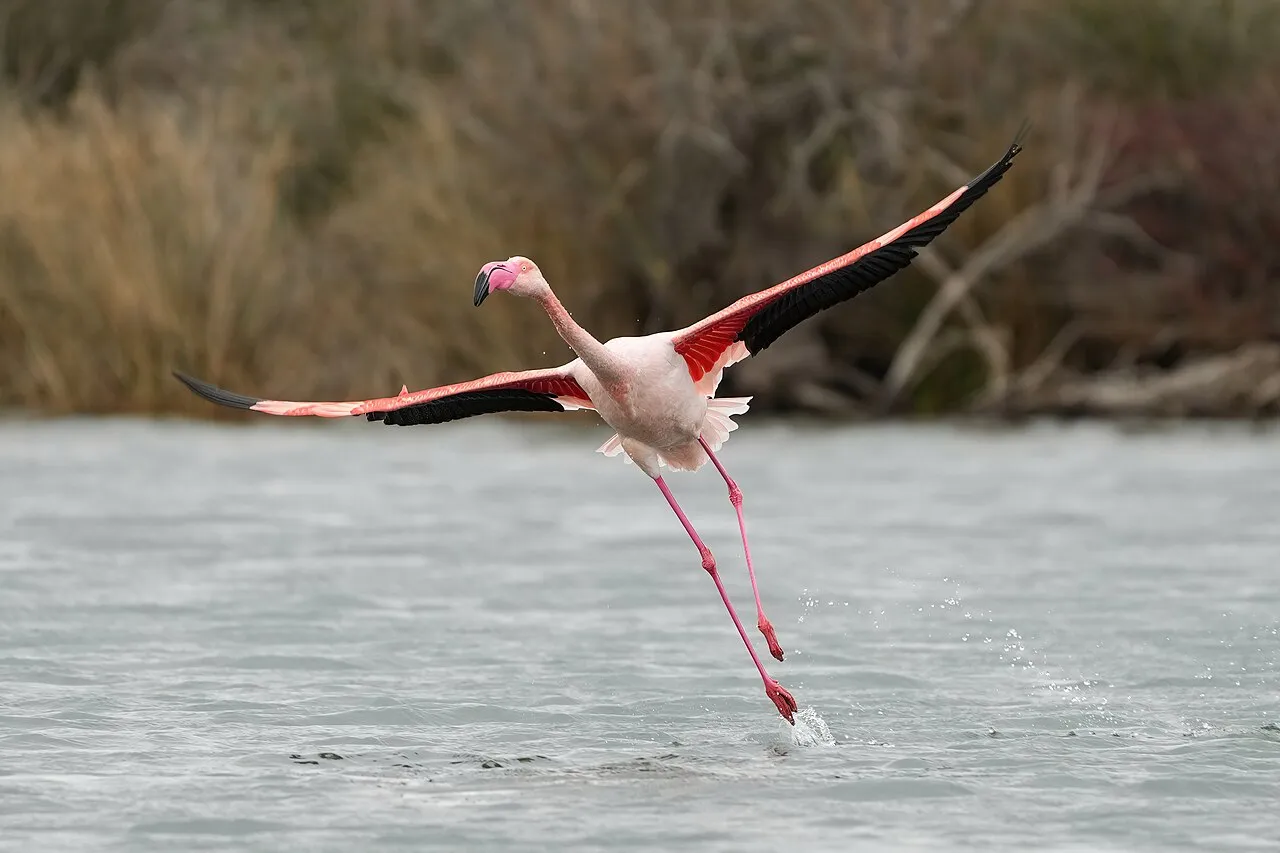
Giles Laurent · CC BY-SA 4.0
The scientific name Phoenicopterus roseus combines the Greek for crimson-winged with the Latin for rose-coloured. The Greeks and Romans knew the bird well. The name was coined by the German naturalist Peter Simon Pallas in 1811.
The word flamingo comes from Spanish or Portuguese flamengo, usually linked to the Latin flamma, flame. The Korean name, honghak, means red crane, though flamingos are not related to cranes at all; the name simply reflects the long legs and neck.
The greater flamingo was once lumped with the American flamingo, but differences in colour, bill pattern and DNA mean most authorities now treat them as separate species. The American flamingo is a deep orange-pink; the greater is much paler, almost white with a pink blush.
| Species | Scientific name | Range |
|---|---|---|
| Greater flamingo | Phoenicopterus roseus | Africa, southern Europe, SW Asia |
| American flamingo | Phoenicopterus ruber | Caribbean, Galapagos |
| Chilean flamingo | Phoenicopterus chilensis | Southern South America |
| Lesser flamingo | Phoeniconaias minor | Africa, India |
| Andean flamingo | Phoenicoparrus andinus | High Andes |
| James's flamingo | Phoenicoparrus jamesi | High Andes |
No subspecies are recognised.
3. Evolution
For a long time, nobody could agree where flamingos belonged. Their long legs suggested storks and herons; their bills, webbed feet and honking calls suggested ducks and geese.
In the twenty-first century, DNA and anatomical studies delivered a surprise: the flamingo's closest relatives are grebes, small diving birds that build floating nests. The two look nothing alike, but they share particular feather lice, eggshell structure, foot features and genetic markers. Together they now form a group called Mirandornithes, Latin for wonderful birds.
Fossils add to the story. Palaelodids, apparent flamingo relatives with shorter legs and adaptations for swimming, are known from Europe and elsewhere from roughly 30 million years ago. Flamingos with modern-looking filter bills appear a few million years ago, and fossils show that flamingos once lived in Australia, disappearing as its great inland salt lakes dried out.
4. Range and habitat
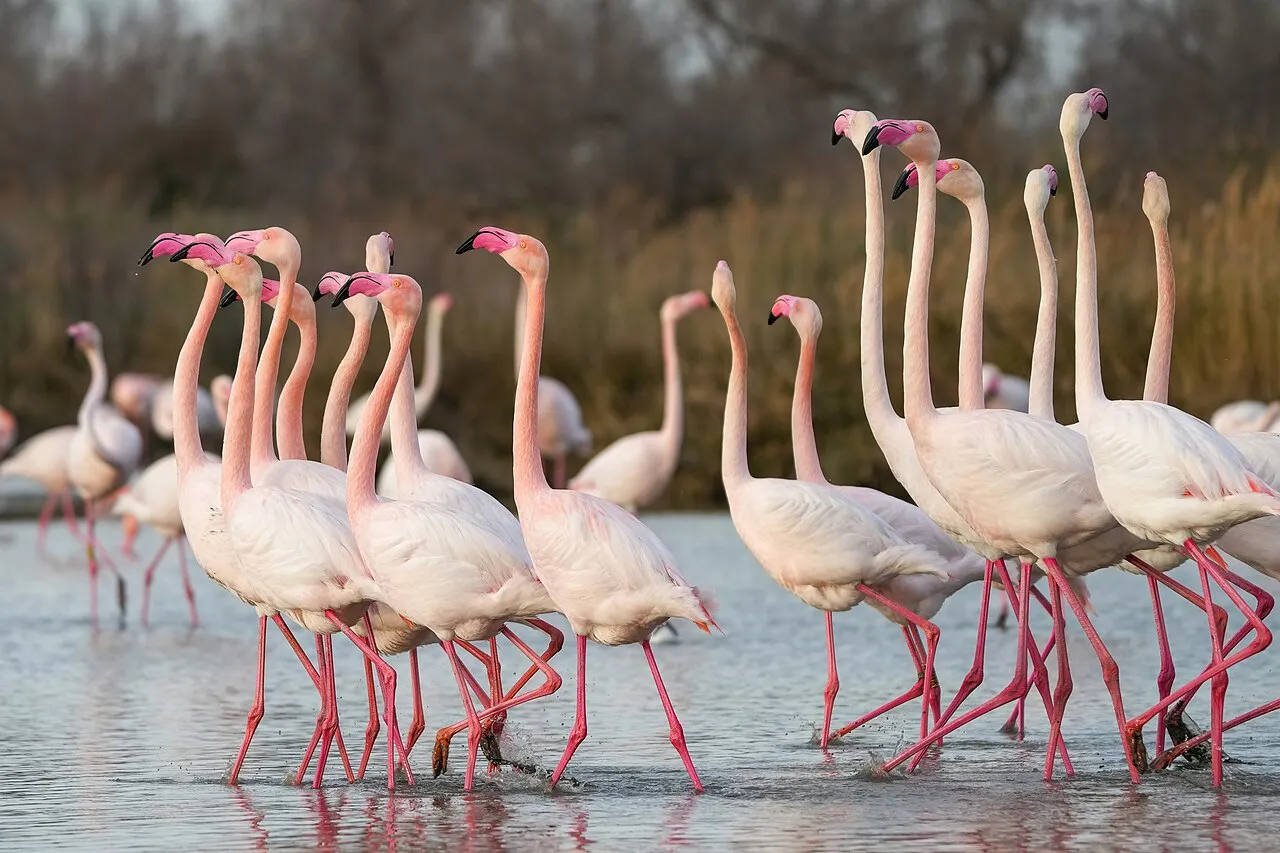
The greater flamingo has the widest distribution of any flamingo. In Africa it occurs along the northern coast, at the lakes of the East African Rift and at salt pans and coastal lagoons in the south. In Europe it breeds in Mediterranean wetlands in Spain, southern France, Italy, Greece and Turkey. It is found on lakes in Iran and southern Kazakhstan, on the coasts of Arabia, and in western India, Pakistan and Sri Lanka.
Key breeding sites include the Camargue in southern France, Fuente de Piedra in Spain, lakes in Turkey and Iran, the Rann of Kutch in Gujarat, India, and the soda lakes of East Africa. When the monsoon floods the Rann of Kutch, hundreds of thousands of flamingos may gather there, earning it the nickname Flamingo City.
Its habitat is shallow, salty water: hypersaline lakes several times saltier than the sea, alkaline soda lakes, salt pans and salt works, coastal lagoons and estuarine mudflats. Fish struggle in such places, so there is little competition, while the brine shrimp and algae flamingos eat can be extraordinarily abundant.
Greater flamingos are nomadic, moving hundreds or thousands of kilometres as water conditions change, often at night, and may switch breeding sites from year to year. Korea lies well outside the normal range, and wild records there are essentially nonexistent.
5. Body
Greater flamingos are the tallest and heaviest flamingos. Males are somewhat bigger than females, and in a flock the difference in height is often noticeable.
| Measure | Value |
|---|---|
| Height | about 110–150 cm |
| Wingspan | about 140–165 cm |
| Weight | about 2–4 kg (males heavier) |
| Legs | more than half the bird's total height |
The body is whitish with a pink flush, the wing coverts are vivid crimson and the flight feathers are black. At rest the bird looks pale pink, but in flight the crimson and black flash dramatically. The bill is pink with a black tip.
5.1. Bill and tongue
The flamingo bill is one of the oddest in the bird world. Bent downwards midway, it lies horizontal when the head is upside down in the water. In most birds the lower jaw is the larger, fixed part; in flamingos the upper jaw is smaller and moves, an inversion suited to feeding upside down.
The edges are lined with fine plates called lamellae. A thick, fleshy tongue moves like a piston several times a second, sucking water in and pushing it out while the lamellae act as a sieve. The greater flamingo's lamellae are relatively coarse, so it takes larger items such as brine shrimp, insect larvae and small molluscs. The lesser flamingo's are much finer, suited to microscopic blue-green algae, so the two species can share a lake without competing much.
5.2. Why pink?
Flamingos are not born pink. Chicks hatch in greyish-white down, and juveniles are grey-brown. The colour comes from carotenoid pigments in the diet: the liver converts pigments from brine shrimp and algae into pink and red forms that are deposited in feathers, skin and legs. Full adult colouring takes about three to four years.
Because a rich colour signals a healthy, well-fed bird, it is thought to matter in mate choice. In the breeding season, greater flamingos rub secretions from the preen gland near the tail onto their feathers to intensify the pink, a behaviour some researchers have compared to applying make-up. While raising chicks, parents pass so much pigment to their young in their crop milk that they visibly fade.
6. Behaviour and ecology
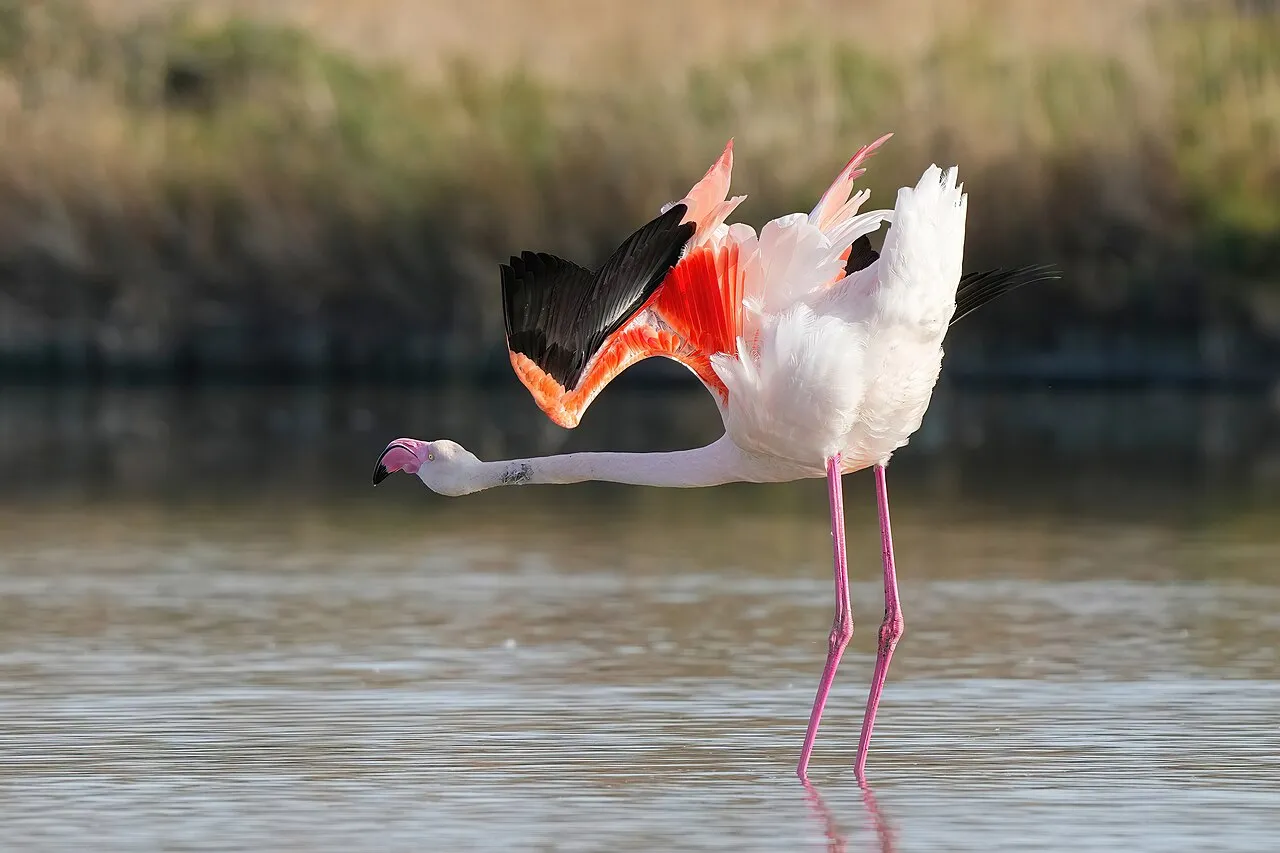
Greater flamingos are almost always in groups, from a few dozen to tens of thousands. They feed, rest and travel together; big flocks spot predators sooner and help synchronise breeding.
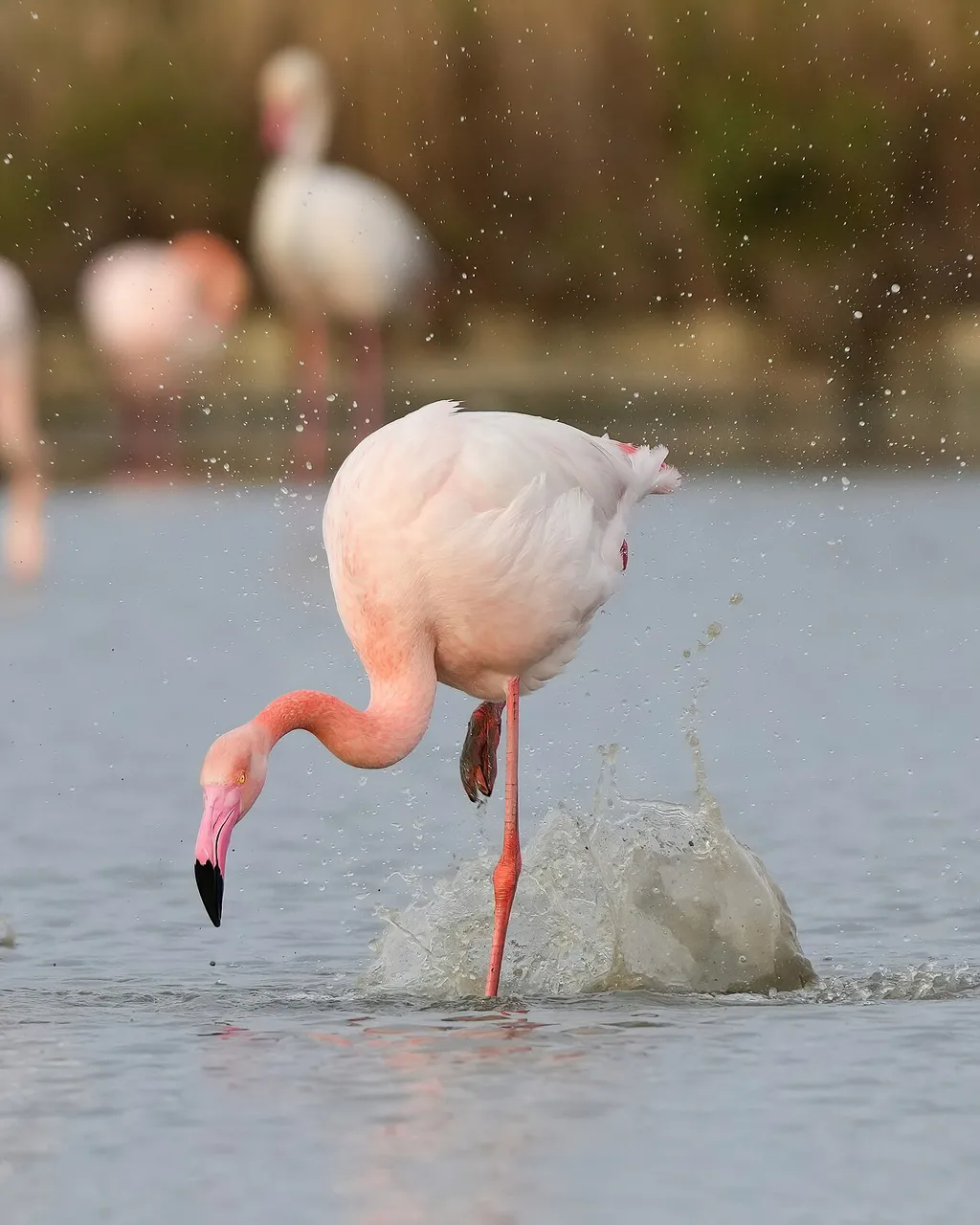
Most of the day goes to feeding. They wade slowly through shallow water with heads upside down, sometimes stamping or paddling to stir up food from the mud. In deeper water they swim and up-end like ducks. They often feed at night too.
To rest, a flamingo stands on one leg with its neck folded over its back and its head tucked into its feathers, a posture that conserves heat and requires little muscle effort.
In flight, neck and legs stretch out fore and aft so the bird looks like a long cross. Take-off requires a running start across the water. Travelling flocks fly in lines or V formations.
7. Diet and feeding
Greater flamingos are omnivores. The main foods are:
- Small crustaceans, especially brine shrimp (Artemia)
- Larvae and pupae of midges and other insects
- Small clams and snails
- Worms and other small invertebrates
- Blue-green algae and diatoms
- Seeds, roots and organic matter in the mud
The bird lowers its upside-down head and filters water and mud through its bill. It may also trample in a circle, stirring up sediment, leaving rings of footprints and bill marks on the mudflat.
Brine shrimp thrive in water far saltier than the sea and are the key source of the pink pigments. Commercial salt works, where salinity rises in evaporation ponds, often teem with brine shrimp and attract flamingos. Salt glands above the eyes allow them to cope with salty water and food, though they will seek out fresh water to drink when it is available.
8. Reproduction and life cycle
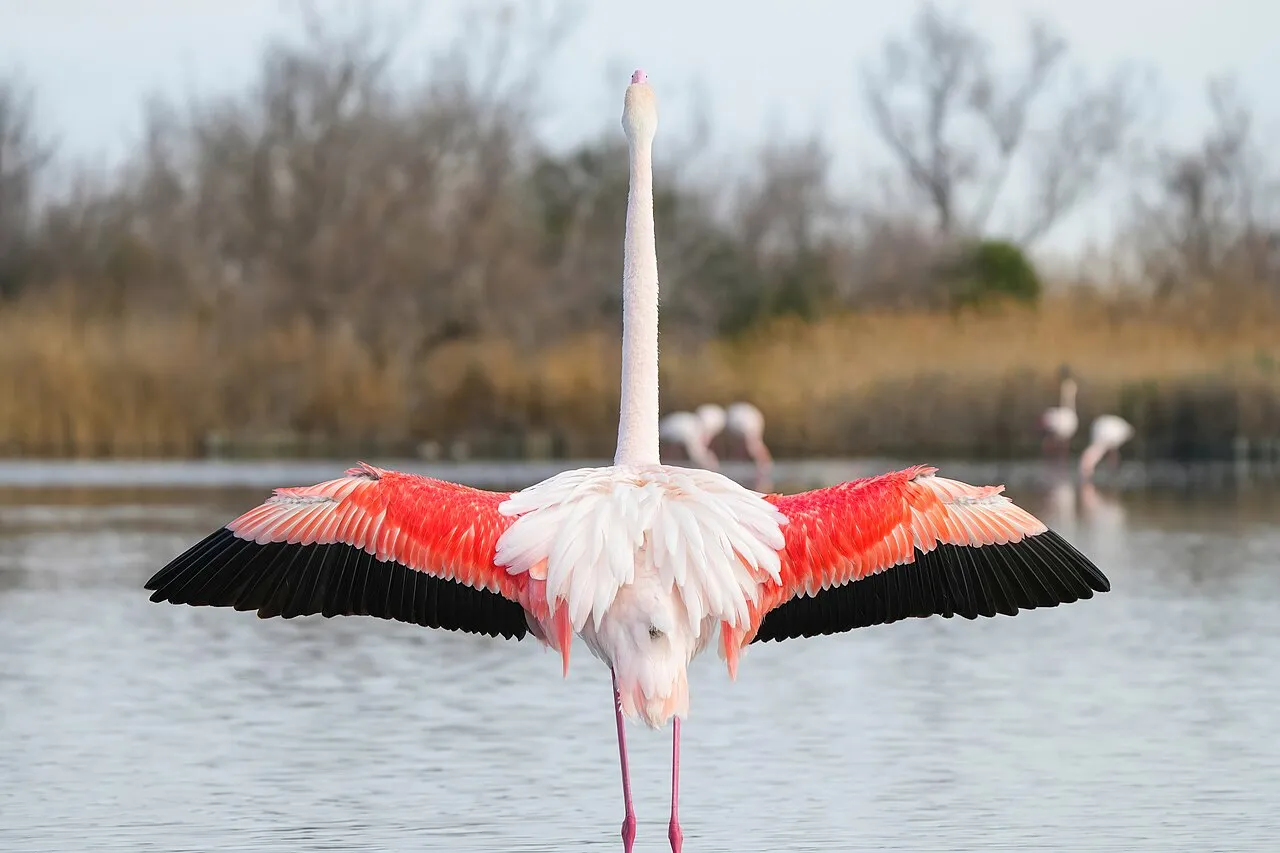
Breeding begins with mass displays. Hundreds or thousands of birds crowd together, stretching their necks and flagging their heads from side to side, flashing open their wings to show the crimson coverts, and marching in tight groups that abruptly change direction. These group performances synchronise the colony so that many pairs lay at about the same time. Pairs are usually monogamous for a season but often change partners from year to year.
The nest is a cone of mud scraped together with the bill, typically a few tens of centimetres high with a hollow on top, which keeps the egg above sudden floods and away from the heat of the ground. Nests are packed within pecking distance of their neighbours.
A single egg is laid and incubated by both parents for about 27 to 31 days. The chick hatches in grey-white down with a straight bill. Both parents feed it crop milk, a fat- and protein-rich secretion from the upper digestive tract, coloured red by dietary pigments. Few birds produce crop milk, pigeons being the best-known example, and in flamingos both sexes do.
| Stage | Timing | Notes |
|---|---|---|
| Egg | about 27–31 days | Mud nest, shared incubation |
| Chick | First week | Grey down, straight bill, crop milk |
| Creche | From about 1–2 weeks | Joins large groups of chicks |
| Bill bends | About 1–2 months | Begins filter-feeding |
| Fledging | About 2.5–3 months | Grey-brown juvenile plumage |
| Pink | About 3–4 years | Adult plumage |
| First breeding | Usually 3–6 years | Joins breeding colonies |
After a few weeks, chicks gather in creches that can number thousands, watched over by a few adults, and parents find their own offspring by voice. Decades of ringing in the Camargue have shown that greater flamingos can live and breed for several decades in the wild, and one captive bird was reported to be over 80 years old.
9. Intelligence, communication, special abilities
The greater flamingo's call is a goose-like honk, and a large flock produces a constant clamour. Parents and chicks have individually distinctive voices that let them find one another among thousands.
Flamingo society is surprisingly rich. Studies of captive and wild flocks have found lasting friendships, birds that consistently rest and feed beside particular individuals, as well as pairs that avoid each other. Such bonds occur between birds of the same sex as well as between mates.
Their special talent is tolerance of extremes. Tough, scaly skin on the legs lets them stand for hours in hypersaline or caustic alkaline water; some East African soda lakes are alkaline enough to burn human skin, yet flamingos feed and breed there. Research on one-legged standing found that the body's weight sits directly over the supporting joint, locking it passively; even a dead flamingo could be balanced on one leg, demonstrating how little muscle effort the pose requires.
10. Predators and survival
Adult greater flamingos are taken by foxes, jackals, hyenas and large raptors, and baboons sometimes raid colonies in Africa. But the vast, salty shallows where flamingos live are hard for mammals to reach, a defence in themselves.
Eggs and chicks fall prey to gulls, raptors and storks. When water levels drop and colonies become connected to the shore, foxes and feral dogs can cause devastating losses, which is why some reserves manage water levels to keep breeding islands surrounded by water.
Weather is the biggest danger. Droughts can prevent breeding entirely, sudden floods drown nests, and severe cold snaps in the Mediterranean have killed large numbers of flamingos.
11. Relationship with humans
Flamingos and people go back to ancient civilisations. An Egyptian hieroglyph shaped like a flamingo was used to write the word for red, and prehistoric rock art in southern Spain appears to depict flamingos.
The Romans prized flamingo tongues as a delicacy, and a Roman cookbook includes recipes for flamingo. Around the Mediterranean, colonies were raided for eggs and meat for centuries.
In modern times flamingos have a special relationship with the salt industry. Evaporation ponds become rich in brine shrimp as salinity rises, providing excellent feeding. In the Camargue, conservationists built an artificial nesting island inside a salt works, and a colony that had nearly vanished recovered dramatically, a celebrated example of industry and wildlife coexisting.
There is conflict too. In some regions flamingos trample rice paddies and eat seed, angering farmers, and flocks near airports pose bird-strike risks.
Korea has no historical connection with the species. Flamingos are known there only from zoos, which often keep a mix of greater, Chilean and American flamingos.
12. Conservation
The IUCN classifies the greater flamingo as Least Concern because of its wide range and large population. Global numbers are estimated at somewhere from several hundred thousand to around a million birds, but their nomadic habits make counting difficult and estimates vary. Mediterranean and West African populations are thought to have increased since the late twentieth century thanks to protection.
Because breeding is concentrated at a handful of sites, the loss of one can have outsized effects. Main threats:
- Drainage and development of wetlands, including tourism
- Water abstraction and dams lowering lake levels
- Soda-ash mining and changes in the salt industry
- Disturbance at colonies by people, drones and vehicles
- Collisions with power lines
- Lead shot and water pollution
- Drought and extreme weather linked to climate change
Conservation tools include building nesting islands, managing water levels and restricting access during breeding. The species is covered by the African-Eurasian Migratory Waterbird Agreement (AEWA) and listed on CITES Appendix II. Korea has no domestic protection category for it.
13. In zoos
Flamingos are among the most familiar zoo birds: they live long in captivity and adapt reasonably well to group life. But they tend to breed only when the flock is large enough to trigger mass displays, so small groups often fail to breed. Some zoos have installed mirrors to make flocks look bigger, with reported success.
Captive flamingos need carotenoid-enriched food to stay pink; without it they fade to white within months.
The traditional practice of pinioning, surgically removing the wing tip to prevent flight, is increasingly criticised on welfare grounds. More zoos now keep flamingos in large, netted walk-through aviaries instead.
14. In culture
Flamingos are pop-culture favourites. In Lewis Carroll's Alice's Adventures in Wonderland, the Queen of Hearts' croquet game uses live flamingos as mallets, a scene illustrated countless times.
In the United States, the pink plastic lawn flamingo designed by Don Featherstone around 1957 became a kitsch classic. From the 1980s, flamingos turned into icons of Miami, Florida and tropical holidays in television, fashion and interior design, and inflatable flamingo pool floats remain a summer staple.
The American flamingo is the national bird of the Bahamas, flamingo lakes are major tourist attractions in East Africa and India, and the Indian state of Gujarat has adopted the greater flamingo as its state bird.
In English, standing like a flamingo describes balancing on one leg, and several yoga poses borrow the name.
15. Trivia
- The joint that looks like a backwards knee halfway down a flamingo's leg is actually the ankle. The real knee is hidden up near the body under the feathers.
- A group of flamingos is sometimes called a flamboyance.
- Chicks hatch with straight bills that gradually bend into the adult shape.
- A feeding flamingo can pump water through its bill dozens of times a minute.
- When a flock takes off, the crimson and black underwings flash so that the sky seems to blush red.
- A greater flamingo at Adelaide Zoo in Australia was reported to be over 80 years old and was described as the world's oldest known flamingo.
Wild animals are not pets. Catching, trading or keeping them is illegal in most places. If you find an injured wild animal, call your local wildlife rescue centre.
FAQ
Why are flamingos pink?
Carotenoid pigments from the algae and tiny crustaceans they eat are deposited in their feathers. A poor diet makes them fade, which is why zoos add pigments to the food.
Why do they stand on one leg?
The leading idea is that it reduces heat loss in cold water. Studies also show their anatomy locks into a stable one-legged stance with little muscle effort, so it is a genuinely restful pose.
Do wild flamingos ever reach Korea?
Korea is far outside its normal range. Occasional sightings in East Asia usually turn out to be escapees from collections, or extremely rare vagrants.
Photo credits
Photos are freely licensed images from Wikimedia Commons. Authors and licenses are listed below.
- 010 Greater flamingos male and female in the Camargue during mating season Photo by Giles Laurent.jpg — Giles Laurent · CC BY-SA 4.0
- 002 Greater flamingo taking off in the Camargue Photo by Giles Laurent.jpg — Giles Laurent · CC BY-SA 4.0
- 005b Greater flamingos courtship display in the Camargue during mating season Photo by Giles Laurent.jpg — Giles Laurent · CC BY-SA 4.0
- 005c Greater flamingos courtship display in the Camargue during mating season Photo by Giles Laurent.jpg — Giles Laurent · CC BY-SA 4.0
- 005d Greater flamingos courtship display in the Camargue during mating season Photo by Giles Laurent.jpg — Giles Laurent · CC BY-SA 4.0
- 005e Greater flamingos courtship display in the Camargue during mating season Photo by Giles Laurent.jpg — Giles Laurent · CC BY-SA 4.0