TailVille
1. Overview
The common ostrich is the largest living bird. A big male can stand over 2.5 metres tall and weigh well over 100 kilograms, taller and heavier than most adult humans.
It has wings but cannot fly. Instead, its long, muscular legs carry it at around 70 kilometres per hour, making it the fastest two-legged runner alive. It is also the only bird with just two toes on each foot.
Ostriches roam the open savannas, dry grasslands and semi-deserts of Africa from the southern edge of the Sahara to South Africa. They graze alongside zebras and antelope, and with their height and huge eyes they often spot approaching predators first.
They lay the largest eggs of any living bird, each equal in weight to more than twenty hen's eggs. Such superlatives have fascinated people for millennia, and ostriches have been hunted and later farmed for feathers, leather, eggshell and meat. Since the Somali ostrich was recognised as a separate species around 2014, the name common ostrich, Struthio camelus, refers to the remaining populations.
2. Name and classification
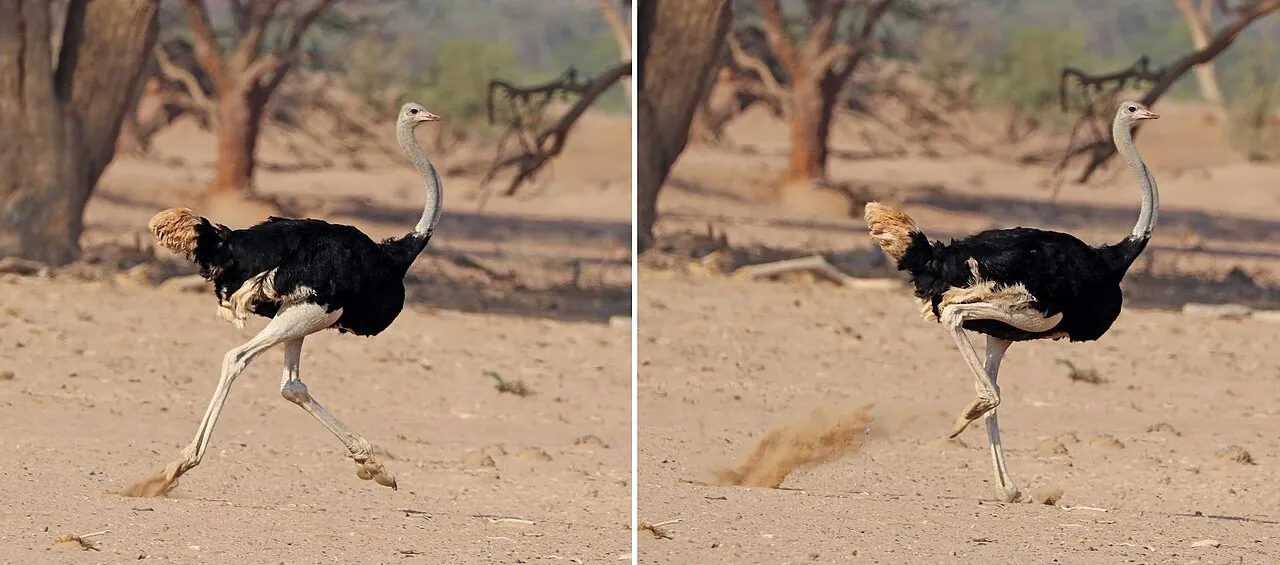
The scientific name Struthio camelus is a nod to the ancient Greek strouthokamelos, camel-sparrow. Struthio derives from strouthos, sparrow or bird, and camelus means camel: the long neck and legs, the swaying gait and the ability to cope with hot, dry country all reminded the Greeks of camels.
The Korean name tajo, written with characters meaning camel and bird, reflects exactly the same idea, as do the Chinese and Japanese names. Two separate traditions looked at this bird and both thought of a camel.
The English word ostrich comes from the Latin avis struthio via Old French.
2.1. Subspecies and the Somali ostrich
The commonly recognised subspecies are:
| Subspecies | Range | Notes |
|---|---|---|
| North African ostrich S. c. camelus | Sahel, West Africa to Sudan | Largest; males have red necks and a bald-looking crown |
| Masai ostrich S. c. massaicus | Kenya, Tanzania | Breeding males flush pink on neck and legs |
| Southern ostrich S. c. australis | Zambia southwards | Males have greyish necks |
| Arabian ostrich S. c. syriacus | Arabia, Syria | Extinct around the 1960s |
The Arabian ostrich was hunted out in the mid-twentieth century as firearms and vehicles spread. Saudi Arabia and neighbouring countries have since reintroduced North African ostriches, considered its closest living relatives.
The Somali ostrich, Struthio molybdophanes, of Ethiopia, Somalia and northern Kenya, has blue-grey skin on the male's neck and legs. Genetic and ecological differences led to its recognition as a separate species around 2014, and the IUCN lists it as Vulnerable.
3. Evolution
Ostriches belong to the palaeognaths, an ancient group named for their primitive palate structure. It includes the rheas of South America, the emus and cassowaries of Australasia, the kiwis of New Zealand and the tinamous of South and Central America, which can fly. The extinct elephant birds of Madagascar and moas of New Zealand were palaeognaths too.
It was long assumed that these flightless birds were relics of the supercontinent Gondwana, stranded on separate landmasses as it broke apart. DNA studies upended this: the flying tinamous nest inside the group, and kiwis turn out to be closer to Madagascar's elephant birds than to emus. The leading interpretation now is that palaeognath ancestors could fly and that flightlessness evolved several times independently.
Genetic trees put ostriches at the base of the palaeognaths, the first lineage to branch off. Fossils of Struthio appear in Africa in rocks about 20 million years old, and the genus later spread widely across Eurasia. During the ice ages, ostriches lived in India, China and Mongolia; Struthio asiaticus is one such extinct species. Palaeolithic sites in China and Mongolia have produced beads made from drilled ostrich eggshell, evidence that people once shared the East Asian steppes with these birds.
4. Range and habitat
Markrosenrosen · CC BY-SA 4.0
Wild ostriches today live only in Africa, from the Sahel in the west through Kenya and Tanzania in the east to Namibia, Botswana and South Africa in the south. The range is fragmented rather than continuous, and the North African subspecies, which once spanned many countries, survives only in pockets.
They favour open country with long sightlines: savanna with scattered grass and trees, short-grass plains, sparse scrub, semi-desert and the margins of true deserts. They avoid dense woodland and tall grass, where predators are harder to spot and running is difficult.
Ostriches tolerate drought well. They get much of their water from plants and drink regularly when water is available, but can go for days without. In the heat of the day they hold their wings away from the body to expose the bare skin of their flanks and thighs to the breeze.
A small feral population descended from birds imported for the nineteenth-century feather trade persists in parts of South Australia.
5. Body
Males and females look very different. Males are glossy black with white plumes on the wings and tail; females and juveniles are greyish-brown, a camouflage that helps them on the nest. The neck and thighs are almost bare, with skin coloured red, pink or grey depending on subspecies.
| Measure | Male | Female |
|---|---|---|
| Height | about 2.1–2.75 m | about 1.75–1.9 m |
| Weight | about 100–145 kg | about 63–100 kg |
| Egg weight | about 1.3–1.5 kg | |
| Running speed | about 70 km/h in bursts, about 50 km/h sustained |
5.1. Legs and feet
Ostrich legs are built for speed. The muscle mass is concentrated high in the thigh, while the lower leg is mostly long, light bones and tendons, so the limb can swing quickly like a pendulum. At full sprint a single stride can cover three to five metres.
There are only two toes. The large inner toe carries a thick, hoof-like claw; the smaller outer toe helps with balance. Fewer toes means less contact with the ground, the same principle that gave horses a single hoof.
Those legs are also weapons. Ostriches kick forwards and downwards, and the big claw can disembowel a predator. Lions and hyenas treat adult ostriches with caution, and people have been seriously injured or killed.
5.2. Eyes, wings and feathers
Ostrich eyes are about five centimetres across, the largest of any land vertebrate and reportedly bigger than the bird's brain. Long lashes shield them from dust and glare, and from its lofty vantage point an ostrich can detect movement kilometres away.
The wings, useless for flight, have other jobs: balance during sharp turns at speed, courtship and threat displays, shading and cooling in the heat, and insulation on cold nights. Some ostriches retain small claws on the wing tips.
The feathers lack the tiny hooks that zip the barbs of flight feathers together, so they are loose, soft and billowy, exactly the quality that made them so valuable to milliners. Ostriches also lack a preen gland, so their plumage gets soaked in rain.
6. Behaviour and ecology
Ostriches are active by day, feeding mostly in the morning and late afternoon and resting through the midday heat. At night they sit on the ground with the neck stretched along the earth or folded over the body.
Social life shifts with the seasons. Outside the breeding season they form loose groups of about five to fifty, and in the dry season hundreds may gather at water and good grazing. When breeding begins, males establish territories and groups break up into breeding units.
Ostriches often mingle with zebras, wildebeest, antelope and giraffes. The birds' keen eyesight may complement the mammals' sharp noses and ears, giving everyone earlier warning of predators.
When threatened, an ostrich usually runs. Cornered, or defending eggs and chicks, it spreads its wings, hisses and kicks. To hide, it lies flat with its neck stretched along the ground, a posture that from a distance can look as if the head has vanished into the sand, the origin of the famous myth.
7. Diet and feeding
Ostriches are omnivores with a mainly plant-based diet: grasses, leaves, seeds, roots, flowers and fruit, supplemented by locusts and other insects, lizards and the occasional small rodent.
Having no teeth, they swallow stones and grit that collect in the muscular gizzard and grind tough plant matter. An adult's gizzard can hold more than a kilogram of stones. This habit leads captive ostriches to swallow coins, nails and keys, sometimes with fatal results.
They peck food and collect it in the upper neck until there is enough to form a bolus, which can be seen sliding down the long neck as it is swallowed. An exceptionally long gut extracts every bit of nutrition from fibrous plants.
8. Reproduction and life cycle
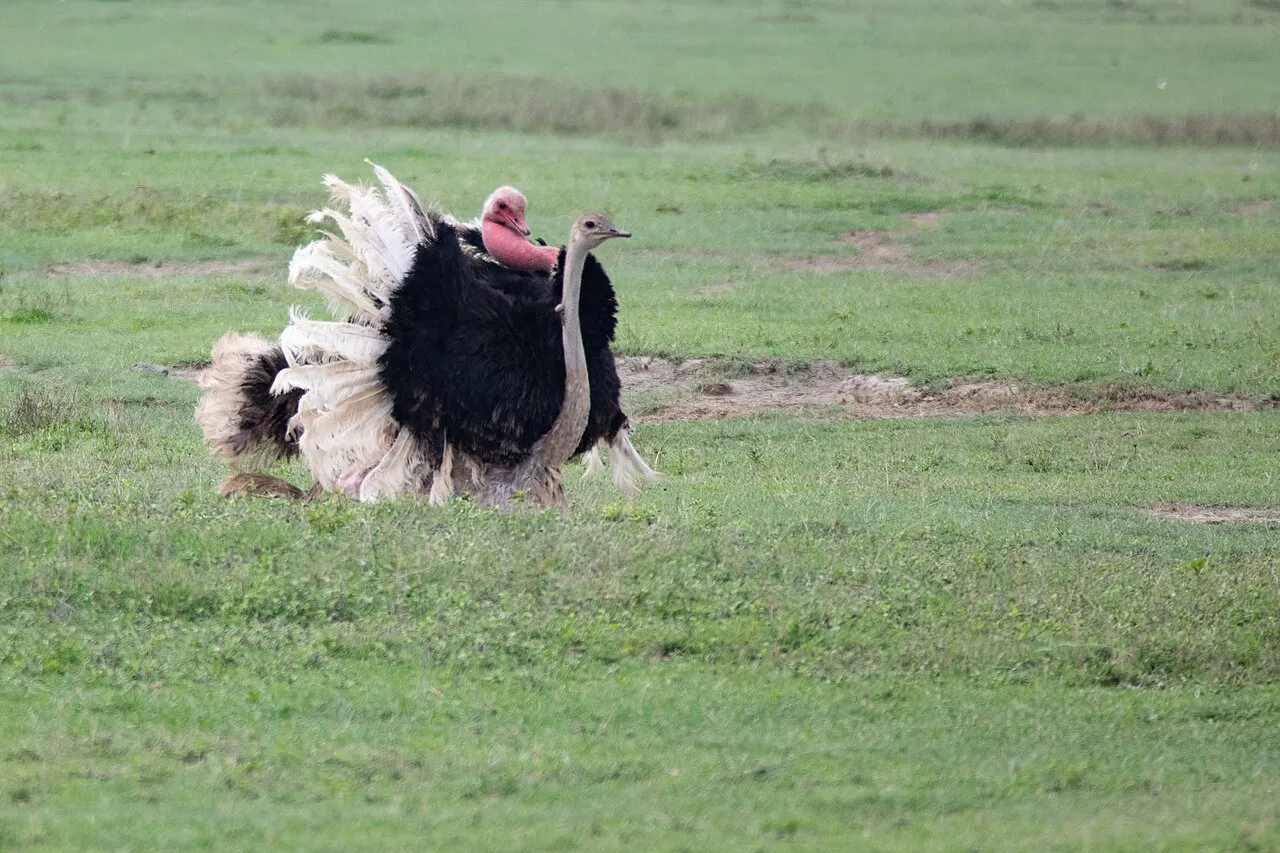
In the breeding season, the bare skin on a male's bill, neck and shins flushes red or pink. He claims a territory and booms a deep, lion-like call to warn off rivals. To court a female he sinks to the ground, alternately sweeping his wings in great flourishes while twisting his neck from side to side.
The ostrich mating system is unusual. The male scrapes a shallow nest one to three metres across, and his dominant, or major, hen lays first. Other minor hens then lay in the same nest and leave, so a nest can accumulate twenty or more eggs. When there are too many to cover, the major hen recognises her own eggs, keeps them in the centre and rolls the extras to the edge, where they act as a buffer against predators.
Both parents incubate. The dull-coloured female usually sits by day and the black male at night, when each is least conspicuous. Incubation takes about 42 to 46 days.
| Stage | Timing | Notes |
|---|---|---|
| Egg | about 42–46 days | Communal nest, shared incubation |
| Hatchling | At hatching | About 1 kg, spiky striped down |
| Chick | 1–4 months | Grows about 1 cm a day, follows parents |
| Juvenile | 4 months–2 years | Grey-brown plumage, lives in groups |
| Maturity | Females about 2–3 years, males about 3–4 | Begins breeding |
Chicks can walk almost immediately and leave the nest within days. When families meet, chicks may merge into creches, with one pair escorting dozens, sometimes over a hundred, young. Even so, lions, hyenas, jackals and raptors take a heavy toll, and few chicks survive their first year.
Wild ostriches live around 30 to 40 years; captive birds can live longer.
9. Intelligence, communication, special abilities
Ostriches are often mocked as bird-brained, and it is true their brain is smaller than one of their eyes. Yet they manage everything their lives demand: recognising their own eggs among dozens, spotting distant predators and maintaining social hierarchies.
They communicate by sound and posture. The male's booming call, produced by inflating his neck, carries far and is easily mistaken for a lion's roar. Other sounds include hisses, bill-clapping and the whistling peeps of chicks. Wing and tail position and neck angle signal mood and rank.
Their great gift is running. The top speed of around 70 km/h is impressive, but the endurance is even more so: they can hold about 50 km/h for long stretches. Researchers have shown that the tendons in an ostrich's legs store and return energy like springs, making running remarkably efficient, and the design has inspired work on bipedal robots and prosthetic limbs.
10. Predators and survival
Adult ostriches can be taken by lions, leopards, cheetahs, spotted hyenas and African wild dogs, usually by surprising a resting bird, since a head-on fight risks a devastating kick.
Eggs and chicks face many more enemies. Jackals, hyenas, mongooses and raptors take chicks, and Egyptian vultures famously crack eggs by picking up stones in their beaks and hurling them down, one of the best-known examples of tool use in birds.
Parents may perform distraction displays, staggering away with drooping wings as if injured to lure predators from the nest.
11. Relationship with humans
People and ostriches go back a very long way. In South Africa, engraved ostrich eggshell water flasks with geometric patterns have been dated to around 60,000 years ago. Eggshell beads have been made for tens of thousands of years and remain a traditional craft among the San and other peoples of southern Africa.
In ancient Egypt the ostrich feather symbolised Maat, goddess of truth and justice. In the afterlife, the heart of the deceased was weighed against her feather; a heart heavier than the feather condemned its owner. Ostriches were prized game and spectacle in Mesopotamia and Rome as well.
In the eighteenth and nineteenth centuries, ostrich plumes became the height of fashion in Europe. Uncontrolled hunting devastated wild populations, and from the mid-1800s ostrich farming took off in South Africa, where feathers at times fetched prices compared to gold by weight. The boom collapsed in the early twentieth century with changing fashions, the rise of the open-topped motor car and the First World War.
Today ostriches are farmed in many countries for meat, leather and eggs. The meat is a lean red meat, and the leather, with its distinctive bumps where feathers were plucked, is used for luxury goods.
Korea had its own ostrich-farming fad in the late 1990s. It was promoted as a promising new income source, but the market never took off, and most farms closed; a few survive as tourist or petting farms. However long they have been farmed, ostriches remain powerful, easily startled animals. They are not pets, and visitors to farms should follow staff instructions closely.
12. Conservation
The IUCN lists the common ostrich as Least Concern, because populations in eastern and southern Africa remain relatively secure in national parks, reserves and extensive ranchland. The global wild population is not precisely known, and estimates vary widely; the overall trend is considered to be declining.
The regional picture is uneven. The North African subspecies of the Sahel has collapsed under hunting, overgrazing, civil conflict and the spread of firearms, and has disappeared from many countries. Projects in Niger, Chad and elsewhere protect remnant birds and release captive-bred ones.
Main threats:
- Hunting for meat and feathers, and egg collecting
- Conversion of habitat to farmland and overgrazing
- Fences and roads blocking movements
- Hybridisation with farmed birds, eroding the genetic distinctiveness of wild populations
- Desertification and drought
International trade is regulated, and certain populations of the North African subspecies are listed on CITES Appendix I. Korea has no domestic protection category for the species.
13. In zoos
Ostriches are a zoo staple, often kept in mixed African savanna exhibits alongside giraffes, zebras and antelope. Mixed exhibits look natural, but they need ample space, because a startled ostrich can bolt into fences or other animals.
Common problems in captivity include swallowing foreign objects, leg injuries on slippery ground and frostbite in cold winters. Keeping visitors from throwing items into enclosures is important, and heated indoor housing is essential in climates like Korea's.
Attractions offering ostrich rides or races, still found in some tourist destinations, are widely criticised for causing stress and injuries to the birds and risking the safety of riders.
14. In culture
The most famous ostrich idiom is burying one's head in the sand, meaning to ignore a problem in the hope it will go away. Psychologists and economists even speak of the ostrich effect, for example investors avoiding their portfolios when markets fall. Real ostriches do nothing of the sort, but the myth has lasted almost two thousand years, at least since the Roman naturalist Pliny the Elder wrote about it.
Ostriches also carried religious meaning, from Maat's feather in Egypt to the ostrich eggs still hung from the ceilings of some Eastern Orthodox and Coptic churches.
In animation, the ballet-dancing ostriches of Disney's Fantasia (1940) are iconic, and the bird is a favourite of cartoons and adverts as a fast, comically awkward character. South African coins and stamps have featured ostriches as well.
15. Trivia
- Hard-boiling an ostrich egg takes well over an hour, and a single egg makes an omelette big enough for a family.
- The shell is about 2 mm thick. In the Kalahari, people filled empty shells with water and buried them in the sand for the dry season.
- Ostriches are almost unique among birds in passing urine and faeces separately.
- Researchers have studied ostrich gizzard stones to understand gastroliths found with dinosaur fossils.
- The quip that an ostrich's eye is bigger than its brain is true, but it is a very effective survivor all the same.
- During Korea's 1990s ostrich craze, eggshell crafts and ostrich-meat dishes were briefly marketed as local specialities.
Wild animals are not pets. Catching, trading or keeping them is illegal in most places. If you find an injured wild animal, call your local wildlife rescue centre.
FAQ
Do ostriches really bury their heads in the sand?
No. From a distance, a bird turning its eggs in a ground nest, or lying flat with its neck along the ground to hide, can look headless. Faced with real danger, an ostrich runs or kicks.
Are farmed ostriches the same as wild ones?
Same species, but most farm birds are mixed stock bred for meat, leather and feathers. Wild ostriches roam huge areas in groups and are powerful, easily stressed animals, never suitable as pets.
How strong is an ostrich egg?
The shell is about 2 mm thick and can bear an adult's weight. Egyptian vultures crack them by throwing stones, and people in southern Africa have used empty shells as water flasks for tens of thousands of years.
Photo credits
Photos are freely licensed images from Wikimedia Commons. Authors and licenses are listed below.
- Struthio camelus - Etosha 2014 (3).jpg — Yathin S Krishnappa · CC BY-SA 4.0
- Common ostrich (Struthio camelus australis) male running composite.jpg — Charles J. Sharp · CC BY-SA 4.0
- Common ostrich mating in ngorongoro.jpg — Markrosenrosen · CC BY-SA 4.0