TailVille
1. Overview
Picture an Antarctic winter: months of darkness, air temperatures below minus 40 degrees Celsius and blizzards with winds over 100 kilometres per hour. Of all the animals on Earth, only one chooses this season, in this place, to raise its young. That animal is the emperor penguin.
The largest of the eighteen living penguin species, an adult emperor stands over a metre tall and can weigh more than 40 kilograms before the breeding season. It has a black back, a white belly, and soft yellow ear patches that blend into a golden glow on the upper chest, a regal look that earned it its name.
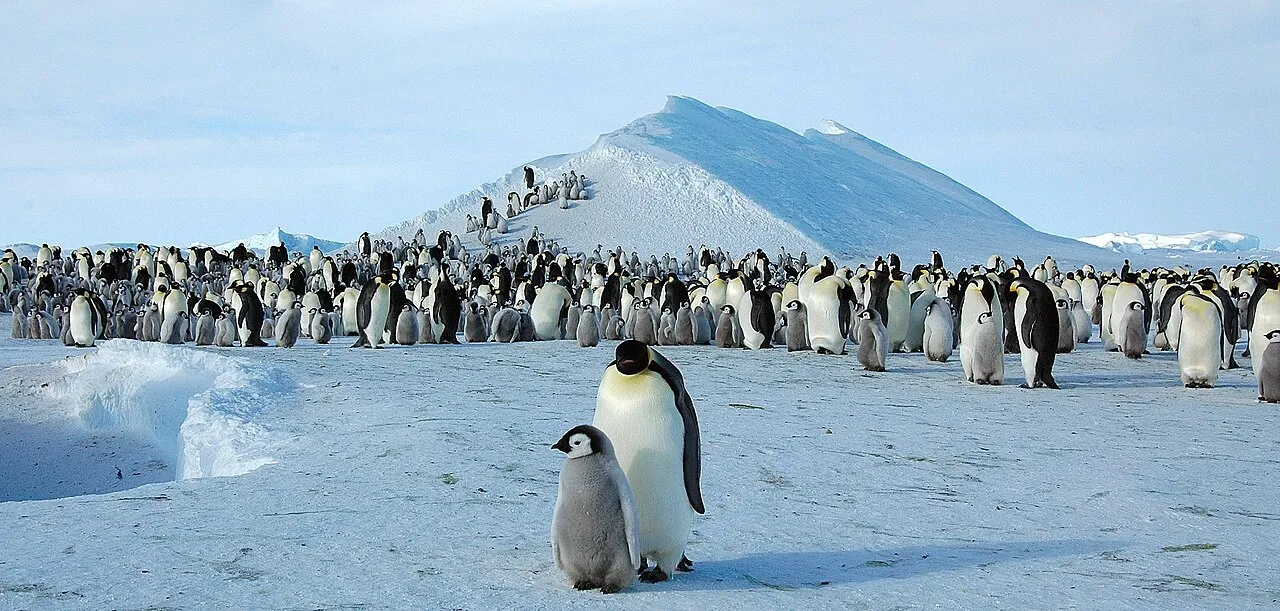
Emperors breed almost exclusively on fast ice, the sea ice locked to the Antarctic coast. They build no nest. After the female lays a single egg, the male balances it on his feet under a fold of belly skin and incubates it through the darkest two months of the year, eating nothing and huddling with thousands of other males against the cold.
This extraordinary life story, made famous by documentaries and animated films, has turned the emperor penguin into the face of Antarctica. It has also made it one of the clearest examples of a species threatened by climate change: as sea ice shrinks, so do the emperor's breeding platforms. The IUCN currently lists it as Near Threatened.
2. Name and classification
Denis Luyten · Public domain
The scientific name is Aptenodytes forsteri. Aptenodytes is Greek for wingless diver: penguins do have wings, of course, but they are stiff flippers used for swimming rather than flying. The species name honours Johann Reinhold Forster, the German naturalist who sailed on Captain James Cook's second voyage. The emperor was formally described by the British zoologist George Robert Gray in 1844.
Its closest relative, the king penguin, was named first. When an even larger species turned up, it was only fitting to promote it to emperor, or so the popular story goes.
The origin of the word penguin itself is uncertain. It was first applied to the great auk, a flightless seabird of the North Atlantic that was hunted to extinction in the 1840s. European sailors who later met similar black-and-white birds in the Southern Hemisphere reused the name. Suggested roots include Welsh words for white head and the Latin pinguis, fat.
No subspecies are recognised. Genetic studies suggest emperor colonies around Antarctica exchange individuals fairly often, though the Ross Sea birds appear somewhat distinct.
3. Evolution
Penguins go back almost to the end of the dinosaurs. Waimanu, a fossil penguin from New Zealand, lived around 60 million years ago and was already a flightless diver. Penguins' closest living relatives are the tubenoses, the albatrosses, petrels and shearwaters, so their ancestors were probably flying seabirds that gave up the air as they specialised for diving.
Some extinct penguins dwarfed today's species. Fossils from Antarctica, New Zealand and South America dated to roughly 30 to 40 million years ago belong to birds estimated at 1.5 to 2 metres tall. The emperor is the biggest living penguin, not the biggest ever.
The great penguins, genus Aptenodytes, split from other penguins relatively early. Emperors and kings themselves diverged a few million years ago, and an extinct relative, Aptenodytes ridgeni, is known from Pliocene rocks in New Zealand.
As Antarctica became ice-bound from about 34 million years ago, many penguin lineages vanished or retreated northwards. The emperor took the opposite path, adapting to the deep cold. Genetic studies suggest that during the last ice age, emperor populations were much smaller and had fewer colonies, expanding again as the ice retreated.
4. Range and habitat
Credit: NOAA NMFS SWFSC Antarctic Marine Living Resources (AMLR) Program. · Public domain
Emperor penguins live all the way around the coast of Antarctica, roughly between 66 and 78 degrees south. They are true Antarctic birds; stray individuals occasionally turn up in New Zealand, southern South America or the Falklands. In 2011 a young emperor came ashore on a beach near Wellington, New Zealand, and became a national celebrity.
Most colonies sit on fast ice, sea ice anchored to the coast, to grounded icebergs or to islands, which stays put through winter. Crucially, it must last until the chicks have grown waterproof feathers in early summer; if it breaks up too soon, chicks drown. A few colonies use ice shelves, the floating extensions of continental glaciers, and a handful are on land.
Satellites have transformed our knowledge of where emperors breed. A 2009 analysis of satellite images identified 46 colonies, and later surveys pushed the total past 60. The trick is that penguin guano stains the ice reddish-brown, visible even from space.
Outside the breeding season, emperors roam the Southern Ocean. Tracking studies show that juveniles leaving their colonies travel thousands of kilometres, some reaching waters far north of the continent.
5. Body
Emperors are the heaviest penguins, and their weight swings dramatically through the year: the difference between a bird fattened for breeding and the same bird after months of fasting can exceed ten kilograms.
| Measure | Value |
|---|---|
| Standing height | about 100–130 cm |
| Weight before breeding | males about 35–45 kg, females about 28–35 kg |
| Weight after the long fast | can drop to about 20–25 kg |
| Flipper length | about 30–40 cm |
| Swimming speed | usually 6–9 km/h, faster in bursts |
| Dive depth | typically tens of metres to 200 m; record over 500 m |
Males and females look almost identical. Males average slightly larger, but voice or DNA is needed to sex them reliably.
5.1. Built for cold
Almost everything about an emperor's body is a defence against cold.
- Feathers: short, stiff feathers overlap like roof tiles, packed far more densely than on most birds, with a layer of down beneath that traps air. During the annual moult the bird cannot enter the sea for three to four weeks and must fast until the new coat grows in.
- Fat: a thick blubber layer insulates and fuels the long fasts.
- Small extremities: the bill, flippers and feet are small for the body size, reducing heat loss, in line with the rule that cold-climate animals tend to be bulky with short appendages.
- Countercurrent heat exchange: arteries running to the flippers and feet lie against returning veins, so outgoing warm blood heats the cold blood coming back. The feet stay cold while the core keeps its heat.
- Nasal heat recovery: intricate nasal passages reclaim heat and moisture from each exhaled breath.
A 2012 thermal-imaging study even found that the outer surface of an emperor's plumage can be colder than the surrounding air, a sign of how little heat escapes.
5.2. Built for diving
Emperors dive deeper and longer than any other bird. Most foraging dives reach tens of metres to about 200 metres and last a few minutes, but birds have been recorded below 500 metres and holding their breath for well over 20 minutes, with the longest dives reported at around half an hour.
Several adaptations make this possible. Unlike most birds, their bones are solid rather than hollow, resisting pressure and reducing buoyancy. Blood and muscle are rich in oxygen-binding haemoglobin and myoglobin. During a dive the heart rate slows dramatically and blood is diverted to the brain and heart, while muscles tolerate low oxygen for extended periods.
6. Behaviour and ecology
Dargaud · CC BY-SA 4.0
The emperor's year follows the rhythm of the sea ice. In March and April, the southern autumn, adults fattened at sea gather at their colonies. A colony may lie tens of kilometres, sometimes more than a hundred, from open water, so the birds alternate between waddling and tobogganing on their bellies.
Unlike most penguins, emperors are not territorial. Without nests there is nothing to defend, and survival depends on staying close together.
Their signature behaviour is the huddle. When temperatures plunge and the wind rises, hundreds or thousands of birds press together into a dense mass. Inside, temperatures can exceed 20 degrees Celsius, tens of degrees warmer than outside. Because the core becomes too hot and the edge too cold, the huddle is constantly in motion. Research using time-lapse cameras has shown that tiny synchronised steps every few tens of seconds ripple through the group like waves, gradually cycling birds between edge and centre without any leader.
After breeding, the birds disperse to feed through the summer, then haul out on the ice for several weeks of fasting while they moult.
7. Diet and feeding
Emperors eat fish, krill and squid. The balance varies by region and season, but across much of Antarctica the most important prey is the Antarctic silverfish, a small schooling fish. Antarctic krill and small squid are also major items.
They hunt by sight. Their eyes are adapted to the dim light of deep water, and they often attack from below, picking out prey silhouetted against the light filtering down from the surface. Backward-pointing spines on the tongue and palate grip slippery fish.
Parents store food in the stomach and regurgitate it, partly digested, for their chicks. Salt glands above the eyes extract excess salt from seawater and food and expel it through the nostrils.
A foraging trip can last from a few days to several weeks, with dozens or even more than a hundred dives a day.
8. Reproduction and life cycle
Emperor penguin breeding is one of the great endurance stories of the animal world.
8.1. Courtship and laying
Arriving males call with a trumpeting display, bowing their heads and inflating their chests. Emperors are monogamous within a season, but fewer pairs reunite in later years than in nest-holding penguins, probably because there is no fixed meeting point.
In May or June the female lays a single egg weighing about 450 to 500 grams and almost immediately passes it to the male. The transfer is delicate: the pair stand toe to toe and roll the egg across. A few seconds on bare ice can freeze it, and inexperienced couples often fail. The female then walks back to the sea to feed.
8.2. The fathers' winter
The male balances the egg on his feet and covers it with the brood pouch, a featherless fold of belly skin. Incubation lasts about 64 to 67 days, spanning the coldest, darkest part of the year. Males huddle and move as little as possible to save energy.
Counting from arrival at the colony, a male may go about 115 days without food and lose some 40 percent of his body weight. If the chick hatches before the female returns, he can feed it a protein- and fat-rich secretion from his oesophagus, sometimes called penguin milk, to keep it alive for a few days.
8.3. Raising the chick
Around hatching time the female returns, plump from feeding. Amid thousands of birds, the pair find each other by voice alone. She takes over the chick, tucking it onto her own feet and regurgitating food, and the starving male finally heads for the sea, often tens of kilometres away. From then on the parents take turns foraging and feeding.
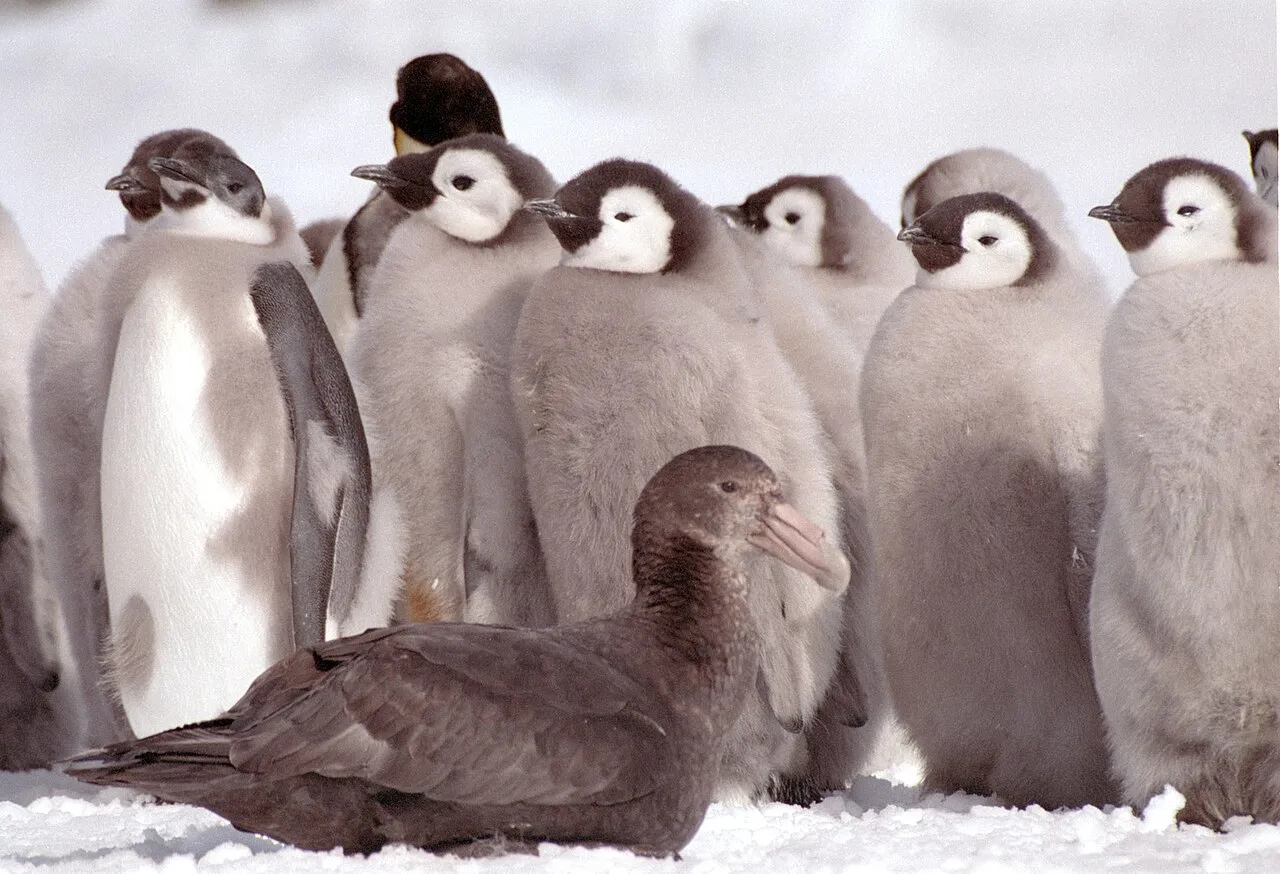
At about seven weeks the chick leaves its parent's feet and joins a creche, a huddle of chicks that keeps warm while both parents are away. Returning adults call, and their own chick answers.
| Stage | Approximate timing | Notes |
|---|---|---|
| Egg | Laid May–June, about 64–67 days | Incubated by the male |
| Hatching | July–August | Grey down, black-and-white face |
| On the feet | About 7 weeks | Parents alternate brooding and feeding |
| Creche | September–November | Chicks huddle together |
| Fledging | December–January | Waterproof plumage, departure to sea |
| Immature | 1–4 years | Wanders the ocean |
| First breeding | Usually 3–6 years | Returns to a colony |
Chicks fledge about five months after hatching, in midsummer, when the sea ice is breaking up and food is most abundant. First-year survival is low, and many young birds do not live through their first winter.
Wild emperors typically live 15 to 20 years, with some living considerably longer.
9. Intelligence, communication, special abilities
In a colony of thousands, emperors find mates and chicks purely by voice. Their call is unusual: using both sides of the syrinx, the bird's vocal organ, independently, they produce two frequencies at once. The interference between them creates a beat pattern unique to each individual, allowing recognition even in a deafening crowd. Penguins with fixed nests, which can rely partly on location, have simpler calls.
Females that lose a chick sometimes try to adopt or steal another. Several bereaved females may fight over one chick, injuring it, and the kidnapped chick is often abandoned soon after, an example of powerful parental drive misfiring.
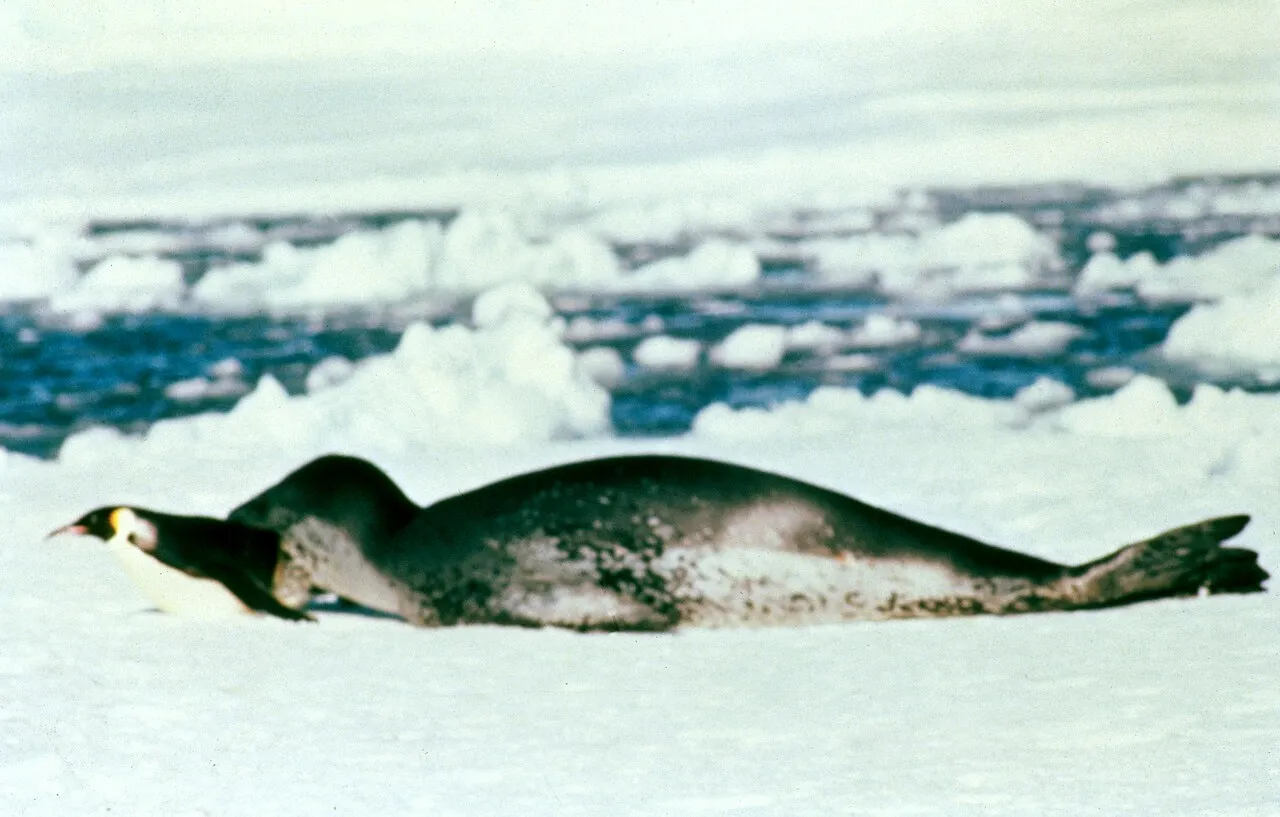
Underwater, emperors can release air trapped in their plumage as a cloak of microbubbles when rocketing towards the surface. This lubricates the body, cutting drag and allowing bursts of two to three times normal speed, enough to leap onto the ice out of reach of a pursuing seal.
10. Predators and survival
At sea, the emperor's main predators are leopard seals and orcas. Leopard seals lurk at the ice edge to ambush penguins entering the water, while orcas hunt them farther out. That is why groups of emperors often hesitate at the edge until one bird jumps, and the rest follow in a rush.
On the ice, adults have few enemies, but eggs and chicks are targeted by southern giant petrels and skuas, which pick off weak chicks at the edge of a creche.
The greatest killers of chicks, however, are weather and ice. Blizzards and extreme cold kill many, and premature sea-ice breakup can wipe out an entire year's breeding. After 2016, the large colony at Halley Bay in the Weddell Sea failed almost completely for several years as the ice broke up early, and many adults appear to have moved to a nearby colony. In 2022, satellite studies concluded that several colonies in the Bellingshausen Sea probably lost nearly all their chicks when the ice melted before they had fledged.
11. Relationship with humans
Living so far from people, emperors were barely touched by humans for most of history. Sealers and explorers encountered them in the eighteenth and nineteenth centuries, and the heroic age of Antarctic exploration brought the first serious observations.
One episode became legendary. In the winter of 1911, three men from Robert Falcon Scott's expedition hauled sledges for weeks through the polar night to the emperor colony at Cape Crozier to collect eggs. Scientists hoped penguin embryos would illuminate the evolutionary link between birds and reptiles. Temperatures fell to around minus 50 to 60 degrees, and the men barely survived. One of them, Apsley Cherry-Garrard, recounted the ordeal in The Worst Journey in the World, one of the classics of travel writing. The eggs that made it back ultimately yielded little scientific insight.
Unlike some sub-Antarctic penguins, emperors were never commercially harvested on a large scale for oil or meat; their colonies were simply too remote.
Korea has a connection too. It operates King Sejong Station on King George Island, opened in 1988, and Jang Bogo Station at Terra Nova Bay on the Ross Sea, opened in 2014. Emperor colonies lie near Jang Bogo, and researchers from the Korea Polar Research Institute study their numbers, movements and foraging using drones, satellites and tracking devices. In 2016 the Ross Sea became the world's largest marine protected area.
12. Conservation
In 2012 the IUCN moved the emperor penguin from Least Concern to Near Threatened. Numbers were still high, but the species was judged likely to decline significantly as the climate warms, and some scientists argue it should be uplisted further.
Population estimates come from satellite imagery. A 2009 study estimated around 238,000 breeding pairs; work published around 2020, after more colonies were found, put the figure at roughly 256,000 to 278,000 pairs. Including immature and non-breeding birds, the total population likely exceeds half a million. Recent analyses suggest declines in some regions.
The central threat is the changing sea ice:
- Early breakup drowns chicks that have not yet grown waterproof feathers.
- Too little ice leaves no stable platform for a colony.
- Too much ice lengthens the walk to open water, making it harder to feed chicks.
- Warming seas and ice loss affect prey such as krill and silverfish.
Modelling studies warn that under continued high emissions, the great majority of colonies could be quasi-extinct by 2100. Citing such projections, the United States listed the emperor penguin as threatened under its Endangered Species Act in 2022. Within the Antarctic Treaty system, there have been proposals to designate it a Specially Protected Species.
Other concerns include possible competition with the growing Antarctic krill fishery and disturbance from tourism and research. Korea has no domestic protection category for the species, but Korean activities in Antarctica are governed by the Act on Antarctic Activities and the Protection of the Antarctic Environment, which strictly regulates disturbing or capturing Antarctic wildlife.
13. In zoos and aquariums
Very few institutions worldwide keep emperor penguins. Plenty of zoos and aquariums display penguins, but most are temperate species from South America and Africa, or gentoos and kings. Emperors are large, need near-Antarctic temperatures, deep swimming space and seasonally shifting day length, and are notoriously difficult to maintain; captive breeding successes are few.
Facilities that keep them simulate polar light cycles, chill the air and water close to freezing, and filter the air carefully, because penguins from pristine Antarctica are vulnerable to fungal respiratory infections such as aspergillosis. Supporters point to research and education value; critics question whether a handful of birds from a species that lives in colonies of thousands can thrive in a small enclosure.
The trend today is away from collecting wild birds and towards caring for existing animals, research, and funding conservation in Antarctica itself. It goes without saying that an emperor penguin can never be a private pet.
14. In culture
The 2005 French documentary March of the Penguins, following emperors on their trek to the colony and the males' winter vigil, turned the species into a global star. It was a box-office phenomenon and won the Academy Award for Best Documentary Feature; a sequel followed in 2017.
The 2006 animated film Happy Feet told the story of Mumble, an emperor penguin who tap-dances instead of singing, and wove in themes of overfishing and environmental damage. It won the Academy Award for Best Animated Feature. BBC natural history series have repeatedly filmed emperor huddles and seal chases; in one, the crew dug a ramp in the snow so penguins trapped in an icy ravine could climb out, sparking debate about whether wildlife filmmakers should intervene.
Penguins are beloved in Korea. Pororo, the hero of the hugely popular preschool animation, is a penguin, and EBS's character Pengsoo, presented as a penguin from Antarctica, became a national sensation around 2019. Neither is officially identified as an emperor, but for many viewers the emperor is the archetypal Antarctic penguin.
Tux, the Linux mascot, is a penguin, and emperors appear in countless ice-cream and air-conditioner adverts, as well as on stamps and coins from the French Southern and Antarctic Lands, the British Antarctic Territory and other polar authorities.
15. Trivia
- Guano stains from emperor colonies are visible in satellite images, and several previously unknown colonies were first discovered from space.
- A fasting male can lose more than ten kilograms, the equivalent of a person standing outdoors for months without eating.
- Huddle studies show that a tiny step by one bird can ripple through the whole group like a wave, and researchers have compared the dynamics with traffic jams.
- Emperors eat snow to get water; for fasting males it is virtually the only water available.
- Fledglings entering the sea for the first time swim and dive instinctively without ever having been taught, starting with short, shallow practice dives.
- From the air, creches of grey chicks show up as clusters of grey dots on the ice, and drones and aerial photographs are now used to count them.
- The king penguin, the emperor's closest relative, has an even longer breeding cycle of 14 to 16 months, so a pair can raise at most two chicks every three years.
Wild animals are not pets. Catching, trading or keeping them is illegal in most places. If you find an injured wild animal, call your local wildlife rescue centre.
FAQ
How do I tell an emperor penguin from a king penguin?
Emperors are bigger and stockier, with pale yellow ear patches that fade into the chest. Kings are slimmer with vivid orange, comma-shaped patches. Emperor chicks are grey with a white face; king chicks are woolly brown all over.
Why breed in the coldest season?
Raising a chick takes so long that eggs must be laid in early winter, so the young are ready to go to sea in midsummer, when food is plentiful and the ice is breaking up.
Are emperor penguins endangered?
It is listed as Near Threatened. Numbers are still in the hundreds of thousands, but models suggest steep declines this century as sea ice shrinks; the US listed it as threatened in 2022.
Photo credits
Photos are freely licensed images from Wikimedia Commons. Authors and licenses are listed below.
- Aptenodytes forsteri -Snow Hill Island, Antarctica -adults and juvenile-8.jpg — Ian Duffy from UK · CC BY 2.0
- 2007 Snow-Hill-Island Luyten-De-Hauwere-Emperor-Penguin-03.jpg — Denis Luyten · Public domain
- Fish8426 - Flickr - NOAA Photo Library.jpg — Credit: NOAA NMFS SWFSC Antarctic Marine Living Resources (AMLR) Program. · Public domain
- Giant petrel and emperor penguin chicks.jpg — Dargaud · CC BY-SA 4.0