TailVille
At a glance
Rough ranges for supplies, food and electricity in Korea (USD is approximate). Purchase or adoption fees are not included.
First-time reptile keepers with limited space who enjoy evening observation and the occasional gentle handling session.
Anyone who can't face keeping live insects at home, or who wants a pet that is lively during daytime hours.
1. Overview
The leopard gecko is a ground-dwelling lizard from the dry interior of South Asia. Its yellow body speckled with dark spots earned it a big-cat name, but an adult is a modest animal: about 20 to 25 cm from nose to tail tip and 45 to 80 grams in weight, small enough to sit comfortably in an open palm.
Among pet reptiles it is probably the species most often recommended to beginners. It is calm, makes no noise, sheds no fur, and tends to pick one corner of its enclosure as a toilet, which keeps cleaning simple. That reputation can be misleading, though. A leopard gecko cannot produce its own body heat, so it depends on a carefully controlled warm floor and a cooler retreat every single day of the year, and its diet consists of live insects that you will have to buy, store and handle.
Unlike most geckos, it has movable eyelids and can blink, and it lacks the adhesive toe pads that let other geckos run up glass. Its thick tail works as a fat reserve, and a plump tail is one of the easiest ways to judge whether the animal is in good shape. With a typical captive lifespan of 15 to 20 years, adopting one is a commitment closer to that of a dog than of a hamster.
2. Name and classification
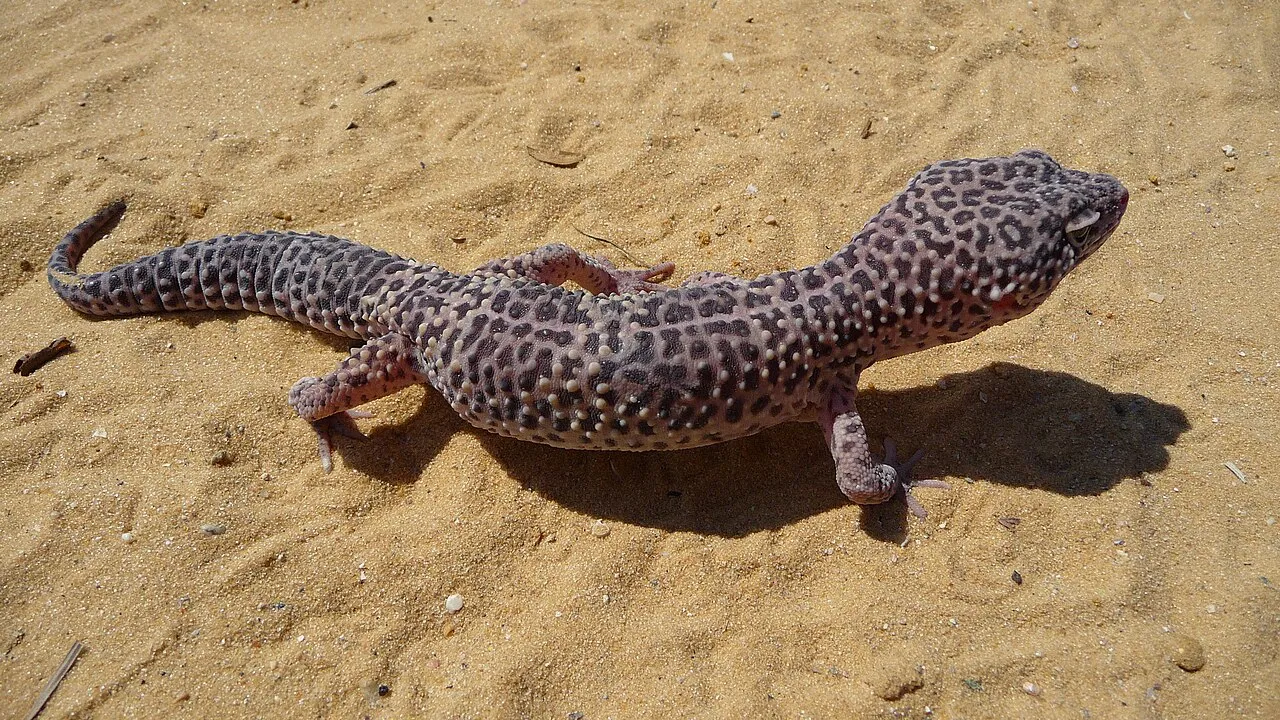
George Chernilevsky · Public domain
2.1. Scientific name and meaning
The scientific name is Eublepharis macularius. The genus name joins the Greek eu, meaning good or true, with blepharon, meaning eyelid, a nod to the feature that separates this group from most other geckos. The species name comes from Latin for spotted, so the whole name roughly reads as the spotted lizard with proper eyelids. The British zoologist Edward Blyth described the species in 1854.
In English-speaking hobby circles the animal is often shortened to leo. Korean keepers use a direct transliteration of the English name, and casually shorten it in their own way.
2.2. Where it sits in the family tree
Leopard geckos belong to the squamates, the order that holds lizards and snakes, and within it to the family Eublepharidae, the eyelid geckos. This family split from the larger gecko family Gekkonidae a very long time ago. Its members share movable eyelids, the absence of sticky toe pads and a mostly terrestrial lifestyle.
| Rank | Group |
|---|---|
| Class | Reptilia |
| Order | Squamata |
| Family | Eublepharidae |
| Genus | Eublepharis |
| Species | E. macularius |
2.3. Close relatives
The genus also contains the western leopard gecko of Iran and Iraq (E. angramainyu), the East Indian leopard gecko (E. hardwickii) and the Turkmen species (E. turcmenicus), among others. A few of these turn up in the pet trade in small numbers, but nearly every animal you will see for sale is E. macularius. A more familiar cousin in the same family is the African fat-tailed gecko, Hemitheconyx caudicinctus, which looks and lives much like a leopard gecko and is a common second species for keepers.
Animals sold as giants or super giants are not a separate species; they are leopard gecko lines selected for large body size. There are also persistent reports of hybrids with related species in some older bloodlines, which is one reason serious breeders care about documented lineage.
3. History
In the wild, leopard geckos live across rocky grassland and semi-desert in Pakistan, eastern Afghanistan, northwestern India and eastern Iran. Summer days there are scorching at ground level and winter nights can drop below freezing, so the species copes by spending daylight hours under rocks or in burrows dug by rodents and coming out to hunt after dusk.
Until the middle of the twentieth century only small numbers of wild-caught animals reached Europe and North America. Things changed in the 1970s, when American hobbyists began breeding them reliably. Through the 1980s and 1990s breeders isolated one new color or pattern after another, and those genetic variants, called morphs, turned the species into a hobby of its own. Export limits in the countries of origin combined with captive breeding success mean that almost every pet leopard gecko today was hatched in captivity. It is often cited as an example of a reptile that became popular without draining wild populations.
The species gained a following in Korea from the 2000s onward, as specialist reptile shops and online communities appeared. From the mid-2010s, social media and video platforms made its smiling face and endless color variations widely known, and it quickly became the default starter reptile there as in many other countries. Reptile expos now tend to feature more leopard gecko tables than almost anything else, and many local breeders import foreign bloodlines to build their own lines.
4. Body
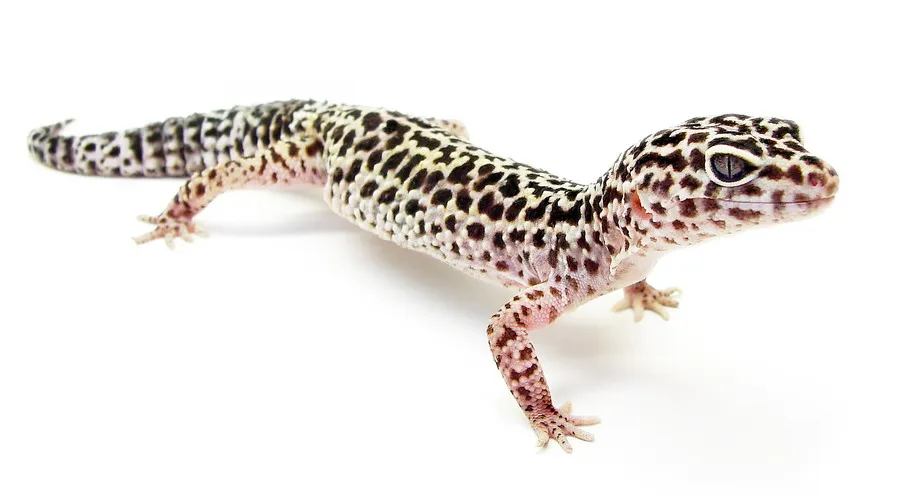
4.1. Size and build
A hatchling measures about 7 to 9 cm in total and weighs 2 to 4 grams. Growth is fast during the first year, and most reach adult size between 18 and 24 months. A typical adult is 20 to 25 cm and 45 to 80 grams, while some large-bodied lines exceed 100 grams. Males usually have broader heads and heavier builds than females.
The body sits low and long, carried on legs positioned underneath rather than sprawled out, so the gecko can amble slowly yet sprint short distances when startled. The tail makes up close to half the total length and swells as fat is stored. In a healthy adult, the widest part of the tail should be roughly as thick as the neck or slightly thicker; a tail much wider than the body suggests the animal is overweight.
4.2. Senses
The eyes are large with vertical pupils that open wide in the dark and close to thin slits in bright light. Although the species is active at night, it is thought to see color reasonably well. Being able to watch it close its eyes when it sleeps is one of the small charms that sets it apart from most geckos.
There is a visible ear opening on each side of the head, and you can sometimes see the eardrum inside. The gecko frequently flicks its tongue against surfaces and the air to collect scent particles, which are passed to the vomeronasal organ in the roof of the mouth. Tapping a new object or your hand with its tongue is simply how it investigates.
4.3. Skin and shedding
The skin is covered in tiny granular scales, with rows of raised tubercles running down the back. Hatchlings wear bold black and yellow bands that usually break up into spots as they mature.
Young geckos shed every one to two weeks, adults roughly every four to eight weeks. Before a shed the whole body turns pale and dull, and within a day or two the gecko pulls the old skin off with its mouth and usually eats it. Not finding shed skin therefore does not mean a shed did not happen. Eating the skin is thought to recycle nutrients and remove traces that could attract predators.
4.4. Tail loss and regrowth
When grabbed by a predator or held firmly by the tail, the gecko can drop its tail at built-in fracture points, a process called autotomy. The discarded piece keeps wriggling to hold the attacker's attention while the gecko escapes. A leopard gecko's tail does grow back, but the new one is shorter, rounder, smoother and plainer than the original. Because the fat reserve goes with it, offer a little extra food afterward and switch to paper towel substrate until the wound has sealed cleanly.
4.5. Telling males from females
Sexing becomes reliable at around three to six months or once the gecko passes 15 to 20 grams. Males have a V-shaped row of small pores just in front of the vent, called preanal pores, and two distinct bulges at the base of the tail where the hemipenes sit. Females show faint or no pores and a flat tail base. Young animals are easy to get wrong, so if breeding is on your mind, have an experienced breeder or vet confirm.
5. Morphs and colors
Few pet reptiles come in as many morphs as the leopard gecko. A morph is a heritable variation in color or pattern, and they fall broadly into recessive, co-dominant (incomplete dominant), dominant and line-bred types, the last being traits built up through many generations of selective breeding rather than a single gene. Animals combining several morphs carry long stacked names or a shorthand combination name.
| Morph | Inheritance | What it looks like |
|---|---|---|
| Normal (wild type) | - | Yellow ground with black spots |
| Hypomelanistic (hypo) | Line-bred | Few or no spots on the body |
| Tangerine | Line-bred | Strong orange coloration |
| Tremper albino | Recessive | Reduced melanin, brown pattern, pale eyes |
| Bell albino | Recessive | Darkest albino strain, light-sensitive |
| Rainwater albino | Recessive | Smaller, lighter albino strain |
| Mack snow | Co-dominant | White instead of yellow; the super form is black and white with solid dark eyes |
| Blizzard | Recessive | Plain, patternless body |
| Murphy patternless | Recessive | Pattern fades away with age |
| Eclipse | Recessive | Eyes partly or fully solid black or red |
| Enigma | Dominant | Scrambled spots; linked to a neurological disorder |
| Lemon frost | Co-dominant | Bright yellow; linked to skin tumors |
The three albino strains are caused by different genes, so crossing a Tremper with a Bell produces normal-looking babies rather than albinos. Always ask which strain an albino belongs to. Popular combinations include the RAPTOR, which brings together Tremper albino, eclipse and orange line-bred traits, and the super snow eclipse, built from two copies of mack snow plus eclipse.
Not every morph is purely cosmetic. Enigma geckos are associated with enigma syndrome, in which affected animals tilt their heads, circle and miss their prey. Lemon frost animals have shown a high rate of iridophore tumors in the skin. Albinos often squint under bright light. Rare combinations command high prices, but for a first gecko a normal, hypo or tangerine type with no known health problems is the sensible choice.
6. Behaviour
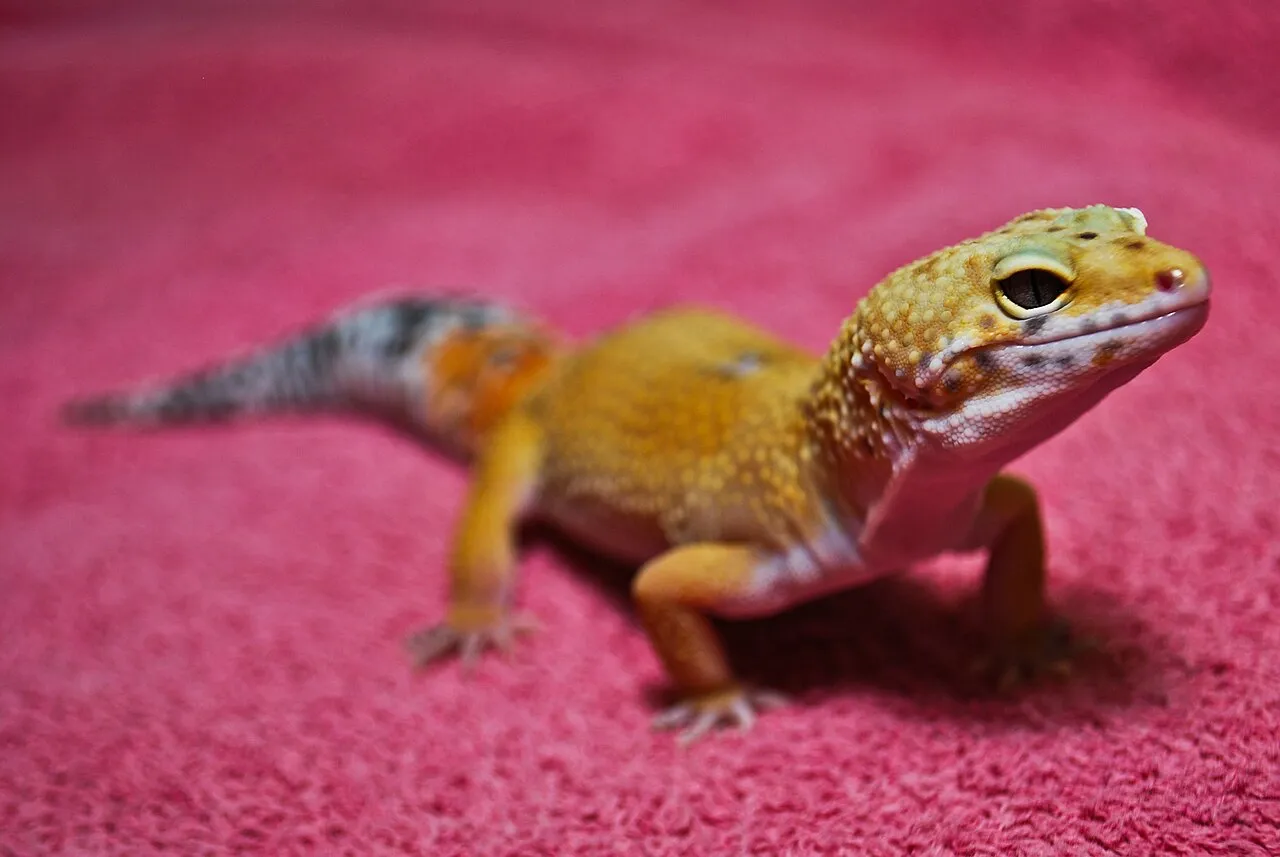
Animal Kingdom Pet Hospital · CC BY-SA 2.0
6.1. Life in the wild
Wild leopard geckos are most active around dusk and dawn. During the day they warm their bellies on rock surfaces heated from above, and after dark they forage for beetles, grasshoppers, spiders, scorpions and other arthropods. When winter temperatures fall, they cut back activity for weeks or months and live off the fat in their tails. They are largely solitary and seek each other out mainly during the breeding season.
6.2. At home
In an enclosure the gecko usually hides during the day and comes out to explore as the lights go off in the evening. A newly arrived animal may stay out of sight and refuse food for two or three weeks; leave it alone during that period and let it settle. Once adjusted, many come to the front of the tank when someone approaches, waiting for food, and tolerate being picked up and walking slowly across a hand.
They have a strong habit of using one corner as a toilet, so placing a square of paper towel there makes cleanup quick. They drink by lapping from a shallow dish, and around sheds they spend more time in the humid hide.
6.3. Reading the signals
A leopard gecko is silent most of the time, but its body language says a lot. Knowing these signs helps you spot stress or illness early.
- Slow side-to-side tail waving: alertness, stalking prey, or a male reacting to another gecko.
- Rapid rattling of the tail tip: excitement just before a strike, often seen at feeding time.
- Puffing up and arching the back: a strong warning; back off.
- Chirps or squeaks: an alarm call when grabbed or startled.
- Open mouth and a fixed stare: a defensive stance that can lead to a bite.
- Constant scratching at the glass or pacing: temperatures may be off or the enclosure may be too small.
- Lying out in the open during the day for long periods: possibly overheating or unwell.
7. Life stages
Leopard geckos grow quickly, multiplying their body weight many times over during the first year. Nutrition and calcium during that window shape bone health for life, so it is the period when feeding and supplements deserve the most attention.
| Stage | Age | Approx. weight | Notes |
|---|---|---|---|
| Hatchling | 0-3 months | 2-15 g | Bold bands, starts eating after the first shed, fed daily |
| Juvenile | 3-12 months | 15-45 g | Rapid growth, bands break into spots, sex becomes visible |
| Subadult | 12-18 months | 40-60 g | Growth slows, feeding intervals lengthen |
| Adult | 18 months-10 years | 45-80 g | Stable weight, can breed, fed two or three times a week |
| Senior | 10 years and up | Varies widely | Less active, smaller appetite, longer gaps between sheds |
A typical captive lifespan is 15 to 20 years, and well-kept animals have been recorded living longer. Signs of aging include a gradually smaller appetite, a tail that slowly thins, and less accurate strikes at prey. Cloudy eyes and stuck shed become more common too. For older geckos, offer smaller, softer insects and consider a checkup at an exotic animal clinic about every six months. It is hard to tell age from illness at home, so any sudden change is worth a vet visit.
8. Housing
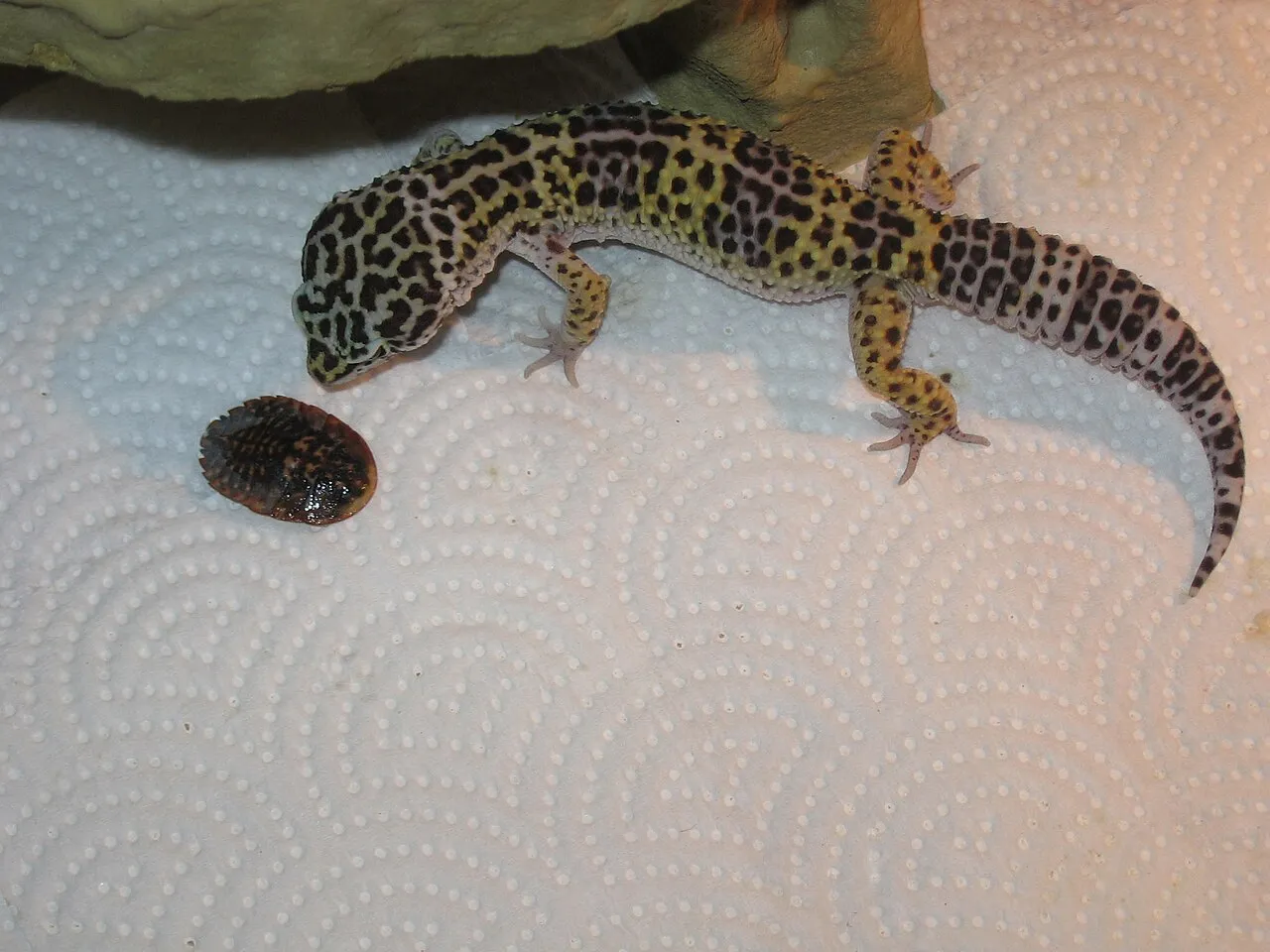
Michał Zawiślak (mihauz @) · CC BY-SA 2.5
8.1. Enclosure
For one adult, a tank of at least 90 x 45 x 45 cm (roughly 120 liters or more) is a reasonable minimum, and a wider footprint such as 120 x 60 x 45 cm is better. Leopard geckos use floor space far more than height. Front-opening glass enclosures help because your hand does not descend from above like a predator, and models with vents at the top and front circulate air better. Some keepers start hatchlings in smaller tubs so they find food easily, but most young geckos do fine in a full-size enclosure if it has plenty of hides.
8.2. Temperature and humidity
The key is a thermal gradient: a warm side and a cool side within the same enclosure. Leopard geckos absorb much of their heat through the belly, so many setups combine an under-tank heat mat with an overhead heat lamp.
| Zone | Target |
|---|---|
| Warm-side floor surface | 31-33 °C |
| Warm-side air | 27-29 °C |
| Cool side | 24-27 °C |
| Night minimum | Above 20 °C |
Every heat source must run through a thermostat, with the probe placed on the floor surface where the gecko lies. An infrared thermometer makes spot checks easy. Keep ambient humidity around 30 to 40 percent, but provide one humid hide filled with damp moss or soil, placed between the warm and cool zones, to help with shedding. Keeping the whole enclosure damp invites skin and respiratory infections.
8.3. Lighting
The old view was that a nocturnal gecko has no use for UVB. Plenty of leopard geckos do live healthy lives without it when calcium and vitamin D3 supplements are used correctly. However, it is now understood that wild animals receive low levels of ultraviolet light at dusk and near burrow entrances, and many keepers have shifted to a low-output UVB tube (about 5 to 7 percent) covering half the enclosure, with plenty of shade on the other side. Run lights 10 to 12 hours a day on a timer to keep a steady rhythm. Albino strains are sensitive to light, so give them extra hides and keep brightness modest.
8.4. Substrate and equipment
For young geckos, use substrates that cannot be swallowed: paper towel, newspaper, slate tile or reptile carpet. Many keepers move adults onto a naturalistic soil and sand mix; if you do, avoid loose calcium sand on its own and choose a blend that packs down firmly. Walnut shell and coarse bark chips carry an impaction risk and are best avoided.
- Enclosure of at least 90 x 45 x 45 cm with a secure lid
- Heat mat and heat lamp, plus one or two thermostats
- A probe thermometer for the floor, a hygrometer and a handheld infrared reader
- Three hides: warm, cool and humid
- Shallow water dish and a small calcium dish
- Low-output UVB tube and timer (optional but recommended)
- Insect container, feeding tongs, calcium and multivitamin powders
- A kitchen scale accurate to 0.1 gram for weight checks
9. Diet
9.1. Staples and treats
Leopard geckos are strict insectivores. They cannot digest fruit or vegetables, so there is no reason to offer them. The best staples are dubia roaches and crickets, which offer good nutritional balance, with mealworms, superworms and black soldier fly larvae as supporting options. Waxworms, silkworms and hornworms are irresistible and useful for tempting a gecko that has gone off its food, but they are either very fatty or very watery, so treat them as occasional extras.
Feed the insects nutritious vegetables, grain meal or commercial insect food for about 24 hours before offering them, a practice known as gut-loading. Just before feeding, shake them gently in a container with calcium powder to dust them.
9.2. How much and how often
Choose insects no larger than the space between the gecko's eyes. Offer as many as it will eat in 10 to 15 minutes, then remove leftover crickets, which may nibble a resting gecko.
| Age | Frequency | Rough amount |
|---|---|---|
| 0-6 months | Daily | 5-8 small insects |
| 6-12 months | Every other day | 6-8 medium insects |
| Adult | Two or three times a week | 6-10 insects, adjusted to body condition |
Keep a small dish of calcium without D3 in the enclosure at all times, and dust insects with a calcium plus D3 product and a multivitamin about once a week. If you provide UVB, you can reduce the D3 further. Too much vitamin A or D3 is also harmful, so follow product instructions. Logging weight every two weeks is the simplest way to know whether you are feeding the right amount.
9.3. Foods to avoid
- Wild-caught insects: they may carry pesticides or parasites.
- Fireflies and other bioluminescent insects: they contain toxic compounds.
- Fruit, vegetables and human food: geckos cannot digest them.
- Oversized insects or hard-shelled large beetles: risk of impaction and regurgitation.
- A diet of only waxworms or superworms: leads to obesity and fatty liver disease.
- Insects that died long ago: low nutritional value and possible bacterial growth.
10. Health
Leopard geckos are hardy, but most of their health problems trace back to husbandry and diet. Reptiles also hide illness well, so by the time symptoms are obvious the problem is often advanced. These are the conditions vets see most often.
| Condition | Main causes | Signs | Prevention |
|---|---|---|---|
| Metabolic bone disease (MBD) | Lack of calcium or D3, excess phosphorus | Soft jaw, bowed legs, tremors, wobbling | Calcium dusting, D3, low UVB |
| Stuck shed (dysecdysis) | Low humidity, no humid hide | Rings of skin left on toes or tail tip | Keep a damp humid hide |
| Impaction | Swallowed sand or bark, oversized prey, low temperatures | No droppings, swollen bluish belly | Safe substrate, proper heat |
| Cryptosporidiosis | Protozoan parasite | Tail wasting quickly, regurgitation, weight loss | Reputable source, quarantine, disinfection |
| Fatty liver | Too much fatty prey | Obesity, lethargy, poor appetite | Balanced staple insects |
| Egg binding (females) | Low calcium, no laying site | Swollen abdomen, refusing food, straining | Laying box, calcium |
| Hemipenal prolapse (males) | Trapped shed or sand | Pink tissue protruding from the vent | Clean substrate, prompt vet care |
Retained skin around the toes can strangle blood flow until a toe dies and falls off. Soak the foot in lukewarm water around 30 °C for about ten minutes, then ease the skin away with a damp cotton swab; if it will not budge, stop and see a vet. Cryptosporidium is extremely hard to treat and spreads easily between animals, so quarantine every new gecko in a separate room for at least 30 to 60 days.
See an exotic vet who treats reptiles promptly if the gecko eats nothing for more than two weeks while losing over 10 percent of its weight, if the tail thins noticeably, if the mouth swells or shows pus, if it walks oddly or trembles, if you see bloody droppings or repeated regurgitation, or if anything protrudes from the vent. At home, the most you should do is bring temperatures into the correct range and keep the animal somewhere quiet. Never use human medicines or ointments on your own.
11. Breeding
Leopard geckos breed readily in captivity, which is exactly why unplanned breeding so often produces babies with nowhere to go. Before pairing anything, work out how you will raise and rehome what could be dozens of hatchlings.
Females should weigh at least 45 to 50 grams and be over a year old before breeding. Younger females can be drained of calcium by egg production. The season usually runs from spring into summer, and a few weeks of slightly lower winter temperatures, often called cooling, is widely believed to encourage breeding. The first eggs appear around three to five weeks after mating, and a female lays again every two to four weeks through the season. Clutches almost always contain two eggs, and a season can bring eight to ten eggs or more. Females store sperm, so one mating can fertilize several clutches.
The eggs have soft, leathery shells and are incubated half-buried in damp vermiculite, perlite or a commercial hatching medium. Leopard geckos have temperature-dependent sex determination. Roughly speaking, incubation at about 26 to 29 °C produces mostly females, temperatures near 31 to 32 °C produce more males, and higher temperatures swing back toward females. Sources differ on the exact thresholds, so treat these figures as a guide only. Hatching takes roughly 35 to 90 days depending on temperature.
Give the female a laying box filled with damp moss and extra calcium during the season. Leaving a male permanently with several females wears them out, so most breeders introduce pairs briefly and then separate them. Avoid pairing morphs with known health problems, such as enigma or lemon frost, and avoid repeated inbreeding. If you plan to sell offspring, check whether a business license is required where you live.
12. Costs
The figures below are rough Korean price ranges converted to everyday terms; actual costs vary with region, product choices and the morph you buy. A normal-colored gecko is inexpensive, while popular morph combinations can cost many times more.
| Item | Typical cost (KRW) | Notes |
|---|---|---|
| Enclosure | 100,000-250,000 | 90-120 cm, front-opening |
| Heating and thermostat | 70,000-150,000 | Heat mat, lamp, controller |
| Lighting | 30,000-80,000 | Low UVB tube and timer |
| Hides, dishes, substrate | 30,000-70,000 | Including a humid hide |
| Thermometers and scale | 20,000-50,000 | More with an infrared thermometer |
| First vet check | 30,000-80,000 | Depends on fecal testing |
| Initial total (excluding the gecko) | About 300,000-600,000 | - |
| Monthly food and supplements | 20,000-40,000 | Less if you breed your own insects |
| Monthly electricity | 5,000-20,000 | Depends on season and equipment |
| Monthly total | About 30,000-60,000 | - |
| Yearly consumables | 30,000-60,000 | UVB replacement, substrate |
Vet fees vary widely between clinics that see reptiles. A basic exam and fecal test usually cost tens of thousands of won, X-rays add more, and surgery for impaction or egg binding can run to several hundred thousand won. Pet insurance rarely covers reptiles, so set aside an emergency fund. Outside Korea the proportions are similar: the setup costs far more than the animal, and the monthly bill is mostly insects and power.
13. Before you get one
Before bringing a leopard gecko home, answer these questions honestly. If any of them gives you pause, there is no harm in waiting until you are better prepared.
- Can you care for it for 15 to 20 years, through moves, relationships, children and job changes?
- Are you comfortable storing and handling live crickets or roaches, and is everyone you live with on board?
- Do you have a plan to keep temperatures safe during a summer power cut or a winter heating failure?
- Is there an exotic vet who treats reptiles within reach? Find the number before you need it.
- Who will check food and temperatures if you travel for a week or more?
- Can you cover the setup cost and an unexpected vet bill?
Choose a breeder or shop that can tell you the hatch date, the parents' morphs, what the animal is currently eating and its recent weight. If you can see the gecko in person, look for clear bright eyes, a plump tail, clean nostrils and vent, a full set of toes and natural, steady movement. Avoid animals whose tails are thinner than their bodies, whose hip bones and spine stand out, or whose droppings are runny and foul-smelling. For a first gecko, a juvenile with a proven feeding record is usually a better bet than a hatchling under three months old. Once it arrives, leave it untouched for one to two weeks and focus only on food and temperature while it settles in.
14. Laws
The leopard gecko is not listed in any appendix of CITES, the Convention on International Trade in Endangered Species, so in most countries it is traded as an ordinary pet reptile without special permits. It is also not covered by the mandatory pet registration schemes that apply to dogs in places such as Korea.
That said, wildlife trade rules are changing in many countries. In Korea, amendments to the Wildlife Protection and Management Act have introduced licensing for businesses that sell or import wild animals, along with a system that defines which species may be imported and sold, being phased in over time. Details, timelines and how far the rules reach into private rehoming can change, so check current guidance from the Ministry of Environment or your regional environmental office before acquiring an animal. Elsewhere, check national and local regulations; some jurisdictions require permits for any reptile, and repeatedly selling animals you have bred can count as running a business.
Never release a pet gecko outdoors, whatever the circumstances. In a cold climate it will likely die; in a warm one it could harm local wildlife. If you can no longer keep it, ask the original seller, a reptile club or a rescue organization to help find a new home. Animal welfare laws in many places, including Korea, can apply to reptiles as well as mammals, so neglect is not just unkind but potentially illegal.
15. In culture
The leopard gecko's face has made it an internet favorite. The shape of its mouth makes it look as if it is permanently smiling, and photos of grinning geckos have circulated widely as memes in many languages. Short clips of one dozing off with its eyes slowly closing, or licking its own eyeball clean, reliably collect views.
In games and animation, spotted lizard characters with chunky tails appear regularly even when no species is named, and many of them look inspired by the leopard gecko. Among cute reptile merchandise such as plush toys, stickers and figurines, it is one of the most frequently used models.
In many East and South Asian cultures, house geckos have long been treated as guardians of the home or signs of good fortune. Those beliefs concern the small wild geckos that live on house walls, however, and there is little traditional folklore tied specifically to the leopard gecko. Its cultural presence is largely a product of the past few decades of pet keeping.
16. Trivia
- Even with eyelids, leopard geckos still lick their eyes clean the way lidless geckos do.
- Thanks to the fat in their tails, healthy adults can go weeks without food. A short winter fast is common, but steady weight loss points to illness.
- Wild leopard geckos are known to hunt venomous prey such as scorpions.
- Using the same toilet spot may help wild geckos keep their shelters clean and avoid advertising their hideout to predators by scent.
- Two males that meet will wave their tails, puff up and then fight with serious bites, which is why males must never share an enclosure.
- They cannot climb glass, but they scramble up rough rock and cork surprisingly well, so keep the lid closed.
- Many leopard gecko owners end up breeding their own feeder insects. Dubia roaches cannot fly or chirp, which makes them a popular choice for home colonies.
- Colors are at their brightest right after a shed, making it the best time for photos.
Health notes are general information. If something seems wrong, contact a vet who treats this species.
FAQ
Does a leopard gecko need UVB lighting?
Many live well on D3 supplements alone, but a growing body of keeper experience suggests that low-level UVB with plenty of shade supports bone health and natural behavior, so it is now widely recommended.
Do leopard geckos bite?
Occasionally, when they mistake a finger for food or feel cornered, but their tiny teeth produce little more than a pinch. Avoid handling right after feeding and keep sessions to about ten minutes.
Can I leave my gecko alone for a long weekend?
A healthy adult that ate well beforehand will be fine for three or four days with fresh water and stable heat. Longer trips need a sitter, and juveniles, which eat daily, need one sooner.
Further reading
- 🗳️ Can reptiles make genuinely good pets?
- 🗳️ Leopard geckos: house together or keep alone?
- ❄️ Winter Care: Keeping Pets Warm and Heaters Safe
- 🦎 Finding an Exotic Pet Vet and Planning Checkups
- 🚗 Moving House and Traveling With Pets
- 🏢 Choosing a Pet When You Live Alone or Work Full Time
Photo credits
Photos are freely licensed images from Wikimedia Commons. Authors and licenses are listed below.
- EUBLEPHARIS-MACULARIUS Leopard-Gecko Leopardgecko 201705276003.jpg — Christian von Faber-Castell · CC BY 4.0
- Eublepharis macularius 2009 G6.jpg — George Chernilevsky · Public domain
- Eublepharis macularius1.jpg — Matt Reinbold · CC BY-SA 2.0
- Eublepharis macularius 01.jpg — Animal Kingdom Pet Hospital · CC BY-SA 2.0
- Eublepharis macularius 1.jpg — Michał Zawiślak (mihauz @) · CC BY-SA 2.5