TailVille
1. Overview
The water deer is a small, antlerless deer whose males sport long, curved upper canines that hang below the lip like tiny tusks. It is found naturally only in Korea and eastern China, and its fondness for reed beds and marshes gives it its English name.
To Koreans it is an utterly ordinary animal. Water deer graze rice paddies, forest edges and riverbanks across the country, and many drivers have had one bound in front of their headlights at night. They are so abundant, and so fond of crops, that South Korea officially classes them as a nuisance species.
Viewed globally, though, the water deer needs protection. In China, its other native stronghold, numbers have fallen sharply, and the IUCN lists the species as Vulnerable. Because the large majority of the world's water deer are believed to live in Korea, the country finds itself in the paradoxical position of being both the species' main refuge and the place where it is treated as a pest.
2. Name and classification
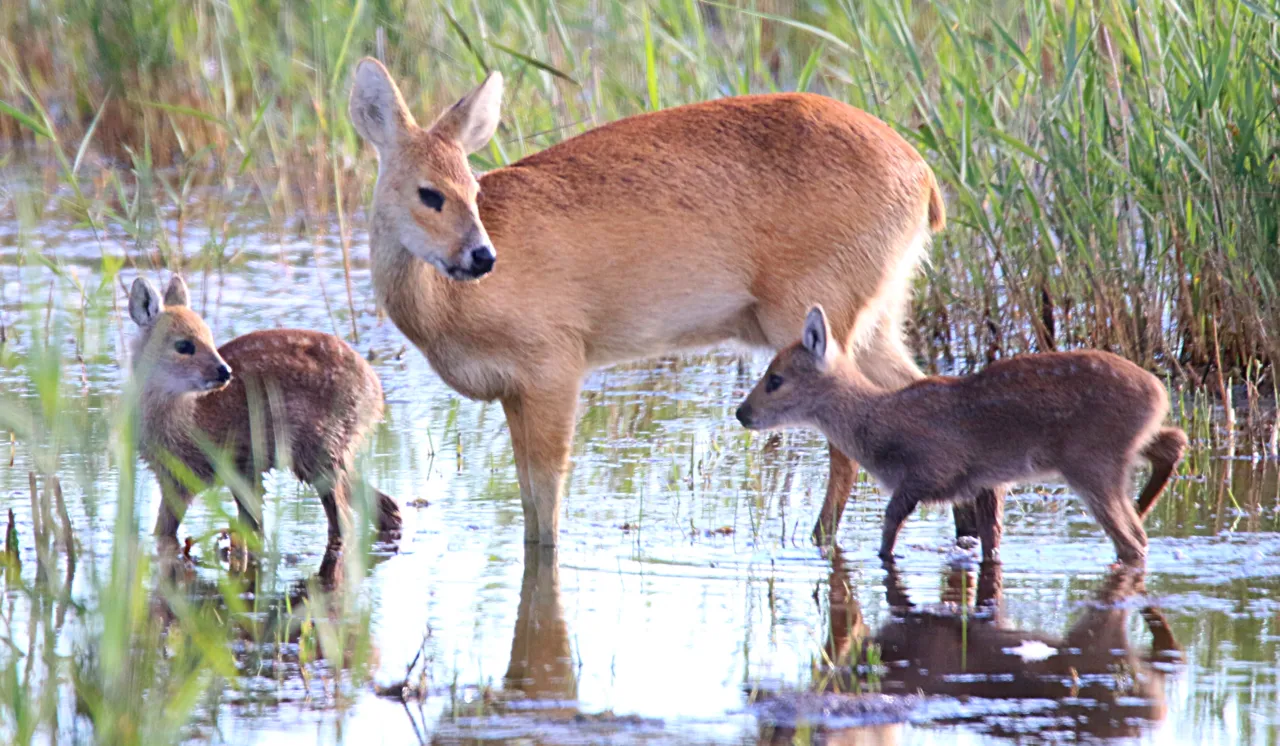
Nick Goodrum from Catfield in Norfolk, United Kingdom · CC BY 2.0
The British naturalist Robert Swinhoe described the species in 1870 as Hydropotes inermis. Hydropotes is Greek for 'water drinker' and inermis is Latin for 'unarmed', a nod to its lack of antlers.
It is the only member of its genus, with two recognised subspecies.
| Subspecies | Range | Notes |
|---|---|---|
| Chinese water deer (H. i. inermis) | Lower Yangtze region, eastern China | Nominate form, declining |
| Korean water deer (H. i. argyropus) | Korean Peninsula | Said to be slightly greyer |
The origin of the Korean name gorani is unclear, and regional names such as bonoru have also been used. It is easily confused with the roe deer, but male roe deer grow antlers and both sexes have a white rump patch. In English its fangs have earned it the nickname 'vampire deer'.
3. Evolution
Water deer have long intrigued biologists because they seem primitive. Tusk-like canines instead of antlers resemble the condition of very early deer, and for a time the species was thought to be the earliest offshoot of the deer family.
Genetic studies changed that view. The water deer belongs to the subfamily Capreolinae and is a relatively close relative of the roe deer. Its ancestors probably had antlers, which were lost during evolution while the canines grew long again. It is a neat example of a feature that looks ancient actually being a later reinvention.
Fossils are scarce, but water deer bones from Pleistocene deposits in China and Korea show that the species has lived in the region for a very long time.
4. Range and habitat
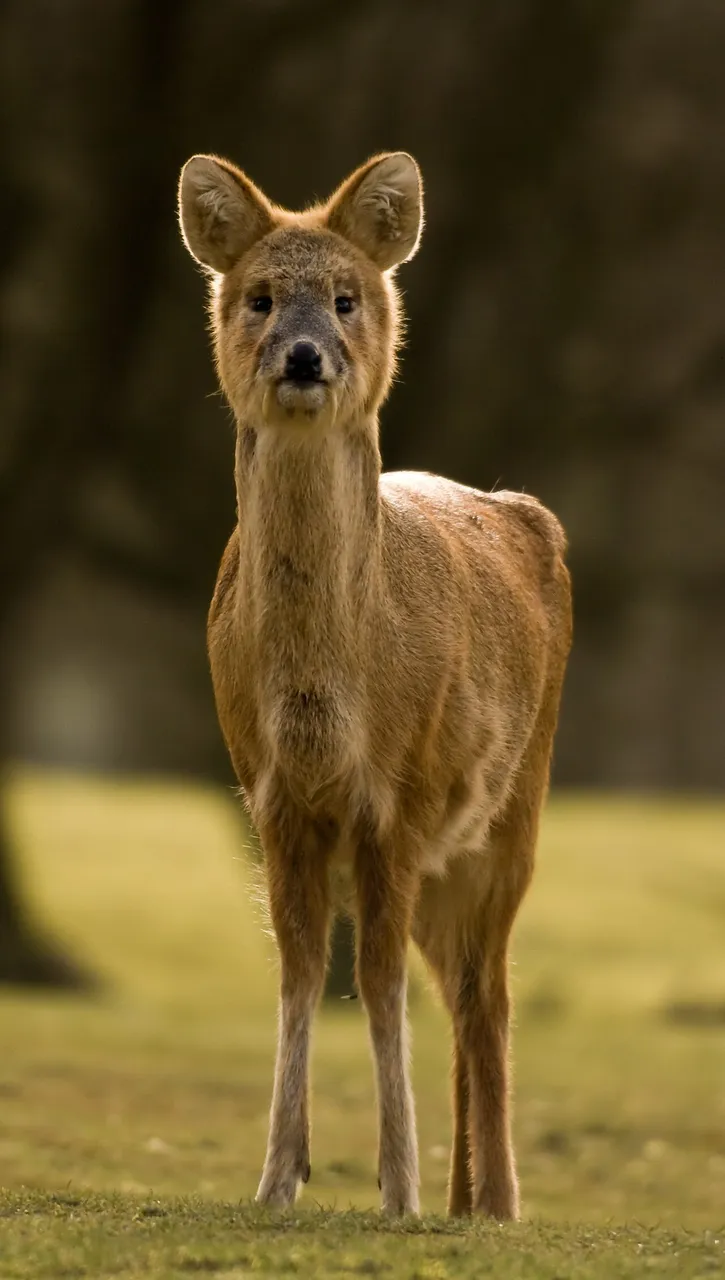
Original: William WarbyDerived work: Bruce1ee · CC BY 2.0
The natural range is limited to the Korean Peninsula and eastern China. In China water deer lived mainly in the lower Yangtze basin and coastal wetlands, but farmland development and hunting fragmented their habitat and drove numbers down steeply. On the peninsula they occur in both North and South Korea, and in the south they are spread almost evenly across the country.
True to their name, they like to be near water: reed beds, riverside grassland, marshes, paddies and fields, and the edges of low hills. They prefer a mosaic of tall cover and open grazing to deep forest, which is exactly what the Korean farming landscape offers. The disappearance of tigers, leopards and wolves from South Korea is also cited as a reason for their abundance.
Outside Asia there is a small population in Britain. Water deer brought to English private parks in the late nineteenth century escaped or were released, founding wild groups mainly in eastern England. A few have also been recorded in parts of France.
5. Body
Water deer are small, about the size of a medium dog. Their hind legs are slightly longer than the forelegs, so the rump sits higher than the shoulders, giving them a bounding, rabbit-like run.
| Measure | Approximate value |
|---|---|
| Head-body length | 75–100 cm |
| Shoulder height | 45–55 cm |
| Tail | 5–8 cm |
| Weight | 9–15 kg, males slightly heavier |
| Male canines | about 5–8 cm visible below the lip |
The males' canines are the defining feature. The upper canines grow long and curve down out of the mouth. They sit loosely in their sockets, and are said to fold back while the deer eats and swing forward for fighting. Females have tiny canines that are barely visible, and neither sex grows antlers.
The coat is tawny to reddish-brown in summer, becoming thicker and greyer in winter. The coarse hairs are hollow, providing good insulation. The ears are large and rounded and the eyes dark and prominent. Unlike most deer, water deer have small scent glands in front of the eyes and glands in the groin. They lack the white rump patch of the roe deer.
6. Behaviour and ecology
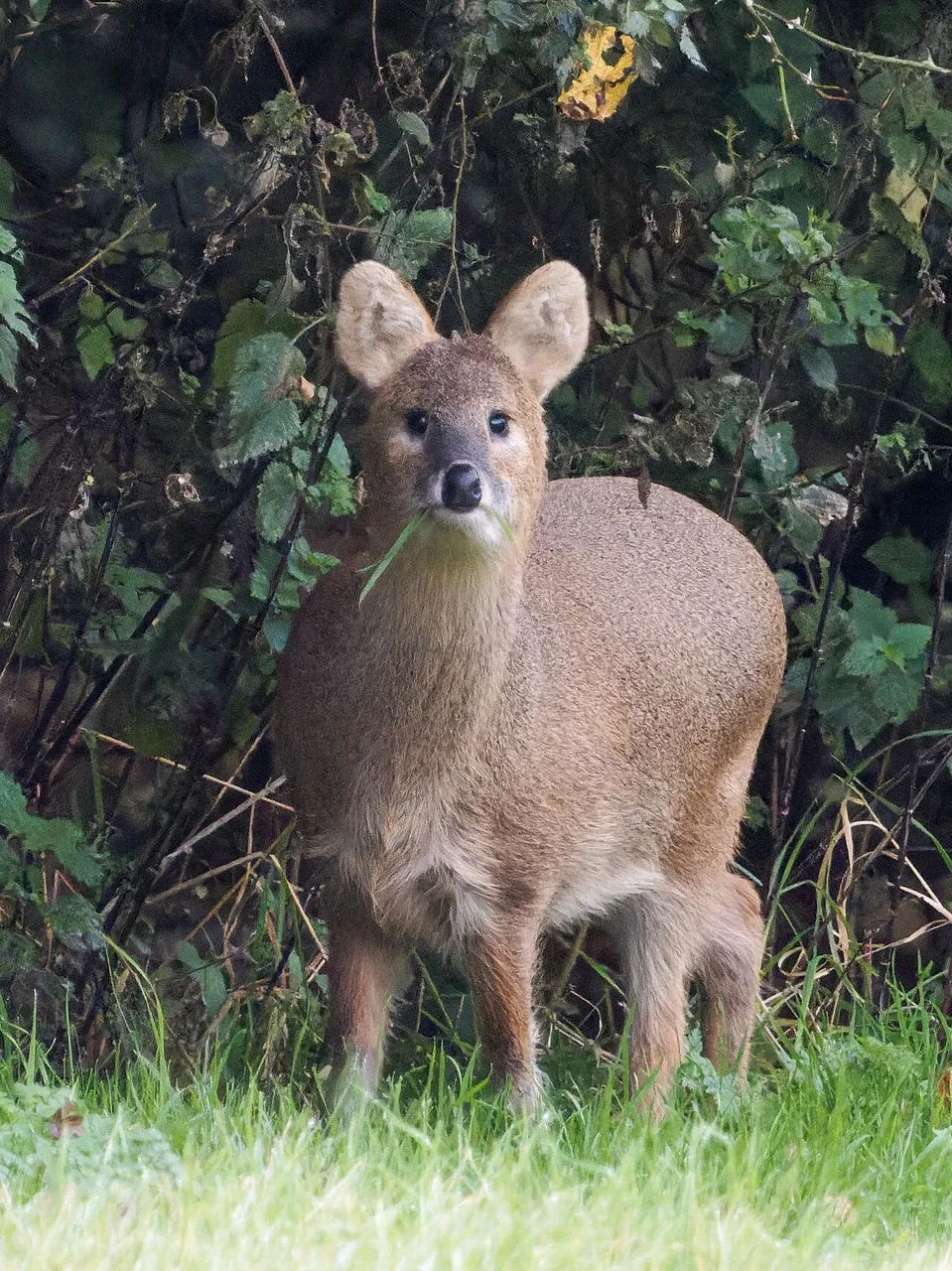
William Stephens · CC BY 4.0
Water deer are largely solitary. Unlike herd-forming deer, they rarely travel together outside the rut or the period when mothers are with fawns. Several may graze in the same rich field, but they are not a herd.
They are most active at dawn and dusk, and at night where people are around. By day they lie low in grass or reeds, then burst from cover and zigzag away when disturbed, running with heads low in a distinctive hare-like bounding gait.
As the rut approaches, males establish territories marked with urine, dung and scent. Rival males that intrude are met with bared tusks, and fights can leave deep wounds on the neck and shoulders. Water deer are strong swimmers, crossing rivers and reaching islands; they can be seen on river islands in the Han River estuary and on sandbars in Korean rivers.
7. Diet and feeding
Water deer are herbivores and selective feeders. Rather than mowing grass in bulk like cattle, they pick out tender, nutritious parts and eat little and often. Their small bodies and relatively short digestive tracts make food quality especially important.
- Spring: new shoots, young grass, legume leaves
- Summer: grasses, shrub leaves, aquatic plants
- Autumn: fruit, spilled grain, vegetables
- Winter: dry grass, bark, leaves of winter crops
Around farms they relish soybeans, sweet-potato shoots, cabbage, lettuce and barley, and nipping off newly sprouted seedlings causes serious losses. Together with wild boar, water deer are among the wildlife species responsible for the most crop damage in South Korea.
Like other deer they are ruminants, bolting food quickly and chewing the cud later in a safe resting spot.
8. Reproduction and life cycle
The rut runs from late autumn into early winter, around November and December, when males fight hard over territories and females and the night rings with shrill calls. Gestation lasts roughly six to seven months, and fawns are born the following May or June.
Water deer are famous as the most prolific deer. Litters of two or three are typical, and litters of five or six or more have been recorded, remarkable when most deer bear one or two young.
| Stage | Age | What happens |
|---|---|---|
| Newborn | 0–1 week | about 0.6–1 kg, spotted coat |
| Lying-out | 1 week–1 month | Hides alone in vegetation; mother visits only to nurse |
| Growing | 1–3 months | Follows mother, starts grazing, spots fade |
| Independence | about 4–6 months | Lives alone from autumn |
| Maturity | about 6–8 months | May breed in its first winter |
Newborns have pale spots on their backs that camouflage them in grass. The mother leaves them hidden and watches from a distance, approaching only to nurse. A lone fawn found in early summer is usually not abandoned, so it should be left where it is.
Wild water deer typically live five or six years, and captive animals have exceeded ten. Fawn mortality is high, and many do not survive their first year.
9. Intelligence, communication, special abilities
Once heard, the water deer's call is hard to forget. A short, harsh bark that sounds like a dog or even a human scream startles many people on their first night in the Korean countryside. Water deer bark to signal alarm or advertise territory, males may make whistling sounds during the rut, and mothers and fawns exchange soft calls.
Scent marking matters too. During the rut, males leave scent on vegetation and the ground and scrape the soil with their forefeet, advertising their presence and territory to rivals.
Their special skills include strong swimming and explosive leaps. They are also masters of hiding: a water deer pressed low and motionless in reeds can go unnoticed even when someone walks right past it.
10. Predators and survival
In the past, tigers, leopards, wolves and lynx were probably the water deer's main predators in Korea. With those large carnivores almost gone from the south, today's predators are mainly yellow-throated martens, feral dogs, eagle owls and golden eagles. Groups of yellow-throated martens have been observed hunting water deer fawns and even adults.
The loss of predators is one reason water deer are so numerous in Korea. Human-related threats, however, are severe. Water deer are the wild animal most often killed on Korean roads, with tens of thousands thought to die every year, which also poses a serious risk to drivers. Many more are culled under nuisance-animal permits because of crop damage.
11. Relationship with humans
In Korea the relationship is a love-hate affair. People find water deer endearing, with their big eyes and comical fangs, but farmers see them as pests that wreck carefully tended crops. Under the Wildlife Protection and Management Act the water deer is designated a nuisance wild animal, so local authorities can permit culling where damage occurs, and many districts run damage-control teams.
Farmers defend their fields with electric fences, netting, repellents and devices that emit noise or light. Water deer jump well and clear low fences easily, so fence height and construction matter.
Traffic collisions are a major problem. Dazzled by headlights, a water deer may freeze or dash into the road. Drivers on roads where deer are common are advised to slow down, and if an animal appears, to brake and sound the horn rather than swerve. Roadkill can be reported to the relevant authorities for removal.
As awareness grows that Korea's 'pest' is globally Vulnerable, some argue for science-based population management rather than indiscriminate culling. Whether the water deer should be seen as a nuisance or as a resource to protect is a question Korean society is still working through.
12. Conservation
The IUCN lists the water deer as Vulnerable, mainly because of its steep decline in China. There, wetland habitat has been converted to farmland and aquaculture ponds, and hunting and snaring have reduced the species to small, isolated populations.
In South Korea, by contrast, it is abundant. Estimates vary widely with method, but the south alone is thought to hold several hundred thousand animals, and many assessments conclude that most of the world's water deer live on the Korean Peninsula. Britain's introduced population is estimated in the low thousands, a meaningful share for an animal outside its native range.
| Region | Situation (broad trend) |
|---|---|
| Korea | Abundant; managed as a nuisance species |
| China | Scarce, declining, protected |
| Britain | Introduced; estimated in the thousands |
From an international conservation perspective, the Korean population is therefore vital to the species' future. Given how many die every year on roads and in culls, experts stress the need for long-term population monitoring and careful management.
13. In zoos
In Korea water deer are so common that they draw little attention in zoos, but abroad they are prized as an unusual fanged deer. They are nervous animals that startle at sudden noise or approaching people, and a panicked deer can injure itself against fencing, so they need cover, space and quiet.
Korean wildlife rescue centres receive many water deer injured in road accidents, along with fawns 'rescued' by well-meaning people who assumed they were orphaned. Fawns that become too used to people struggle to return to the wild, so rescue staff keep human contact to a minimum.
Some people want to raise a fawn at home, but taking wild animals without permission can be illegal, and adult males can injure people with their tusks. If you find a young water deer, don't touch it; leave it where it is or contact a rescue centre.
14. In culture
Water deer don't star in myths the way tigers and bears do, but they have become minor celebrities in Korean internet culture. Clips of their scream-like bark and jokey imitations of the 'gorani sound' have gone viral, and the deer that leaps out of the dark is a staple of drivers' anecdotes. Their fanged faces have inspired countless vampire-themed cartoons.
Abroad, the 'vampire deer' nickname makes them a favourite of documentaries and articles about strange animals. In Britain, the introduced deer live quietly in the countryside and are sought out by photographers and naturalists.
In Korean literature and painting they sometimes appear alongside roe deer as symbols of peaceful hills and fields, although old texts often fail to distinguish the two, so it is not always clear which animal is meant.
15. Trivia
- The water deer is one of very few deer species without antlers.
- Musk deer and muntjacs also have long canines, but they belong to different lineages.
- 'A pest in Korea, vulnerable worldwide' is the line that almost always comes up when the water deer is introduced.
- Water deer are regularly seen swimming to river islands in the Han River estuary.
- A fawn curled up alone in early-summer grass almost certainly has a mother watching from nearby.
Wild animals are not pets. Catching, trading or keeping them is illegal in most places. If you find an injured wild animal, call your local wildlife rescue centre.
FAQ
If they are so common in Korea, why are they Vulnerable?
IUCN categories apply to the whole species. Water deer have declined sharply in China through wetland loss and hunting, so the species is Vulnerable despite Korea's large population.
What should I do if I find a fawn alone in the grass?
Usually its mother has hidden it and is watching nearby. Don't touch or take it; just leave. If it is injured or still there after a day, contact a wildlife rescue centre.
What should I do if a water deer jumps in front of my car?
Swerving can cause a worse accident. Authorities advise braking and sounding the horn. Slow down on roads with deer warning signs, especially at night.
Photo credits
Photos are freely licensed images from Wikimedia Commons. Authors and licenses are listed below.
- Hydropotes inermis male.JPG — Altaileopard · Public domain
- Chinese water deer with her two fawn's (42269652764).png — Nick Goodrum from Catfield in Norfolk, United Kingdom · CC BY 2.0
- Hydropotes inermis inermis Whipsnade Zoo (crop).jpg — Original: William WarbyDerived work: Bruce1ee · CC BY 2.0
- Hydropotes inermis 168257189.jpg — William Stephens · CC BY 4.0