TailVille
1. Overview
The ruby-throated hummingbird weighs about as much as a small coin, roughly three to four grams, yet it is one of the most remarkable travellers in the bird world. It is the only hummingbird that breeds widely in eastern North America, so for most people from Ontario to Florida, 'the hummingbird' at the backyard feeder is this species. Adult males carry a throat patch that flashes deep ruby-red when it catches the light, which gives the bird its name.
Tiny as it is, the ruby-throat can beat its wings more than fifty times per second, hover motionless in front of a flower, fly backwards and change direction in an instant. In autumn many individuals nearly double their body weight and then cross the Gulf of Mexico in a single non-stop flight of up to around 800 kilometres over open water.
This article focuses on the ruby-throated hummingbird but also explains what makes hummingbirds as a group so unusual. The family contains more than 360 species, all found only in the Americas. There are no wild hummingbirds in Korea, Europe or Africa, so reports of 'hummingbirds' in those places almost always turn out to be hawk-moths, which hover at flowers in a strikingly similar way.
2. Name and classification
Henley Quadling · CC BY-SA 4.0
The ruby-throated hummingbird, Archilochus colubris, belongs to the hummingbird family Trochilidae in the order Apodiformes, which it shares with the swifts. Its only congener is the black-chinned hummingbird (Archilochus alexandri) of the western United States and Mexico, whose males have a black throat with a violet band. The two occasionally hybridise where their ranges meet in Texas.
The genus name may honour the ancient Greek poet Archilochus, although the reason is unclear, and colubris is thought to derive from an eighteenth-century word for hummingbirds whose own origin is obscure. The English name comes from the humming sound produced by the wings.
2.1. The hummingbird family at a glance
Hummingbirds form one of the largest bird families, with roughly 360 species. Most live in the northern Andes, but the family reaches Alaska in the north and Tierra del Fuego in the south.
| Notable species | Highlights |
|---|---|
| Bee hummingbird | Endemic to Cuba, 5–6 cm and about 2 g, the smallest bird in the world |
| Giant hummingbird | Andes, about 20 cm and 20 g, the largest hummingbird |
| Sword-billed hummingbird | The only bird whose bill is longer than its body |
| Ruby-throated hummingbird | The only widespread breeding hummingbird in eastern North America |
| Rufous hummingbird | Travels between Alaska and Mexico, one of the longest migrations relative to body size |
Recent research suggested that the giant hummingbird actually consists of two species with different breeding areas and migratory habits.
3. Evolution
Hummingbirds' closest living relatives are the swifts. Both groups have tiny legs and wings highly specialised for flight, and they are thought to have diverged around forty million years ago.
Surprisingly, the oldest known hummingbird fossils come from Europe, not the Americas. Eurotrochilus, found in roughly thirty-million-year-old deposits in southern Germany, already had a long, slender bill and wing bones suited to hovering. Similar fossils have since turned up in France and Poland. Hummingbird ancestors evidently once lived in the Old World, disappeared there, and survived and flourished only in the Americas.
Molecular studies suggest that modern hummingbirds became established in South America around twenty million years ago and then diversified rapidly. The uplift of the Andes created a ladder of habitats and flowering plants at different altitudes, and hummingbirds radiated alongside them. The close match between flower shapes and bill lengths and curves is a classic example of coevolution. The group that includes the ruby-throat is a relatively recent lineage that spread into North America.
4. Range and habitat
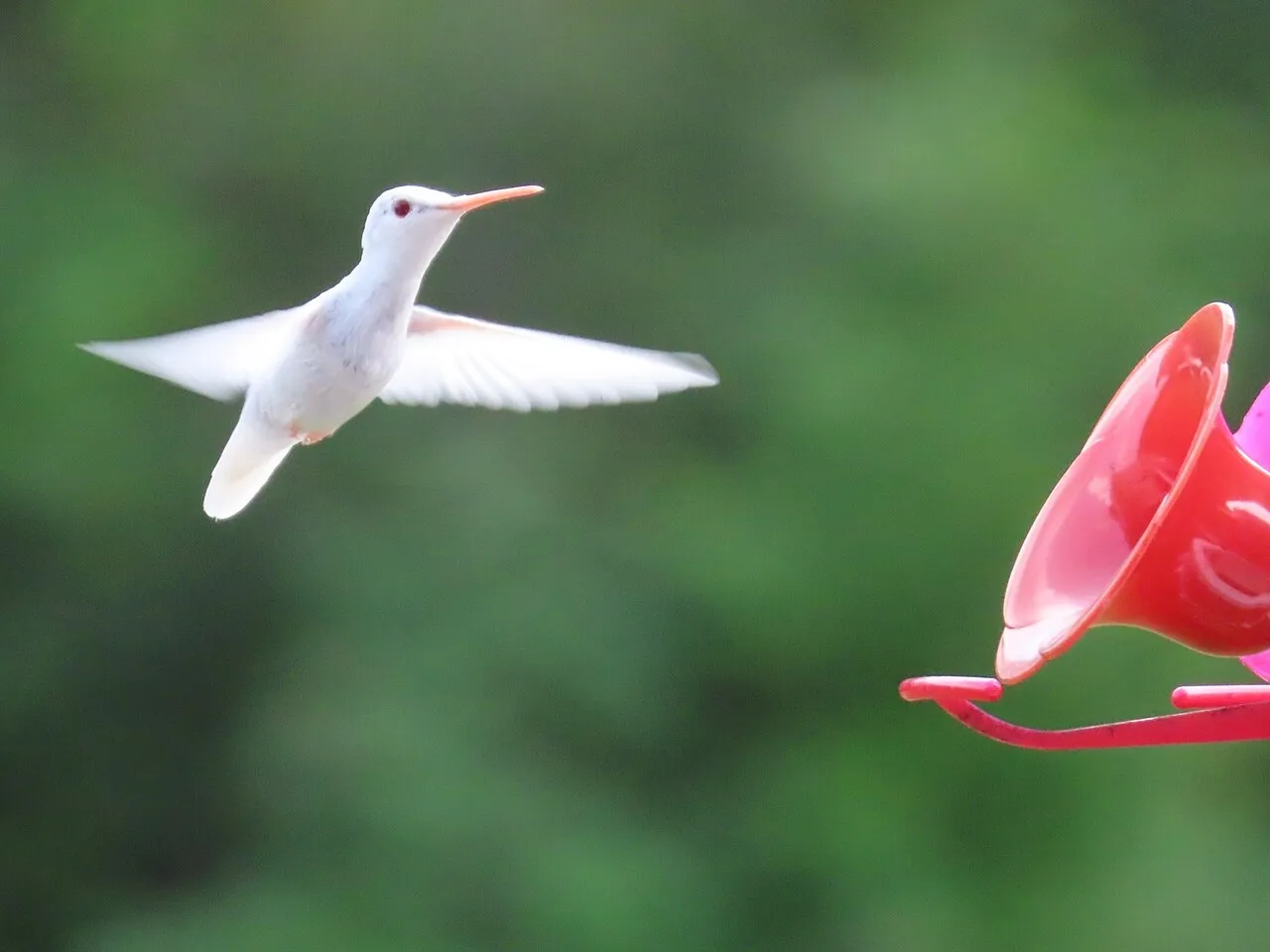
no rights reserved · CC0
In summer the ruby-throat breeds across almost all of eastern North America, from Florida and eastern Texas north to southern Canada, between eastern Alberta and Nova Scotia, and west to the edge of the Great Plains.
In winter it moves to southern Mexico and Central America as far as western Panama, with small numbers staying in southern Florida and along the Gulf Coast.
Its preferred habitats are edges of deciduous and mixed forests, clearings, orchards, gardens and parks, anywhere with plenty of flowers and scattered trees. It adapts well to suburbs, where flower beds and sugar-water feeders have become important summer food sources. On its tropical wintering grounds it uses dry forest, scrub and farmland edges.
5. Body
| Measurement | Typical value |
|---|---|
| Length | about 7–9 cm |
| Wingspan | about 8–11 cm |
| Weight | about 2.5–4 g, up to roughly 6 g before migration |
| Wingbeats while hovering | about 50–60 per second |
| Heart rate | over 1,000 beats per minute when active |
| Body temperature | about 40°C when active, far lower in torpor |
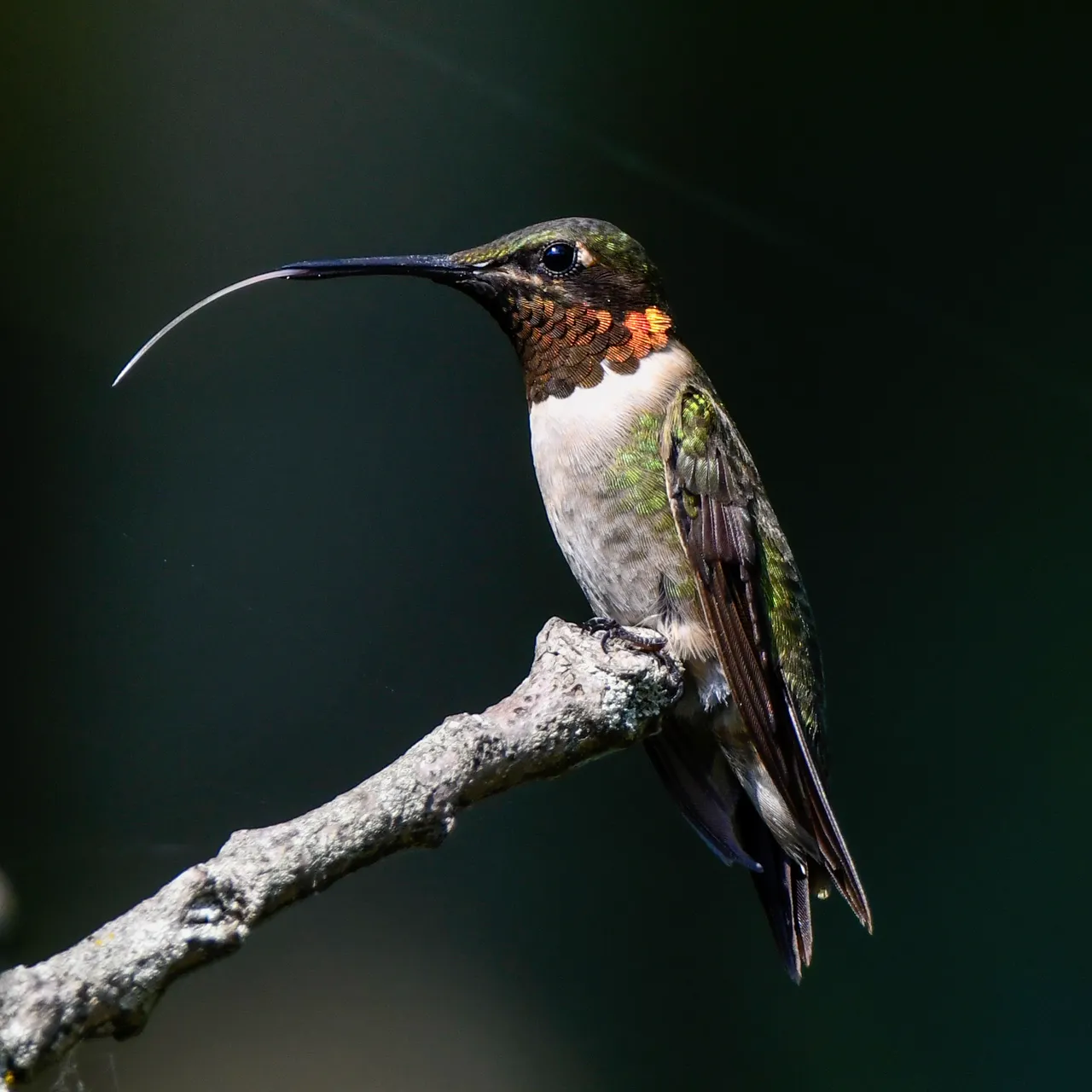
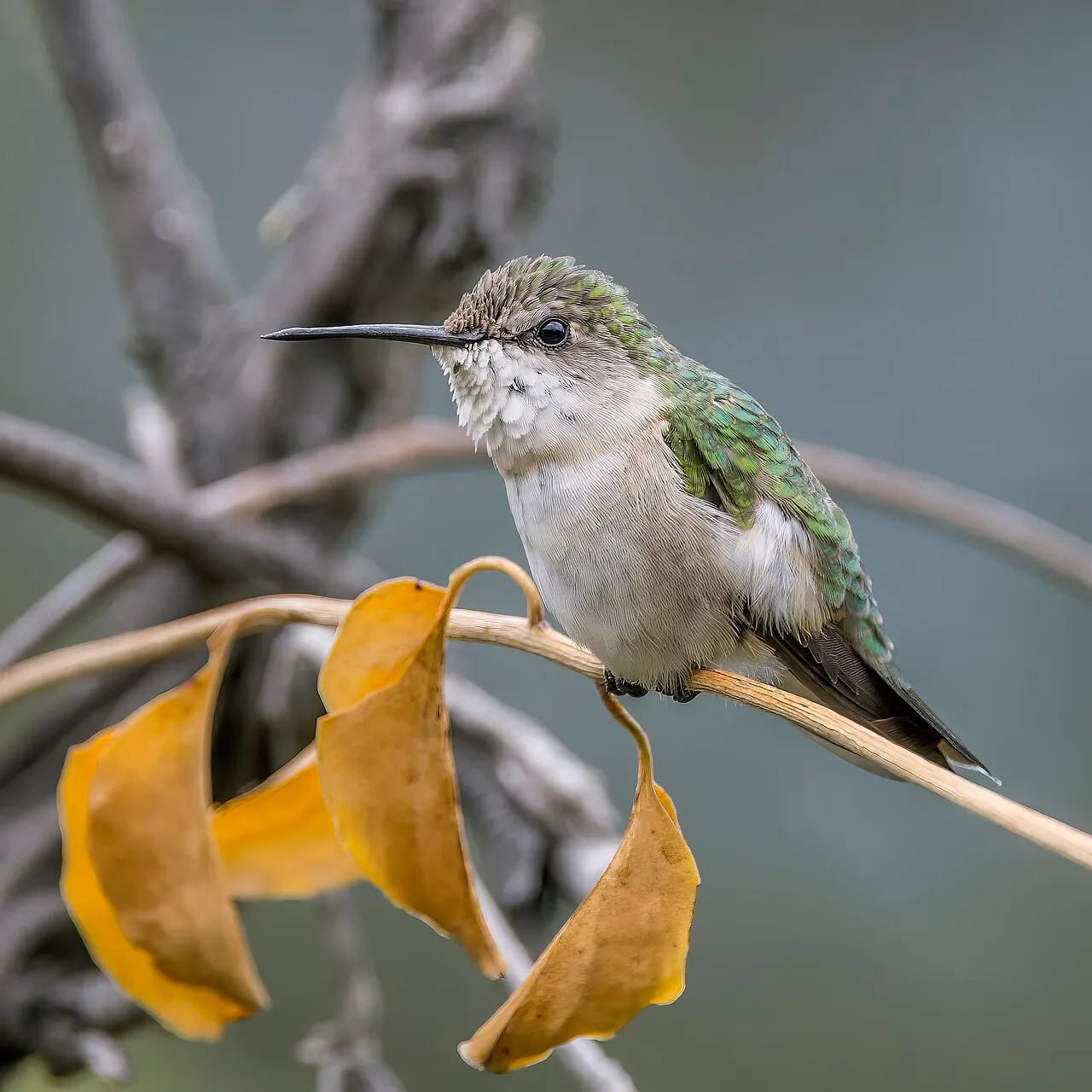
The back is iridescent emerald green and the underparts greyish white. Males have the famous red throat, or gorget. Its colour is structural, produced by microscopic layers in the feathers, so it glows ruby only when light strikes it head-on and can look almost black from other angles. Females have a white throat and white tips on the outer tail feathers, and are slightly larger than males.
A hummingbird's body is an extreme flying machine. The flight muscles make up around a quarter of body weight, and a highly mobile shoulder joint lets the wing sweep in a figure-of-eight pattern, generating lift on both the forward and backward strokes. That is what makes true hovering possible. The trade-off is that the legs are so small that hummingbirds cannot walk or hop; they can only perch and shuffle sideways.
The needle-like bill hides a long, forked tongue. The eyes are large for the head and can detect ultraviolet light invisible to humans.
6. Behaviour and ecology
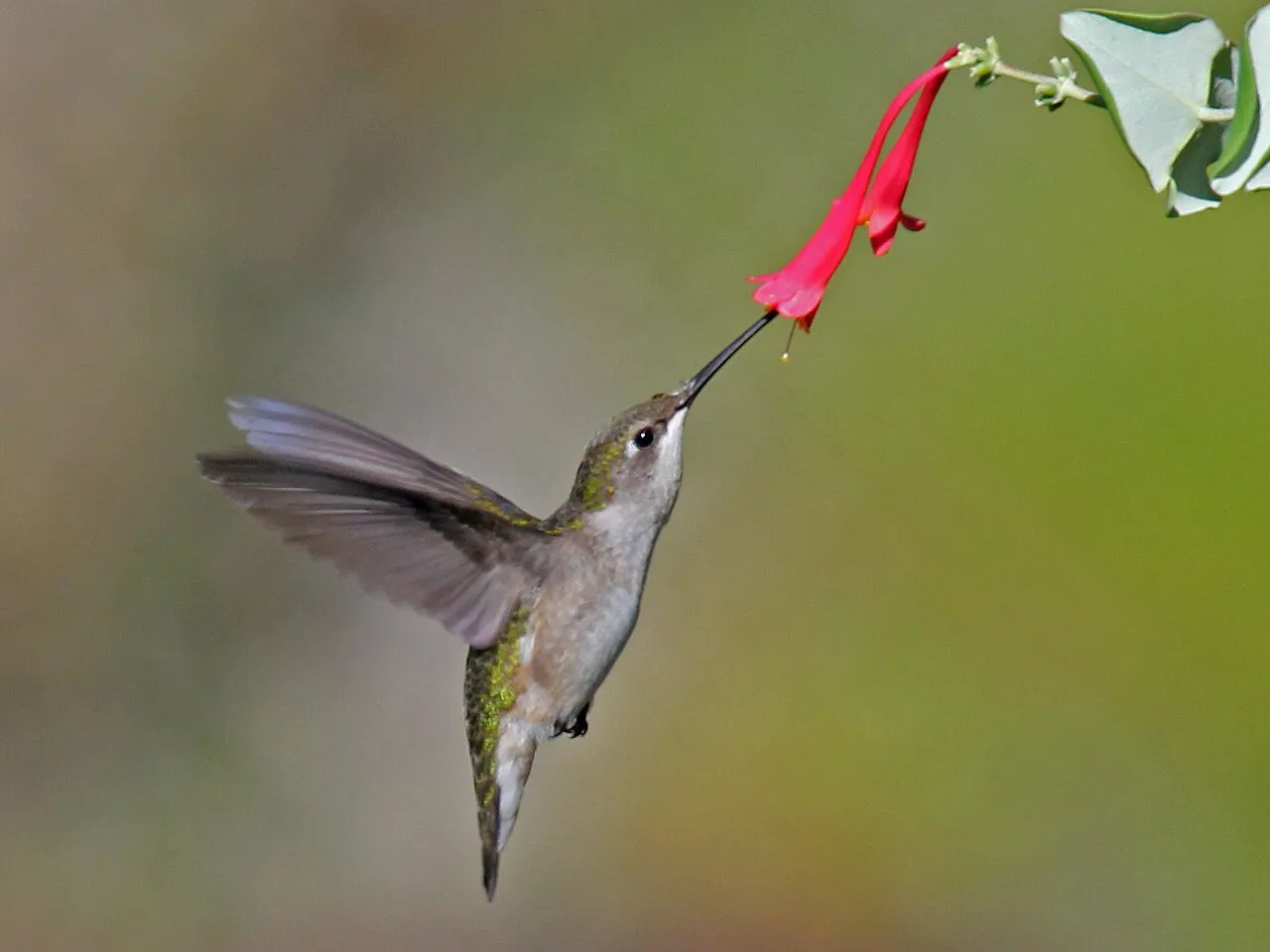
Ruby-throats are solitary. They do not form pair bonds, and males and females meet only to mate. Males defend patches of flowers or feeders as territories, chasing away other hummingbirds with sharp chattering calls and aggressive dives. They have been seen charging birds and even squirrels many times their size.
Life revolves around food. With a tiny body and an extraordinarily high metabolism, a ruby-throat needs to feed every ten to fifteen minutes through the day and may visit hundreds of flowers or more daily.
At night it saves energy by entering torpor, a state in which body temperature drops dramatically and heart rate and breathing slow to a fraction of normal. It is almost like a nightly mini-hibernation. Warming up again in the morning by shivering can take many minutes.
6.1. The Gulf crossing
The ruby-throat's migration is one of the great journeys of the animal kingdom. In late summer the birds feed intensely on nectar and insects, laying down fat until some nearly double their weight. Many then appear to fly straight across the Gulf of Mexico from the US coast to the Yucatán Peninsula, a non-stop flight over water with no flowers and nowhere to rest, powered entirely by stored fat.
Others follow the Texas coast overland, and how individuals choose between routes, perhaps depending on weather and body condition, is still being studied. In spring they return north between March and May, with males arriving before females to claim territories. Many backyard observers report birds returning to the same garden and feeder year after year, suggesting a remarkable memory for places.
7. Diet and feeding
Hummingbirds are famous nectar-feeders, but nectar alone is not enough. It supplies sugar as fuel for flight, while protein and fat for growth come from small insects and spiders. Ruby-throats snatch gnats in mid-air, pick insects from spider webs and glean aphids from leaves. Nesting females hunt insects especially intensively to feed their chicks.
They favour red or orange tubular flowers such as trumpet creeper, scarlet bee balm, cardinal flower and native honeysuckles. Such flowers tend to be red, a colour bees see poorly, with little scent and deep nectar, traits thought to have evolved for hummingbird pollination. In early spring before many flowers open, ruby-throats feed at sap wells drilled in tree bark by sapsuckers.
The tongue was long thought to work like a drinking straw. High-speed filming revealed a more elegant mechanism: the forked, fringed tip unfurls in the nectar and then rolls closed to trap liquid, and the tongue also acts as a tiny elastic pump, drawing nectar up as it springs back into shape. This happens more than a dozen times per second.
Many North American households hang sugar-water feeders. The usual recommendation is one part white sugar to four parts water, with no honey or red dye, and frequent cleaning to prevent mould.
8. Reproduction and life cycle
In the breeding season males perform a dramatic courtship display, swinging back and forth in a wide U-shaped arc and producing a buzzing sound with the wings at the bottom of each dive, then shuttling rapidly from side to side in front of the female. After mating the male leaves; the female builds the nest, incubates and raises the young alone.
The nest is a tiny cup about the size of a walnut shell. The female felts together plant down from thistles and dandelions, binds it with spider silk and decorates the outside with flakes of lichen so that it looks like a knot on a branch. The stretchy silk lets the nest expand as the chicks grow.
| Stage | Duration | Notes |
|---|---|---|
| Nest building | about 6–10 days | female alone, using plant down and spider silk |
| Clutch | usually 2 eggs | white, pea-sized, laid a day or two apart |
| Incubation | about 12–14 days | female only |
| Nestlings | about 18–22 days | fed regurgitated nectar and insects |
| First breeding | the next spring | mature at about one year |
In the south some females raise two broods a year. Typical lifespan in the wild is estimated at three to five years, and banding records include a female that lived more than nine years.
9. Intelligence, communication and special abilities
A hummingbird's brain is tiny in absolute terms but among the largest of any bird relative to body size, and the hippocampus, linked to spatial memory, is proportionally large.
That memory is put to work daily. Experiments show that hummingbirds remember which flowers they have visited and tend to return when the nectar has had time to refill, while avoiding blooms they have recently emptied.
Their vision is extraordinary too. Humans have three types of colour-sensitive cones; hummingbirds have four, including one tuned to ultraviolet. Field experiments demonstrated that hummingbirds can distinguish 'non-spectral' colours such as ultraviolet-plus-green, combinations humans cannot even imagine.
Ruby-throats do not sing; their calls are short chips and twitters. Instead, wing sounds act as signals. Adult males have narrow tips to their outer flight feathers, producing a higher, sharper whine that may help them intimidate rivals and advertise to females.
Flight is the hummingbird's defining talent: hovering, flying backwards, sliding sideways and even briefly flipping upside down. Engineers have studied hummingbird wingbeats when designing miniature drones.
10. Predators and survival
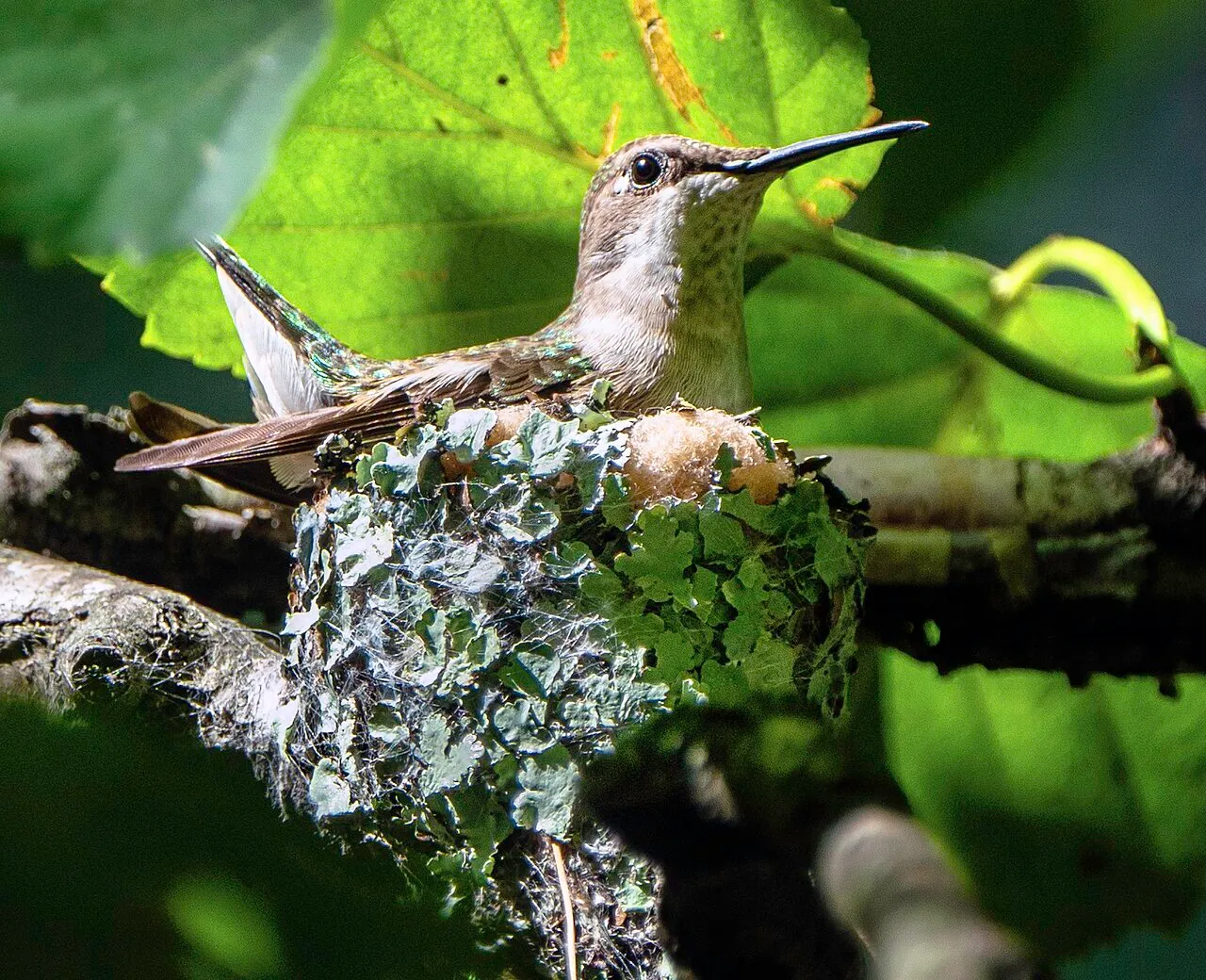
Lorie Shaull · CC BY-SA 4.0
Their small size exposes them to surprising predators. Besides kestrels, small hawks and cats, praying mantises have repeatedly been recorded ambushing hummingbirds at flowers and feeders. Hummingbirds can also become entangled in the webs of large spiders, and frogs and fish occasionally catch them near water. Jays, squirrels and snakes raid nests.
Their main defence is speed and agility: a threatened hummingbird can vanish in an instant. Females camouflage their nests carefully.
Bigger dangers come from weather during migration and from human environments. Strong headwinds over the Gulf can exhaust fat reserves before landfall, and window collisions, pesticide-driven insect declines and habitat loss all take a toll.
11. Relationship with humans
Hummingbirds held a special place in many Indigenous cultures of the Americas. The name of the Aztec sun and war god Huitzilopochtli is usually interpreted as 'hummingbird of the south' or 'hummingbird on the left', and fallen warriors were believed to return as hummingbirds. In Caribbean and South American stories, hummingbirds often appear as brave messengers that brought fire or tobacco to people.
There is a darker chapter too. In the nineteenth century, iridescent hummingbird skins and feathers were hugely fashionable in Europe and North America for hats, jewellery and parlour displays, and enormous numbers were shot in South America for export. Outrage at the feather trade helped launch the bird-protection movements in Britain and the United States.
Today the ruby-throat is one of the most beloved garden birds in eastern North America. Planting hummingbird flowers and hanging feeders is a popular hobby, and every spring volunteers log first arrival dates, feeding citizen-science maps that track the migration northward.
In Korea, Europe and elsewhere outside the Americas, people often believe they have seen a hummingbird when they have actually seen a hummingbird hawk-moth or a related species hovering at flowers at dusk. Antennae and six legs give the moth away.
12. Conservation
The ruby-throated hummingbird is listed as Least Concern by the IUCN. Its breeding range is vast, and North American bird-monitoring data suggest a population in the tens of millions that has been stable or slightly increasing over recent decades, although estimates vary considerably by method.
There are still concerns. Climate change may shift flowering times out of step with the birds' arrival, pesticides reduce the insects chicks depend on, and forests on the Central American wintering grounds continue to be cleared.
In the United States and Canada the species is protected under migratory bird laws, which make it illegal to capture or keep hummingbirds or to possess their nests, eggs or feathers without a permit. Nearly all hummingbird species are listed on CITES Appendix II, which regulates international trade.
For the family as a whole the picture is more worrying: many species confined to small mountain ranges or islands in Latin America are classified as Endangered or Critically Endangered because of habitat loss.
13. In zoos and aviaries
Hummingbirds are extremely difficult to keep. They need constant supplies of nectar and live insects, large flight spaces and carefully controlled temperature and humidity. For that reason only a limited number of zoos and botanical gardens with large tropical walk-through aviaries display them, and captive breeding in such facilities has provided valuable data on growth and metabolism.
Keeping a hummingbird privately is practically impossible and illegal in most countries. The best way to see them up close is to watch wild birds at flowers or feeders within their natural range. Injured birds should be taken to licensed wildlife rehabilitators.
14. Hummingbirds in culture
- One of the most famous Nazca Lines in the Peruvian desert is a giant hummingbird, so large it can only be appreciated from the air.
- Trinidad and Tobago is nicknamed 'the land of the hummingbird' and features the bird on its coat of arms; Jamaica's national bird is the streamertail, a hummingbird with long tail streamers.
- The acclaimed 2018 Korean film House of Hummingbird, directed by Kim Bo-ra, follows a teenage girl in 1990s Seoul; the title evokes a small creature that never stops beating its wings.
- A South American fable tells of a hummingbird carrying water drop by drop to fight a forest fire, 'doing what I can', and it is widely quoted in environmental campaigns.
- Towns across the southern and eastern United States hold hummingbird festivals with public banding demonstrations during migration.
15. Trivia
- In flight a ruby-throat may breathe around 200–250 times a minute.
- Hummingbird eggs are about the size of a pea, yet very large relative to the mother's body.
- Hummingbirds evolved a sweet taste: their ancestors, like swifts, had a savoury (umami) receptor that in hummingbirds was repurposed to detect sugars.
- Red dye in feeders is unnecessary; red parts on the feeder itself are enough to attract the birds.
- Male ruby-throats often head south weeks before females and young, so late-summer feeders are dominated by green-throated birds.
- Some hummingbirds have been recorded visiting more than a thousand flowers in a single day.
Wild animals are not pets. Catching, trading or keeping them is illegal in most places. If you find an injured wild animal, call your local wildlife rescue centre.
FAQ
Can you see hummingbirds in Korea?
Wild hummingbirds live only in the Americas. Hovering 'hummingbirds' seen in Korea are almost always hawk-moths, which have antennae and six legs.
How can such a tiny bird cross the sea?
Before migrating it feeds heavily and nearly doubles its weight in fat, which fuels a non-stop flight of hundreds of kilometres over the Gulf.
What goes in a hummingbird feeder?
Where hummingbirds live, people typically use one part white sugar to four parts water, with no honey or red dye, cleaning and refilling every few days.
Photo credits
Photos are freely licensed images from Wikimedia Commons. Authors and licenses are listed below.
- Composite-ruby-throated-hummingbird.jpg — Gary Bridgman · CC BY 2.5
- Ruby-Throated Hummingbird.png — Henley Quadling · CC BY-SA 4.0
- Ruby-throated Hummingbird, Macdonald, Meredith and Aberdeen Additional, ON, Canada imported from iNaturalist photo 314800928 (cropped).jpg — no rights reserved · CC0
- Ruby-throated Hummingbird (Archilochus colubris) RWD4.jpg — Dick Daniels (http://carolinabirds.org/) · CC BY-SA 3.0
- Ruby-throated hummingbird (Archilochus colubris) female Palopo.jpg — Charles J. Sharp · CC BY-SA 4.0
- Ruby-throated hummingbird on nest 01.jpg — Lorie Shaull · CC BY-SA 4.0