TailVille
1. Overview
The polar bear is a bear of the Arctic sea ice. Adult males can far exceed 500 kg, making it, alongside the biggest Alaskan brown bears, the largest land carnivore alive. Its pale coat, thick blubber, broad paws and extraordinary nose are all adaptations for hunting seals in a frozen world tens of degrees below zero.
Polar bears are born on land, but they spend most of their lives on sea ice and in the water, and many countries classify them as marine mammals alongside whales and seals. Even the scientific name means sea bear.
Today the polar bear has become the emblem of climate change. Sea ice is its hunting platform, and as warming makes the ice form later and melt earlier, the bears face longer and longer periods without food. The IUCN lists the species as Vulnerable, and continued ice loss is expected to cause substantial declines in the coming decades.
2. Name and classification
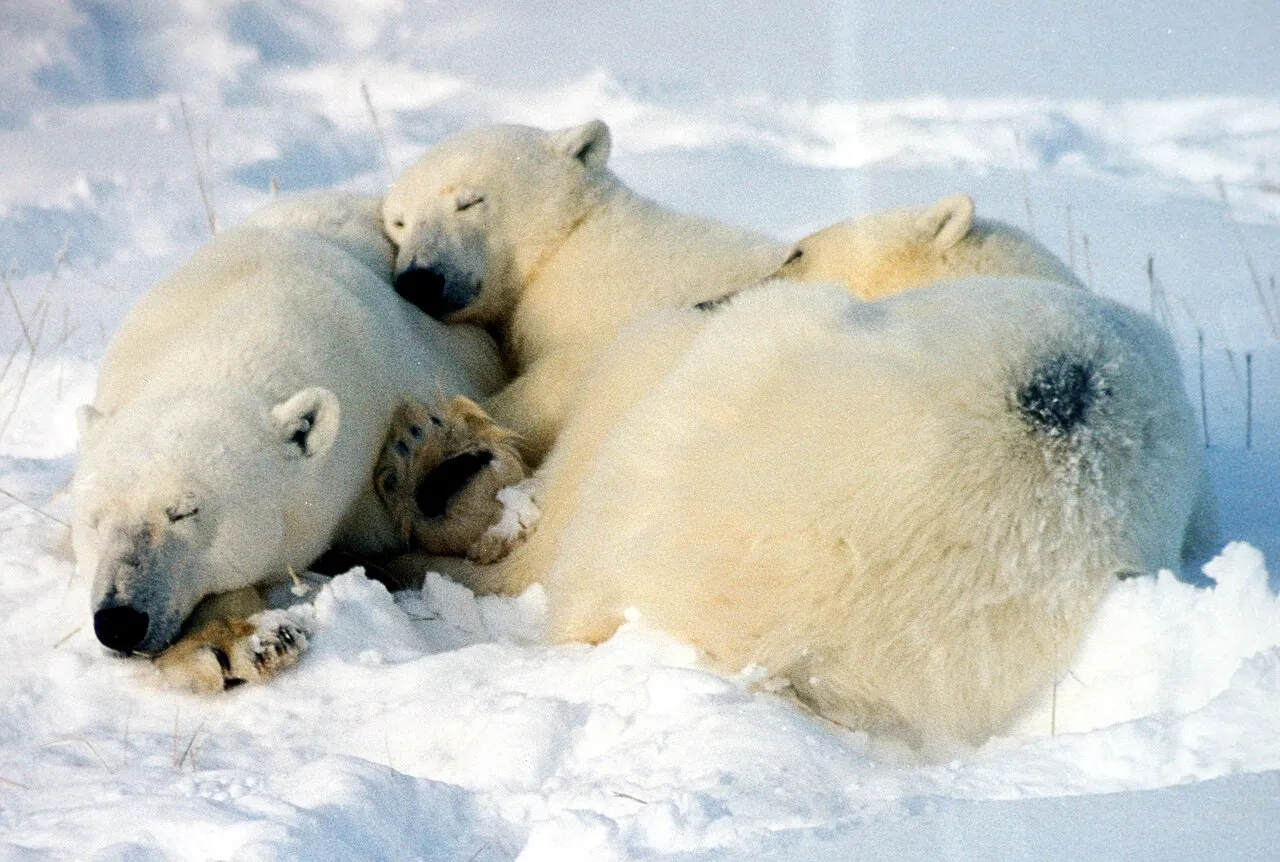
No machine-readable author provided. Mbz1 assumed (based on copyright claims). · CC BY-SA 3.0
The scientific name Ursus maritimus is Latin for maritime bear. It was formally named in the late eighteenth century and was once placed in a genus of its own, Thalarctos, but today it sits in the genus Ursus with the brown bear and American black bear.
The Inuit call the polar bear nanuq, and in Inuit culture it is a powerful being treated with deep respect by hunters. Old Norse and Scandinavian names translate roughly as ice bear or sea bear.
No subspecies are generally recognised. Instead, for research and management, the Arctic is divided into nineteen subpopulations. Each lives in a different sea-ice environment and faces different trends and threats.
3. Evolution
The polar bear is a relatively young species that branched off from the brown bear. Estimates of when vary widely, from a few hundred thousand years ago to considerably earlier, but on the timescale of bear evolution it is recent either way.
One of the oldest polar bear fossils is a jawbone from Svalbard, Norway, estimated at roughly 110,000 to 130,000 years old, showing that polar bears much like today's already existed by then.
The relationship with brown bears is complicated. Genetic studies show that the two species continued to interbreed repeatedly after they split. Brown bears on certain islands in south-eastern Alaska carry polar bear ancestry in their genomes, probably because a stranded polar bear population mixed with incoming brown bears as the ice retreated after the last Ice Age.
In recent years, as the Arctic warms and brown bears push north, wild hybrids have been confirmed. They are nicknamed pizzly or grolar bears.
In a short evolutionary span, polar bears changed a lot: the coat turned pale, the cheek teeth became sharper for shearing meat, and genes involved in processing fat and handling cholesterol in the blood shifted. Their bodies adapted rapidly to a diet built on oily seal blubber.
4. Range and habitat
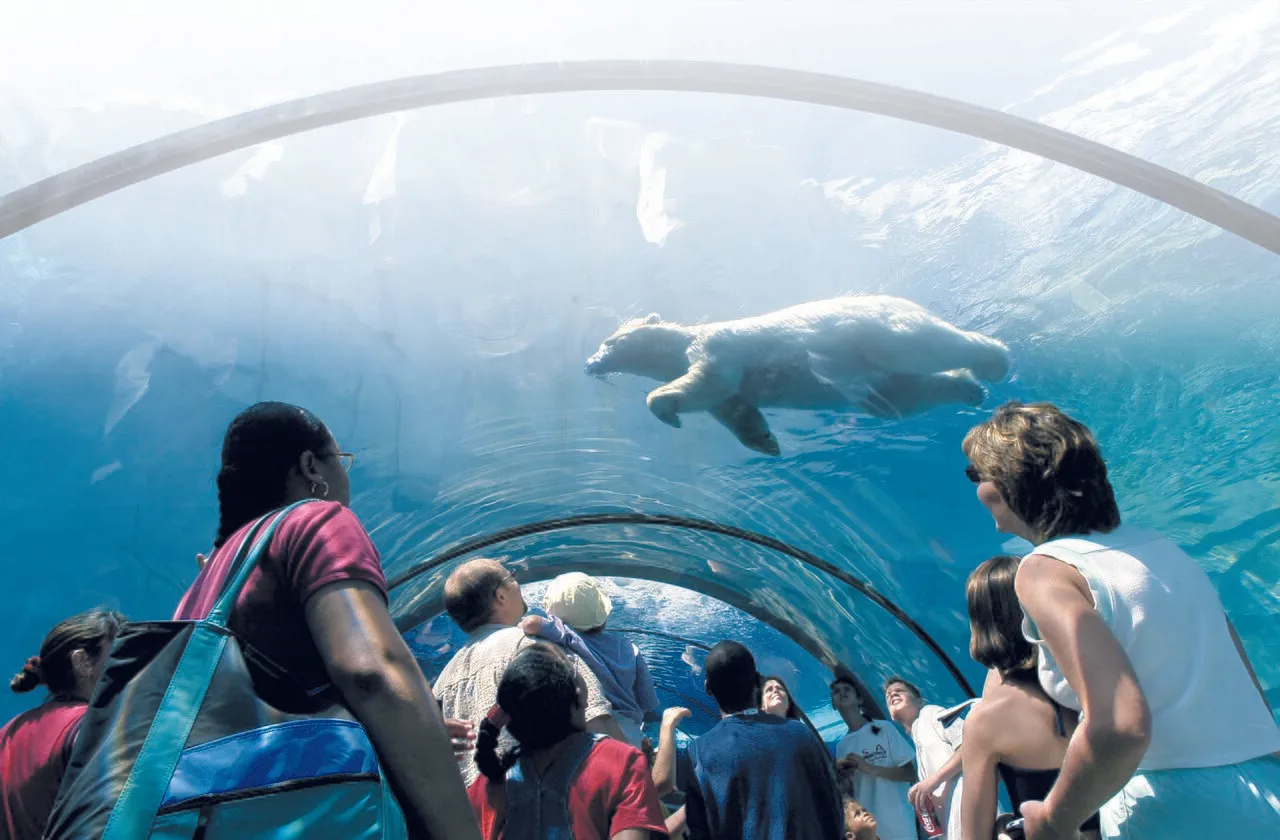
Detroitzoo · CC BY-SA 4.0
Polar bears range across the Arctic in five countries: Canada, the United States (Alaska), Russia, Greenland (Denmark) and Norway (Svalbard). Canada holds well over half the world's polar bears, often estimated at around two-thirds.
Their true habitat is not land but sea ice, especially ice over shallow continental shelves, where productive waters support plenty of seals. Leads, cracks and the edge where ice meets open water are where seals surface to breathe, making them prime hunting grounds.
Life follows the seasonal cycle of the ice, and there are two broad patterns.
| Pattern | Example areas | Lifestyle |
|---|---|---|
| Ice persists year-round | Northern Canadian Arctic islands, northern Greenland | Hunting possible all year on ice |
| Ice melts in summer | Hudson Bay, parts of Baffin Bay | Bears come ashore and fast for months until the ice returns |
In western Hudson Bay, where the ice disappears completely in summer, bears wait on land for months. In autumn they gather along the coast where ice forms first, and a small town there is famous as the polar bear capital of the world.
Home ranges are enormous, sometimes tens or even hundreds of thousands of square kilometres, depending on food and ice. Polar bears do not defend territories, and their ranges overlap widely.
5. Body
Polar bears are the largest bears and show strong sexual dimorphism. They are longer and leaner than brown bears, with a longer neck and relatively small head, a build well suited to swimming and to reaching into breathing holes for seals.
| Measure | Males | Females |
|---|---|---|
| Body length | About 2.4 to 3 m | About 1.8 to 2.4 m |
| Shoulder height | About 1.3 to 1.6 m | Smaller |
| Weight | Usually 350 to 700 kg, occasionally more | Usually 150 to 300 kg, much more when pregnant |
| Standing height | Can reach about 3 m | Smaller |
Weight swings dramatically with the seasons, peaking after spring and early summer seal hunting and dropping during ice-free months. A pregnant female may nearly double her weight before denning.
5.1. Fur and skin
Polar bear fur looks white, but each guard hair is actually unpigmented and translucent. Their hollow or complex inner structure scatters light, making the coat appear white, or creamy yellow in strong sun. A popular claim that the hairs act like fibre-optic cables channelling light to warm the skin was tested and found to be false.
Underneath, the skin is black, as are the nose, lips and footpads. The coat has two layers: dense underfur traps warm air, while long, coarse guard hairs shed water and wind.
Beneath the skin lies a blubber layer up to about 10 cm thick. It insulates, stores energy for lean times and adds buoyancy like a life jacket. Polar bears are so well insulated that overheating is a bigger risk than cold when they exert themselves, which is why they prefer walking slowly to running for long.
5.2. Paws and senses
A polar bear's paws can be around 30 cm across. They spread weight on snow and thin ice like snowshoes and serve as paddles in water: the front paws pull the bear forward while the hind paws steer. Small bumps and fur on the soles prevent slipping, and short, thick claws grip the ice and hold prey.
Smell is the polar bear's star sense. Bears are said to detect seals more than a kilometre away and to locate seal lairs hidden beneath thick snow. Sight and hearing are thought to be roughly comparable to or slightly better than ours. A protective third eyelid, the nictitating membrane, helps shield the eyes from glare and seawater.
6. Behaviour and ecology
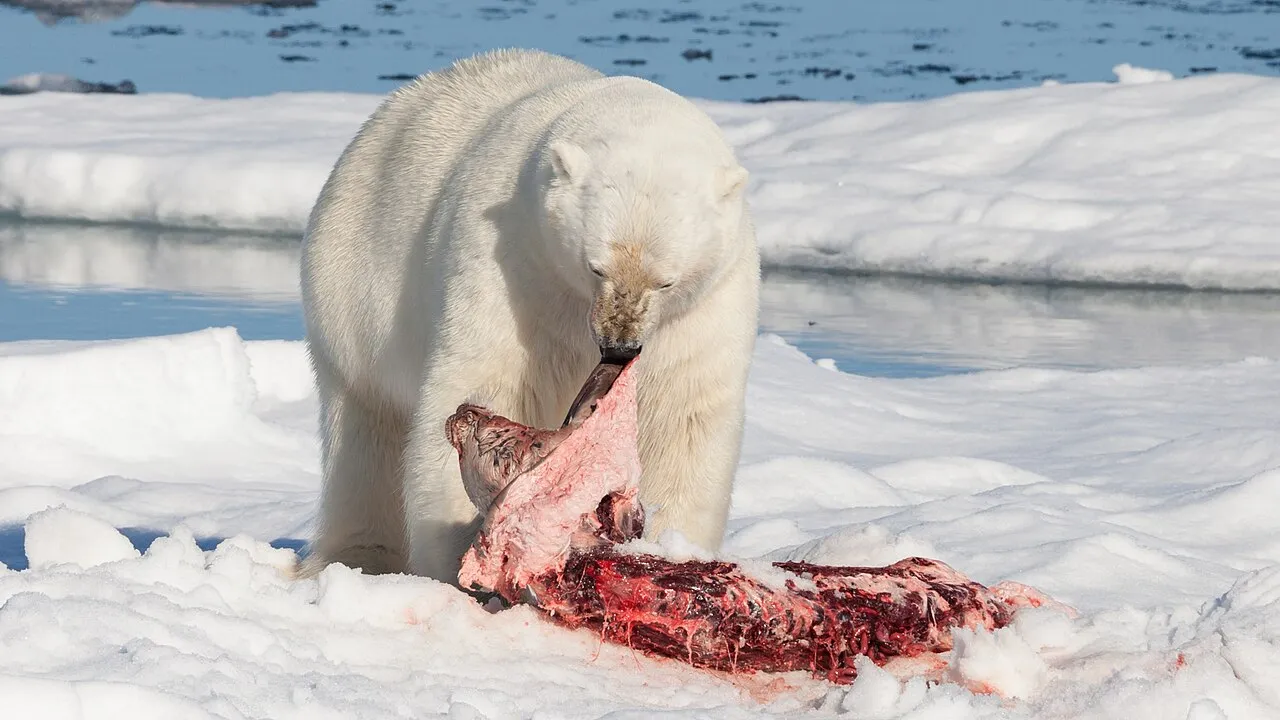
Polar bears are essentially solitary. Apart from mothers with cubs and pairs during the breeding season, they travel alone. Yet where food is plentiful, such as a whale carcass washed ashore, many bears may gather and feed with surprising tolerance. Males waiting on land for the ice in summer often play-fight with each other.
They are superb swimmers, cruising at around 10 km/h and swimming dozens of kilometres without rest. One radio-collared female was tracked swimming hundreds of kilometres over nine days. Such marathons are costly, especially for cubs, and scientists worry they are becoming more frequent as the ice retreats.
On land they can sprint at close to 40 km/h over short distances but overheat quickly, so they rarely run far. They spend much of the day resting or sleeping, and when hunting they show remarkable patience, waiting motionless for hours.
Contrary to popular belief, only pregnant females spend the winter in dens. Other bears stay active on the ice all winter, though they may dig temporary shelters in snowdrifts during severe storms.
Bears in areas where the ice melts must live for months on land with almost no food, relying on fat reserves. They reduce activity to save energy, a state some have called walking hibernation. Recent studies, however, found that polar bears cannot lower their metabolism much while fasting, so longer ice-free seasons lead to rapid weight loss.
7. Diet and feeding
The polar bear is the most carnivorous of all bears. Seals are its staple, especially ringed and bearded seals, and their thick blubber is the high-energy fuel it needs. When hunting is good, a bear may eat the fat and skin and leave much of the meat, which feeds Arctic foxes, gulls and other scavengers.
Its main hunting methods are:
- Still-hunting: seals keep breathing holes open in the ice and surface regularly. A bear lies beside a hole, motionless for hours, then strikes with a forepaw when a seal's head appears and hauls it out.
- Stalking: the bear creeps low across the ice towards a resting seal, or swims up underwater for an ambush.
- Lair raids: in spring, ringed seals give birth in snow caves on the ice. Bears sniff them out and smash through the roof with their forepaws to catch the pups.
Polar bears also take walruses, small whales such as belugas and narwhals, whale carcasses, birds and eggs, reindeer and, in summer, seaweed and berries. None of these provide energy like seals do, so seal hunting on sea ice remains the key to survival.
They can eat enormous amounts in one sitting. The blubber of one large seal can cover several days' energy needs, and a large stomach lets them binge and then fast for a long time. They rarely drink, getting most of the water they need from metabolising fat.
8. Reproduction and life cycle
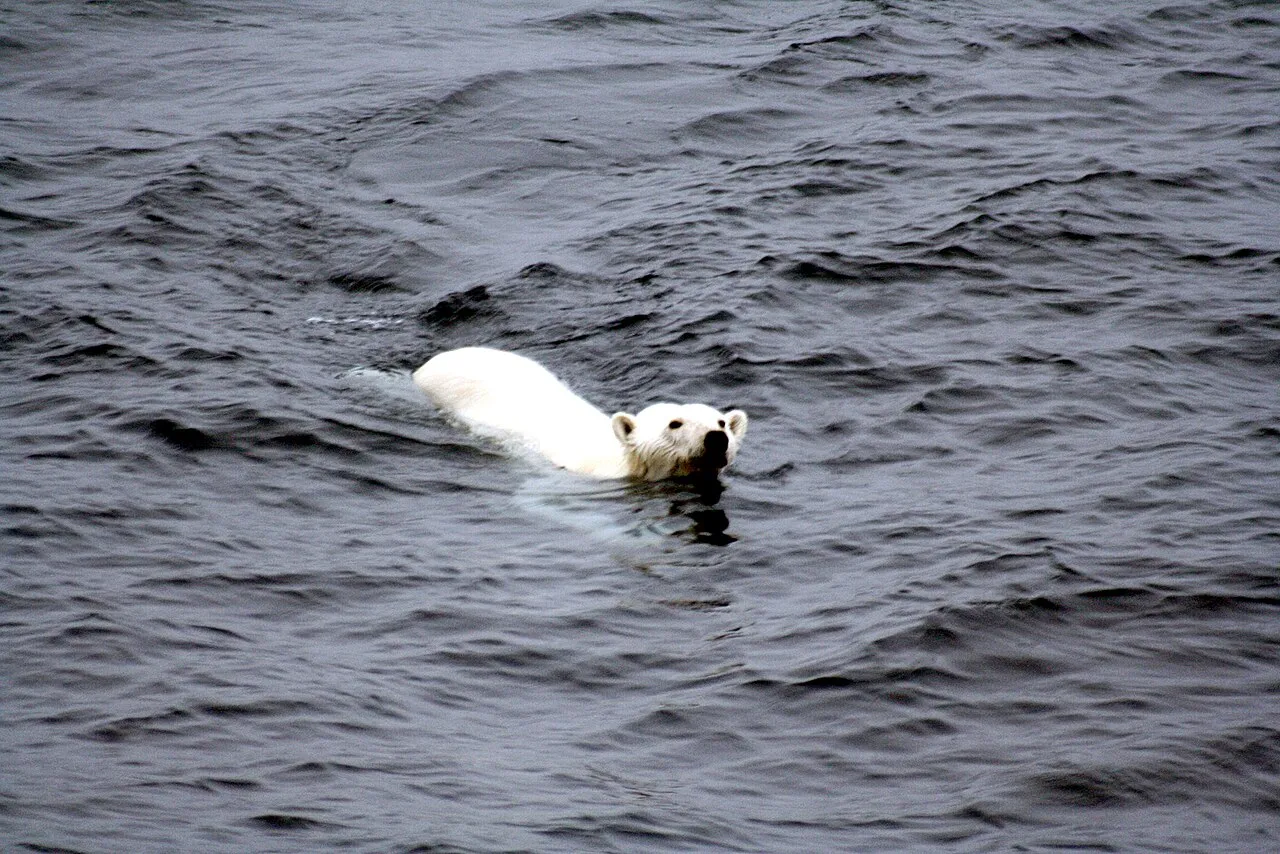
No machine-readable author provided. Mbz1 assumed (based on copyright claims). · CC BY-SA 3.0
Polar bears mate mainly in spring, around April and May, out on the sea ice. Males track the scent trails of receptive females for dozens of kilometres and fight fiercely over them, collecting scars on their faces and necks. A pair stays together for days to more than a week before parting.
Like other bears, polar bears have delayed implantation. The fertilised egg waits until autumn and implants only if the female has built up enough fat; otherwise the pregnancy may not proceed.
In October or November, pregnant females dig dens in deep snowdrifts near the coast or on hillsides and give birth between November and January, usually to twins, sometimes one or three. Newborns weigh only around 600 to 700 g, with closed eyes and short fur. For months the mother eats nothing while nursing them on extremely fat-rich milk.
| Stage | Age | What happens |
|---|---|---|
| Newborn | 0 to 1 month | About 600 to 700 g, eyes closed, nursing in the den |
| Den growth | 1 to 4 months | Eyes open, starts walking; about 10 to 15 kg on leaving the den |
| Emergence | About 3 to 4 months (March–April) | Travels with mother to the sea ice |
| Learning to hunt | 1 to 2 years | Follows mother, learns to hunt, still nurses |
| Independence | About 2 to 2.5 years | Leaves mother |
| Female maturity | About 4 to 5 years | First litter usually at 5 to 6 |
| Male maturity | About 5 to 6 years | Most breed only from 8 to 10 onwards |
| Lifespan | About 15 to 25 years in the wild | Some approach 30 |
Because mothers raise cubs for over two years, they typically breed only about every three years. Cub survival depends heavily on food; in poor ice years, mothers often cannot hunt enough and cubs starve.
9. Intelligence, communication, special abilities
Polar bears are intelligent and curious. They adjust their hunting strategies to circumstances, and captive bears quickly learn to use toys and puzzles to get food. Old Inuit accounts describe polar bears using blocks of ice or rocks to strike walruses; observations of captive bears using objects as tools have lent some support to the idea, though tool use in the wild remains unconfirmed.
They communicate largely by scent and body language. Scent from their footpads is left in their tracks, and research suggests other bears can tell from it who passed by, their sex and their breeding condition, valuable information for animals scattered across vast icescapes.
Vocal signals include hisses, growls and jaw-popping when threatened. Mothers and cubs call softly to each other, and nursing cubs make a contented humming sound.
Their greatest gift is endurance. They maintain body temperature at below minus 40°C and can survive months without eating. Their livers store such enormous amounts of vitamin A that eating one can poison a human; early Arctic explorers left accounts of falling seriously ill after doing exactly that.
10. Predators and survival
Adult polar bears are the apex predators of the Arctic. Apart from humans, nothing routinely hunts them, though killer whales may attack them at sea and walruses can inflict fatal wounds with their tusks.
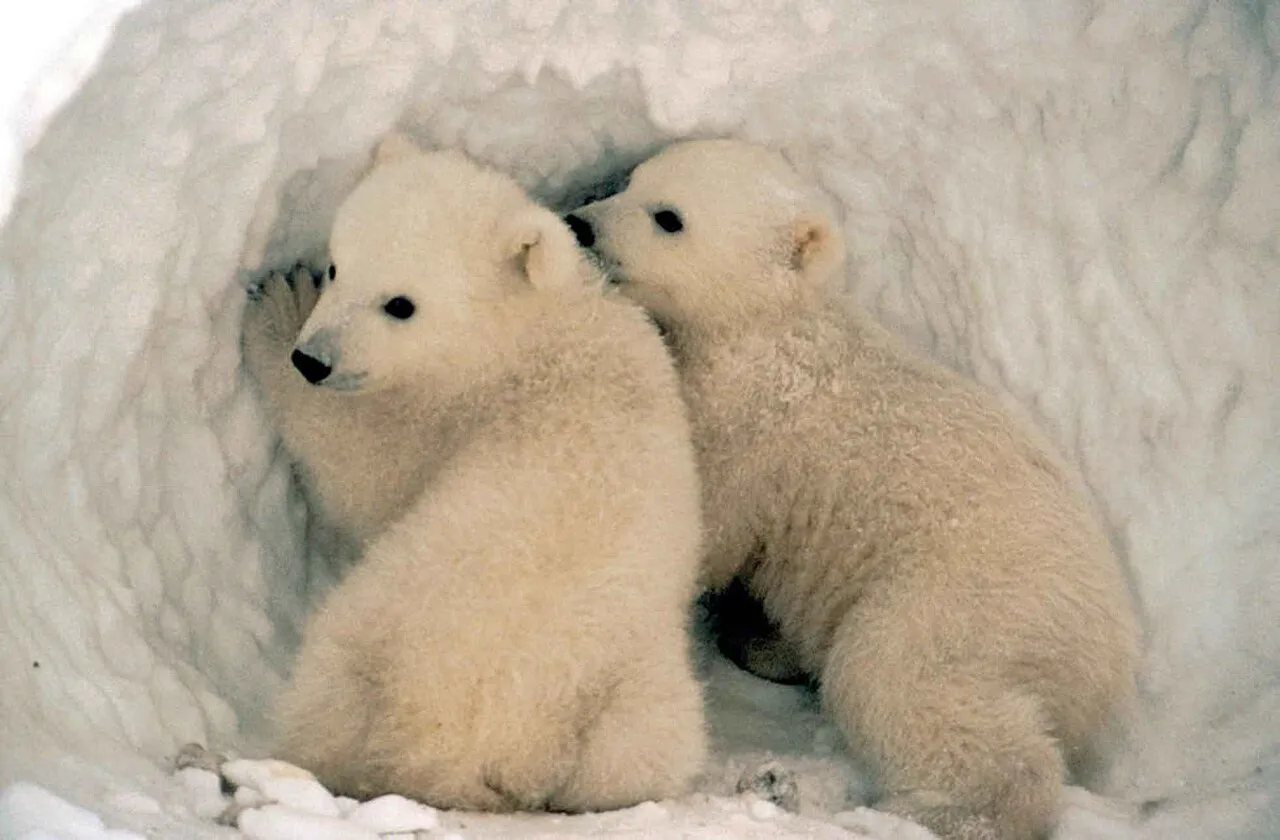
The biggest danger to cubs is other polar bears, especially large males. Males have been seen killing and eating cubs, apparently more often when food is scarce. Mothers will confront males far larger than themselves to protect their young. Cubs also die from starvation, cold and separation from their mothers.
The overriding threat to survival is sea-ice loss. Without ice, bears cannot hunt seals, and longer fasts on land mean weight loss, lower reproduction and poorer cub survival. In some subpopulations, declines in body condition and numbers have already been documented.
Pollution is serious too. Sitting at the top of the food chain, polar bears accumulate persistent organic pollutants and mercury carried to the Arctic by ocean and air currents, which can harm immunity, hormones and reproduction.
11. Relationship with humans
Arctic peoples have lived alongside polar bears for thousands of years. For the Inuit and other Indigenous communities, the bear was a vital source of meat and fur and also a being of great spiritual standing. In many Inuit stories polar bears think and speak like people and sometimes take human form. Some communities still hunt polar bears under strict quotas today.
European exploration brought new pressures. Through the nineteenth and twentieth centuries, explorers, whalers, fur traders and later trophy hunters killed many bears, and by the mid-twentieth century, hunting from aircraft and snowmobiles had driven numbers down sharply.
In response, the five polar bear range states signed the Agreement on the Conservation of Polar Bears in 1973. It banned hunting from aircraft and large motorised vessels, committed the parties to protecting habitat and coordinated research. Signed by Cold War rivals, it is hailed as a landmark of international conservation cooperation, and numbers recovered in many areas afterwards.
Today human–bear conflict is a growing concern. With less ice, bears spend longer on land and are drawn to villages, rubbish dumps and research stations. Some Arctic communities run polar bear patrols that scare bears away with noise and light before conflicts arise.
Polar bears are listed on CITES Appendix II, so international trade in bear parts is controlled. Polar bears also appear in children's culture worldwide, from cartoons to soft toys, making them familiar even to people who will never see the Arctic.
12. Conservation
The polar bear is listed as Vulnerable on the IUCN Red List. The 2015 assessment estimated the global population at roughly 22,000 to 31,000, with a central figure around 26,000, though several of the nineteen subpopulations lack good data.
Trends differ between subpopulations. Some appear stable or even increasing, while declines have been reported where ice loss is severe, such as western Hudson Bay and the southern Beaufort Sea. Scientists warn that if greenhouse gas emissions continue at current rates, many subpopulations could shrink drastically or disappear by the end of the century.
Key threats:
- Sea-ice loss and longer ice-free seasons driven by climate change
- Pollution, including persistent organic pollutants and mercury
- Oil and gas development and increased shipping, raising spill risks and disturbance
- Bears killed in conflicts with people
- Overharvest (now largely regulated)
Polar bears are on CITES Appendix II, which regulates international trade by permit. In 2008 the United States listed the polar bear as threatened under its Endangered Species Act, one of the first listings to cite climate change as the primary threat.
Ultimately, the most important step for polar bears is cutting greenhouse gas emissions to preserve sea ice, which makes their fate a global responsibility rather than an Arctic one.
13. In zoos
Polar bears have long drawn crowds at zoos, yet they are among the animals least suited to captivity. In the wild they roam tens of thousands of square kilometres, and in confined spaces they readily develop stereotypic behaviours such as pacing the same route or repetitive head swaying. One study found that carnivores with large natural ranges show more such behaviour in captivity, and the polar bear was a prime example.
Zoos in warm climates face another problem: summer heat. There have even been cases of algae growing inside polar bears' hollow hairs, turning their coats green. For these reasons, some countries and zoos have stopped keeping polar bears or decided not to acquire new ones.
Good modern facilities aim to provide large areas, deep pools, varied substrates, enrichment programmes that make bears search for food, and cooling. Some take in orphaned cubs rescued from the wild. Supporters argue that zoos can educate visitors about polar bears and climate change; critics counter that animals needing so much space should not be kept at all.
A polar bear can never be a pet. It is one of the largest land carnivores on Earth and may regard humans as prey. In the Arctic, visitors must keep their distance and follow local bear-safety rules.
14. In culture
Polar bears are beloved in popular culture worldwide. A soft-drink company's animated polar bear family became a fixture of winter advertising for decades. In Philip Pullman's fantasy trilogy His Dark Materials, armoured talking bears are noble, formidable warriors.
Polar bears star in countless children's cartoons and picture books, often as gentle giants. Mascots, toys and snack brands borrow their friendly image.
Above all, the polar bear has become the emblem of climate change. Images of a lone bear on a shrinking ice floe, or of an emaciated bear searching for food, have become powerful symbols of global warming. Some scientists caution, though, against tying any individual bear's condition directly to climate change, or relying on emotion alone.
Polar bears have long been a central subject in Inuit carving and printmaking, and they appear on Canadian coins and many Arctic emblems. 27 February is International Polar Bear Day, highlighting the importance of protecting both bears and sea ice.
15. Trivia
- Polar bear skin is black and the hairs are translucent; the white look comes from light scattering.
- The famous story that hunting polar bears cover their black noses with a paw has almost never been observed.
- Polar bears do not live in Antarctica, so pictures of polar bears with penguins are pure fantasy.
- A polar bear's liver holds so much vitamin A that eating it can poison a person.
- Their insulation is so good that on infrared cameras little more than their breath and face shows up.
- A newborn cub weighs only around 600 g, well under one percent of its mother's weight.
- Polar bears can swim for hours but cannot hold their breath underwater for more than a few minutes.
- As warming brings brown bears north, wild polar–brown bear hybrids have been confirmed.
Wild animals are not pets. Catching, trading or keeping them is illegal in most places. If you find an injured wild animal, call your local wildlife rescue centre.
FAQ
Do polar bears hibernate?
Only pregnant females den through the winter to give birth. Other polar bears stay active, hunting on the ice.
Why does polar bear fur look white?
The hairs lack pigment and are translucent; they scatter light, so the coat looks white. The skin underneath is black.
Why is climate change dangerous for polar bears?
Sea ice is their seal-hunting platform. When it forms later and melts sooner, fasting periods lengthen, lowering body condition, breeding and cub survival.
Photo credits
Photos are freely licensed images from Wikimedia Commons. Authors and licenses are listed below.
- Polar Bear AdF.jpg — Arturo de Frias Marques · CC BY-SA 4.0
- Mother cubs.JPG — No machine-readable author provided. Mbz1 assumed (based on copyright claims). · CC BY-SA 3.0
- Polar Bear at DZ.jpg — Detroitzoo · CC BY-SA 4.0
- Polar bear (Ursus maritimus) with its prey.jpg — AWeith · CC BY-SA 4.0
- Polar bear arctic.JPG — No machine-readable author provided. Mbz1 assumed (based on copyright claims). · CC BY-SA 3.0
- Polar bear cubs in the snow.jpg — U.S. Fish and Wildlife Service · Public domain