TailVille
1. Overview
The panther chameleon is a lizard from Madagascar, the great island off Africa's east coast. Males flaunt a riot of turquoise, orange, red, yellow and green, and for many people this is what a chameleon looks like.
Chameleons as a group are famous for eyes that swivel independently, a tongue that shoots out faster than the eye can follow, feet shaped like tongs and a tail that grips branches like a fifth hand. The panther chameleon has all of these features and has been studied intensively; it was the animal in which scientists worked out how chameleons physically change colour.
Its beauty has also been a burden. Panther chameleons are among the most traded reptiles in the international pet market, and many animals have been exported from Madagascar, often suffering high mortality along the way. This article focuses on the panther chameleon, but also explains features shared by chameleons in general.
2. Name and classification
B.navez · CC BY-SA 3.0
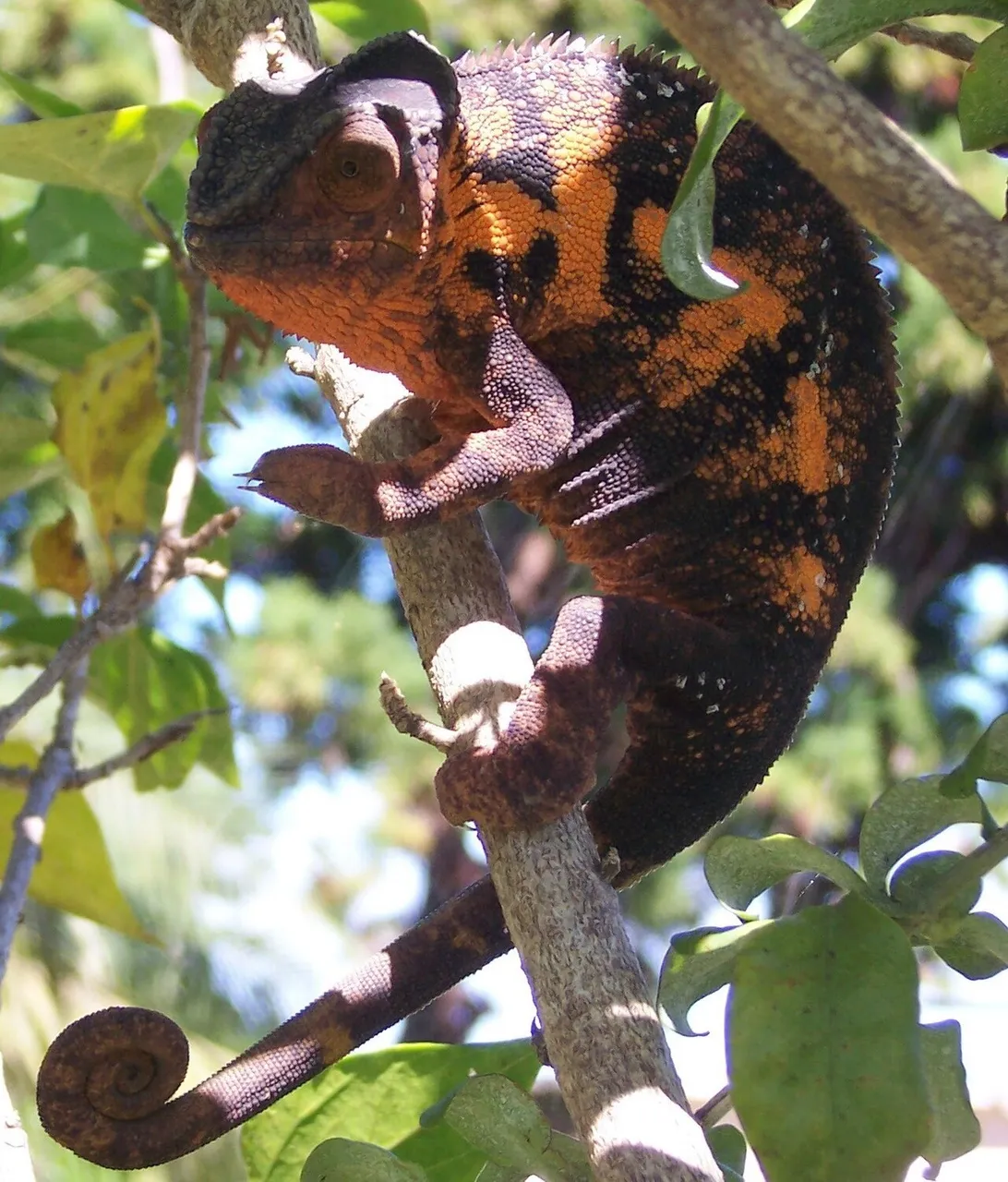
Its scientific name is Furcifer pardalis. Furcifer is Latin for 'fork-bearer', usually explained as a reference to the chameleon's split, fork-like feet. Pardalis refers to the leopard or panther, after the spotted and barred pattern. The species was described by Georges Cuvier in 1829.
The word chameleon comes from Greek khamai, 'on the ground', and leon, 'lion' — a 'ground lion', perhaps for the crested heads and stately walk of the species the Greeks knew.
The family Chamaeleonidae contains around 200 to 220 species, nearly half of which live in Madagascar. Furcifer is almost entirely Malagasy. Biologists divide the family into the mostly tree-dwelling true chameleons and the small, brownish leaf chameleons of the forest floor, such as Brookesia.
2.1. Locales
Males differ so strikingly in colour from region to region that each population is named after its locality. Animals from the island of Nosy Be tend to be blue and turquoise; those from around Ambilobe in the north show bold banding in red, green and blue; east-coast populations lean toward red and pink.
A 2014 genetic study found that many of these locales are also genetically distinct and suggested the panther chameleon may be a complex of several cryptic species. As of now it is still treated as a single species.
3. Evolution
Chameleons are close relatives of agamid lizards; together they form a group called the acrodont iguanians. A tiny lizard preserved in roughly 99-million-year-old Burmese amber was once hailed as the oldest chameleon relative, though its placement is debated. Unquestionable chameleon fossils come from the Miocene, around 20 million years ago, in Africa and Europe.
Where chameleons first arose is still discussed. Many molecular studies favour mainland Africa as the cradle, with several later ocean crossings to Madagascar, the Seychelles and the Comoros. Once in Madagascar, chameleons diversified spectacularly, producing both Parson's chameleon, one of the largest, and Brookesia nana, among the smallest reptiles known.
The projectile tongue, grasping feet, independently moving eyes and prehensile tail probably evolved together as a package for a sit-and-wait hunting life in vegetation.
4. Range and habitat
Charles J. Sharp · CC BY-SA 4.0
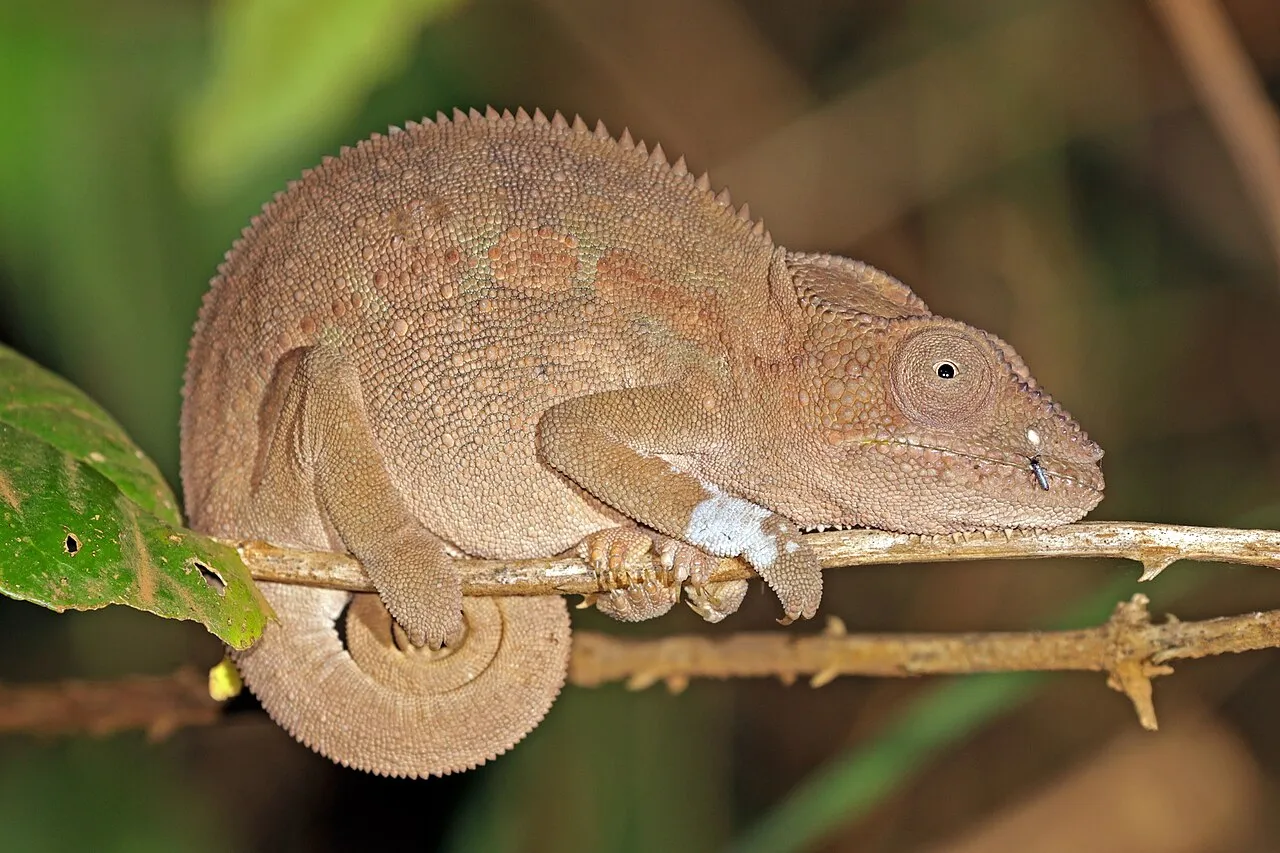
The panther chameleon's native range covers the lowlands of northern Madagascar and much of the east coast, including offshore islands such as Nosy Be. Introduced populations have established themselves on Réunion and Mauritius.
Rather than deep, closed-canopy forest, it prefers sunny, open places: forest edges, scrub, riverbanks, and trees and hedges around villages and farms. This tolerance of disturbed habitat helps explain why it remains common in many areas even as primary forest disappears.
The climate is hot and humid, with daytime temperatures typically in the high twenties to low thirties Celsius, cooler nights around 20 °C, and a pronounced rainy season. Morning dew and rain are vital water sources, because most chameleons do not recognise standing water and instead lick droplets from leaves.
5. Body
Males and females look so different they could pass for separate species.
| Feature | Males | Females |
|---|---|---|
| Total length incl. tail | Usually 35–45 cm, up to about 50 cm | Usually 23–35 cm |
| Weight | Roughly 140–180 g | Roughly 60–100 g |
| Colour | Vivid blue, green, red, orange | Tan, grey or peach; dark with orange marks when gravid |
The body is laterally flattened, making the animal look like a leaf on a branch, with a row of small bumps along the spine. There is a modest helmet-like casque on the head but no horns.
The feet are zygodactyl: the five toes are bundled into a group of two and a group of three that close like tongs, with opposite arrangements on front and hind feet, so they can clamp onto branches of almost any thickness. The prehensile tail wraps around twigs and is coiled up when at rest. Unlike many lizards, chameleons cannot drop and regrow their tails.
5.1. Eyes and tongue
Each eye sits in a cone-shaped, scaly turret with only a pinhole opening for the pupil. The eyes move independently, so one can watch forward while the other scans behind, giving almost 360-degree coverage without moving the head. When prey is spotted, both eyes swing forward to judge distance. Studies suggest chameleon eyes can focus unusually fast thanks to their lens structure.
The tongue can extend 1.5 to 2 times the body length. Elastic collagen sheaths around the tongue bone store energy like a catapult and release it in an instant, giving accelerations that far exceed those of a fighter jet. The tip is coated in thick, sticky mucus and works partly like a suction cup to hold prey.
6. Behaviour and ecology
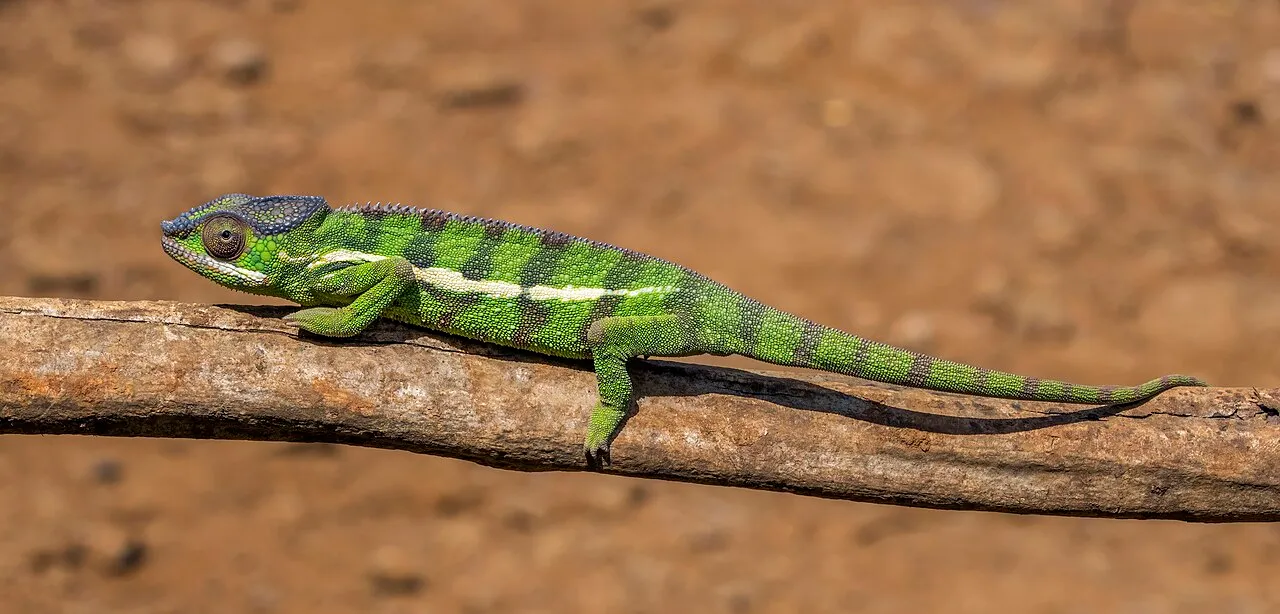
Panther chameleons are active by day and spend nearly all their time in shrubs and trees. In the morning they move to sunny perches to bask, often darkening their skin to absorb more heat. Once warm, they creep along branches with a jerky, rocking gait that is thought to mimic a leaf trembling in the breeze.
Adults are solitary, and males are intolerant of other males. When two meet, each flattens its body sideways to look bigger, flushes into its brightest colours and gapes. Usually one backs down by darkening and retreating, but contests can escalate into biting.
At night they sleep on thin twigs near the ends of branches. Sleeping chameleons turn pale and almost glow in torchlight, which researchers use to count them. Sleeping on slender twigs may give early warning: a heavy predator such as a snake would shake the branch on its approach.
7. Diet and feeding
Panther chameleons are almost entirely insectivorous. Grasshoppers, crickets, flies, moths and butterflies, cockroaches and beetles are all on the menu, and large males occasionally take small lizards or nestling birds. They sometimes nibble leaves or flowers, possibly for moisture or nutrients.
Hunting combines patience and stealth. A chameleon may sit motionless for long periods, eyes swivelling. When prey comes within range, it inches forward, locks both eyes onto the target and fires its tongue. The whole strike, from launch to retrieval, takes well under a second.
Water comes mainly from licking dew and raindrops off leaves. Chameleons are attracted to moving or glistening droplets and often ignore still water entirely.
8. Reproduction and life cycle
Charles J. Sharp · CC BY-SA 3.0
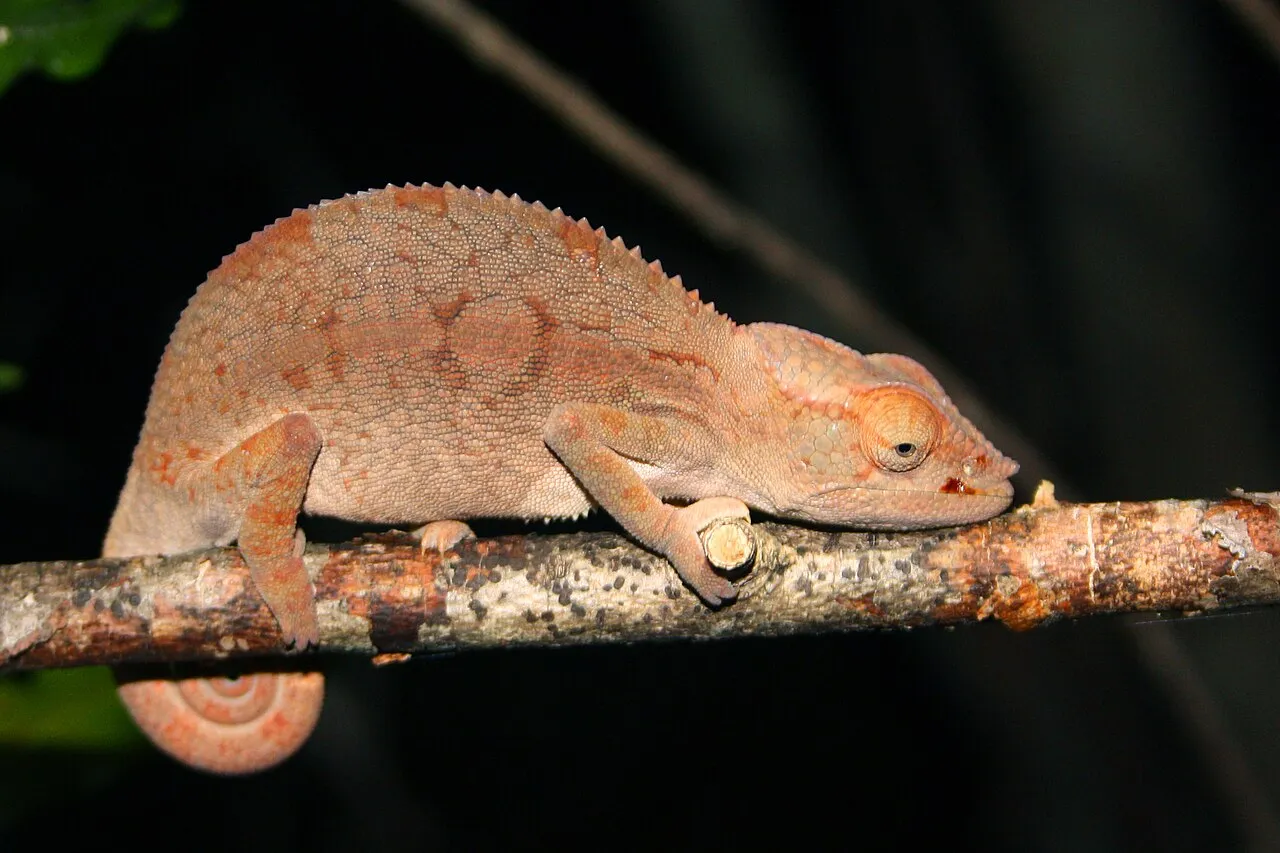
In the breeding season males blaze with their brightest colours and approach females with head-bobbing displays. A receptive female accepts calmly. One that is unreceptive or already carrying eggs turns dark brown or black with vivid orange markings, gapes and hisses — a colour-coded rejection that males usually respect.
About three to six weeks after mating, the female climbs down, digs a burrow in moist soil and lays her clutch, typically 10 to 40 eggs, sometimes more. Females can store sperm and lay multiple clutches from a single mating. The eggs develop slowly underground for roughly six to twelve months, sometimes pausing development during cooler periods.
| Stage | Duration or age | Notes |
|---|---|---|
| Egg | About 6–12 months | Buried in soil |
| Hatchling | Up to 3 months | About 5 cm, hunts independently from day one |
| Juvenile | 3–7 months | Rapid growth; males begin to colour up |
| Adult | From about 7–12 months | Able to breed |
Life is short. Wild males may live around two to five years; females often live less, worn down by producing clutch after clutch. Reliable data on wild lifespan are limited.
9. Intelligence, communication, special abilities
For a long time chameleon colour change was explained solely by pigment cells spreading or concentrating their pigments. In 2015, researchers in Switzerland studying panther chameleons showed that much of the magic happens in a deeper layer of skin cells called iridophores. These contain a lattice of tiny guanine nanocrystals. When the animal is relaxed, the crystals are packed closely and reflect blue light, which combines with yellow pigment above to look green. When the chameleon is excited, the lattice expands, shifting reflected light toward yellow, orange and red. The vivid shifts are therefore largely structural colour — physics rather than paint.
Colour change in panther chameleons is mainly social and physiological, not camouflage. It signals dominance to rivals, attracts or rejects mates and helps regulate body temperature. Experiments suggest that males who brighten more intensely and quickly tend to win contests.
Chameleons see ultraviolet light, and a 2018 study found that bony bumps on the heads of some species fluoresce blue under UV, possibly as a signal. They rarely use sound but may communicate through low-frequency vibrations transmitted along branches.
10. Predators and survival
Predators include snakes, birds of prey, crows and other large birds, and some of Madagascar's carnivorous mammals. Eggs and hatchlings also fall prey to ants, small mammals and other reptiles, and juvenile mortality is very high.
The first line of defence is not being noticed: the resting green and brown colours, leaf-like flattened body and swaying walk all help. If discovered, a chameleon puffs up, gapes and hisses to look bigger. Failing that, it may sidle around to the far side of a branch or simply let go and drop into the undergrowth.
People add pressures of their own: burning and clearing of vegetation, road traffic and collection for the pet trade. Its tolerance of disturbed habitat gives it more resilience than many Malagasy chameleons, but it is not immune.
11. Relationship with humans
In Madagascar, chameleons figure in a variety of local beliefs, which differ from region to region. In some places they are considered ill-omened and avoided; in others there are taboos against harming them.
The biggest issue in the human relationship with panther chameleons is the international pet trade. Since the 1980s large numbers have been exported to Europe, North America and Asia. Madagascar manages exports under CITES with annual quotas, but wild-caught animals often die from dehydration, parasites and stress during capture, holding and long-distance shipping. In captivity, failure to precisely provide UV light, temperature gradients, humidity and moving water commonly leads to metabolic bone disease, dehydration and infection.
For these reasons we do not recommend keeping panther chameleons. Even legal trade places a heavy burden on wild populations and on individual animals, and unpermitted import or export is illegal in many countries. In Korea the species is regulated as a CITES Appendix II internationally endangered species, requiring permits. The best way to meet one is through documentaries or responsible wildlife tourism in Madagascar.
12. Conservation
The panther chameleon is listed as Least Concern on the IUCN Red List, thanks to its wide range, tolerance of farmland and villages, and abundance in many areas. No reliable total population estimate exists.
That does not mean there is nothing to worry about. Madagascar has lost a large share of its original forest over recent decades, and slash-and-burn agriculture, charcoal production and expanding farmland continue. If genetic work leads to the species being split, some locales with small ranges might warrant higher threat categories.
For chameleons as a whole the picture is grimmer. Many species are confined to small patches of montane forest and are listed as Endangered or Critically Endangered. Almost all chameleons are on CITES Appendix II, so international trade requires permits. Expanding protected areas, community-based forest management and enforcement against illegal collection are central to conserving them.
13. In zoos
Panther chameleons are a fairly common sight in zoo reptile houses. Good facilities provide well-ventilated mesh enclosures with live plants, UVB lighting and a basking heat source, and drip or misting systems to supply water. Males are usually kept out of sight of each other, since simply seeing a rival is stressful.
Even for professionals, keeping chameleons healthy long term is demanding. The norm is to display captive-bred animals; importing wild-caught chameleons for display is widely criticised.
Zoo displays can have educational value, letting visitors see colour change and tongue strikes firsthand and drawing attention to Madagascar's disappearing forests. Given the species' short life and sensitivity to stress, however, many argue that displays should be small and that welfare must come first.
14. In culture
Around the world, 'chameleon' describes a person who changes their views or behaviour to suit the situation, sometimes as criticism of an opportunist, sometimes as praise for a versatile actor or musician. Biologically, the metaphor is only half right: panther chameleons change colour to express mood and send signals more than to blend in.
In many African folk tales the chameleon is a messenger of the gods. A widespread story tells how the creator sent the chameleon to tell humans they would live forever, but it dawdled so long that a faster lizard, sent later with the message of death, arrived first — and so people became mortal. Details vary by region.
Chameleons are staples of animation and games: Pascal, the expressive sidekick in Disney's Tangled; the hero of the animated western Rango; and countless colour-shifting or invisible characters and monsters inspired by them. Culture Club's 1983 hit Karma Chameleon gave the animal a place in pop music too.
15. Trivia
- Brookesia nana, described from Madagascar in 2021, may be the smallest known reptile: adult males are under about 2.5 cm long including the tail.
- At the other extreme, Parson's chameleon and Malagasy giant chameleon can exceed 60 cm.
- Research suggests that smaller chameleon species have proportionally longer and faster tongues.
- Female panther chameleons show their dark 'no' colours both when rejecting males and when already gravid, so their reproductive state can be read at a glance.
- Chameleons lack an external ear opening and hear airborne sound poorly, though they sense low-frequency vibrations.
- Because locales are named after places, the locale labels attached to traded animals are frequently inaccurate.
- When a chameleon picks a target, it switches from scanning with each eye separately to fixing both eyes on the prey almost instantly.
Wild animals are not pets. Catching, trading or keeping them is illegal in most places. If you find an injured wild animal, call your local wildlife rescue centre.
FAQ
Do chameleons change colour to match their background?
Mostly not. In panther chameleons, colour change is driven far more by mood, temperature, courtship and rivalry; camouflage comes mainly from their resting colours and patterns.
Why is it called a 'panther' chameleon?
The species name pardalis comes from the Latin for a leopard or panther, referring to its spots and bars.
They are widely sold as pets — is that okay?
We don't recommend it. Wild-caught animals often die from transport stress, their needs are very hard to meet in captivity, and international trade is regulated under CITES permits.
Photo credits
Photos are freely licensed images from Wikimedia Commons. Authors and licenses are listed below.
- Panther chameleon (Furcifer pardalis) male Nosy Be.jpg — Charles J. Sharp · CC BY-SA 4.0
- FurciferPardalisFemale.JPG — B.navez · CC BY-SA 3.0
- Panther chameleon (Furcifer pardalis) female Montagne d’Ambre.jpg — Charles J. Sharp · CC BY-SA 4.0
- Panther chameleon (Furcifer pardalis) male Montagne d’Ambre.jpg — Charles J. Sharp · CC BY-SA 4.0
- Panther chameleon furcifer pardalis female.jpg — Charles J. Sharp · CC BY-SA 3.0