TailVille
1. Overview
The green sea turtle is a large marine turtle found throughout the world's tropical and subtropical seas. With a shell up to around a metre long and a weight of 100 to 200 kilograms, it is among the largest sea turtles after the leatherback. Despite the name, its shell is olive, brown or nearly black; 'green' refers to the colour of its body fat, tinted by a diet of seagrass and algae.
It is the only sea turtle that is essentially herbivorous as an adult. Grazing seagrass meadows like underwater lawnmowers, green turtles help keep these important ecosystems productive and healthy.
Green turtles are also famous for natal homing: decades after hatching, females swim thousands of kilometres back to the region of the beach where they were born to lay their own eggs. For centuries they were heavily exploited for meat, eggs and fat, and today they still face bycatch in fishing gear, plastic pollution, coastal development and climate change.
Decades of protection have brought strong recoveries at many nesting sites, and in 2025 the IUCN moved the species' global Red List status from Endangered to Least Concern. Some regional populations are still declining, however, so the change does not mean protection can stop. Green turtles occasionally reach Korean waters, especially around Jeju Island, where they are a designated protected marine species.
2. Name and classification
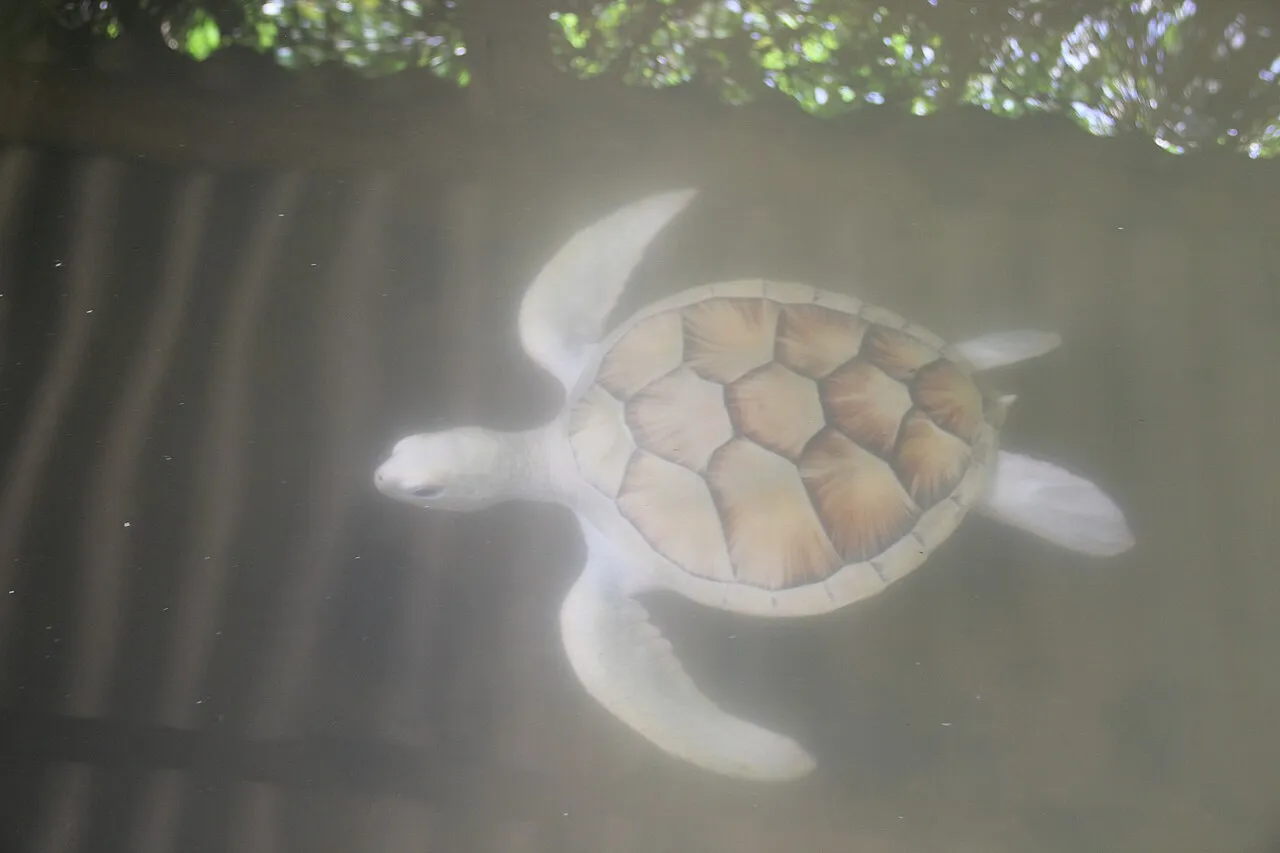
Antony Stanley from Gloucester, UK · CC BY-SA 2.0
The green sea turtle, Chelonia mydas, is the only species in the genus Chelonia within the hard-shelled sea turtle family Cheloniidae. Linnaeus described it in 1758. Chelonia comes from the Greek for tortoise, and mydas is usually traced to a Greek word meaning wet or damp.
There are seven living sea turtle species:
| Species | Scientific name | Notes |
|---|---|---|
| Green turtle | Chelonia mydas | herbivorous adults, worldwide tropics and subtropics |
| Loggerhead | Caretta caretta | large head, eats crabs and molluscs |
| Hawksbill | Eretmochelys imbricata | hawk-like beak, eats sponges |
| Olive ridley | Lepidochelys olivacea | mass nesting events |
| Kemp's ridley | Lepidochelys kempii | smallest and rarest, Gulf of Mexico |
| Flatback | Natator depressus | found only around Australia |
| Leatherback | Dermochelys coriacea | largest, leathery shell, eats jellyfish |
The dark-coloured population of the eastern Pacific, known as the black turtle, has sometimes been proposed as a separate subspecies or species. Genetic studies have generally found it not clearly distinct, so it is usually treated as a regional population of the green turtle.
3. Evolution
Turtle ancestors appeared in the Triassic, around the time of the first dinosaurs. Odontochelys, a roughly 220-million-year-old fossil from China, had a complete lower shell but an incomplete upper shell, offering important clues to how the turtle shell evolved.
Sea turtle ancestors entered the oceans in the Cretaceous. A fossil from Colombia about 120 million years old is considered one of the oldest known sea turtles. Cretaceous seas held a greater variety of marine turtles than today, including Archelon, a four-metre giant from North America's shallow inland sea, which belonged to an extinct group separate from modern sea turtles.
Sea turtles survived the mass extinction that ended the age of dinosaurs and diversified into today's lineages during the Cenozoic. Estimates of when the green turtle lineage split from other sea turtles vary, but it was tens of millions of years ago. Modern green turtle populations are genetically divided between the Atlantic and the Indo-Pacific, a pattern attributed to the rise of the Isthmus of Panama and the cold waters off southern Africa, which long separated the two ocean basins.
4. Range and habitat
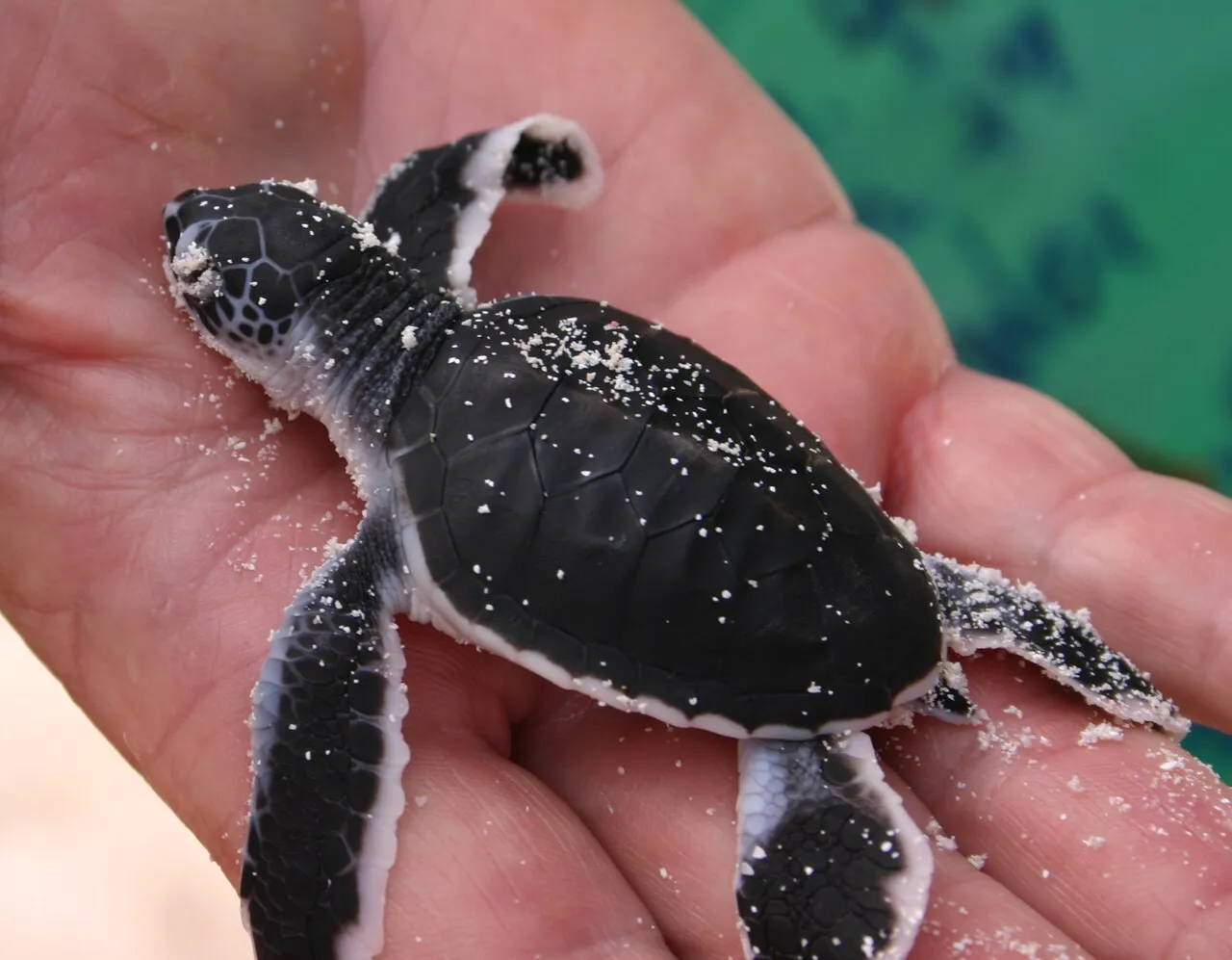
Manuel Heinrich Emha · CC BY-SA 2.5
Green turtles occur widely in tropical and subtropical waters of the Atlantic, Indian and Pacific Oceans. They generally prefer water above about 20°C but wander into temperate seas while foraging or drifting with currents.
Major nesting sites include Raine Island on the northern Great Barrier Reef, Tortuguero on Costa Rica's Caribbean coast, Ascension Island in the mid-Atlantic, the coast of Oman, islands of Malaysia and Indonesia, the north-western Hawaiian Islands and the Galápagos. Raine Island is regarded as the world's largest green turtle rookery, where thousands of females may come ashore on a single night in peak season.
Habitat shifts over a lifetime. Hatchlings head out to the open ocean, drifting with currents among floating seaweed for several years, a period so hard to observe that it was long called the 'lost years'. Once their shells reach a certain size, juveniles move to shallow coastal waters with seagrass beds, coral and rocky reefs. Adults travel hundreds or thousands of kilometres between feeding grounds and nesting beaches.
In Korean waters, green turtles are found mainly around Jeju Island and along the south coast, usually as bycatch in fishing nets or stranded on shore, probably carried north by the Kuroshio Current. There is no confirmed evidence of regular nesting on Korean beaches.
5. Body
| Measurement | Typical value |
|---|---|
| Shell length | adults usually 80–120 cm |
| Weight | usually 70–200 kg, occasionally over 300 kg |
| Front flippers | long and paddle-like, with a single claw |
| Swimming speed | about 2–3 km/h cruising, faster in bursts |
Size varies considerably by region; Atlantic and some Indian Ocean populations are large, while the dark eastern Pacific turtles are relatively small.
The smooth, heart-shaped or oval shell has five large central scutes and four on each side. The scutes meet edge to edge rather than overlapping, distinguishing green turtles from hawksbills. The head is small and rounded, with a single pair of large scales between the eyes, another identification feature.
The lower jaw has a finely serrated edge, perfect for cropping seagrass. Turtles have no teeth; a hard, keratin-covered beak does the work.
The front limbs are long flippers that beat up and down like wings, so turtles appear to fly through the water. The short, broad hind flippers act as rudders and are used by females to dig nest chambers. Unlike land tortoises, sea turtles cannot retract their head or limbs into the shell.
Males have much longer, thicker tails that extend well beyond the shell, and larger, curved claws on the front flippers for gripping the female during mating.
Salt glands behind the eyes excrete excess salt from seawater and food as concentrated 'tears', which is why nesting females appear to weep.
6. Behaviour and ecology
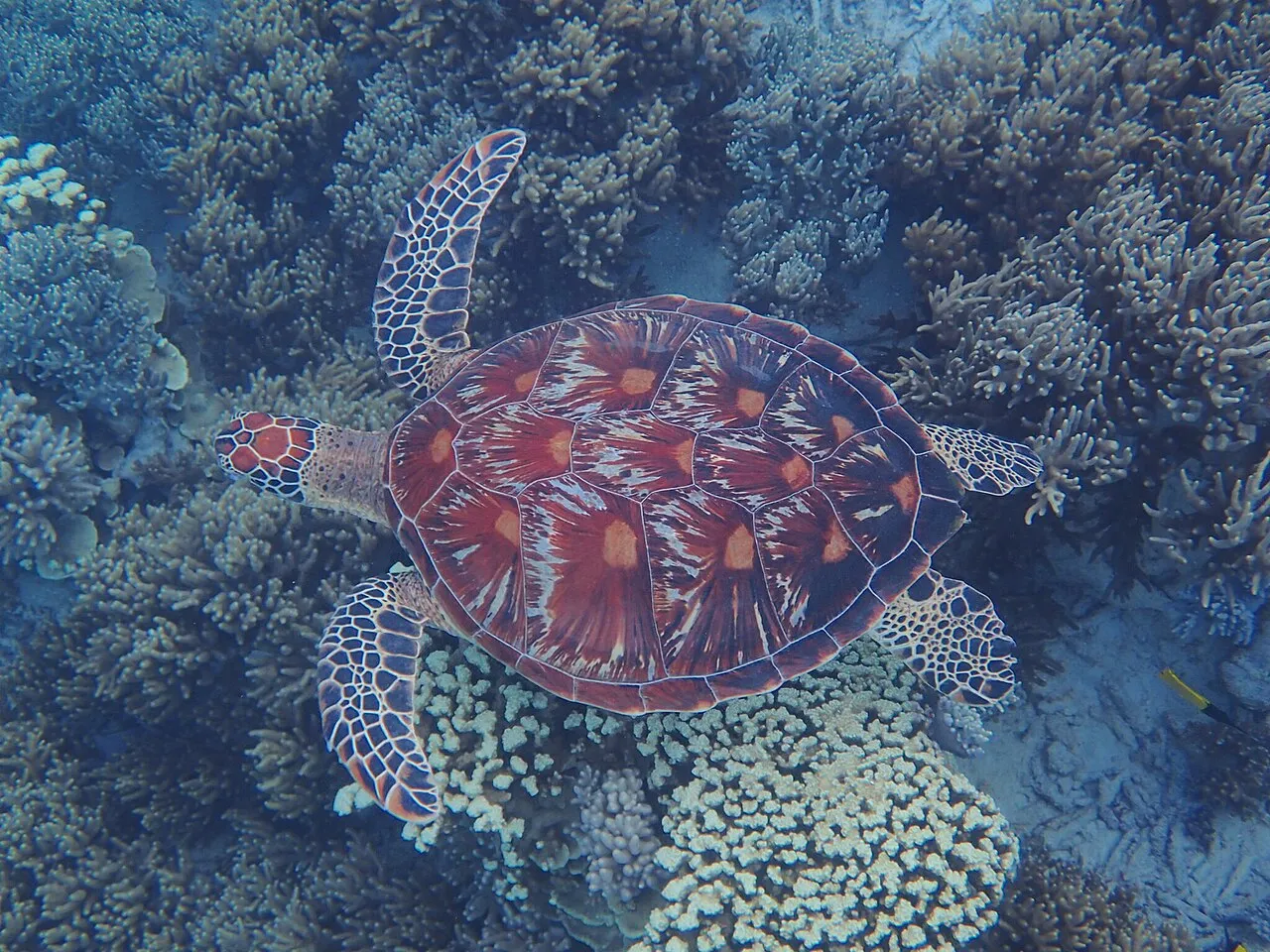
Daniel Eisenhauer · CC BY 4.0
Green turtles spend almost all their time underwater, feeding in seagrass beds and on reefs by day and resting under ledges or in coral crevices at night. Active turtles surface to breathe every few minutes, but resting or sleeping turtles lower their metabolism and can stay down for hours, especially in cool water.
Unusually among sea turtles, some populations haul out on land to bask. In Hawaii, the Galápagos and parts of Australia, green turtles can be seen resting on beaches in the daytime, perhaps to raise body temperature for digestion, avoid sharks or save energy.
Their migrations rank among the great journeys of the animal kingdom. Every two to four years, females travel from feeding grounds to nesting beaches; turtles foraging off Brazil, for instance, swim more than 2,000 kilometres to tiny Ascension Island in the middle of the Atlantic, a feat of navigation that long puzzled scientists.
On feeding grounds turtles are highly site-faithful, often using the same seagrass meadow for years and returning nightly to the same resting ledge.
7. Diet and feeding
Diet changes dramatically with age. During the oceanic juvenile stage, green turtles are omnivores, eating jellyfish, small crustaceans, molluscs, fish eggs and floating algae. After moving to coastal habitats, they gradually become herbivores.
Adults crop seagrasses and a variety of red, green and brown algae. The mix depends on location: in the seagrass-rich Caribbean they eat mostly seagrass, while elsewhere algae dominate. Occasionally they take jellyfish or sponges.
Seagrass is low in nutrients and hard to digest. Green turtles rely on gut microbes to ferment and break down the fibre, much as cattle and horses do. Slow digestion helps explain their slow growth.
By grazing seagrass to a consistent height, turtles keep meadows in a state of fresh regrowth, which is more nutritious, and they tend to revisit the same 'grazing plots'. Researchers note that where turtles have declined, seagrass can grow too long and become more prone to decay and disease.
8. Reproduction and life cycle
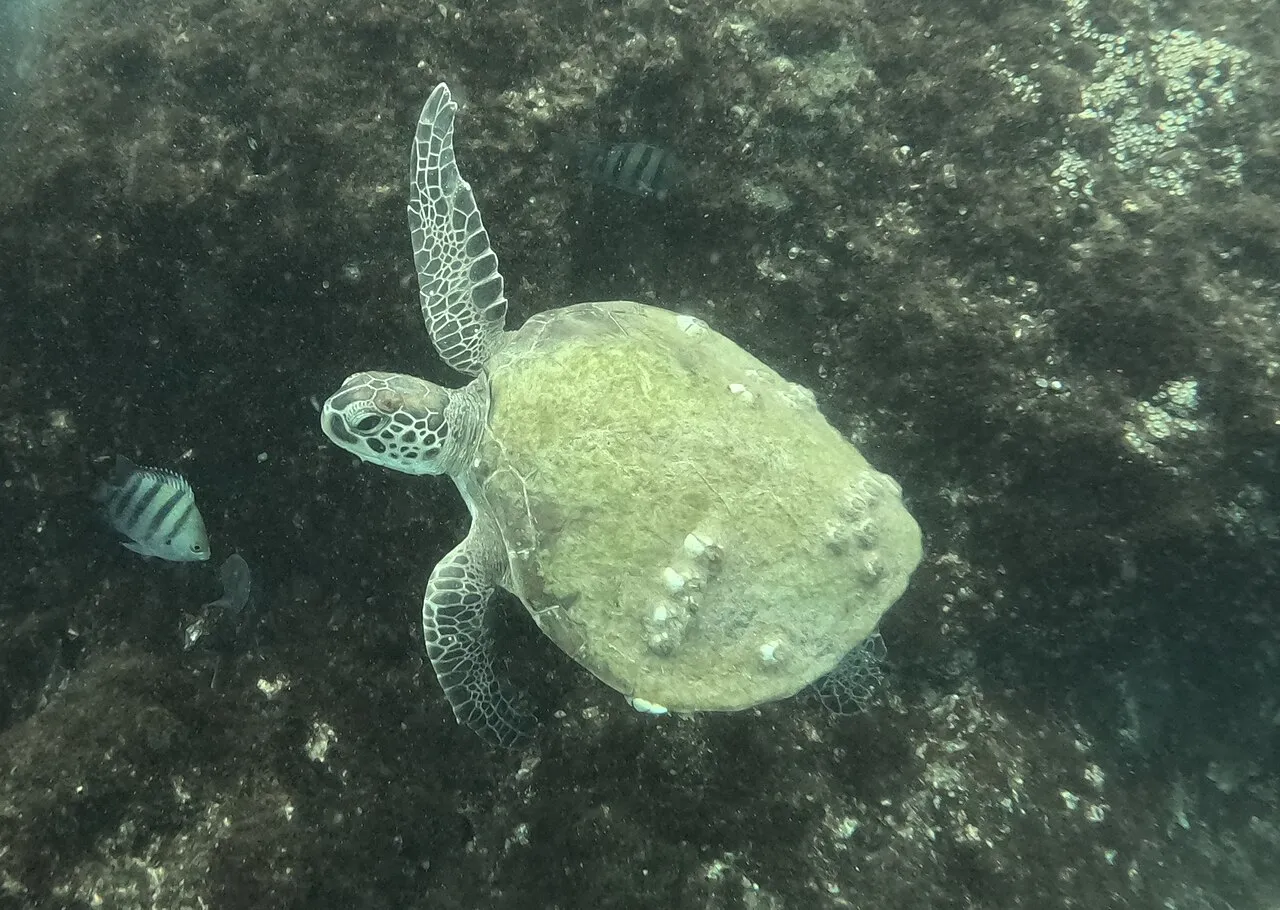
Theo Busschau · CC BY 4.0
Green turtles mature extremely slowly. Depending on region and food supply, first breeding typically occurs somewhere between about 20 and 40 years of age, and even later in some populations.
Males and females gather off nesting beaches to mate. Females then come ashore at night, crawl above the high-tide line, excavate a body pit with their front flippers and carefully dig a deep egg chamber with their hind flippers. They lay ping-pong-ball-sized eggs, cover them and return to the sea. Each nesting takes an hour or more, and a female comes ashore several times in a season at roughly two-week intervals.
| Stage | Duration / number | Notes |
|---|---|---|
| Eggs per clutch | about 100–120 | white, ping-pong-ball sized |
| Clutches per season | usually 3–5 | about 12–14 days apart |
| Breeding interval | every 2–4 years | depends on food availability |
| Incubation | about 45–75 days | faster in warmer sand |
| Hatchlings | shell about 5 cm | emerge together, mostly at night |
| Maturity | about 20–40 years | varies widely by region |
| Lifespan | estimated 70+ years | data are limited |
Sex is determined by sand temperature. Around 29°C is the pivotal point: warmer nests produce more females, cooler nests more males. As beaches heat up with climate change, some rookeries may produce almost only females. A study of turtles from the northern Great Barrier Reef found that the vast majority of young turtles were female, drawing wide attention.
Hatchlings emerge together over a few days, usually at night, and scramble towards the brightest horizon, which is normally the sea. Artificial lights near beaches can lure them inland. Fish, seabirds and crabs take many more in the water, and only a tiny fraction reach adulthood; the often-quoted figure of about one in a thousand is a rough estimate.
9. Intelligence, communication and special abilities
The green turtle's most astonishing talent is navigation. Research shows that sea turtles can sense the intensity and inclination of Earth's magnetic field and use them like a map. Hatchlings appear to imprint on the magnetic signature of their natal beach and follow it back decades later, switching to other cues such as smell, wave direction and coastal features as they get close.
How turtles find a speck like Ascension Island in the open Atlantic puzzled naturalists as far back as Darwin. Satellite tracking now lets researchers follow turtles in real time, revealing that they compensate for currents and home in with remarkable precision.
Sea turtles were long thought to be silent, but recent studies suggest that eggs and hatchlings of some species produce low sounds that may help synchronise hatching and emergence among nestmates.
Green turtles also seem to have good memories, recalling feeding sites and resting spots and learning places where people feed them. In cold water they can drastically lower their metabolism and go hours without breathing.
10. Predators and survival
An adult green turtle's hard shell and large size deter most predators, but large sharks such as tiger sharks can take adults, and orcas and saltwater crocodiles have occasionally been recorded eating sea turtles.
The riskiest stages are egg and hatchling. Eggs are dug up by crabs, foxes, dogs, wild pigs, monitor lizards and raccoons, and poached by people. Hatchlings crossing the beach fall to gulls, frigatebirds and ghost crabs, and fish and seabirds await them at sea. Emerging together en masse is a numbers strategy that overwhelms predators.
Today the gravest threats are human-related: entanglement in nets and fishing lines, boat strikes and ingestion of plastic. Young turtles that eat jellyfish easily mistake floating plastic bags for food. A disease called fibropapillomatosis, which causes tumour-like growths that impair vision and movement, has spread in some regions and tends to be more common in polluted waters.
11. Relationship with humans
Green turtles have fed coastal peoples for thousands of years. Their meat and eggs were nutritious, and because turtles survive for weeks on board without water, sailors in the age of sail carried them alive as fresh meat. The Cayman Islands were once so full of turtles that they were named for them, but centuries of exploitation all but eliminated the islands' nesting population.
In eighteenth- and nineteenth-century Britain, green turtle soup was a prestigious dish of the wealthy. So prized was it that a 'mock turtle soup' made from calf's head was invented for those who could not afford the real thing, which in turn inspired the Mock Turtle in Lewis Carroll's Alice's Adventures in Wonderland.
In the twentieth century many countries banned turtle hunting and egg collecting. At Tortuguero in Costa Rica, research and protection beginning in the 1950s helped green turtle nesting increase substantially over the following decades. Many coastal communities that once sold eggs now earn income from turtle-watching tourism, although traditional hunting and illegal egg collection continue in some places.
In Korea, injured or entangled green turtles found around Jeju and the south coast are regularly rescued, rehabilitated and released, and some satellite-tagged individuals have reportedly headed south towards the waters of Taiwan and Japan, suggesting that Korean waters form part of East Asian turtle migration routes.
12. Conservation
For decades the green turtle was listed as Endangered on the IUCN Red List. In a reassessment published in 2025, its global status was lowered to Least Concern, reflecting increases in overall numbers since the 1970s thanks to sustained protection at major nesting sites: bans on egg collection and hunting, beach protection and improved fishing gear. The change was widely presented as proof that ocean conservation can work.
It is important to remember that this is a global assessment. Some regional populations are still declining or very small, and turtles in the Mediterranean and parts of the Pacific remain under pressure. Because green turtles take decades to mature, relaxing protection could have effects that only become visible many years later, and experts stress that the recovery depends heavily on continued conservation.
Main threats include:
- bycatch in nets and on fishing lines
- illegal hunting and egg collection in some areas
- coastal development and artificial lighting on beaches
- plastic and other marine debris
- loss of seagrass beds and water pollution
- climate change, causing skewed sex ratios and loss of nesting beaches to sea-level rise
- diseases such as fibropapillomatosis
The species is listed on CITES Appendix I, prohibiting commercial international trade. In Korea it is a protected marine species designated by the Ministry of Oceans and Fisheries, and catching, processing, selling or keeping it without permission is prohibited. Anyone finding a sea turtle should report it to the coast guard or relevant authorities rather than handling it.
13. In aquariums
Green turtles are popular residents of large public aquariums, where they help visitors connect with ocean ecosystems and conservation. Many aquariums run rescue, rehabilitation and release programmes and act as hospitals for injured turtles.
Keeping an animal that migrates thousands of kilometres in a tank for long periods is ethically contested, however. Turtles born or kept long-term in captivity may struggle to adapt to the wild and need careful conditioning and health checks before release. Turtle farms that raise animals for meat also exist in some places; supporters argue they reduce pressure on wild turtles, while critics cite welfare and disease concerns.
Swimming with sea turtles is a popular holiday activity, but touching, chasing or feeding them causes stress and can alter natural behaviour. Keep a respectful distance and observe quietly. Sea turtles cannot be kept as pets, and doing so is illegal in Korea and most other countries.
14. Green turtles in culture
- In Hawaii the green turtle is called honu, a symbol of good luck, wisdom and long life; some families regard it as an ancestral guardian spirit.
- In the Japanese folktale of Urashima Tarō, a fisherman rescues a turtle and is carried on its back to the undersea Dragon Palace; the turtle is usually depicted as a sea turtle.
- Korean myths and folktales, from the turtle in the ancient Gujiga song to the turtle-like creature of the Byeoljubu tale, often link turtles with the sea, the Dragon King's palace and longevity.
- Crush, the surfer-dude turtle in Finding Nemo, is a green turtle, and his ride on the East Australian Current echoes real turtle behaviour.
- A widely shared video of a sea turtle with a plastic straw lodged in its nose helped spark campaigns against single-use straws; that turtle was reportedly an olive ridley, but sea turtles in general have become icons of the marine litter problem.
- Hindu and Chinese mythology both feature giant turtles supporting the world, making turtles enduring symbols of stability and eternity.
15. Trivia
- Researchers can identify individual green turtles from photographs of the scale pattern on the side of the face.
- In 2018 a hurricane largely washed away a small island in the north-western Hawaiian chain that was an important green turtle nesting site, an example often cited of climate-related risks to rookeries.
- Barnacles and algae on a turtle's shell can provide clues to where it has been.
- Nesting females are highly sensitive to light and noise, so torches and camera flashes should never be used on nesting beaches.
- People should not carry hatchlings to the sea; the crawl across the sand is thought to help them imprint on their beach and prepare for swimming.
- Because growth is slow and variable, two green turtles of the same size in different regions can differ in age by several years.
Wild animals are not pets. Catching, trading or keeping them is illegal in most places. If you find an injured wild animal, call your local wildlife rescue centre.
FAQ
Why 'green' when the shell isn't green?
The name refers to its body fat, tinted green by a diet of seagrass and algae, not to the shell.
Now that it is Least Concern, is protection still needed?
Yes. The 2025 change is a global assessment; several regional populations are still declining, and the recovery depends on continued protection. Because turtles mature slowly, the effects of relaxing it would show up only years later.
What should I do if I find a sea turtle in Korea?
Green turtles are protected marine species in Korea, so do not catch or keep one. Avoid handling it and report it to the coast guard or relevant authorities.
Photo credits
Photos are freely licensed images from Wikimedia Commons. Authors and licenses are listed below.
- Green sea turtle (Chelonia mydas) Moorea.jpg — Charles J. Sharp · CC BY-SA 4.0
- Albino Turtle, Kosgoda (9824577866).jpg — Antony Stanley from Gloucester, UK · CC BY-SA 2.0
- Baby Chelonia mydas 20060319.jpg — Manuel Heinrich Emha · CC BY-SA 2.5
- Chelonia mydas 527491562.jpg — Daniel Eisenhauer · CC BY 4.0
- Chelonia mydas 529179169.jpg — Theo Busschau · CC BY 4.0