TailVille
1. Overview
The koala is a tree-dwelling marsupial of the eucalyptus forests of eastern Australia. With its round fluffy ears, big black nose and grey fur it is often called a 'koala bear', but it has nothing to do with bears. Its closest living relatives are the burrowing wombats.
Koalas live almost entirely on eucalyptus leaves, which are low in nutrients, high in fibre and laced with compounds that are toxic to most animals. Very few mammals can survive on such a diet, and the koala does it by saving energy, spending most of the day asleep or resting in the branches.
Despite global affection, koalas are in trouble. Land clearing, bushfires, drought, disease, traffic and dog attacks have caused steep declines in some regions. The IUCN lists the species as Vulnerable, and in 2022 the Australian government upgraded the koalas of Queensland, New South Wales and the Australian Capital Territory to Endangered.
2. Name and classification
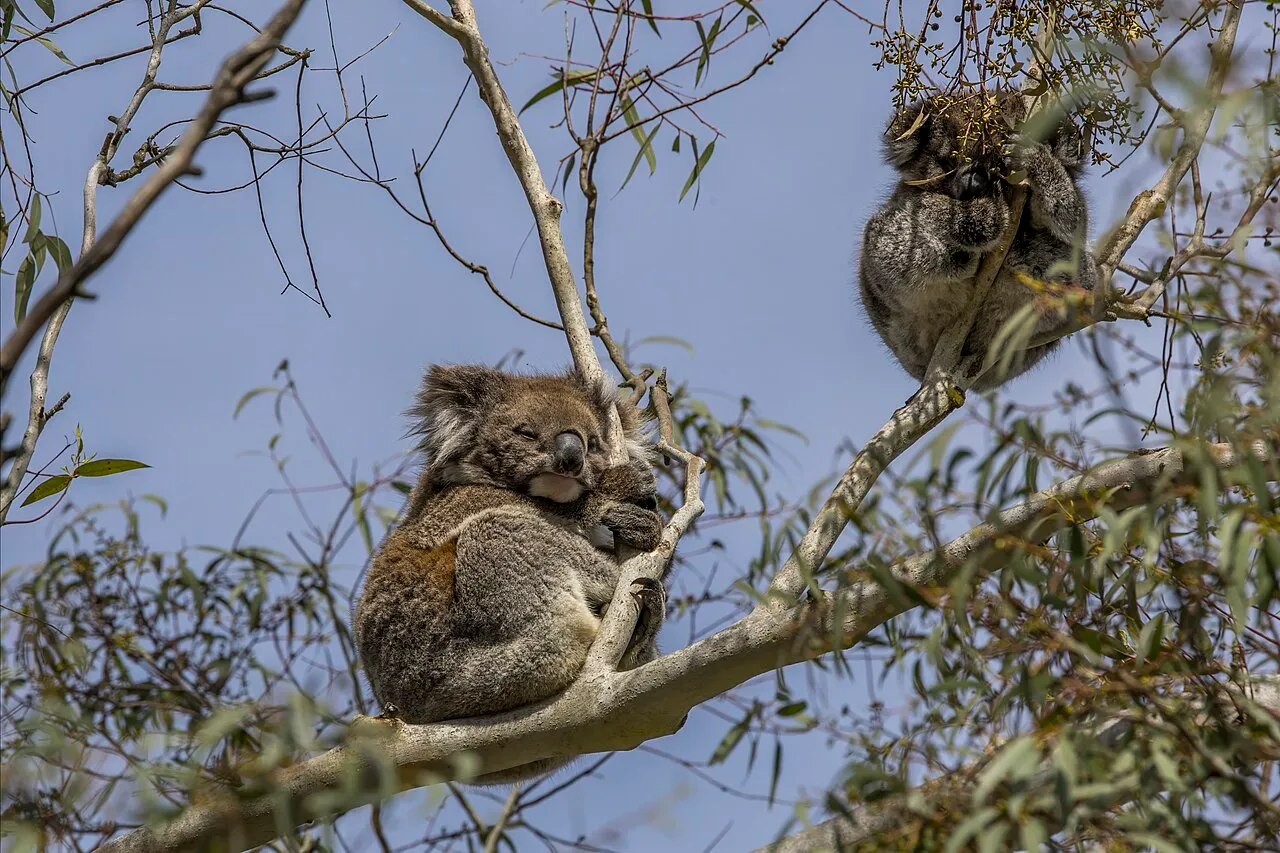
Charles J. Sharp · CC BY-SA 4.0
The scientific name is Phascolarctos cinereus. Phascolarctos combines Greek words for 'pouch' and 'bear', and cinereus is Latin for 'ash-grey', so the name means 'ash-grey pouched bear', reflecting early European impressions.
The word koala comes from an Aboriginal language of eastern Australia. It is often said to mean 'no drink', but sources disagree on whether that translation is accurate. Koalas do get most of their water from leaves, but they drink in hot weather and droughts.
The koala is the only living member of its family, Phascolarctidae. It was once split into three subspecies, from Queensland, New South Wales and Victoria, based on fur and size, but many researchers now regard these as points along a gradual north–south cline rather than true subspecies.
| Region | Typical features |
|---|---|
| North (Queensland) | Smaller, shorter and paler grey fur |
| South (Victoria, South Australia) | Larger, longer and thicker fur, often brownish |
3. Evolution
Koalas and wombats together form the order Vombatiformes. Their ancestors split tens of millions of years ago, after which the koala line adapted to trees and the wombat line to burrows. One explanation for the koala's backward-, downward-opening pouch is that it is a leftover from digging ancestors: in wombats, a rear-facing pouch keeps soil out while they excavate.
Fossils show the koala family was once much more diverse. Rainforests of ancient Australia held several kinds of koala relatives, some of which probably ate plants other than eucalyptus. As Australia dried and eucalyptus forests spread, only the lineage able to cope with those leaves survived.
During the Pleistocene a larger 'giant koala' also existed, but it disappeared along with much of Australia's megafauna.
4. Range and habitat
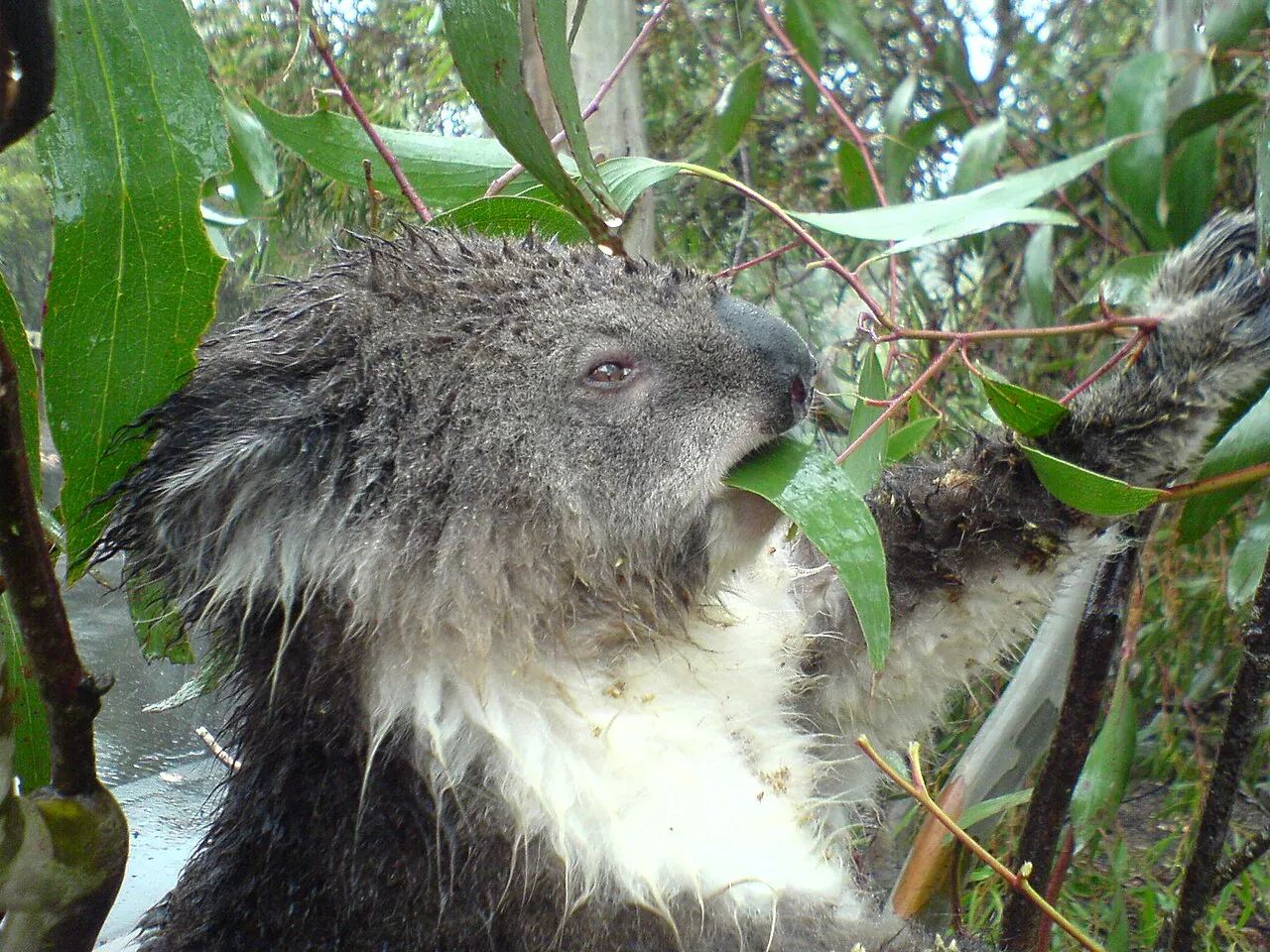
Koalas live in eastern and south-eastern Australia, from north-east Queensland south to Victoria and south-eastern South Australia, in eucalyptus forests and woodlands both near the coast and inland. They do not occur naturally in Western Australia or the Northern Territory.
What matters most is a supply of suitable eucalyptus. Australia has hundreds of eucalyptus species, but koalas favour only some of them, with preferences varying by region. Leaves from trees on fertile soils are more nutritious, so koala hotspots are often on rich river flats and coastal plains, exactly the land people want for farms and housing.
People have moved koalas onto some islands, such as Kangaroo Island in South Australia. When southern koalas were decimated by the fur trade in the early twentieth century, island populations were used to restock the mainland.
5. Body
Koalas are smaller than many people expect, and northern animals are much smaller than southern ones.
| Measure | Approximate value |
|---|---|
| Body length | 60–85 cm |
| Weight, north | males about 6–9 kg, females about 5–7 kg |
| Weight, south | males about 9–14 kg, females about 7–10 kg |
| Tail | Vestigial |
The dense, woolly fur sheds rain well, grey above and white below. Fur on the rump is especially thick, acting as a cushion for long hours on branches. There is practically no tail.
Hands and feet are built for climbing. On the forepaws, two digits oppose the other three, giving a pincer-like grip on branches. On the hind feet the big toe is opposable, and the fused second and third toes serve as a grooming comb. The claws are long and sharp.
Koala fingertips carry fingerprints strikingly similar to ours, said to be hard to tell apart even under a microscope. The brain is small for the body size, which some explain as an energy-saving adaptation to a poor diet, since brains are costly to run.
Males have a scent gland in the middle of the chest that shows as a brown stain, used to mark trees. Females have a pouch that opens downward toward the rear.
6. Behaviour and ecology
Koalas spend around 18 to 22 hours a day asleep or resting quietly. This is not laziness but a strategy for surviving on a low-energy diet. Most of their waking time goes to eating, mainly at night and around dusk.
They are essentially solitary. Each koala has a home range containing a number of favoured trees, overlapping with those of neighbours, and ranging from about one hectare to more than a hundred depending on habitat quality. To move between trees that are not touching, koalas climb down and walk or bound across the ground, which is when dogs and cars catch them.
On hot days koalas hug the lower trunks of trees. Studies show the bark can be noticeably cooler than the surrounding air, helping them shed heat.
7. Diet and feeding
Eucalyptus leaves make up almost the entire koala diet; leaves of other trees are eaten only occasionally. An adult eats roughly half a kilogram of leaves a day.
As food, eucalyptus has many drawbacks: little protein and energy, plenty of tough fibre, pungent oils and toxic compounds. Koalas cope through a set of adaptations:
- They sniff leaves to judge toxicity and nutrition, choosing the best leaves even within a single tree.
- Their molars grind leaves into a fine paste.
- A very long caecum houses microbes that ferment fibre slowly.
- Their livers are adept at breaking down toxins.
Most water comes from the leaves, but in heatwaves or when drought dries the foliage, koalas come down to drink. Images of koalas accepting water from people during heatwaves have drawn attention to how climate change affects them.
Preferred eucalyptus species differ by region, and koalas moved to unfamiliar areas sometimes struggle with the local trees, one reason relocation is not a simple fix.
8. Reproduction and life cycle
The breeding season runs roughly from September to February, through the Australian spring and summer. Males bellow loudly at night to attract females and advertise their size to rivals. Gestation is short, about 35 days, and a single joey is usual.
The newborn is about 2 cm long and weighs less than a gram. Blind and hairless, it crawls into the pouch unaided and attaches to a teat.
| Stage | Age | What happens |
|---|---|---|
| Birth | Day 0 | about 2 cm, under 1 g; crawls to the pouch |
| Pouch growth | 0 to about 6 months | Eyes open, fur grows |
| Pap | about 5–6 months | Eats 'pap', a special soft dropping from the mother |
| Leaves pouch | about 6–7 months | Rides on mother's belly or back |
| Independence | about 12 months | Moves away to find its own range |
| Maturity | Females about 2 years, males 3–4 years | Females usually breed every 1–2 years |
The pap stage is remarkable. Before switching to leaves, the joey feeds on a runny, specialised dropping produced by its mother. It contains the gut microbes needed to digest eucalyptus, seeding the joey's own digestive system.
Wild koalas generally live around 10 to 15 years, females tending to outlive males, which face more injuries and accidents from fighting and roaming during the breeding season.
9. Intelligence, communication, special abilities
Koalas may look placid, but a male's bellow is a shock. During the breeding season males produce a long, deep, rasping call on both in-breath and out-breath, part snore and part belch, sounding like an animal many times their size. Researchers discovered that koalas have a special pair of vocal folds outside the larynx that allows these very low notes. The bellow appears to be an honest signal of body size.
Females and joeys are vocal too. Distressed koalas give piercing, baby-like screams, and mothers and young exchange soft calls. Males rub their chest glands on tree trunks to scent-mark.
Koalas are not known for problem-solving, but they remember their favourite trees and are exceptionally good at choosing leaves by smell. Their whole energy-saving lifestyle is a specialised ability honed for an extreme diet.
10. Predators and survival
Natural predators include dingoes, large pythons, wedge-tailed eagles and powerful owls, the birds mostly taking young koalas. Today's greater threats, however, are tied to people:
- Dog attacks: koalas on the ground near towns are often mauled by pet or feral dogs.
- Traffic: koalas crossing roads between trees are hit by cars.
- Bushfire: tree-bound koalas struggle to escape fast-moving fires.
- Disease: chlamydia causes eye infections, urinary disease and infertility, and koala retrovirus is thought to weaken immunity.
- Heat and drought: when heatwaves and drought dry out leaves, koalas can die of dehydration.
A frightened koala usually climbs high and stays still. On the ground it can bound surprisingly quickly, but not for long.
11. Relationship with humans
Aboriginal Australians hunted koalas and feature them in many stories. After European settlement koalas suffered badly. From the late nineteenth into the early twentieth century, millions of koala pelts were exported for their soft, dense fur, and in the south koalas were almost wiped out. Public outrage led to a ban on koala hunting, a milestone in the Australian wildlife protection movement.
Today the koala is a tourism icon, but also a symbol of the clash between development and conservation. Clearing of eucalyptus forest for housing, roads and farms continues, and community groups, developers and governments argue over how much koala habitat to protect.
The 2019–20 'Black Summer' bushfires dealt koalas a heavy blow. Estimates vary widely with method, but analyses suggested tens of thousands died or lost their habitat. Images of burnt koalas being rescued travelled around the world and focused attention on climate change and biodiversity loss.
12. Conservation
The IUCN lists the koala as Vulnerable. Under Australian federal law, the populations of Queensland, New South Wales and the Australian Capital Territory have been listed as Endangered since 2022. Meanwhile, in parts of Victoria and South Australia koalas have become overabundant and are defoliating their food trees.
Total numbers are hard to count, and estimates range from tens of thousands to several hundred thousand depending on method. Most studies agree, however, that northern populations have declined markedly over recent decades.
Conservation work includes:
- Protecting and restoring eucalyptus habitat and linking fragments with corridors
- Building wildlife crossings and fencing on roads
- Running koala hospitals to treat injured animals
- Researching a chlamydia vaccine
- Campaigns on responsible dog ownership and careful driving
Internationally the koala is on CITES Appendix II, which regulates trade.
13. In zoos
Koalas are hugely popular, but few zoos can keep them. The main reason is food: they need a daily supply of fresh leaves from particular eucalyptus species, so zoos outside Australia must run their own plantations or import leaves at great expense.
Cuddling a koala for a photo was long a tourist staple, but growing concern about stress has led several Australian states to ban or restrict it. From a welfare perspective, many experts recommend giving koalas ample undisturbed rest and keeping human handling to a minimum.
Australian wildlife hospitals and rescue groups play a vital role, treating injured koalas and returning them to the wild. Koalas cannot be kept as pets; even in Australia only licensed institutions may hold them.
14. In culture
With the kangaroo, the koala is Australia's signature animal and a fixture of tourism campaigns and souvenirs. Aboriginal stories explain why koalas rarely drink or how they lost their tails.
In popular culture, a mischievous koala from classic Australian children's literature became a beloved character and later an animated series. In East Asia, the arrival of koalas in zoos in the 1980s sparked a craze, inspiring koala-themed products such as koala-printed biscuits, which remain familiar snacks in Korea and Japan.
Their perpetually drowsy look makes koalas a shorthand for sleepiness and taking it easy. Since the 2019–20 fires they have also become a symbol of the climate crisis and wildlife protection.
15. Trivia
- Koalas are not bears; 'koala bear' is a misnomer.
- Their fingerprints are so like ours that people joke they could confuse a crime scene investigation.
- Koalas are said to smell faintly of eucalyptus oil.
- Before eating leaves, joeys eat a special dropping from their mother to inherit the gut microbes they need.
- Koalas don't sleep all day because eucalyptus makes them 'stoned'; they sleep to save energy.
Wild animals are not pets. Catching, trading or keeping them is illegal in most places. If you find an injured wild animal, call your local wildlife rescue centre.
FAQ
Is the koala a bear?
No. It is a pouched marsupial whose closest relative is the wombat. 'Koala bear' is a misnomer from early European settlers who thought it looked bear-like.
Do koalas sleep so much because eucalyptus drugs them?
That is a common myth. Eucalyptus leaves are low in nutrients and hard to digest, so koalas rest most of the time to conserve energy.
Why are koalas endangered?
Habitat clearing is the biggest factor, compounded by bushfires, drought, diseases such as chlamydia, traffic and dog attacks. In 2022 Australia upgraded several eastern populations to Endangered.
Photo credits
Photos are freely licensed images from Wikimedia Commons. Authors and licenses are listed below.
- Koala climbing tree.jpg — Diliff · CC BY-SA 3.0
- Koala (Phascolarctos cinereus) female Mount Lofty 4.jpg — Charles J. Sharp · CC BY-SA 4.0
- Koala eating.jpg — (--Pumpmeup) · CC BY-SA 3.0