TailVille
1. Overview
Gorillas are the largest living primates. They live only in the equatorial forests of Africa and are divided into two species, the western and eastern gorilla, each with two subspecies. After chimpanzees and bonobos, they are our closest living relatives.
Films love to cast them as roaring, chest-thumping monsters, but real gorillas spend most of the day quietly munching leaves and stems. A silverback, the mature male who leads a group, can put on a terrifying display when threatened, yet the whole point of that show is usually to avoid an actual fight.
Both species are listed as Critically Endangered by the IUCN. Poaching, forest loss and diseases such as Ebola have taken a heavy toll. At the same time, intensive protection has allowed mountain gorillas to increase, so the gorilla story holds both alarm and hope.
2. Name and classification
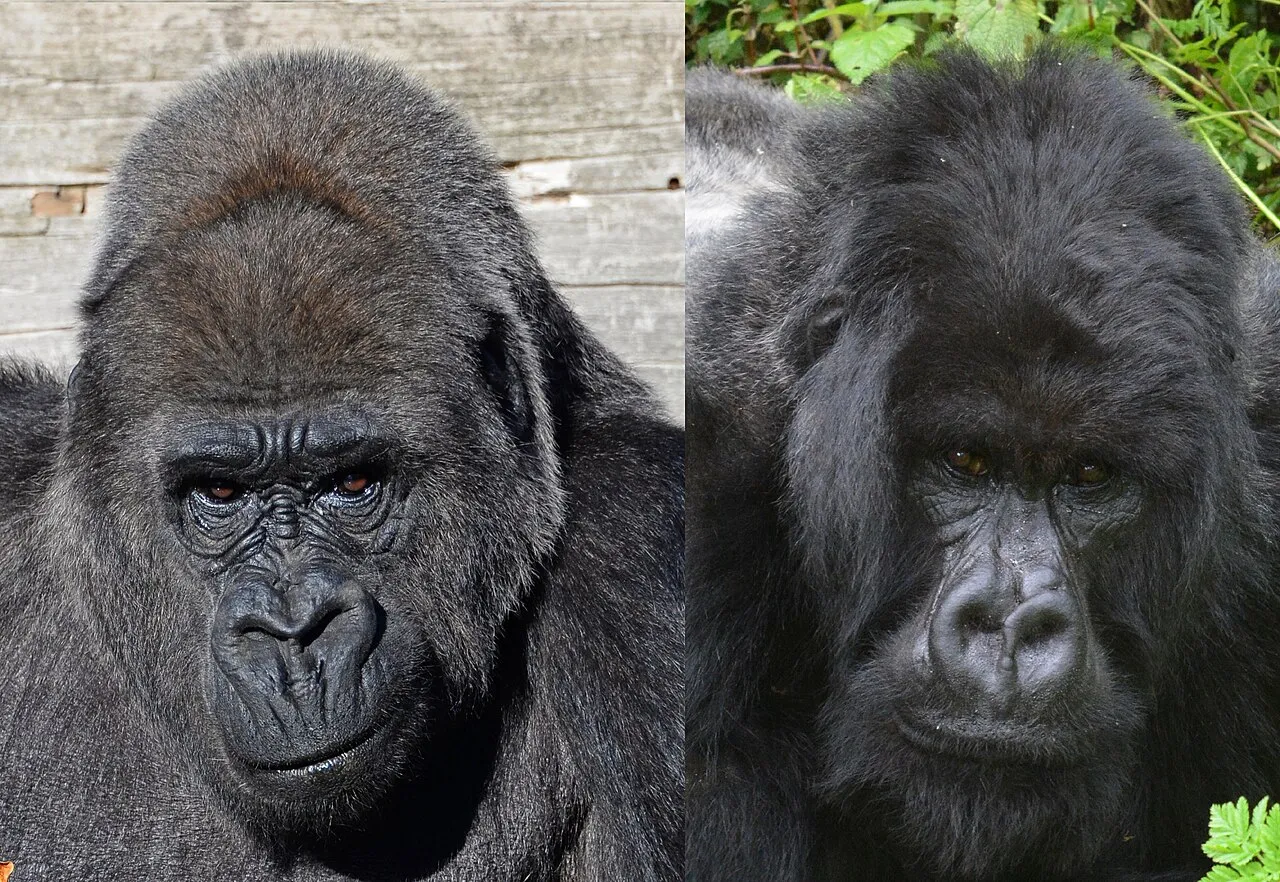
Clément BardotAzurfrog · CC BY-SA 4.0
Gorillas belong to the great ape family Hominidae, genus Gorilla. The name traces back to the account of Hanno, a Carthaginian navigator who sailed down the West African coast around the fifth century BC and described a tribe of hairy people. Whether he met gorillas, chimpanzees or humans is anyone's guess. When Western naturalists formally described the animal in the mid-nineteenth century, they borrowed that ancient word.
| Species | Subspecies | Scientific name | Main range |
|---|---|---|---|
| Western gorilla | Western lowland gorilla | Gorilla gorilla gorilla | Cameroon, Gabon, Republic of Congo, Central African Republic, Equatorial Guinea and nearby |
| Western gorilla | Cross River gorilla | G. g. diehli | Highlands on the Nigeria–Cameroon border |
| Eastern gorilla | Mountain gorilla | G. beringei beringei | Virunga volcanoes (Rwanda, Uganda, DR Congo) and Uganda's Bwindi forest |
| Eastern gorilla | Eastern lowland or Grauer's gorilla | G. b. graueri | Eastern DR Congo |
A name like Gorilla gorilla gorilla, where genus, species and subspecies are identical, is called a tautonym. The mountain gorilla's name honours the German officer who shot one in 1902 and brought it to scientific attention.
3. Evolution
Molecular studies suggest the gorilla lineage split from the common ancestor of humans and chimpanzees around eight to ten million years ago. A roughly ten-million-year-old ape from Ethiopia has been proposed as an early relative of the gorilla line, but this remains debated. Rainforests are terrible at preserving bones, so gorilla ancestors have left very few fossils.
Western and eastern gorillas began to diverge somewhere around one to two million years ago, with some continued gene flow afterwards. The geography of the Congo Basin and repeated shrinking and expansion of forests during Ice Age climate swings gradually pulled the populations apart.
Intriguingly, some stretches of the human genome are more similar to the gorilla's than to the chimpanzee's. This happens because the three lineages split in fairly quick succession, a phenomenon geneticists call incomplete lineage sorting.
4. Range and habitat
Gorillas live only in the equatorial forests of west-central and central Africa. The western and eastern species are separated by roughly a thousand kilometres of Congo Basin forest and rivers.
Western lowland gorillas inhabit lowland rainforest and swamp forest and are famous for gathering in marshy clearings called bais to feed on aquatic plants. Cross River gorillas are scattered across rugged hills on the Nigeria–Cameroon border, apparently pushed up towards the high ground by human pressure.
Mountain gorillas live in volcanic highland forest at around 2,200 to 4,300 metres, where nights can drop close to freezing; their longer, thicker coats reflect that chilly home. Eastern lowland gorillas span a wide altitude range in eastern DR Congo, from lowland rainforest to montane forest.
| Subspecies | Altitude | Typical habitat |
|---|---|---|
| Western lowland | Lowland | Rainforest and swamp forest |
| Cross River | Lowland to montane | Steep hills and forest |
| Mountain | About 2,200 to 4,300 m | Bamboo, cloud forest, subalpine edges |
| Eastern lowland | About 600 to 2,900 m | Lowland rainforest to montane forest |
5. Body
Gorillas show striking sexual dimorphism. Adult males can weigh nearly twice as much as females and have a bony crest on top of the skull, the sagittal crest, which gives the head its conical shape and anchors massive jaw muscles for chewing tough stems.
| Measure | Males | Females |
|---|---|---|
| Standing height | About 1.4 to 1.8 m | About 1.25 to 1.5 m |
| Weight (wild) | About 140 to 200 kg | About 70 to 100 kg |
| Arm span | Can exceed 2 m | Shorter |
The arms are longer than the legs, and on the ground gorillas knuckle-walk, resting their weight on the middle joints of the fingers. Their hands have opposable thumbs and fingerprints, and their big toes splay out to grip.
From around twelve years old, a male's back and rump turn silvery grey, hence the term silverback; younger males with dark backs are called blackbacks. Coat colour is usually black, though western lowland gorillas often look browner with a reddish crown, while mountain gorillas have long, dense fur. The wrinkle pattern around each gorilla's nose is unique, and researchers use these nose prints to identify individuals.
Gorilla strength is often exaggerated. They are far stronger than people, but popular figures such as ten times human strength have never been properly measured.
6. Behaviour and ecology
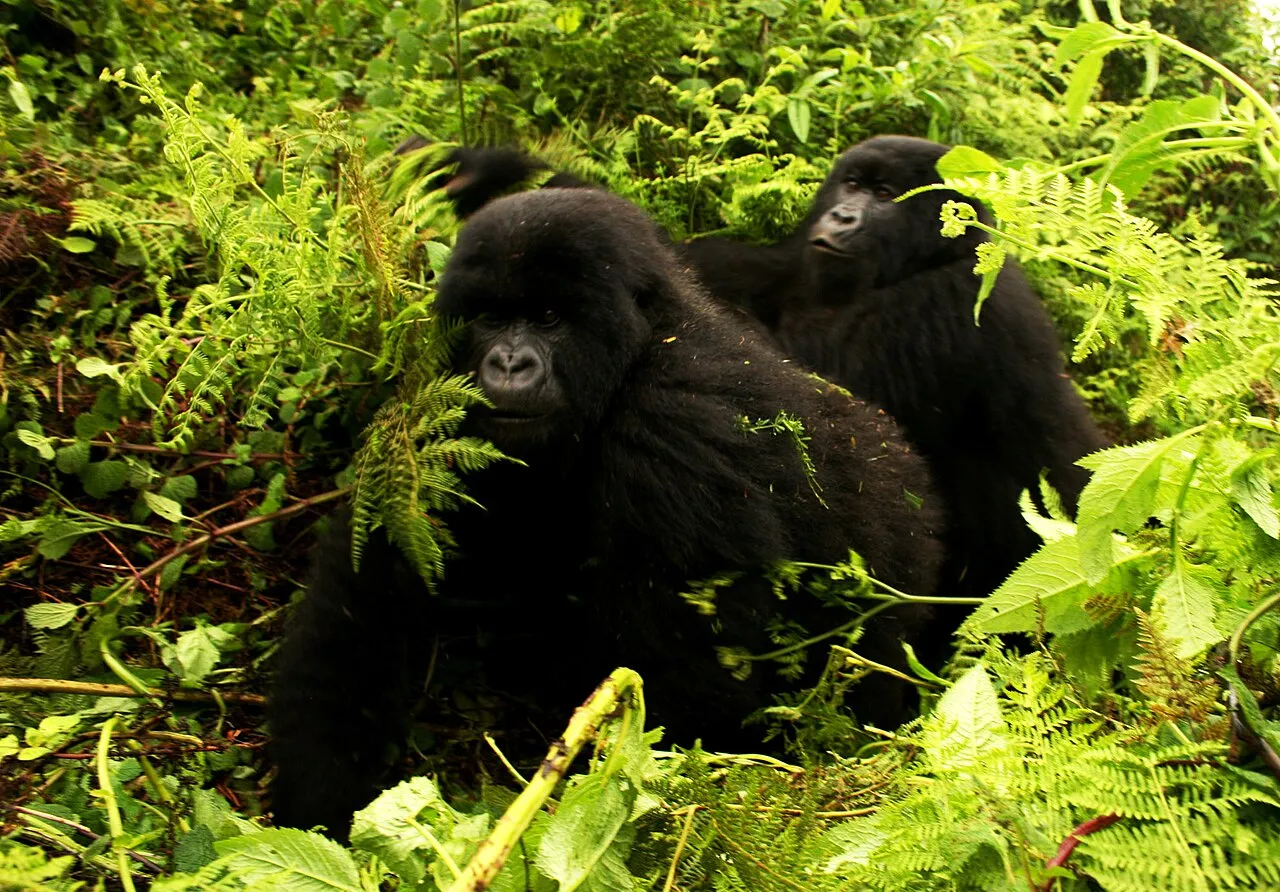
TKnoxB from Chemainus, BC, Canada · CC BY 2.0
Gorillas live in groups, classically made up of one silverback, several adult females and their offspring, usually five to fifteen animals. Among mountain gorillas, groups with two or more silverbacks are common, and some exceed thirty members.
The silverback decides when the group moves and rests, breaks up squabbles and defends the family. When a rival male approaches, he hoots, beats his chest, tears up vegetation and charges. Most of these displays are bluff, but contests for control of a group can turn into real fights with serious injuries or even deaths.
Gorilla groups are held together by the silverback rather than by female kinship. Females often leave their birth group when mature and transfer to another group or a lone male, so the adult females in a group are frequently unrelated. Most young males also leave, spending time alone or in all-male groups before attracting females of their own.
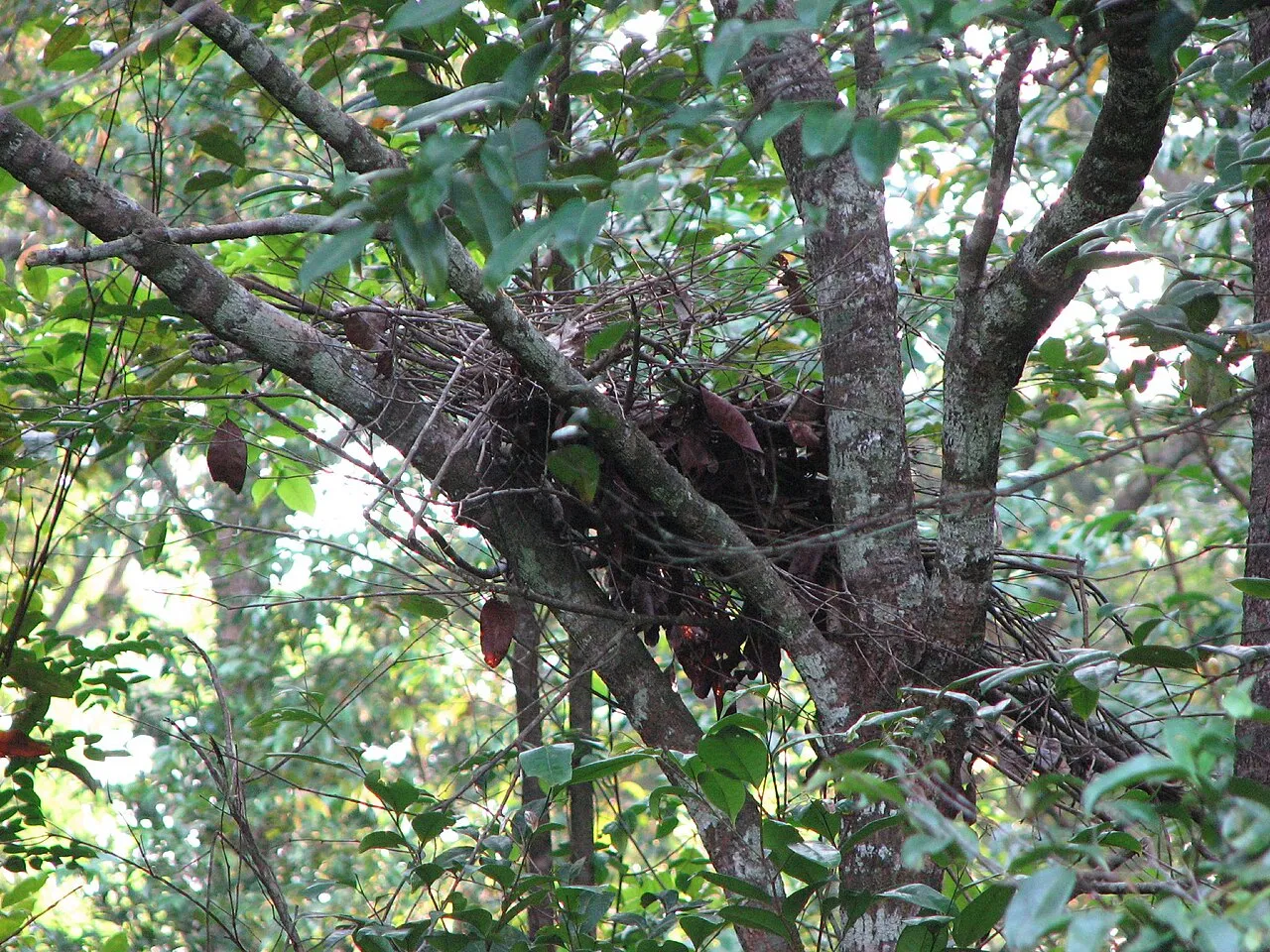
The daily routine is relaxed: feed in the morning, rest at midday while adults groom and youngsters play, feed again in the afternoon while drifting slowly through the forest, typically covering about a kilometre a day. Each evening every gorilla builds a fresh nest of bent leaves and branches. Heavy males usually sleep on the ground, while lighter females and young often nest in trees.
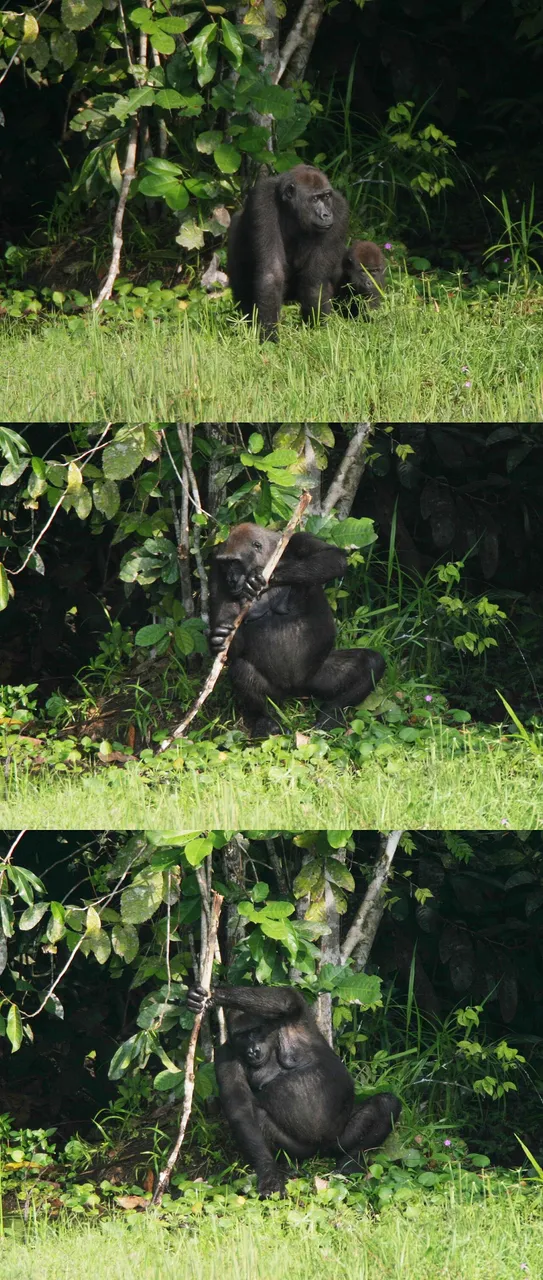
Gorillas avoid deep water and do not swim. Western lowland gorillas made headlines when one was observed apparently using a stick to test the depth of a swampy pool.
7. Diet and feeding
Gorillas are almost entirely vegetarian, but what they eat varies a lot between subspecies.
Mountain gorillas live where fruit is scarce, so they rely on leaves, stems, shoots, pith, bark and roots. Wild celery, nettles, thistles and bamboo shoots are staples, and gorillas have a neat trick of folding nettle leaves to avoid the stinging hairs. When bamboo shoots sprout, groups move into bamboo zones to feast.
Western lowland gorillas have more fruit trees around them and eat far more fruit. In good seasons fruit makes up a large part of the diet and they travel further each day to find it. When fruit runs short they fall back on leaves, stems, bark and swamp plants.
Gorillas also eat insects, especially ants and termites. Western gorillas break open termite mounds, likely a way of topping up protein and minerals.
An adult male may eat up to around 20 to 30 kg of vegetation a day. Because their food is so watery, gorillas rarely need to drink. That big belly is not fat but a long gut built to ferment tough fibre.
8. Reproduction and life cycle
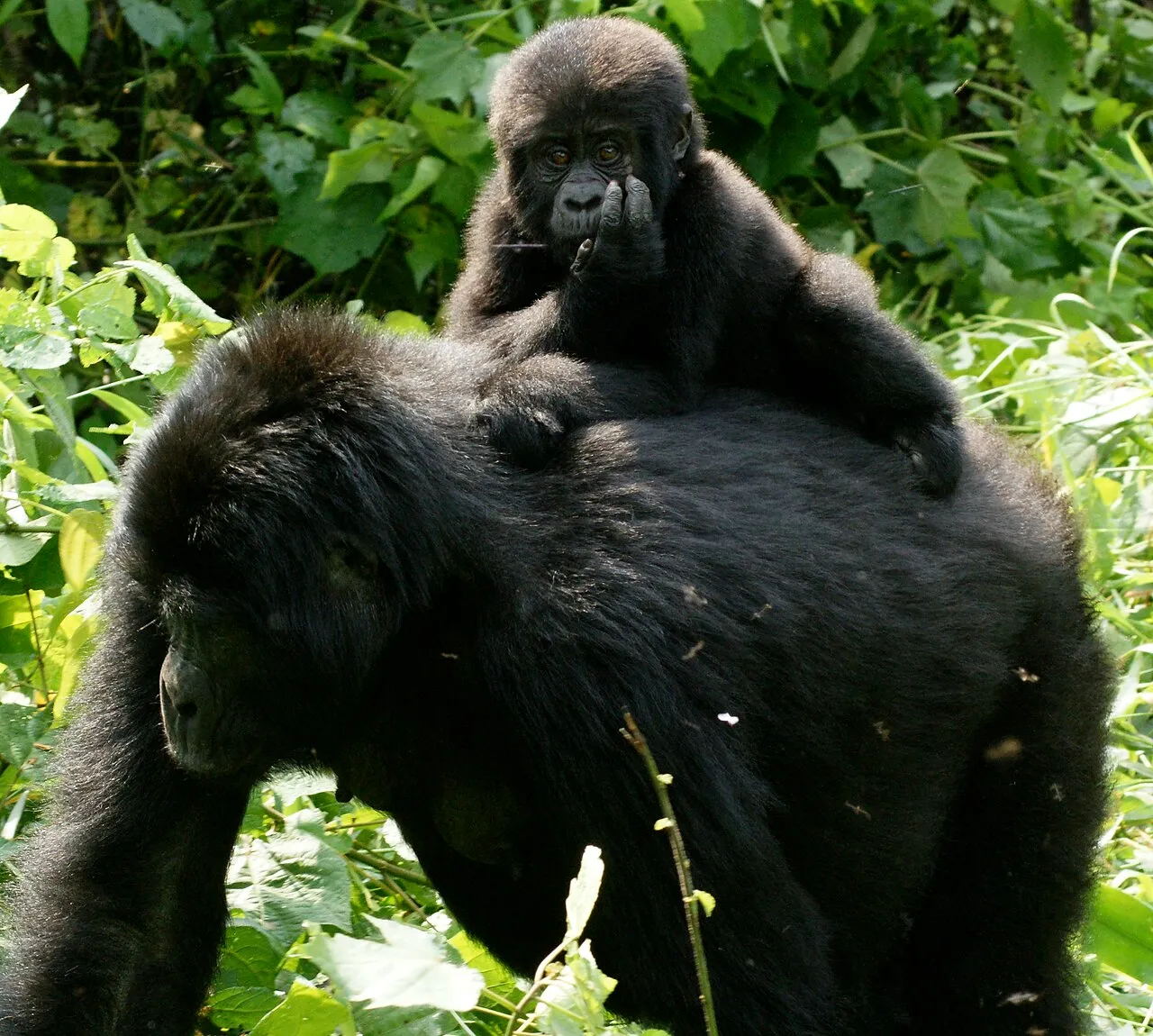
Fiver Löcker from Wellington, New Zealand · CC BY-SA 2.0
Gorillas breed year-round. In one-male groups the silverback does nearly all the mating; in multi-male groups subordinate males also get chances.
Gestation lasts about eight and a half months, similar to humans. Usually a single infant is born, weighing only about 1.5 to 2 kg, smaller than a typical human baby. It clings to its mother's belly for the first months, then rides on her back.
| Stage | Age | What happens |
|---|---|---|
| Newborn | 0 to 6 months | Clings to mother, milk only |
| Infant | 6 months to 3 years | Rides on mother's back and starts eating plants; weaned at about 3 to 4 |
| Juvenile | 3 to 6 years | Plays with other youngsters and starts building its own nest |
| Subadult | 6 to 8 years | Gains independence; young females prepare to transfer |
| Female maturity | About 8 to 10 years | First birth usually around age ten |
| Male maturity | About 12 to 15 years | Back turns silver |
| Old age | 30 to 40 years | Wild lifespan roughly 35 to 40 years |
Females typically give birth about every four years, so each produces only a handful of offspring in her lifetime.
Gorilla society has a darker side. When a new male takes over a group he may kill infants sired by his predecessor, which brings their mothers back into breeding condition sooner. Staying close to a strong silverback is seen as a female strategy to protect her young from this risk.
In captivity some gorillas have lived beyond fifty, and a few past sixty.
9. Intelligence, communication, special abilities
Gorillas are highly intelligent. Results on mirror self-recognition vary between individuals, but some gorillas have passed. Wild gorillas have been seen using sticks to probe water depth and laying down a trunk as a makeshift bridge across a swamp. They use tools less often than chimpanzees, probably because their plant food is easy to reach without them rather than because they lack the capacity.
Some gorillas raised by people learned hundreds of signs from a modified sign language. Whether this amounts to language in the human sense is still debated.
In the wild, gorillas communicate with a rich mix of sounds and gestures: soft belch-like rumbles of contentment, sharp barks of alarm, roars of threat, and humming or singing while they eat. These food songs may tell the group that a good meal is at hand, or simply express pleasure.
The most famous display is chest beating. Gorillas strike with cupped palms rather than fists, producing a hollow, drum-like sound that can carry close to a kilometre through the forest. A study of mountain gorillas found that larger males produce lower-pitched beats, suggesting the display advertises body size. Females and youngsters chest-beat too, often during play.
10. Predators and survival
Leopards are the only natural predator capable of killing adult gorillas, and there is some evidence that they occasionally do, but attacks on silverback-guarded groups are rare. When danger appears, the silverback steps forward to display while females and young retreat.
Disease, injury and, for infants, infanticide are more common natural causes of death. Because gorillas are so closely related to us, they catch human respiratory infections such as colds, flu and measles easily. Gorilla tourism programmes therefore enforce minimum distances, turn away visitors who are ill and increasingly require face masks.
Ebola has been devastating. Outbreaks in central Africa in the early 2000s wiped out gorillas across some areas, with estimates of deaths running into the thousands.
11. Relationship with humans
Western science formally described the gorilla in 1847. Nineteenth-century explorers portrayed it as a savage monster, and many were shot for museum specimens and trophies. That image carried straight into early twentieth-century cinema.
Field researchers changed the picture. From the 1960s, Dian Fossey and others spent years with mountain gorilla groups in Rwanda and showed the world a peaceful, family-centred animal. Fossey campaigned fiercely against poaching and was murdered in 1985; her life later became a feature film.
Today the most important link between gorillas and people is ecotourism. In Rwanda, Uganda and DR Congo, small groups of visitors can spend a limited time with habituated mountain gorilla families. Permits are expensive, and the revenue funds protection and supports local communities, giving neighbours a strong reason to value living gorillas.
Conflict exists too. Gorillas raid crops at forest edges, and land clearing and firewood collection eat away at habitat. In war-torn regions, park management has collapsed at times and many rangers have lost their lives protecting wildlife.
Some minerals used in phones and electronics are mined in eastern DR Congo, inside gorilla range, which is why conservation groups link gorilla protection to conflict minerals and electronics recycling. Gorillas are listed on CITES Appendix I, so international commercial trade is banned.
12. Conservation
Both western and eastern gorillas are listed as Critically Endangered on the IUCN Red List, though the picture differs between subspecies.
| Subspecies | Estimated numbers | Notes |
|---|---|---|
| Western lowland | Roughly 300,000 to 360,000 (late-2010s surveys) | Most numerous, but declining |
| Cross River | About 250 to 300 | Rarest gorilla |
| Mountain | Just over 1,000 (late-2010s census) | Downlisted from Critically Endangered to Endangered in 2018 |
| Eastern lowland | A few thousand; estimates vary widely | Hit hard by war and mining |
Western lowland numbers look large, but they live in vast, hard-to-survey forest and are judged to be declining steeply across generations due to poaching and Ebola. Eastern lowland gorillas crashed from the late twentieth century as armed conflict and bushmeat hunting around mining camps spread through eastern DR Congo.
Mountain gorillas are the success story. Down to a few hundred in the 1980s, they have risen steadily thanks to armed ranger patrols, field veterinary teams that treat snares and illnesses, and tourism revenue shared with local communities.
Key threats:
- Poaching and snares for bushmeat
- Logging, farming and mining destroying forest
- Ebola and human-borne respiratory diseases
- Armed conflict and breakdowns in park management
- Capture of infants for illegal trade
Gorillas are on CITES Appendix I, which bans international commercial trade.
13. In zoos
Almost all gorillas in zoos are western lowland gorillas; mountain gorillas have never done well in captivity and are essentially absent from zoos.
In the past, zoo gorillas were often kept alone in bare concrete cages and developed stress behaviours. Good modern facilities instead keep family groups with a silverback, females and young, in large planted enclosures with nesting material and feeding puzzles. Keepers train gorillas to cooperate with health checks. Heart disease is a leading cause of death in captive males, which has led to diets rich in leafy greens rather than sugary fruit and processed food.
The ethics remain contested. Some argue that confining such intelligent, human-like animals is wrong in itself, or worry about the stress of constant public exposure. Others point to zoos' role as genetic insurance, as funders of field conservation and as places that build public concern for wild gorillas.
A gorilla can never be a pet. Poachers often kill the adults of a group to capture one infant, and grown gorillas have strength and social needs no household could meet. Infants rescued from trafficking need years of rehabilitation in specialist sanctuaries.
14. In culture
The most famous gorilla in popular culture is surely King Kong, the giant ape who first climbed a skyscraper and swatted at biplanes in 1933. Remade several times since, Kong is both monster and tragic victim, a symbol of wild nature exploited by modern society.
Apes raise the hero in the Tarzan stories, and in cartoons and games gorillas often appear as burly protectors or lovable strongmen.
In English an 800-pound gorilla is a dominant player nobody can ignore, and gorilla is slang for a big, intimidating person. The word also sells toughness on product labels, from tapes to glues.
The film about Dian Fossey's life raised public awareness of gorilla conservation enormously, and in several African countries the gorilla has become a national tourism emblem. Rwanda holds an annual naming ceremony for mountain gorilla infants born in the previous year, turning conservation into a national celebration.
15. Trivia
- Gorillas are reported to be almost all blood type B. That they share the ABO system with us at all is another sign of close kinship.
- Like us, gorillas have fingerprints, and their nose wrinkles work as individual ID.
- Because each gorilla builds a new nest every night, researchers count nests to estimate population size.
- Mountain gorillas' longer fur helps them cope with cold highland nights.
- Gorillas are surprisingly shy. They avoid eye contact in tense situations and treat a direct stare as a threat.
- Over short distances a gorilla can run at more than 30 km/h.
- The panting play face and laughter-like sounds gorillas make when tickled are used in research on the evolutionary roots of human laughter.
- Cross River gorillas are so rare and wary that for years almost no good photographs of them existed.
Wild animals are not pets. Catching, trading or keeping them is illegal in most places. If you find an injured wild animal, call your local wildlife rescue centre.
FAQ
Are gorillas aggressive?
They are generally peaceful. A silverback's chest-beating and charges are mostly bluff meant to avoid fights, but a threatened gorilla can be dangerous.
How many kinds of gorilla are there?
Two species, western and eastern, each with two subspecies: western lowland and Cross River, and mountain and eastern lowland (Grauer's).
Why are gorillas declining?
Poaching for bushmeat, forest loss from logging and mining, diseases such as Ebola, and armed conflict are the main causes.
Photo credits
Photos are freely licensed images from Wikimedia Commons. Authors and licenses are listed below.
- Gorille des plaines de l'ouest à l'Espace Zoologique.jpg — Thurundir · CC BY-SA 4.0
- Gorilla gorilla & Gorilla beringei.jpg — Clément BardotAzurfrog · CC BY-SA 4.0
- Gorilla nest.jpg — Jefe Le Gran · CC BY 2.0
- Gorillas-moving.jpg — TKnoxB from Chemainus, BC, Canada · CC BY 2.0
- Gorillas in Uganda-3, by Fiver Löcker.jpg — Fiver Löcker from Wellington, New Zealand · CC BY-SA 2.0
- Gorrila tool use-Efi.jpg — See Source · CC BY 2.5