TailVille
1. Overview
Sitting half-submerged at the water's edge with a blank expression while a bird or monkey perches calmly on its back: the capybara is the world's largest rodent and, according to the internet, the most relaxed animal alive. It is a rodent like rats, squirrels and guinea pigs, yet adults weigh around 50 kg, about the size of a large dog.
Capybaras live along rivers, lakes, marshes and seasonally flooded grasslands of South America. Webbed toes make them strong swimmers, and when threatened they dive and can stay underwater for several minutes. They graze in groups that may number in the dozens and eat several kilograms of grass a day.
They belong to the cavy family, Caviidae, alongside guinea pigs, and the resemblance is clear: a capybara looks rather like a giant guinea pig. For centuries South Americans have hunted capybaras for meat and leather, and they are still hunted and farmed in some countries.
Viral images of capybaras lounging in hot springs or sharing space peacefully with other animals have made them international celebrities. That popularity has increased demand for capybaras as pets and cafe animals, even though they need large areas of water and the company of their own kind.
2. Name and classification
Giles Laurent · CC BY-SA 4.0
The scientific name is Hydrochoerus hydrochaeris, from the Greek for water and pig. Several local names in South America also compare it to a pig because of its barrel-shaped body and coarse hair, though it is unrelated to pigs.
Capybara comes from Tupi, an Indigenous language of Brazil, and is usually translated along the lines of grass-eater or master of the grasses, although interpretations vary. Spanish-speaking regions use names such as chigüire, carpincho and ronsoco.
Capybaras are caviomorph rodents. They were once placed in their own family, Hydrochoeridae, but genetic studies show they belong inside the cavy family, Caviidae, so they are now usually treated as a subfamily within it. Their close relatives include guinea pigs, the maras of Patagonia and rock cavies.
2.1. The lesser capybara
The genus contains two species: the familiar capybara and the lesser capybara, Hydrochoerus isthmius, found in Panama, north-western Colombia and western Venezuela. The lesser capybara weighs around 30 kg and has been treated as a separate species since the 1990s. It is poorly studied, and little is known about its ecology or numbers.
3. Evolution
The story of South American rodents begins with an ocean crossing. Around 40 million years ago South America was an island continent, yet rodents related to African groups suddenly appear in its fossil record. The Atlantic was much narrower then, and the leading explanation is that ancestral rodents drifted across on rafts of vegetation washed out to sea by floods. South American monkeys are thought to have arrived in a similar way.
From those castaways came porcupines, chinchillas, agoutis, guinea pigs, capybaras and many more, collectively called caviomorphs. On a continent with few competitors they diversified spectacularly, and some became giants. Rodents estimated at hundreds of kilograms, possibly approaching a tonne, once lived in South America, though these belonged to other lineages, not the capybara's ancestors.
The capybara line evolved within the cavy family. Capybara-like fossils appear from roughly ten million years ago, and some were larger than living capybaras. When the Isthmus of Panama joined the Americas about three million years ago, capybaras spread into North America as far as the southern United States, but those North American forms died out after the last ice age.
4. Range and habitat
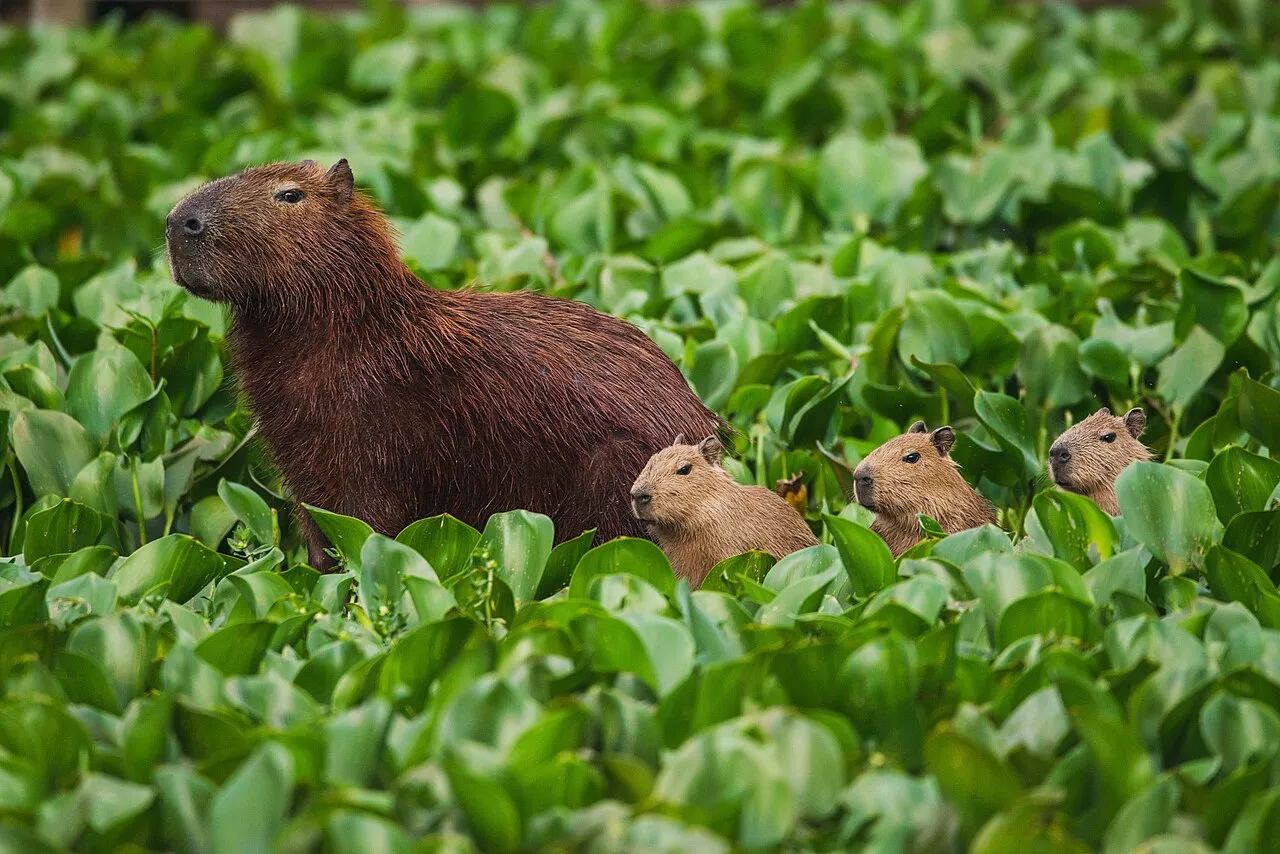
Capybaras live throughout most of South America east of the Andes, from eastern Panama, Colombia and Venezuela south to north-eastern Argentina and Uruguay. Brazil holds some of the largest populations.
Water is essential. Capybaras live along rivers, lakes, swamps, marshes and mangroves and rarely stray far from water. Seasonally flooded grasslands such as the llanos of Venezuela and Colombia and Brazil's Pantanal are ideal. Water lets them cool off, escape predators and mate.
Capybaras adapt well to human landscapes and are common in riverside parks, reservoirs, golf courses and farmland, even in big cities such as São Paulo. Near Buenos Aires, a luxury housing development built on former wetlands became international news when capybaras moved into gardens and lawns, sparking conflict with residents and a flood of memes.
Capybaras have also turned up outside their native range. In Florida, animals likely descended from escapees have been seen in the wild, raising concern that they could become established as an invasive species.
5. Physical characteristics
Capybaras have barrel-shaped bodies, short legs and only a vestigial tail.
| Feature | Typical value |
|---|---|
| Length | about 1.06 to 1.34 m |
| Shoulder height | about 50 to 62 cm |
| Weight | about 35 to 66 kg, occasionally more |
| Newborn | about 1.5 to 2 kg |
| Front toes | four, partly webbed |
| Hind toes | three, partly webbed |
| Teeth | 20, all growing continuously |
Females tend to be slightly heavier than males, and capybaras in the south of the range are generally larger than those in the north.
The hair is long, coarse and sparse enough that skin shows through, ranging from reddish-brown to greyish. Because the coat is thin, capybaras sunburn easily and wallow in mud for protection. They have few sweat glands and depend on water and shade to stay cool.
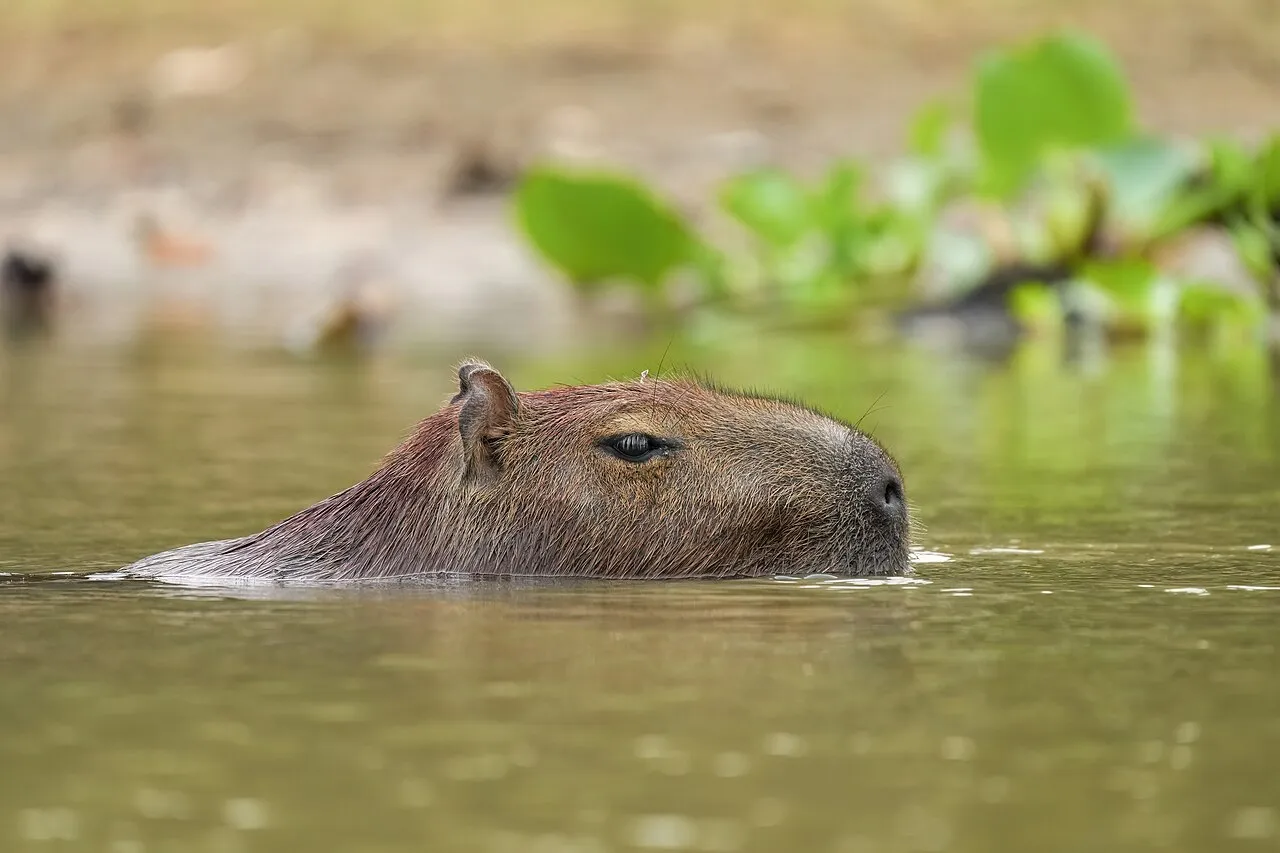
The eyes, ears and nostrils sit high on the large, blunt head, so like a hippo or crocodile a capybara can stay almost fully submerged while still breathing, seeing and hearing. Both the chisel-like incisors and the cheek teeth grow throughout life and are worn down by constant grazing.
5.1. Scent glands
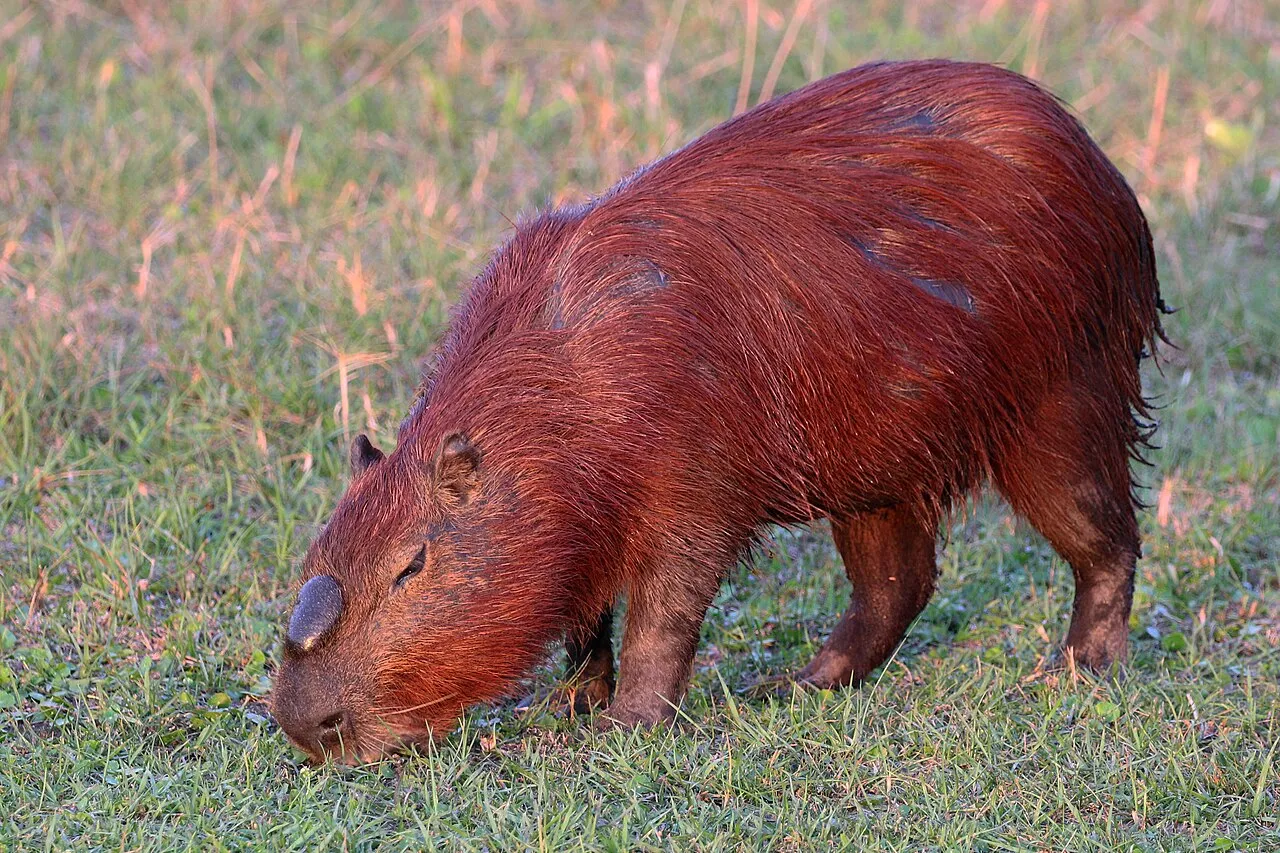
Adult males have a prominent, hairless dark bump on top of the snout called the morrillo, a scent gland that secretes a sticky substance. Males rub it on grass and shrubs to mark territory, and dominant males tend to have the largest morrillos. Both sexes also have anal glands that produce individually distinctive scents.
6. Behaviour and ecology
Charles J. Sharp · CC BY-SA 4.0
Capybaras are social. Groups typically contain 10 to 20 animals, but in the dry season, when animals crowd around remaining water, aggregations of dozens or even more than a hundred form. A group usually consists of a dominant male, several females, their young and subordinate males. The dominant male tries to monopolize mating and chases rivals, while subordinate males hang around the edges.
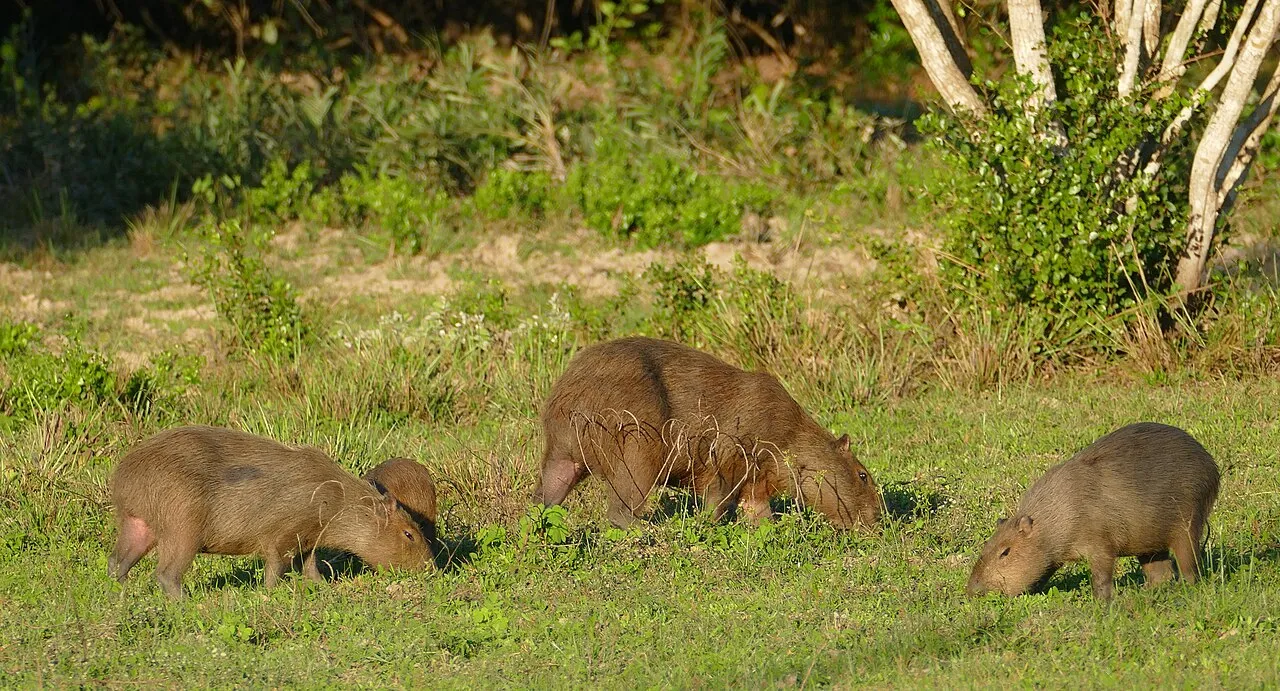
Daily routines depend on temperature. Capybaras rest in water or shade during the heat of the day and graze in the early morning, late afternoon and evening. Where people disturb them, they become largely nocturnal. They sleep in short bouts and sometimes doze in the water with only their noses above the surface.
They are excellent swimmers. When alarmed they plunge into water and can hold their breath for around five minutes, sometimes hiding among floating vegetation with only their nostrils exposed.
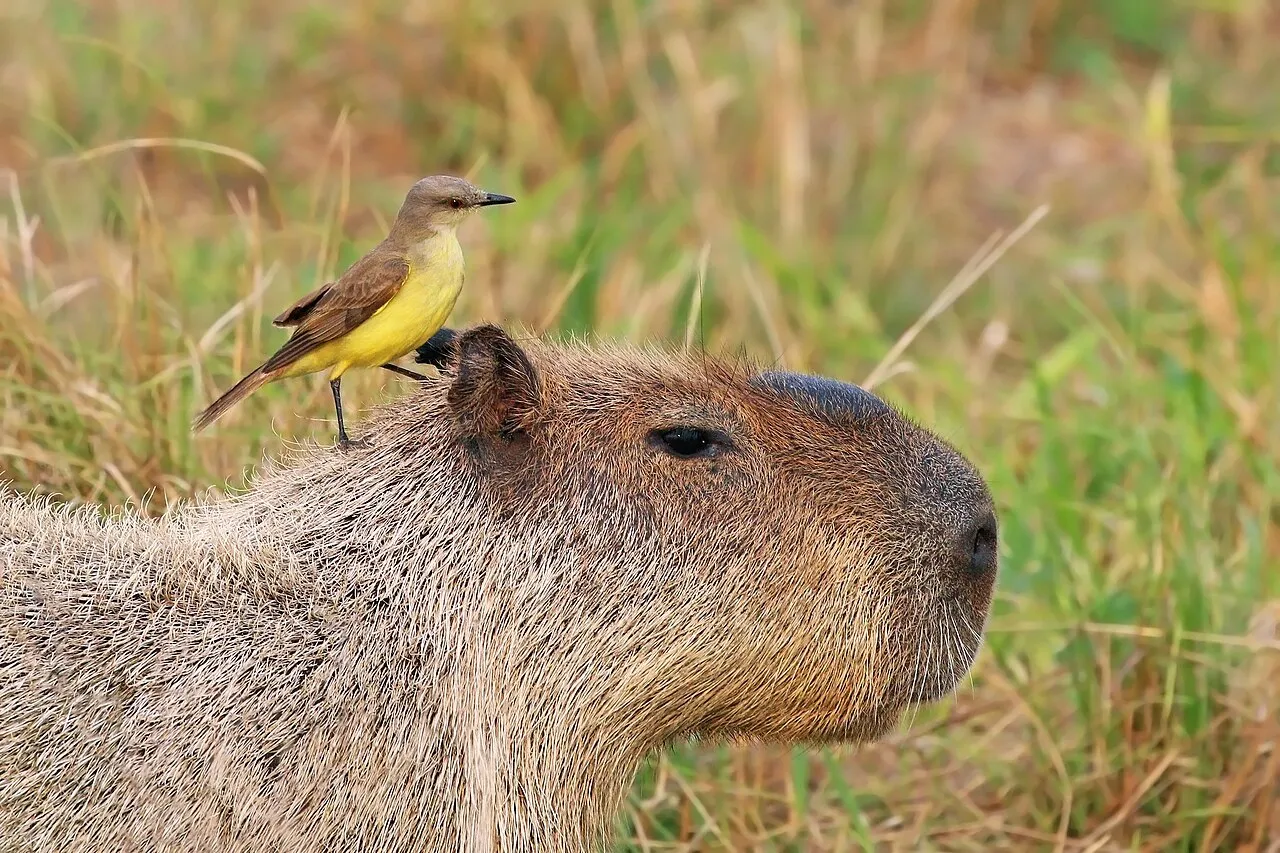
Capybaras have notable relationships with other animals. Birds such as cattle tyrants, cowbirds and caracaras perch on their backs to pick off ticks and flies, and capybaras often lie down to make access easier. This has earned them a reputation as nature's armchair. The idea that capybaras befriend everything is exaggerated, though; they bark in alarm and can bite when threatened.
7. Diet and feeding
Capybaras are herbivores that feed mainly on grasses and aquatic plants near water. In the wet season, when fresh grass is abundant, they select a few highly nutritious species; in the dry season they broaden their diet to tougher grasses, reeds, bark, fruit and grain. Near farms they raid sugarcane, maize, rice and melons, causing conflict with farmers. An adult eats roughly 3 to 3.5 kg of grass a day.
Grass is low in nutrients and hard to digest, so capybaras use two strategies. Microbes in the enlarged caecum ferment plant fibre, and capybaras practise coprophagy, eating special soft faeces produced in the caecum that are rich in microbial protein and vitamins. They usually do this in the early morning, as do rabbits and guinea pigs.
Capybaras are also reported to regurgitate food and chew it again, somewhat like cattle, squeezing every bit of nutrition from tough plants. Like humans and guinea pigs, they cannot make their own vitamin C and must get it from fresh plants; in captivity, a shortage can lead to gum disease.
8. Reproduction and life cycle
Bernard DUPONT · CC BY-SA 2.0
Capybaras can breed year-round, but mating peaks at the start of the rainy season and usually takes place in water. A receptive female gives a whistling call, and males chase her through the water. The dominant male tries to monopolize matings, but females often slip into the water to evade him and mate with subordinates.
Gestation lasts about 130 to 150 days, and litters average four pups, ranging from one to eight. Females usually breed once a year, sometimes twice in good conditions. They give birth in dense vegetation a short distance from the group and return with the pups after a few days.
| Stage | Age | What happens |
|---|---|---|
| Newborn | 0 to 1 week | Born furred with teeth; walks and swims within hours |
| Nursing | 1 week to 4 months | Mixes milk and grass; may nurse from several females |
| Juvenile | 4 months to 1 year | Stays with peers inside the group |
| Maturity | about 15 months to 2 years | Breeds at around 30 kg |
| Adult | from 2 years | Subordinate males may leave the group |
Capybara pups are highly precocial: born with open eyes and full fur, they start nibbling grass within days. Females in a group share care, sometimes nursing pups that are not their own, and the young cluster together in the middle of the group for safety.
Wild capybaras typically live 8 to 10 years, though many die earlier from predation or hunting. In captivity they can reach around 12 years.
9. Intelligence, communication and special abilities
Capybaras are vocal. Pups give a purring call as they follow their mothers, contented animals make clicking sounds, whistles help group members keep track of one another, and a short, sharp bark warns of danger, sending the group onto alert or into the water. In disputes they chatter their teeth as a threat.
Scent is just as important. Secretions from the morrillo and anal glands identify individuals and mark territory. Studies suggest the chemical make-up of anal gland secretions differs between individuals, functioning like a scent ID card.
Why capybaras tolerate other animals so readily is not fully understood. Their size means small animals pose little threat, as herbivores they have no reason to attack, and with tick-eating birds the relationship is mutually beneficial. Together these factors have produced the chill capybara image. In the wild, however, capybaras remain watchful animals, constantly alert for predators.
10. Predators and survival
Capybaras are an important food source for many South American predators. The jaguar is the main one, and in places such as the Pantanal capybaras make up a large share of its diet. Pumas and ocelots also take capybaras, while caimans and anacondas threaten them in the water. Young capybaras fall prey to harpy eagles and other large raptors, foxes and feral dogs.
Water is the capybara's main defence, though it is not perfectly safe: jaguars hunt on land and caimans in the water, so capybaras shift between the two as threats change. Group living helps too. Many eyes spot predators sooner, and when the whole group bolts into the water at once, a predator struggles to single out one animal. Pups are kept in the middle.
Despite their bulky look, capybaras can sprint at around 35 km/h over short distances.
11. Relationship with humans
Indigenous South Americans have long hunted capybaras for meat and hides, and hunting continued after European colonization. Capybaras remain an important resource in Venezuela, Colombia, Argentina and Brazil.
The most famous story concerns Lent in Venezuela. According to a widely told account, church authorities, at some point between the sixteenth and eighteenth centuries, classified the semi-aquatic capybara as akin to fish so that it could be eaten during Lent, when meat was forbidden. The details and documentation vary between sources, but salted, dried capybara is still eaten in Venezuela around Easter.
In Argentina, capybara leather, known as carpincho leather, is prized for gloves, bags and shoes because it is soft yet durable. In the llanos of Venezuela and Colombia, some ranches have managed wild capybaras and harvested a quota each year, an approach studied as an example of sustainable wildlife use, though poor management can lead to overhunting.
There are conflicts too. Capybaras damage crops, and in Brazil the ticks they carry can transmit Brazilian spotted fever, a potentially deadly disease. Studies suggest that growing capybara populations in urban parks have increased the risk.
12. Conservation status
The capybara is listed as Least Concern by the IUCN. It has a vast range, breeds quickly and adapts well to human-modified landscapes, so populations are generally stable. There is no reliable global estimate, but capybaras are very common in Brazil, Venezuela and elsewhere.
The picture varies locally:
- Overhunting for meat and leather has caused declines in some areas. In Venezuela, hunting reportedly increased during periods of economic crisis and food shortage.
- Draining and filling wetlands destroys habitat, although expanding pasture has actually boosted capybara numbers in some regions by providing more grass.
- Roads and urban growth bring more vehicle collisions.
The lesser capybara is poorly studied and listed as Data Deficient. Capybaras are not listed on CITES. In Korea they have no protected status, but laws revised in 2023 generally prohibit exhibiting live wild animals outside licensed zoos and aquariums, which restricts capybara cafes after a grace period.
13. In zoos, and as pets
Capybaras do fairly well in zoos. They are placid and can share space with other species, so they often live in mixed South American exhibits with maras, tapirs, birds and monkeys. Good exhibits offer a pool deep enough for full immersion, shade, mud wallows and enough companions to form a group. Some Japanese zoos became famous for letting capybaras soak in warm baths in winter, spreading the hot-spring capybara image worldwide.
Capybaras are very difficult pets:
- They grow to nearly 50 kg and need large outdoor spaces.
- They must have a pool or pond for swimming; without water they suffer from skin problems and overheating.
- As herd animals, they become lonely and stressed when kept alone.
- Their ever-growing teeth require constant grazing and large quantities of fresh hay and grass.
- They are prone to vitamin C deficiency, skin disease and dental problems, and few vets can treat them.
- They can bite when frightened or during breeding season, and their incisors are very sharp.
Some US states allow capybaras with a permit, but many ban them. In Korea, capybara cafes where visitors could touch and feed the animals became popular for a time, but indoor spaces without adequate water and constant handling by crowds can be highly stressful. What a capybara really needs is wide open water and its own kind.
14. In culture
In the 2020s the capybara became an internet meme. Photos of capybaras sitting expressionless beside monkeys, birds, cats, turtles and even caimans spread with captions calling them friends with everyone and the embodiment of calm. Images of capybaras soaking in hot springs with citrus fruit balanced on their heads are especially beloved. Short capybara videos set to catchy music went viral, and plush toys, stationery and game characters followed.
In Japan, capybara-inspired characters have been popular since the 2000s, and capybaras bathing in hot springs appear on the news almost every winter. In Korea, describing someone as capybara-like is a compliment for a calm, unflappable personality.
In South America capybaras are regional symbols, appearing as mascots for sports teams and schools in Argentina and Brazil. The story of capybaras occupying an Argentine gated community was widely shared as a joke about nature reclaiming land from the wealthy.
15. Trivia
- Capybaras can sleep in water, dozing with only their noses above the surface.
- All of a capybara's teeth, incisors and molars alike, grow throughout life.
- Capybara droppings are smooth and olive-shaped, and capybaras often defecate in water.
- With few sweat glands, they handle heat poorly and spend hot days largely submerged.
- One of the capybara's closest living relatives is the pet guinea pig, which is more than fifty times lighter.
- Capybaras have stout, hoof-like claws, and their tracks are sometimes mistaken for those of small deer or pigs.
- In some Brazilian cities capybaras are so common along urban rivers that joggers and grazing capybaras share the same riverside paths.
Wild animals are not pets. Catching, trading or keeping them is illegal in most places. If you find an injured wild animal, call your local wildlife rescue centre.
FAQ
Do capybaras really get along with every animal?
As herbivores they have little reason to attack, and tick-eating birds benefit them, so they often look relaxed. But the friends-with-everyone image is exaggerated; they bark and bite when threatened.
Are capybaras related to guinea pigs?
Yes. Capybaras belong to the cavy family alongside guinea pigs. They are more than fifty times heavier but share many features of appearance and digestion.
Can a capybara be kept as a pet?
It is very difficult. Capybaras grow to nearly 50 kg and need a pool for swimming, a large outdoor area and companions. Kept alone indoors, they easily suffer skin problems and stress.
Photo credits
Photos are freely licensed images from Wikimedia Commons. Authors and licenses are listed below.
- Capybaracropped.jpg — Giles Laurent · CC BY-SA 4.0
- 055 Capybara swimming in Encontro das Águas State Park Photo by Giles Laurent.jpg — Giles Laurent · CC BY-SA 4.0
- Capivara(Hydrochoerus hydrochaeris).jpg — Clodomiro Esteves Junior · CC BY-SA 4.0
- Capybara (Hydrochoerus hydrochaeris) alpha male.JPG — Charles J. Sharp · CC BY-SA 4.0
- Capybaras (Hydrochoerus hydrochaeris) grazing in the evening.jpg — Bernard DUPONT · CC BY-SA 2.0
- Cattle tyrant (Machetornis rixosa) on Capybara.jpg — Charles J. Sharp · CC BY-SA 4.0