TailVille
1. Overview
Ask which animal is the largest ever to have lived, and the answer is not a dinosaur but a creature swimming in today's oceans: the blue whale. Adults commonly exceed 25 metres, the very largest reach around 30 metres, and weights of 150 tonnes or more have been estimated. Some sauropod dinosaurs may have matched it in length, but most researchers agree none came close in mass.
This giant lives on krill, shrimp-like crustaceans a few centimetres long. A blue whale engulfs a mouthful of water larger than its own body, strains it through hundreds of baleen plates, and swallows the krill left behind, eating several tonnes on a good day.
Blue whales were hunted almost to extinction during the twentieth century. Hundreds of thousands were killed in Antarctic waters alone. Commercial hunting was banned internationally in 1966, yet recovery has been painfully slow, and the species is listed as Endangered on the IUCN Red List.
This article covers the blue whale's biology, its near-disappearance, and why the biggest animal on Earth remains surprisingly hard to study.
2. Name and classification
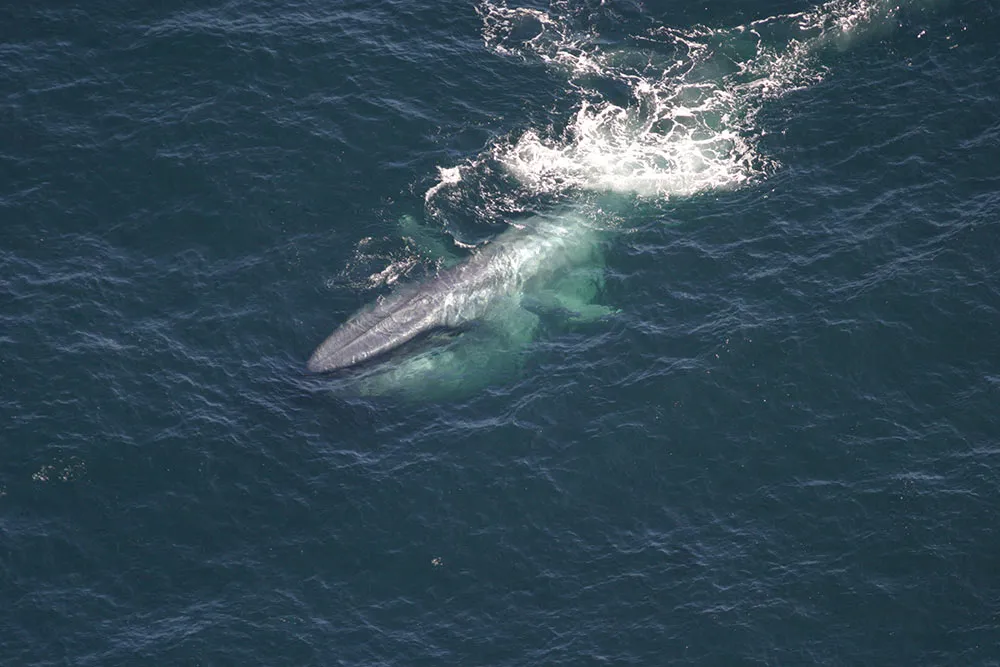
NOAA Fisheries/Lisa Conger · Public domain
The scientific name is Balaenoptera musculus. Balaenoptera combines the Latin balaena, whale, with the Greek pteron, wing or fin, meaning finned whale. Musculus can mean muscle or little mouse in Latin, and it has been suggested that Linnaeus, who named the species, was making a deliberate joke by giving the largest animal on Earth a name that could mean little mouse.
Blue whales are rorquals, members of the family Balaenopteridae. Rorquals have long pleats running from the chin to the belly that let the throat balloon outward when feeding. Relatives include the fin whale, sei whale, Bryde's whale, minke whales and the humpback whale.
Old whalers called it sulphur-bottom because of the yellowish film of diatoms that sometimes coats the belly. In Korean it was long known as huin-gin-suyeom-gorae, roughly white long-baleen whale, but the name daewang-gorae, king whale, is now more common.
2.1. Subspecies
Several subspecies are recognized, though the details vary between authorities. The northern blue whale, B. m. musculus, lives in the North Atlantic and North Pacific. The Antarctic blue whale, B. m. intermedia, is the largest. The pygmy blue whale, B. m. brevicauda, lives in the southern Indian Ocean and around Australia and is shorter, though still over 20 metres. A northern Indian Ocean form, B. m. indica, is sometimes recognized, and Chilean blue whales may also deserve separate status. Each population sings a distinctive song, so researchers can often identify which group they are hearing from recordings alone.
3. Evolution
Baleen whales descend from toothed ancestors. After splitting from toothed whales around 34 million years ago, early baleen whale lineages included forms with both teeth and primitive baleen. Teeth were gradually lost, and today baleen whale embryos still form tooth buds that are reabsorbed before birth.
Remarkably, true gigantism is a recent development. Fossil studies suggest that for most of their history baleen whales were around 10 metres long or less, and that very large body sizes appeared only in the last 4.5 million years or so. As ice ages began, ocean upwelling intensified and prey such as krill became concentrated in dense, seasonal patches. Huge bodies made it efficient to migrate long distances between those patches and to gorge when food was plentiful.
Genetic studies reveal gene flow between blue whales and other rorquals, and blue-fin whale hybrids have been confirmed in the wild. Recent analyses of the blue whale genome have found changes in genes linked to DNA repair and cancer suppression, offering clues to Peto's paradox: the puzzle of why giant animals with trillions of cells do not get cancer more often.
4. Range and habitat
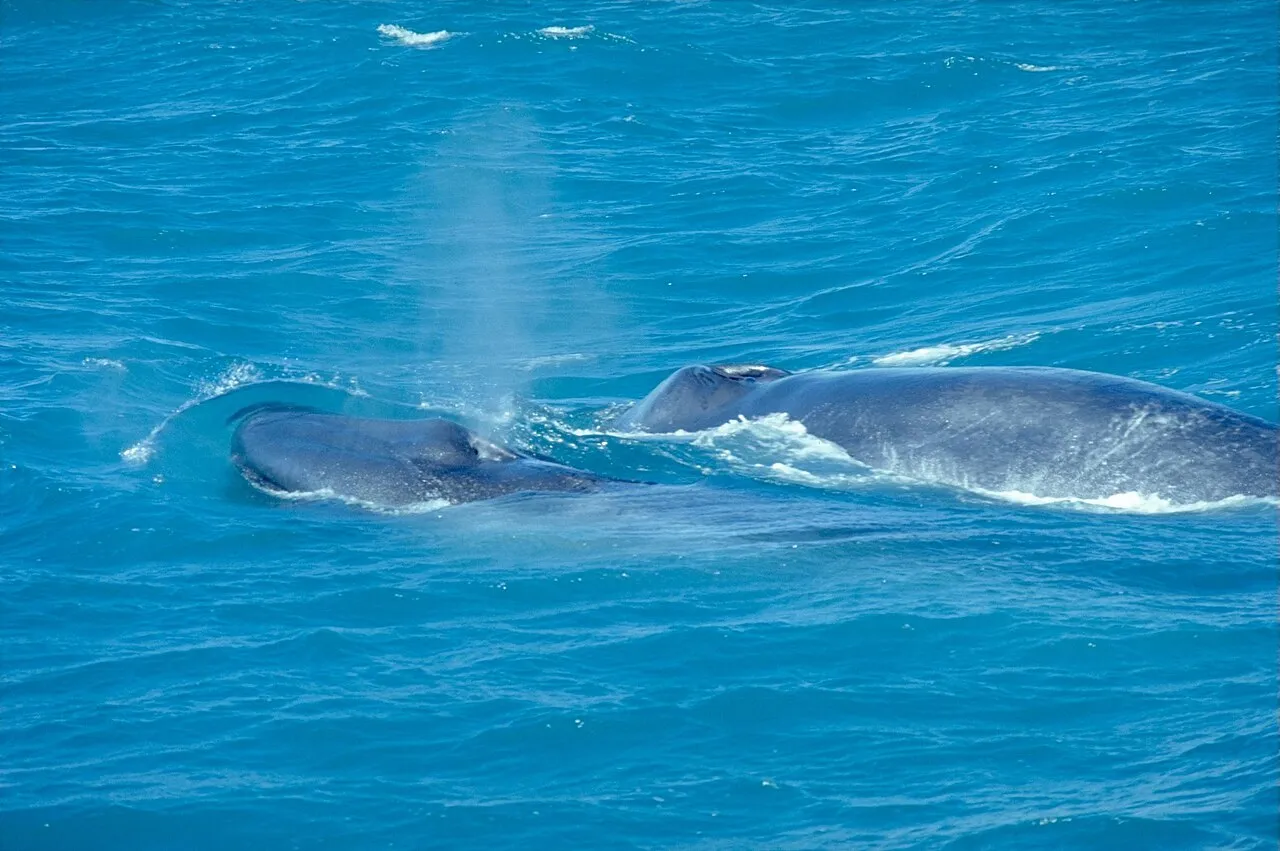
Blue whales occur in every ocean, from the edges of the polar ice to the tropics. They mostly use deep water beyond the continental shelf but come close to shore where food is concentrated.
Many populations migrate seasonally, feeding in cold, productive high-latitude waters during summer and moving toward warmer waters in winter, where calving is thought to occur. Unlike humpbacks, however, blue whales have no well-defined breeding grounds known to science, and where most calves are born remains uncertain. Some populations, such as those in the northern Indian Ocean off Sri Lanka, stay in warm water year-round.
Good places to see them include the coast of California, the Gulf of California in Mexico, the Gulf of St Lawrence in Canada, the waters off Iceland, southern Sri Lanka, southern Chile and southern Australia. Historical whaling records mention blue whales in waters around Korea, but sightings there today are extremely rare.
5. Physical characteristics
The blue whale is long and slender for its size. Seen from above, the head forms a broad U shape, and a raised splashguard protects the paired blowholes. The blow is a tall, slender column that can rise nine metres or more and is visible from far away.
| Feature | Typical value |
|---|---|
| Length | usually 20 to 28 m; Antarctic animals up to about 30 m |
| Weight | roughly 100 to 150 tonnes or more |
| Newborn | about 7 m, 2 to 3 tonnes |
| Heart | about 180 kg; the car-sized comparison is an exaggeration |
| Baleen | about 270 to 395 plates per side, up to about 1 m long, black |
| Throat pleats | about 60 to 90 |
| Cruising speed | 8 to 20 km/h, bursts over 30 km/h |
The largest measured animals were taken at Antarctic whaling stations in the early twentieth century, when measuring methods were inconsistent, so famous figures such as 33 metres should be treated with caution. The largest scientifically reliable measurements fall just under 30 metres. As in most baleen whales, females are slightly larger than males.
5.1. Skin and colouring
The skin is blue-grey with a mottled pattern of lighter and darker patches that is unique to each animal, allowing photo-identification. Underwater, sunlight makes the body look strikingly blue. The dorsal fin is tiny for the body size and sits far back, appearing at the surface well after the blow. The tail flukes can span around seven metres.
5.2. Physiology of a giant
In 2019 researchers attached a suction-cup sensor to a wild blue whale and recorded its heartbeat for the first time. During deep feeding dives the heart slowed to as few as two beats a minute, then raced to more than 30 beats a minute at the surface. The team suggested the heart was operating near its physiological limits, which may help explain why no larger animal has evolved. The aorta is wide enough for a person's head, and the tongue alone can weigh a few tonnes.
6. Behaviour and ecology
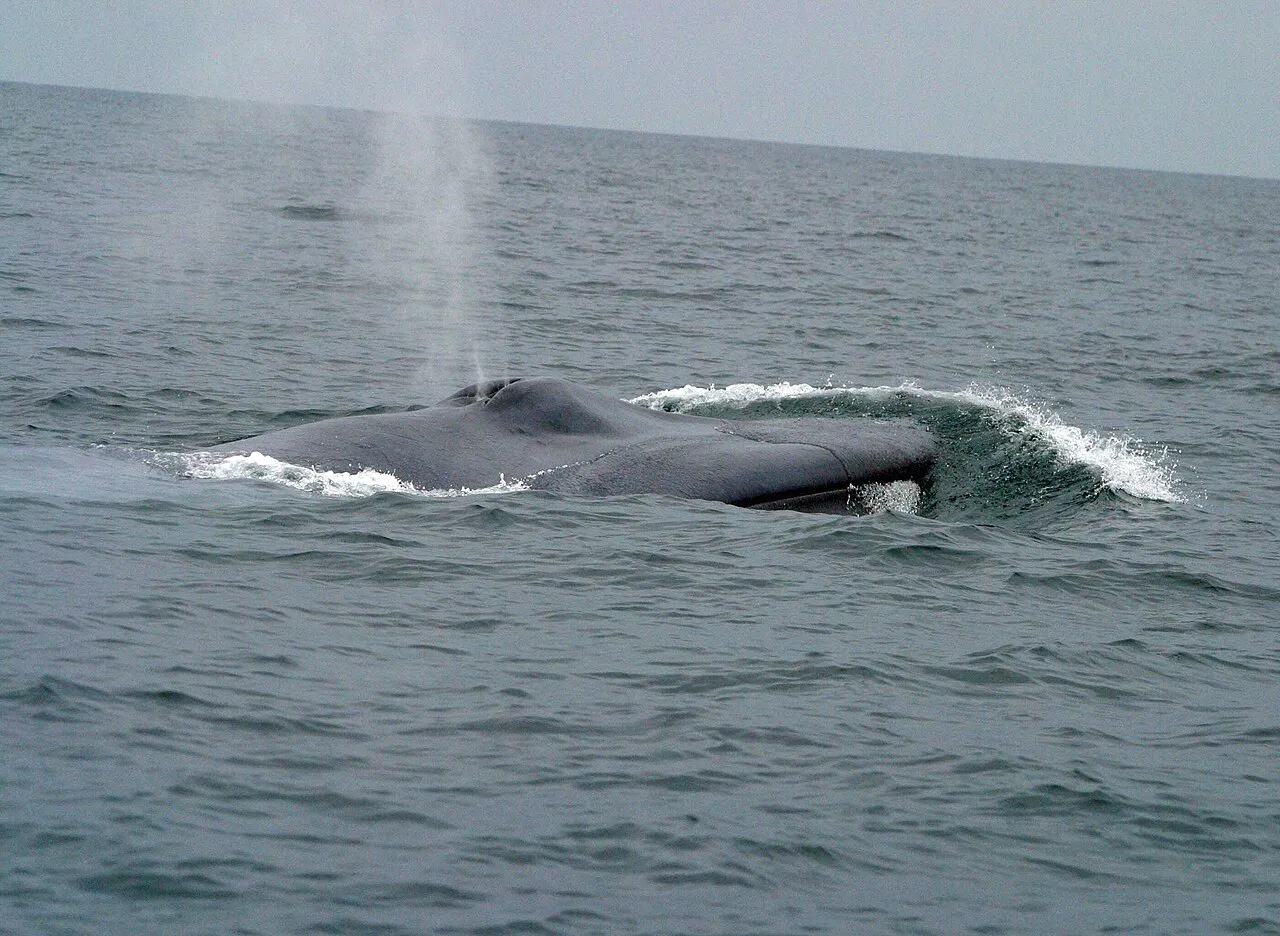
Blue whales usually travel alone or in pairs or trios. Dozens may gather where food is abundant, but they do not form the long-lasting groups typical of dolphins. Calling them solitary may be misleading, though: their low-frequency calls travel hundreds of kilometres, so animals far out of sight may still be in acoustic contact.
Daily routines follow the krill. Krill swarms sink deep during the day and rise toward the surface at night, so blue whales tend to feed at 100 to 200 metres by day and shallower at night. Dives typically last around ten minutes and sometimes more than twenty.
Their migrations are vast. Satellite tags show animals travelling thousands of kilometres between seasons. Eastern North Pacific blue whales feed off California in summer and travel in winter to an upwelling area off Central America known as the Costa Rica Dome.
7. Diet and feeding
Blue whales are krill specialists. In the Southern Ocean they eat Antarctic krill; elsewhere they take other krill species and occasionally small copepods.
They feed by lunging. On finding a dense swarm, a whale accelerates, opens its jaws to nearly 90 degrees, and its pleated throat balloons outward to engulf a volume of water comparable to or greater than its own body mass. It then closes its mouth and uses its tongue and throat muscles to force the water out through the baleen, trapping the krill inside. Each lunge takes tens of seconds, and several lunges can be packed into a single dive.
The traditional figure for daily intake was around four tonnes. A 2021 study combining tags, drones and acoustic surveys of prey suggested that, during peak feeding, blue whales may eat well over ten tonnes of krill a day. They build up fat reserves during the feeding season and live off them when food is scarce.
Because lunging costs so much energy, blue whales seem to lunge only when krill is dense enough to pay off, skipping thinner patches in a kind of cost-benefit calculation.
7.1. A giant ocean fertilizer
Blue whale faeces are rich in iron and nitrogen and fertilize phytoplankton near the surface. Because whales feed at depth and defecate near the surface, they move nutrients upward, an effect sometimes called the whale pump. One intriguing hypothesis is that the removal of great whales by whaling actually reduced krill numbers in parts of the Southern Ocean, because fewer whales meant less fertilizer for the plankton that krill eat.
8. Reproduction and life cycle
Blue whale mating has rarely been observed directly. It is thought to happen from late autumn into winter, and males have been seen following females in what appear to be competitive chases.
Gestation lasts about 10 to 12 months, and a female gives birth to one calf every two to three years. Newborns are around seven metres long and weigh two to three tonnes. The milk is extraordinarily rich, roughly 30 to 50 percent fat, and calves gain weight at a rate often quoted as tens of kilograms per day, perhaps close to 90 kg at peak.
| Stage | Age | What happens |
|---|---|---|
| Newborn | 0 to 6 months | Drinks fat-rich milk and grows rapidly |
| Weaning | around 6 to 8 months | Reaches about 13 to 16 m; starts eating krill |
| Immature | 1 to 10 years | Lives independently and keeps growing |
| Sexual maturity | about 5 to 15 years | Breeding begins at over 20 m long |
| Full size | around 20 to 30 years | Growth largely stops |
Lifespan is estimated at 70 to 90 years. Baleen whales can be aged by counting layers in their earplugs, waxy plugs that build up in the ear canal in annual bands like tree rings. These plugs also record exposure to pollutants and stress hormones over a whale's life, giving scientists a kind of lifetime diary.
9. Intelligence, communication and special abilities
Blue whales are among the loudest animals on Earth. Their calls are very low, around 10 to 40 hertz, mostly below or at the edge of human hearing, yet source levels above 180 decibels have been measured underwater. Low frequencies carry far in water, so under good conditions the calls may reach animals hundreds of kilometres away.
Males produce repetitive songs, and each population has its own song structure, probably used to attract mates and advertise presence. Researchers have discovered that the pitch of blue whale songs worldwide has been dropping steadily for decades. Explanations include recovering populations no longer needing to shout as loudly to reach distant mates, or changes in ocean noise and conditions, but the cause is not settled.
Tracking studies suggest blue whales remember where and when food was plentiful in previous years and time their migrations accordingly. That memory-based strategy may become a liability if climate change shifts the timing of krill blooms.
Echolocation is a toothed whale ability; baleen whales such as blue whales are not thought to use precise biosonar. They likely navigate using a combination of vision, low-frequency sound, and sensitivity to seafloor features and water temperature.
10. Predators and survival
Orcas are essentially the only natural predator of adult blue whales. Attacks had long been suspected, but the first detailed record of orcas killing a healthy adult blue whale came from Western Australia in 2019, when dozens of orcas worked together for hours to exhaust and bring down the whale. Many blue whales carry orca tooth rake scars, so attacks on calves and weaker animals may not be rare.
Blue whales appear to rely on size and sustained speed to outrun orcas rather than fighting back as humpbacks sometimes do. Sharks scavenge carcasses but rarely, if ever, attack healthy adults.
Today the greatest dangers come from people: collisions with large ships on busy shipping lanes, entanglement in fishing gear, and underwater noise.
11. Relationship with humans
Blue whales were too fast and powerful for the open-boat whalers of the sailing era. That changed in the late nineteenth century with steam-powered catcher boats and the explosive harpoon cannon developed in Norway, along with the practice of pumping air into carcasses to keep them afloat.
From the early twentieth century, shore stations and factory ships in the Southern Ocean made the blue whale a prime target, since a single animal yielded enormous quantities of oil. Roughly 360,000 blue whales are thought to have been killed worldwide during the twentieth century, the great majority in the Southern Hemisphere, including around 30,000 in the 1930 to 1931 season alone. Whale oil went into margarine, soap, lubricants and nitroglycerine for explosives.
With stocks collapsing, the International Whaling Commission banned the hunting of blue whales in 1966. After the Cold War it emerged that the Soviet Union had continued illegal whaling for years, meaning the true toll was higher than official records showed.
11.1. Connections with Korea
People on the Korean Peninsula have a long history with whales. Prehistoric petroglyphs along the Bangucheon stream in Ulsan show several kinds of whales and scenes of whale hunting, among the oldest known depictions of whaling anywhere. They were inscribed on the UNESCO World Heritage List in 2025 as the Petroglyphs along the Bangucheon Stream. Which species the carvings show is debated, and it is not clear whether blue whales are among them.
Foreign whaling companies hunted large whales in the East Sea in the early twentieth century, and after 1945 Korean whaling centred on Jangsaengpo in Ulsan. Deliberate whaling has been banned in Korea since the 1986 international moratorium. The blue whale is designated a protected marine species by Korea's Ministry of Oceans and Fisheries.
In 2024 the name daewang-gorae made headlines in Korea when it was given to a deep-sea gas exploration project in the East Sea, introducing the whale's Korean name to many people for the first time.
12. Conservation status
The blue whale is listed as Endangered on the IUCN Red List. The 2018 assessment moved it down from Critically Endangered, reflecting population increases since the 1990s. The global mature population is estimated at around 5,000 to 15,000, with a total population perhaps in the range of 10,000 to 25,000, though estimates vary considerably by method.
The collapse of the Antarctic blue whale is the starkest story. Before whaling there were probably more than 200,000 in the Southern Ocean; by the 1970s only a few hundred may have remained, well under one percent of the original number. They are now increasing by several percent a year but remain a small fraction of their former abundance. The eastern North Pacific population has recovered more strongly and is thought to number in the low thousands.
Main threats include:
- Ship strikes, especially where feeding grounds overlap with shipping lanes, as off California and Sri Lanka. Some areas now use voluntary speed limits or shifted lanes.
- Noise from ships, seismic surveys and military sonar, which can mask calls and disrupt feeding.
- Climate change, which alters sea ice and the distribution of krill.
- Krill fishing, an expanding industry in the Antarctic that supplies aquaculture feed and supplements.
The blue whale is listed in CITES Appendix I, which bans international commercial trade.
13. In zoos and aquariums
No blue whale has ever been kept alive in captivity. An animal that weighs over 100 tonnes, eats several tonnes of krill a day and migrates thousands of kilometres cannot realistically or ethically be confined in a tank. That simple fact means everything we know about blue whales has come from studying them at sea or from whaling records and stranded carcasses.
Instead, many natural history museums display blue whale skeletons or life-size models. Skeletons recovered from stranded whales are often cleaned and assembled over several years and give visitors a powerful sense of scale. Whale watching is the other way to meet a blue whale, and responsible operators follow distance rules so that boats do not crowd feeding or resting animals.
14. In culture
The blue whale is shorthand for the biggest thing imaginable. It appears in almost every children's animal book, usually next to a bus, a basketball court or an aeroplane for scale. In 2017 London's Natural History Museum replaced the dinosaur cast in its main hall with a blue whale skeleton named Hope, symbolizing a species humanity pulled back from the brink.
The story of the 52-hertz whale, often called the loneliest whale in the world, is linked to blue whales. Since the late 1980s, hydrophones have picked up an animal calling at an unusually high 52 hertz. Some suspect it is a blue-fin hybrid or simply an individual with an unusual voice. The story has inspired songs, novels and documentaries as a symbol of a voice no one can hear.
The blue whale was also a staple of the Save the Whales posters of the 1970s and 1980s, which helped build support for the international moratorium on commercial whaling.
15. Trivia
- Despite its enormous mouth, a blue whale's throat is narrow. It could not swallow a person; it can only swallow small prey such as krill.
- You can often identify a whale species from its blow. A tall, straight column usually means a blue or fin whale.
- A newborn blue whale already outweighs a fully grown elephant.
- Baleen is made of keratin, the same protein as fingernails and hair. In the past it was used for corset stays and umbrella ribs, though blue whale baleen was less prized than that of right whales.
- When a blue whale dies and sinks, its carcass becomes a whale fall, a seafloor ecosystem that can support hundreds of species for decades.
- A blue whale's lungs are thought to hold roughly 5,000 litres of air.
Wild animals are not pets. Catching, trading or keeping them is illegal in most places. If you find an injured wild animal, call your local wildlife rescue centre.
FAQ
Are daewang-gorae and huin-gin-suyeom-gorae the same animal?
Yes, both are Korean names for the blue whale. The older name means white long-baleen whale, but because the whale is not white, the name meaning king whale has become more common.
Is the blue whale bigger than the dinosaurs?
Some giant sauropods may have matched it in length, but most researchers agree no known animal has been heavier.
Could a blue whale swallow a person?
No. Its mouth is enormous but its throat is narrow, suited only to small prey such as krill. Blue whales pose no threat to people.
Photo credits
Photos are freely licensed images from Wikimedia Commons. Authors and licenses are listed below.
- Anim1754 - Flickr - NOAA Photo Library.jpg — NOAA Photo Library · Public domain
- Blue-whale.jpg — NOAA Fisheries/Lisa Conger · Public domain
- BlueWhaleWithCalf.jpg — Andreas Tille · CC BY-SA 4.0
- Bluewhale1 noaa crop.jpg — NOAA · Public domain