TailVille
At a glance
Rough ranges for supplies, food and electricity in Korea (USD is approximate). Purchase or adoption fees are not included.
People who want a hands-on, affectionate bird and enjoy a whistling companion for many years.
Allergy sufferers, people who are out all day, or anyone unsure where they'll be in ten years.
1. Overview
The cockatiel is a slender, medium-small parrot from the dry plains of inland Australia, instantly recognisable by its tall, wispy crest and round orange cheek patches. At 30 to 33 cm including its long tail and 80 to 110 grams, it is more than twice the weight of a budgie, and it is in fact a member of the cockatoo family. It shares the crest and powder down of the big cockatoos, but in a size and volume that suit an ordinary home.
Cockatiels are prized for their gentle, cuddly temperament. A hand-tame bird will lower its head to ask for scratches and happily nap on your shoulder. Few become clear talkers, but many males are superb whistlers that learn whole tunes, from children's songs to ringtones.
The flip side is a nervous disposition, a lot of feather dust and a lifespan of 15 to 20 years or more. This article looks at the cockatiel's name and classification, history, anatomy and colour mutations, behaviour, care, diet, health, breeding, costs, legal status and cultural footprint.
2. Name and classification
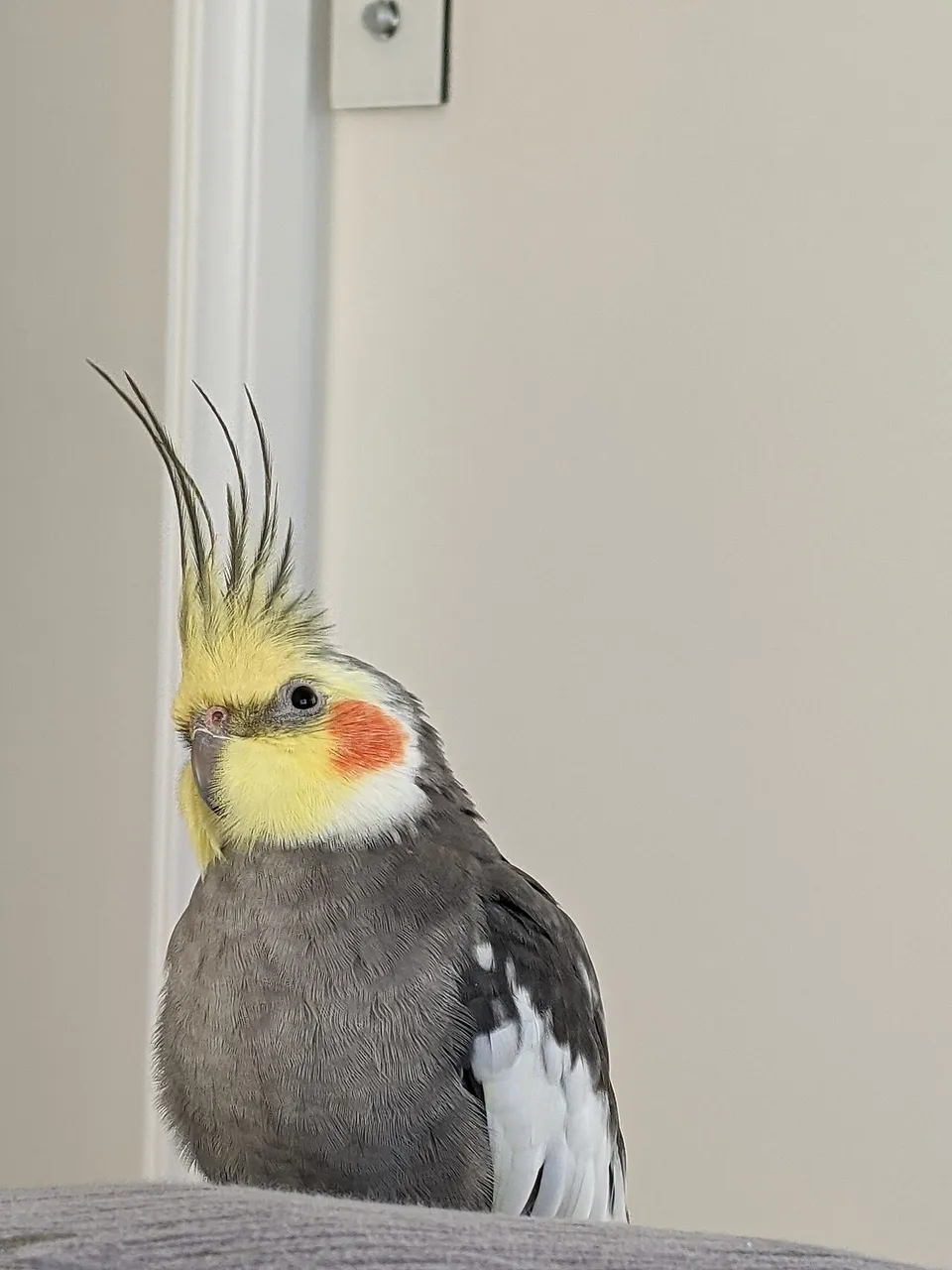
CatBird01 · CC BY-SA 4.0
2.1. Scientific name and etymology
The scientific name Nymphicus hollandicus was published in 1792 by the Scottish writer Robert Kerr. Nymphicus refers to the nymphs of Greek mythology, reportedly because early European observers found the bird so graceful, and hollandicus points to New Holland, the old European name for Australia. Put together, the name means something like 'nymph of New Holland'.
The English word cockatiel is generally traced to a Dutch diminutive meaning 'little cockatoo' and came into use in the late nineteenth century. In Australia the bird is also called the quarrion, a name borrowed from an Aboriginal language.
2.2. Korean and Japanese names
The Korean name wanggwan-aengmu means 'crown parrot', inspired by the upright crest, and owners often shorten it affectionately to wanggwani. In Japan the bird is okame-inko, after Okame, a traditional mask and folk character with round, rosy cheeks. Korea named the bird for the top of its head, Japan for its cheeks.
2.3. Place in the cockatoo family
The cockatiel is placed in the cockatoo family, Cacatuidae, as the sole species of the genus Nymphicus. Its long tail and slim body once tempted taxonomists to group it with the true parakeets, but it has the hallmarks of a cockatoo: a movable crest, powder-down feathers and a gall bladder, among other anatomical details. Genetic studies suggest that within the family it sits relatively close to the black cockatoos.
It is both the smallest cockatoo and the only one with a long, pointed tail.
3. History
3.1. To Europe and America
Live cockatiels started arriving in Europe around the middle of the nineteenth century. They paired and raised chicks readily in cages, so European aviculturists were soon breeding their own, and once Australia clamped down on wildlife exports, virtually every cockatiel worldwide became the descendant of captive-bred stock.
For a long time the only colour was the wild grey. In the mid-twentieth century American breeders established the pied, with its patches of clear yellow and white, and soon afterwards the creamy yellow lutino, which became a sensation. From the 1960s onwards pearl, cinnamon, whiteface and other mutations emerged across Europe, building the range we see today. Sources differ slightly on exactly when and where each mutation first appeared.
3.2. Cockatiels in Korea
Records of the first cockatiels in Korea are hard to find. For years bird markets sold them as a pricier 'mid-range' parrot compared with budgies and Java sparrows, and many keepers date their real popularity to the 2000s, when online communities and social media took off. Hand-fed babies became widely available and the cockatiel gained its reputation as a bird that follows you around like a friendly cat.
Today cockatiels are a staple of Korean parrot cafes and YouTube channels, and lutino, whiteface and pied birds are common. Their popularity has also brought more impulse purchases and rehoming, which is why Korean keepers increasingly stress learning about lifespan, noise and dust before buying.
4. Physical characteristics
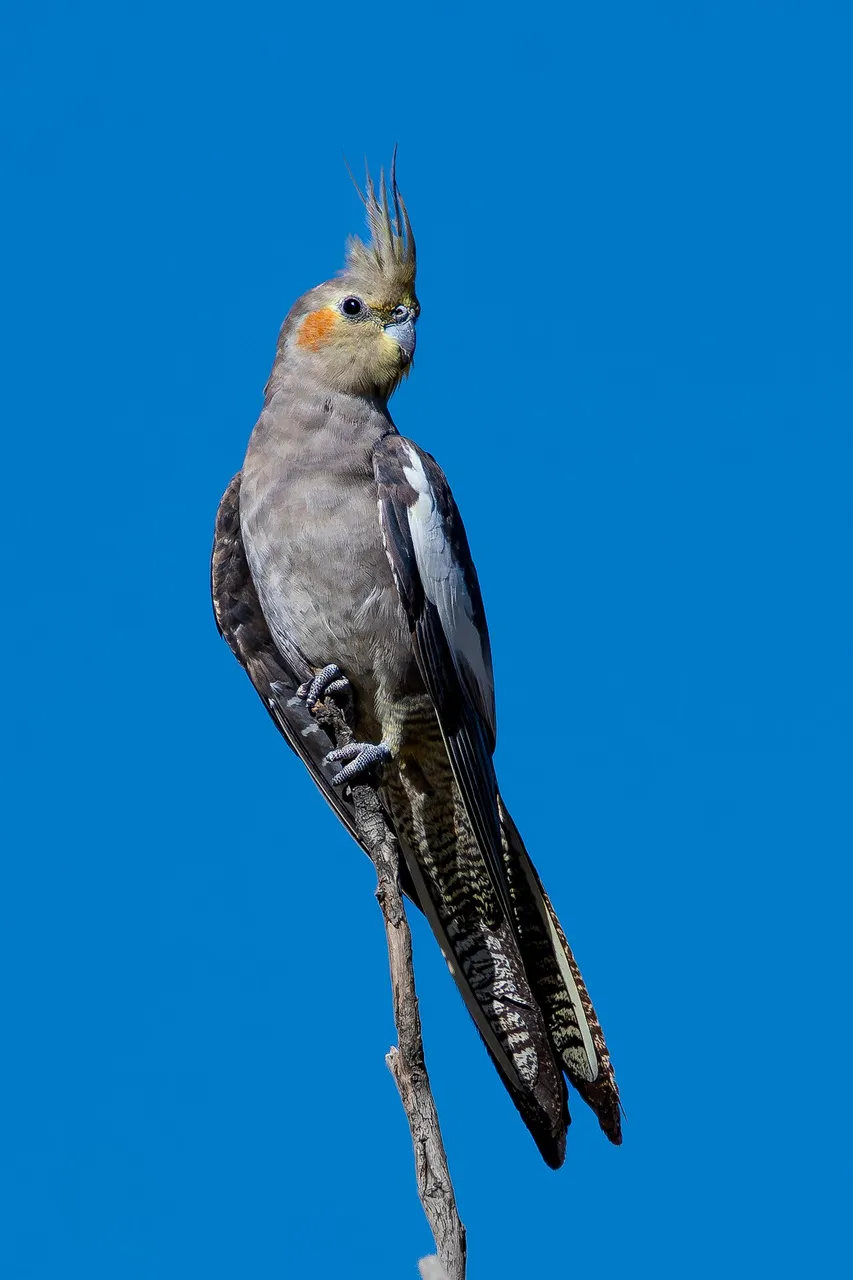
Photo by: Ganatron – paulweberphoto.com · CC BY 4.0
4.1. Build and crest
Cockatiels have a slim body and a tail that makes up nearly half their length. Long, narrow wings make them fast, enduring fliers, and wild birds cover great distances in search of water and food. The short, strong, hooked beak is designed for cracking seed husks.
The crest consists of a dozen or so long, fine feathers raised and lowered by muscles, and its angle changes with the bird's mood, making it the single best guide to how a cockatiel is feeling. The orange cheek patches sit over the ear openings, which are hidden beneath the feathers.
4.2. Feathers and powder down
The wild-type normal grey is charcoal grey all over with a broad white bar along the edge of each wing. Adult males have a bright yellow face and vivid orange cheeks, while females have a grey face and duller cheeks.
Powder down is one of the cockatiel's defining features. Special down feathers scattered across the body constantly crumble at the tips, releasing a fine white powder that spreads through the plumage for waterproofing and conditioning. A soft, slightly chalky feel and white dust on your fingers are signs of a healthy bird. That same dust floats in the air, though, and can trigger coughing, allergies and, in rare cases, a hypersensitivity lung disease known as bird fancier's lung. Air purifiers, ventilation and regular baths all help.
4.3. Sexing
In normal greys, sexing becomes fairly straightforward after the first moult at six to twelve months.
| Feature | Male | Female |
|---|---|---|
| Face | Bright yellow | Grey or faintly yellow |
| Cheek patch | Strong, bright orange | Muted orange |
| Underside of tail | Plain dark grey | Barred with yellow |
| Underside of flight feathers | Plain | Small yellow spots |
| Behaviour | Frequent singing, heart-wing display | Quieter, may raise tail in a soliciting posture |
Young birds of both sexes look like females, so even males have barred tails until they moult. Lutino, whiteface, pearl and pied birds can be difficult or impossible to sex by appearance, so if sex matters to you, ask for a DNA test.
5. Colour mutations
Dozens of cockatiel mutations exist, but these are the ones you are most likely to meet. Many birds combine several, producing names like 'whiteface pearl pied'.
| Mutation | Appearance | Notes |
|---|---|---|
| Normal grey | Wild type: grey body, yellow face in males | Often described as the hardiest |
| Lutino | White to creamy yellow body, red eyes | Prone to a bald patch behind the crest |
| Pied | Grey body broken by yellow and white patches | Amount of pied varies widely |
| Pearl | Pearl-like spots on back and wing feathers | Males lose most of the pearling as they mature |
| Cinnamon | Warm brown instead of grey | Chicks may have reddish eyes |
| Whiteface | No yellow or orange; white face | Lacks yellow pigment |
| Albino (whiteface lutino) | All white with red eyes | A combination of two mutations |
| Pastelface | Cheeks a soft apricot | Gentle look |
| Silver, emerald and others | Silvery or olive tones | Less common in many countries |
Lutinos are hugely popular, but they often inherit a bald patch behind the crest. It is not harmful in itself, yet pairing birds with large patches tends to make it bigger, so careful breeders take it into account.
6. Behaviour
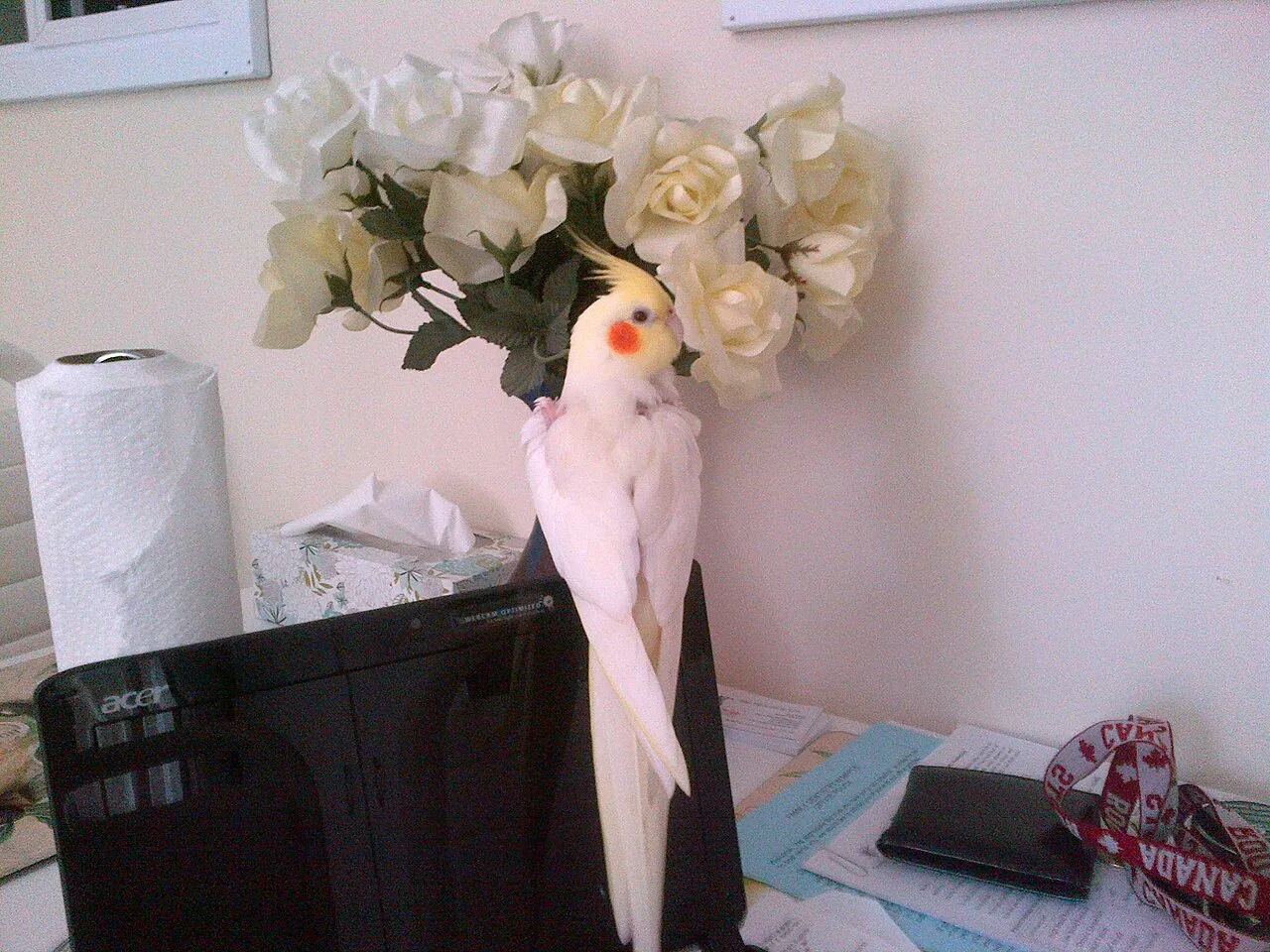
Kroon78 · CC BY-SA 3.0
6.1. In the wild
Wild cockatiels live in pairs or small groups across the savanna, scrubland and farmland of inland Australia, sometimes gathering in hundreds where food is plentiful. They feed mostly on the ground, picking up grass seeds and spilled grain, which is why pet cockatiels love to wander the floor and peck at whatever they find.
When alarmed, a flock bursts into the air together with harsh calls. Grey plumage blends well with dead branches, and a perched bird may stretch upright to look like part of the tree. Breeding begins after rain brings a flush of food, usually in hollows of old trees near water.
6.2. At home
A cockatiel treats its owner as a mate or flockmate and wants to be wherever you are. When you leave the room it sends out a rising contact whistle to find you, and a quick whistle back from the other room often settles it. Making a habit of answering is one of the easiest ways to keep the calling down.
Males court by lifting their wings slightly at the shoulders into a heart shape and hopping along while whistling. They will serenade a mirror, a shiny object or simply your hand. Hens are usually quieter and more placid but may crouch with tail raised when hormonal.
Night frights are the big night-time hazard. A tremor, passing headlights, an insect or a cat's shadow can send a cockatiel thrashing around its cage in the dark, breaking feathers or causing bleeding. A dim night light and plenty of clear space inside the cage are the best defence.
6.3. Reading the crest and body
- Crest swept back at a relaxed angle: calm and content.
- Crest straight up: curiosity, interest or sudden surprise; a thin, upright body tips it towards alarm.
- Crest flattened, body lowered, hissing: frightened or angry; give it space.
- Head bowed and offered, feathers slightly fluffed: a request for a head scratch.
- Heart-shaped wings with whistling: a male showing off or courting.
- Stretched tall and frozen: wary or frightened.
- Beak grinding while standing on one leg: relaxed and ready for sleep.
- Persistent tail-bobbing: may signal laboured breathing and illness.
7. Life stages
Cockatiels typically live 15 to 20 years, and birds well past 20 are not unusual with good care. That is longer than most dogs, so plan accordingly.
| Stage | Age | What happens |
|---|---|---|
| Egg | About 18 to 21 days | Both parents incubate, usually the male by day and the female by night |
| Chick | 0 to 4 weeks | Hatches in yellow down; eyes open at 7 to 10 days |
| Fledgling | 4 to 6 weeks | Leaves the nest and starts flying, still fed by parents |
| Juvenile | 6 to 12 weeks | Weaned; short crest and tail, pinkish cere |
| Adolescent | 3 to 12 months | First moult turns a male's face yellow; peak curiosity and energy |
| Adult | 1 to 10 years | Breeding age; temperament settles |
| Senior | 12 years and up | Less active; joints and eyesight decline; liver and kidney disease risk rises |
Older cockatiels move more slowly on perches, and some develop cataracts that cloud the eyes. Arthritic feet struggle to grip, so the bird spends more time on the floor. Add a flat platform perch, place food and water low, and give extra protein and rest during moults. A check-up with blood work once or twice a year can catch liver and kidney problems early.
8. Housing
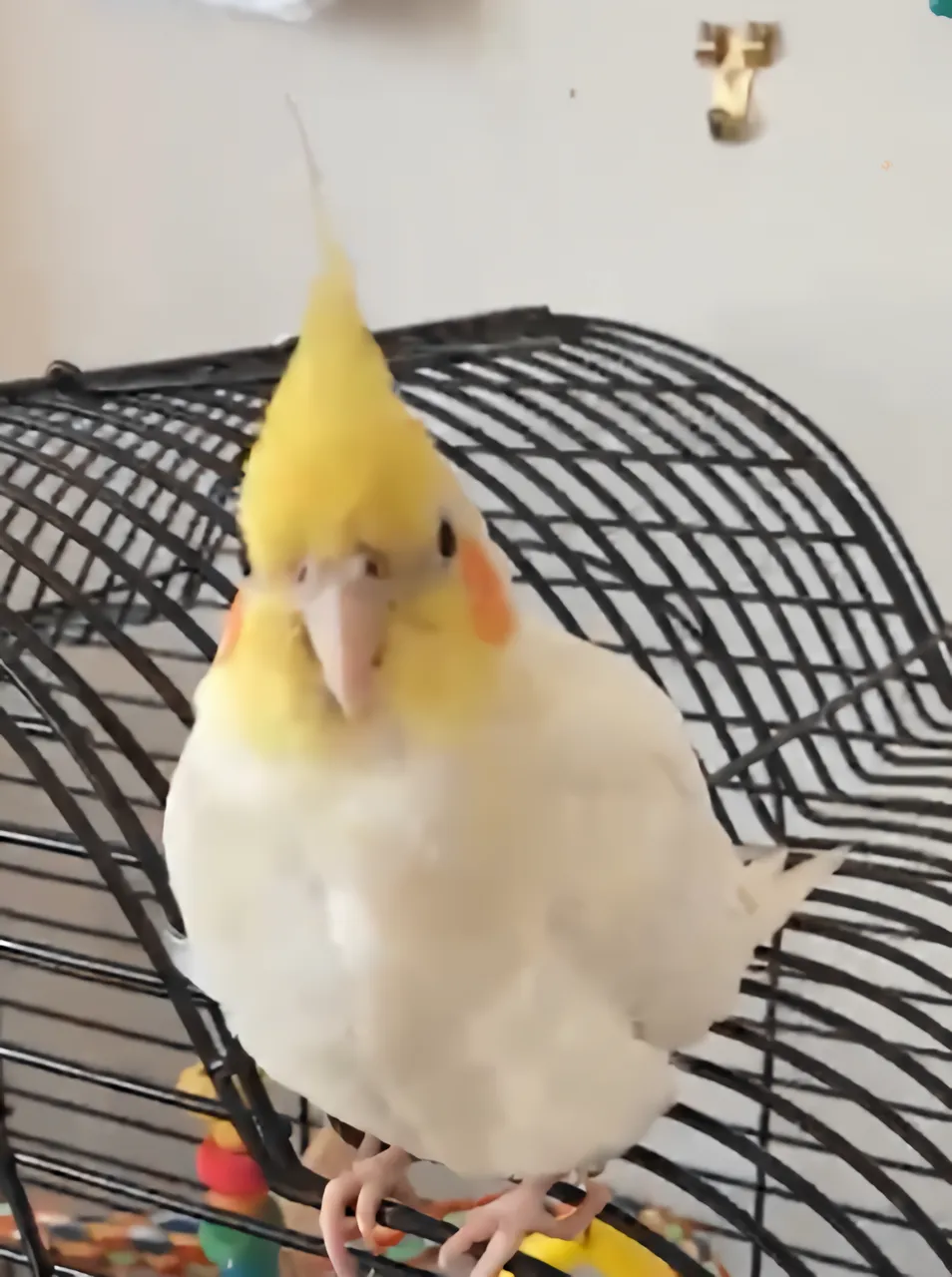
8.1. The cage
For one cockatiel, 60 cm wide, 45 cm deep and 70 cm high is the minimum, and the long tail needs room in every direction. A tail that constantly brushes the bars or floor becomes frayed and broken, so check that there is clearance below the tail tip when the bird perches. Bar spacing of 1.2 to 1.6 cm suits them; budgie-sized cages are far too small.
With night frights in mind, avoid cramming the cage with toys. The fewer obstacles a panicking bird can hit, the lower the risk of injury. Fit two or three natural-wood perches of about 1.5 to 2 cm at different heights, and consider a foraging tray near the floor to satisfy the urge to search for food on the ground.
8.2. Environment
Keep the room at 20 to 27°C with humidity around 40 to 60 percent. Although cockatiels come from dry country, very dry indoor air makes the dust worse and the skin itchy. Provide extra warmth below 15°C and shade and ventilation above 30°C.
Give 10 to 12 hours of dark, quiet sleep, but use a dim night light rather than total darkness. If you cover the cage, leave one side partly open so a startled bird can see its surroundings. Many owners run an air purifier near the cage to manage dust; just keep it far enough away that the bird is not sitting in a strong draught.
8.3. Equipment checklist
- A cage with generous width and height, bars 1.2 to 1.6 cm apart
- Two or three natural-wood perches of 1.5 to 2 cm, plus a flat platform perch for later life
- At least two sets of food and water bowls
- Medium-parrot pellets, a seed mix and millet spray
- A mineral block or cuttlebone
- Shreddable toys in paper, palm leaf and soft wood, and a floor foraging tray
- A bath dish and a mister
- A night light and a breathable cage cover
- A digital gram scale
- A travel carrier
- A HEPA air purifier
- Floor paper, a cleaning brush and a bird-safe cleaner
9. Diet
9.1. Staple foods and portions
The usual recommendation is a medium-parrot pellet making up 60 to 70 percent of the diet, with seed and vegetables making up the rest. An adult eats roughly 15 to 25 grams a day, about two to three tablespoons, depending on activity and body weight; adjust according to what is left the next morning. Seed-only cockatiels are prone to fatty liver and vitamin A deficiency, which shows up as rough skin and vulnerability to respiratory infections.
Because cockatiels are ground foragers, food served only in a bowl soon becomes boring. Scatter pellets and seed in a floor tray or hide them in paper cups and boxes to provide exercise and reduce stress behaviours such as feather-plucking.
9.2. Fresh food and treats
Offer about a spoonful of vegetables daily, such as broccoli, kale, bok choy, pumpkin, carrot, bell pepper, peas and sweetcorn kernels. Cockatiels are suspicious of new foods, so pretending to eat the same thing beside them, or chopping it finely and sprinkling it over pellets, helps win them over. Fruit like apple, pear, melon or berries two or three times a week is enough.
Sunflower seeds and peanuts are cockatiel favourites but very fatty; limit them to a few a day and use them as rewards for training such as stepping up or entering the carrier. Treat millet spray the same way.
9.3. Foods to avoid
- Avocado: can cause heart damage and breathing difficulty.
- Chocolate, coffee, tea, cola and other caffeinated drinks
- Alcohol
- Onion, garlic and leeks
- Apple and pear pips, cherry, plum and peach stones
- Biscuits and bread with salt, sugar or butter
- Raw beans, raw potato peel and mushrooms
- Any seed or nut that might be mouldy
Fumes from self-cleaning ovens, overheated non-stick cookware, scented candles, aerosol fresheners and fresh paint are also seriously dangerous to indoor birds. Move your cockatiel to another space during renovations or heavy cleaning.
10. Health and disease
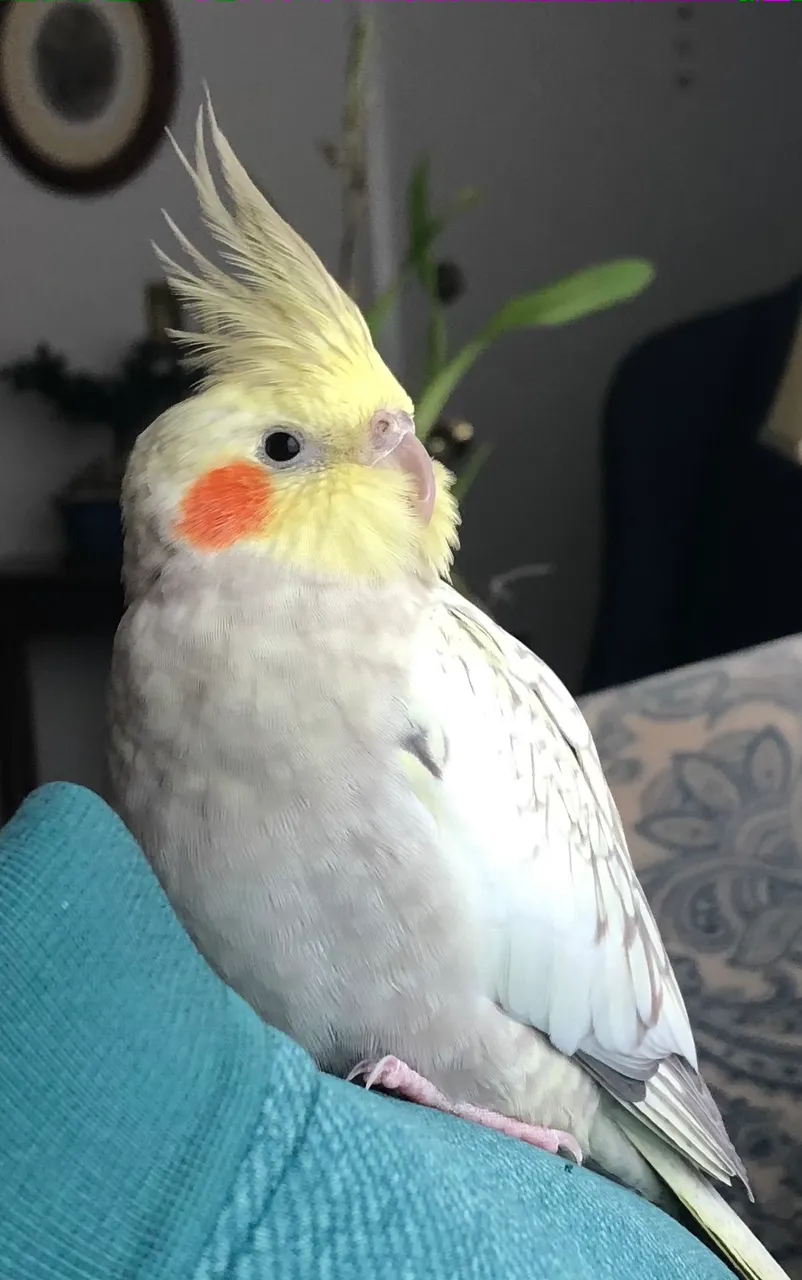
Michelamillerdickson96 · CC BY-SA 4.0
Cockatiels are generally considered hardy, but they are experts at hiding illness. Have a new bird examined by an avian vet soon after it arrives and yearly afterwards, and weigh it weekly. The information here is a guide only; diagnosis and treatment are a vet's job.
10.1. Common conditions
| Condition | Cause | Main signs | Prevention and response |
|---|---|---|---|
| Chronic laying and egg binding | Constant hormones, low calcium | Clutch after clutch, straining, crouching on the floor | Long nights, no nest sites, calcium, hormone treatment if needed |
| Fatty liver | High-fat seed diet, little exercise | Obesity, overgrown beak and nails, odd feather colour | Pellet diet, foraging |
| Giardia and other gut parasites | Contaminated food or water | Loose droppings, feather-plucking, itching | Faecal testing, hygiene |
| Psittacosis (chlamydiosis) | Bacterial infection | Conjunctivitis, nasal discharge, green droppings, lethargy | Testing; can infect people |
| PBFD and polyomavirus | Viruses | Feather abnormalities, sudden death in chicks | Buy tested birds, quarantine |
| Night-fright injuries | Panic in the dark | Broken blood feathers, bleeding, wing wounds | Night light, uncluttered cage |
| Heavy-metal poisoning | Lead or zinc in ornaments or wire | Wobbling, vomiting, red or black droppings | Safe materials only |
| Conjunctivitis and sinusitis | Infection, vitamin A deficiency | Swollen or watery eyes, sneezing | Balanced diet, hygiene |
A growing blood feather carries a blood supply in its shaft and can bleed heavily if snapped. Apply cornflour or an avian styptic with gentle pressure, and go to a vet if bleeding persists or recurs. In hand-fed chicks, crop stasis and burns from formula that is too hot are common accidents.
10.2. Warning signs
- Tail-bobbing with each breath or open-beaked breathing
- Sitting fluffed with eyes closed for long periods in daytime
- Falling off perches or sitting on the floor
- Eating almost nothing for a day, or noticeable weight loss within a week
- Green, black or red droppings, or yellow-tinged urates
- A hen with a swollen belly straining without passing an egg
- Wet or crusty eyes or nostrils
- Bleeding that won't stop
Because cockatiels mask symptoms for so long, the moment you think something seems a little off is often the moment to call the vet. Find out in advance which exotic-animal clinics near you offer out-of-hours care.
11. Breeding
Cockatiels breed well in captivity, but most experienced keepers wait until birds are about 18 months old and physically mature. A compatible pair courts with song and heart-wing displays and begins taking turns inside the nest box.
The hen lays four to seven eggs at intervals of one or two days, and incubation lasts about 18 to 21 days. Unusually, the male is a committed incubator, typically sitting by day while the female takes the night shift. Chicks fledge at four to five weeks and are fully weaned at around seven to ten weeks.
- Nest boxes of roughly 25 to 30 cm square with a 7 to 8 cm entrance are commonly used.
- Extra calcium and protein before and during laying are important.
- Remove the nest box to give a rest period and avoid more than two clutches a year.
- Some parents neglect or attack chicks, so learn about hand-rearing and locate an avian vet beforehand.
- If you cannot take lifelong responsibility for every chick, don't breed.
If a hen keeps laying when you don't want chicks, lengthen nights to 12 to 14 hours, remove dark nesting spots and avoid stroking her back and tail. If laying continues, ask your vet about hormone-suppressing treatment.
12. Costs
Costs differ hugely between countries, so these are broad indications. In Korea, a cockatiel typically costs the equivalent of roughly 40 to 150 US dollars, more for hand-fed birds and rare colour combinations, and many Western markets are similar or somewhat higher.
| Item | Typical range | Notes |
|---|---|---|
| Bird | 40 to 150 dollars | Hand-fed and rare colours cost more |
| Cage | 80 to 200 dollars | Tall and wide enough for the tail |
| Basic equipment | 40 to 80 dollars | Perches, bowls, toys, carrier |
| Air purifier | Optional | Worth it for dust |
| First vet visit | 40 to 120 dollars | Faecal and PCR tests add cost |
| Monthly food | 12 to 25 dollars | Pellets, seed, vegetables |
| Monthly supplies | 8 to 25 dollars | Toys, floor paper, filters |
| Annual check-up | 80 to 160 dollars | Including blood work |
| Emergencies | Several hundred dollars or more | Egg binding, poisoning, injuries |
Over a 15- to 20-year life the total adds up. Senior birds often need more frequent check-ups and medication, so set money aside regularly for veterinary care.
13. Before you get one
Run through these questions before bringing a cockatiel home.
- Can I keep this bird for 15 to 20 years through moves, marriage, children or work abroad?
- Does anyone at home have asthma, allergies or other lung problems that powder down might worsen?
- Can I spend at least one to two hours a day with the bird outside its cage?
- Will contact calls carry through thin walls to neighbours?
- Is there an avian vet nearby?
- Can I keep the bird completely separate from cats, dogs and other predators?
At the seller, check for clean eyes and nostrils, no tail-bobbing when breathing, well-muscled flanks either side of the keel bone and soft, evenly powdered plumage. If you want a hand-tame bird, bring it home only once it is fully weaned; beginners who take unweaned chicks often run into crop problems or malnutrition.
Adult cockatiels are also available through rescues and rehoming groups. With an adult, personality and health are already visible, which can make it the better choice for a first-time keeper.
14. Laws and regulations
The cockatiel is one of the few parrots exempt from CITES Appendix II, so no CITES permits or transfer documents are needed in most countries. It is not a protected species under Korea's wildlife protection law either.
- Animal welfare laws in Korea and most other countries apply to birds, so neglect, cruelty and abandonment can be prosecuted; check current rules in your jurisdiction.
- Where pet registration is mandatory it usually covers dogs, not birds.
- During avian-influenza outbreaks, authorities may temporarily restrict bird sales, movements and shows.
- International travel with a bird requires veterinary certification and import approval from the destination country.
- Regular breeding and selling may require a business licence; ask your local authority.
Releasing a pet cockatiel outdoors counts as abandonment in many places and rarely ends well for the bird, which is poorly equipped to survive cold winters and predators.
15. Cockatiels in culture
Thanks to their whistling, cockatiels are perennial internet stars. Videos of cockatiels whistling anime themes, nursery rhymes or video-game music note for note have racked up millions of views, and clips documenting a male gradually learning a tune over several weeks are popular too.
In Japan, where the bird is named after a round-cheeked folk mask, those orange cheeks are a symbol of cuteness, and cockatiel plush toys, stationery and sweets are everywhere. They are regulars at bird cafes and bird-themed exhibitions. Korea has followed a similar path, with cockatiels starring in parrot cafes and their crested expressions turning up as emoticons and character goods.
In Australia the quarrion has long been a familiar outback bird, appearing in landscape paintings, photography and souvenirs.
16. Trivia
- Many owners say cockatiels smell faintly of toasted grain or biscuits, thought to be a mix of powder down and skin oils.
- Males usually start learning songs within their first few months, and the sounds they hear then often stay in their repertoire for life. Keepers joke that once a cockatiel learns the microwave beep, you are stuck with it.
- Crest feathers are moulted and regrown one or two at a time, and a new crest feather looks like a stiff little rod while it grows in.
- Most white cockatoos look the same in both sexes, but cockatiels, like the gang-gang and some black cockatoos, show visible differences between males and females.
- Wild cockatiels call to each other in flight to keep track of flockmates, and the contact call aimed at you is that same instinct.
- Being timid, a cockatiel may stare at a new toy from a distance for days. Placing it outside the cage first, then moving it in, usually speeds acceptance.
Health notes are general information. If something seems wrong, contact a vet who treats this species.
FAQ
Do cockatiels talk?
Some pick up a few words, usually a bit garbled. Their real talent is whistling; play the same short tune repeatedly and many males will learn it well.
What does the crest tell me?
Relaxed and slightly back means content; straight up signals curiosity or alarm; flat against the head with hissing means back off.
How do I prevent night frights?
Leave a dim night light on, place the cage against a quiet wall away from passing headlights and shadows, and keep clutter inside the cage to a minimum so a panicked bird has room.
Further reading
- 🗳️ Is wing clipping parrots necessary?
- 🗳️ Pet birds: is more time out of the cage always better?
- 📋 Before You Get a Pet: An Honest Checklist
- ❄️ Winter Care: Keeping Pets Warm and Heaters Safe
- 🦎 Finding an Exotic Pet Vet and Planning Checkups
Photo credits
Photos are freely licensed images from Wikimedia Commons. Authors and licenses are listed below.
- Cockatiel 3.jpg — Photo by: Ganatron – paulweberphoto.com · CC BY-SA 4.0
- Bird-4years.jpg — CatBird01 · CC BY-SA 4.0
- Cockatiel (Female).jpg — Photo by: Ganatron – paulweberphoto.com · CC BY 4.0
- Daisy Flower Lutino Cockatiel.jpg — Kroon78 · CC BY-SA 3.0
- Eddie, a 1.5 year old male cockatiel.png — WoaItsBren · CC BY-SA 4.0
- Female Pearl Cockatiel.jpg — Michelamillerdickson96 · CC BY-SA 4.0