TailVille
At a glance
Rough ranges for supplies, food and electricity in Korea (USD is approximate). Purchase or adoption fees are not included.
Busy households where someone is usually home, and people who enjoy a chatty, interactive cat.
Anyone wanting a quiet cat, people out all day, or flat-dwellers with noise-sensitive neighbours.
1. Overview
The Siamese is a breed from present-day Thailand, the old kingdom of Siam. Its emblem is the pointed pattern: a pale cream or near-white body with darker face, ears, legs and tail, set off by vivid blue eyes. Like every house cat it is Felis catus.
It is one of the oldest and best-known breeds in the world. After arriving in Britain in the late nineteenth century it shaped the history of Western cat breeding, contributing to the Himalayan (colourpoint Persian), Balinese, Oriental Shorthair, Tonkinese and others.
In temperament the Siamese is famous as a talker and a cat that attaches itself fiercely to its people. Grooming is easy, but interaction and play take a lot of time, so for the right owner it is a superb companion and for the wrong one a source of mutual frustration. This article leaves general cat information to the main cat article and covers the Siamese's history, looks, personality, care, breed health and what to check before buying.
2. Name and origin
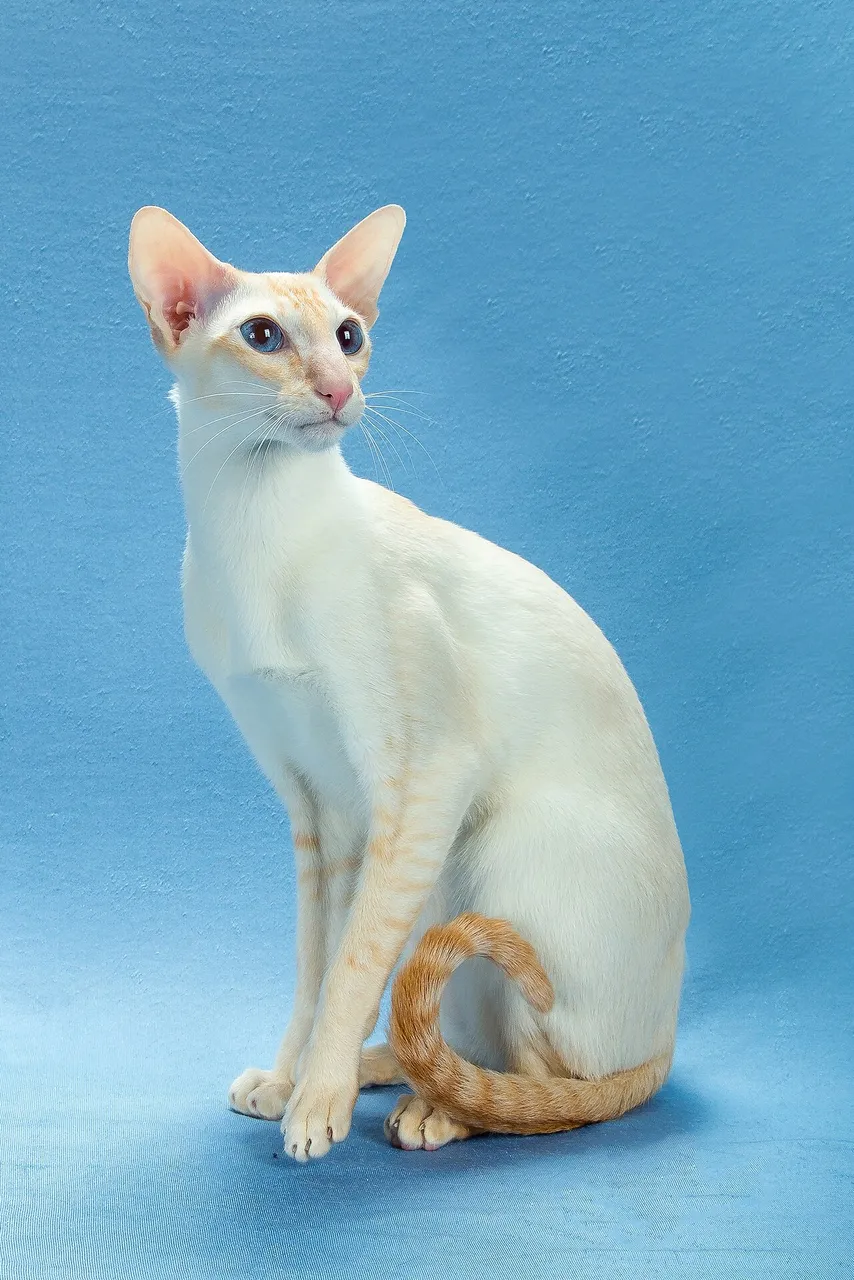
Larry Johnson · CC0
2.1. Cats of the kingdom of Siam
The Siamese comes from Thailand in Southeast Asia. Old Thai manuscripts known as the Tamra Maew, usually translated as the Cat-Book Poems, describe and illustrate cats believed to bring good fortune. One of them, the Wichianmat, has the same pointed pattern as today's Siamese. Exactly when these texts were first composed is uncertain; many accounts trace them to the Ayutthaya period, but the surviving copies are generally thought to be later.
Stories say these cats were treasured in royal households and temples, though some of those tales may have been romanticised as the breed was introduced to the West.
2.2. To Britain and America
The Siamese became properly known in the West in the late nineteenth century. Records show Siamese cats at the 1871 Crystal Palace show in London, and a well-known story tells of a British diplomat in Bangkok bringing cats home in the 1880s. In America, around the same time, a US diplomat in Bangkok is recorded as sending a Siamese to Lucy Hayes, wife of President Rutherford B. Hayes.
Early Siamese were rounder-faced and sturdier than today's show cats, and crossed eyes and kinked tails were common. From the mid-twentieth century show breeding favoured a long, pointed wedge head and a slender, elongated body, producing the 'modern' Siamese. Fans of the older look preserve it as the traditional or 'applehead' Siamese, and some registries recognise it under the name Thai.
The CFA, TICA, GCCF and FIFe all recognise the Siamese, which is counted among the very first recognised breeds.
3. History and popularity in Korea
The Siamese was one of the first breeds Koreans knew by name, back when the idea of a pedigree cat was still new. In the 1980s and 1990s it and the Persian were the pedigree cats you were most likely to see, and even people with no interest in cats knew the name. The Siamese of that era in Korea were reportedly mostly of the rounder traditional type.
From the 2000s other breeds such as the Russian Blue, Scottish Fold and British Shorthair took the spotlight, and the Siamese's relative popularity dipped, though it remains well loved. Koreans often call pointed Korean Shorthairs or mixed-breed cats 'Siamese mixes'; this describes appearance rather than an official breed.
Pointed cats turn up fairly often in Korean shelters, probably because Siamese ancestry from earlier decades has spread into the general cat population.
4. Appearance and breed standard
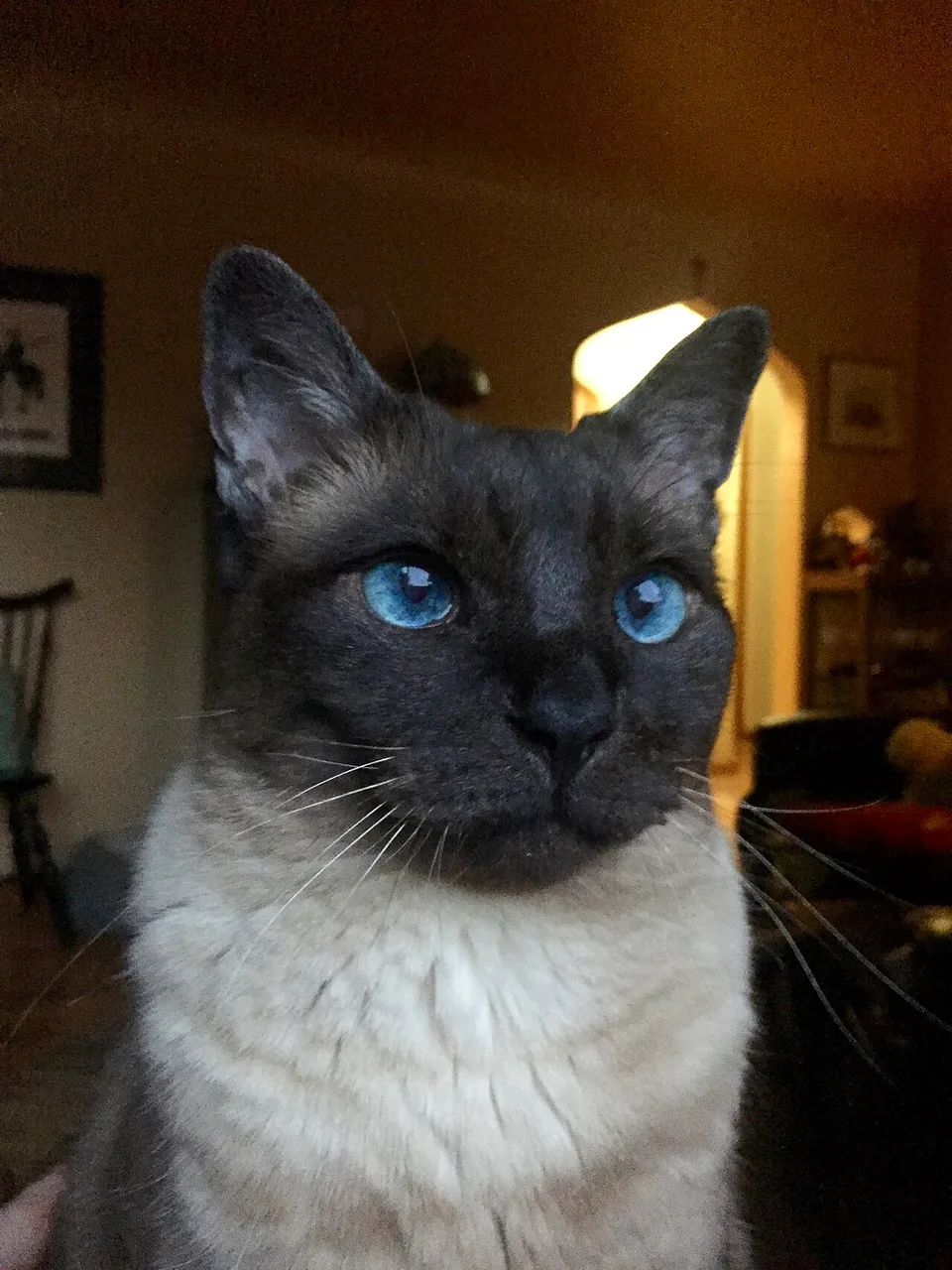
Whitepatrick · CC BY-SA 4.0
The modern Siamese has a long, slim 'tubular' build: body, legs, tail and neck all form long, elegant lines. The traditional Siamese is sturdier with a rounder head.
| Feature | Modern Siamese | Traditional Siamese (Thai) |
|---|---|---|
| Weight | About 2.5–5 kg | About 3–5.5 kg |
| Build | Long, slender, fine-boned | Medium, comparatively solid |
| Head | Long wedge with straight profile | Rounded wedge or 'applehead' |
| Ears | Very large and pointed, continuing the wedge | Medium to large |
| Eyes | Almond-shaped, deep blue, slightly slanted | Almond to oval, blue |
| Tail | Long, thin, tapering to a point | Medium to long |
| Coat | Short, fine and close-lying with almost no undercoat | Short |
Recognised point colours vary by registry, but the classic four are seal point (dark brown), chocolate point (lighter brown), blue point (blue-grey) and lilac point (pinkish grey). Some registries accept red, cream and lynx (tabby) points as Siamese, while others class them as a separate breed, the Colorpoint Shorthair.
The pattern comes from a mutation that makes tyrosinase, the enzyme producing pigment, temperature-sensitive. It works only below body temperature, so colour develops on the cooler ears, face, legs and tail. Kittens, warmed in the womb, are born nearly white, and the body coat gradually darkens with age or in cold surroundings.
5. Temperament
If you had to sum up the Siamese in a phrase, it would be 'chatty, loving busybody'. The voice is loud, low and raspy, unforgettable once heard, and it is used constantly: when hungry, when bored, when you're in another room, or simply when there's something to say. Answer back and most will happily keep the conversation going.
Siamese attach strongly to their people and are said to favour one person in particular. They supervise the housework, sit on keyboards and burrow under the duvet at night, always aiming to be close.
Clever and curious, many teach themselves to turn handles and open drawers, and they learn fetch or high-fives readily. They have little tolerance for boredom, though, and an under-stimulated Siamese may knock things off shelves, yowl at night or suck on wool and fabric to make its feelings known.
This breed feels loneliness and stress keenly when left alone for long periods, so if the house is empty during the day, a compatible feline companion is well worth considering.
6. Who it suits and who it doesn't
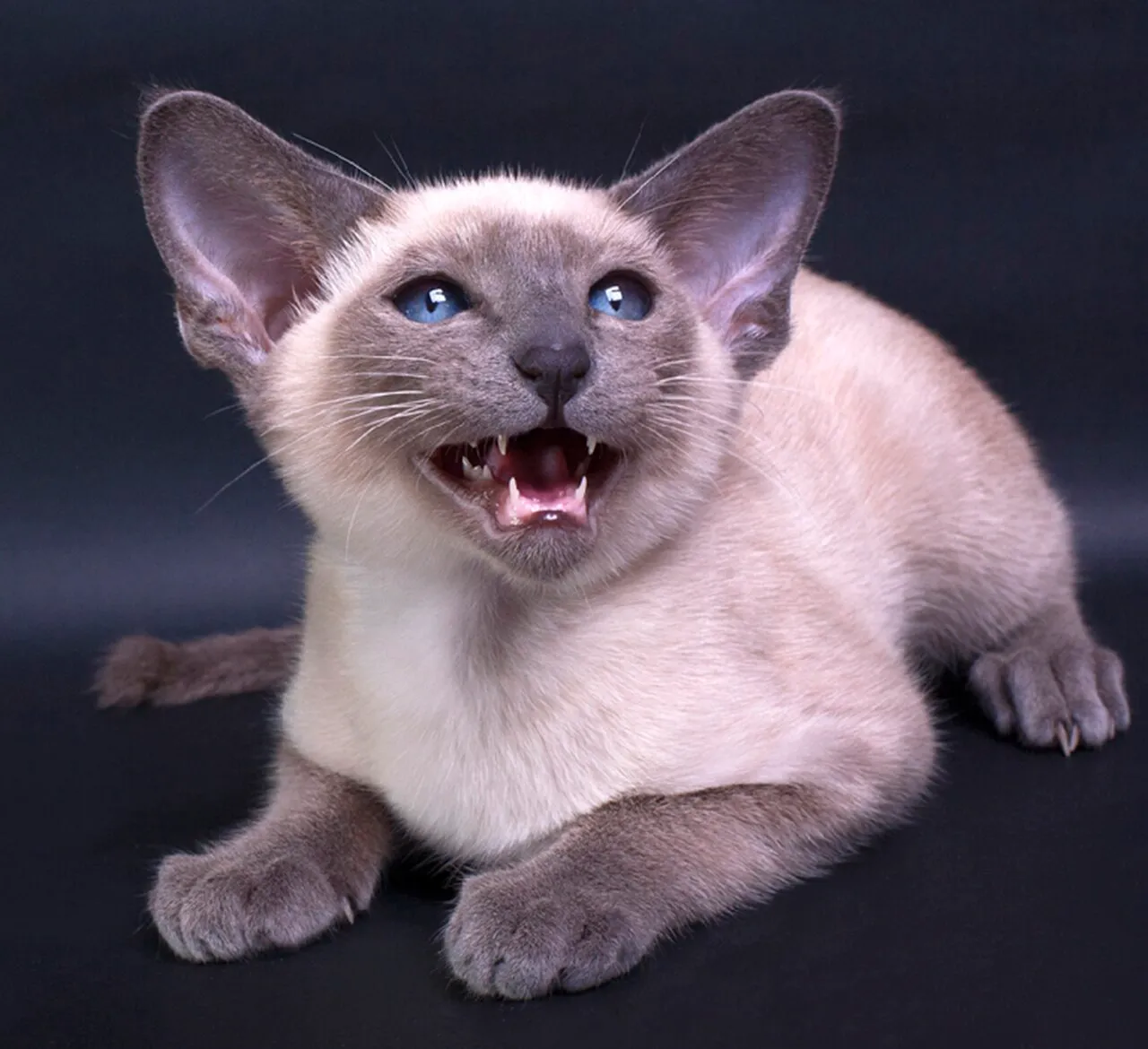
Valerius Geng · CC BY-SA 3.0
- Suits: home-workers, busy family homes and anyone who enjoys a two-way conversation with their cat
- Suits: owners who will offer training and puzzle games
- Suits: people who want minimal grooming
- Doesn't suit: anyone wanting a quiet, independent cat
- Doesn't suit: people who are out most of the day or travel often
- Doesn't suit: residents of thin-walled flats with noise-sensitive neighbours
7. Exercise and play
Siamese are active and agile and love to climb and run. They need mental work as much as physical exercise.
- Vertical space: cat trees reaching towards the ceiling, wall shelves and catwalks.
- Hunting games: two or three wand-toy sessions a day totalling at least 20–30 minutes.
- Brain work: puzzle feeders, hidden treats and clicker training for tricks like sit, high-five and fetch.
- Fetch: many Siamese will retrieve a small ball or scrunched-up paper.
- Harness: bold, sociable individuals may take to harness walks; practise thoroughly indoors and start somewhere quiet.
Rotate toys to keep them novel, and always put away toys with strings after play.
8. Coat and hygiene
The fine, short coat has almost no undercoat and is very easy to look after. A weekly once-over with a rubber or soft brush, finished with a hand or microfibre cloth along the lie of the coat, brings up the shine.
- Shedding: noticeably lighter than many breeds, but not zero, and Siamese still produce the main cat allergen, so they are not hypoallergenic.
- Teeth: the breed is known for periodontal disease, so brush daily if possible, and at least three times a week.
- Ears: big ears collect dust; check weekly and clean only when needed.
- Warmth: a thin coat and little body fat make them feel the cold. Provide blankets or a heated pad in winter, taking care to avoid low-temperature burns.
- Claws: trim every two to three weeks.
9. Diet and weight
A lean, muscular build is normal for a Siamese. They are active, but neutering and age can bring unexpected weight gain.
| Item | Guideline |
|---|---|
| Daily energy (neutered 4 kg adult) | About 200–250 kcal |
| Feeding | Two to four measured meals |
| Treats | Under 10% of calories; use them as training rewards |
| Body check | Ribs and hip bones easy to feel but not jutting |
| Water | Include wet food; several water bowls |
Siamese often yowl loudly for food, and feeding every time they ask quickly builds overeating habits. Stick to set meal times and amounts. An automatic feeder can weaken the link between you and food, which may reduce early-morning wake-up calls.
Conversely, an older Siamese that keeps losing weight may have hyperthyroidism, kidney disease or liver disease, so book a check-up.
10. Inherited disease and health
The Siamese is known as a long-lived breed, but the conditions below are worth knowing. Diagnosis and treatment must come from a vet.
10.1. Progressive retinal atrophy (PRA)
PRA is an inherited disease in which the retina's light-sensing cells gradually degenerate, leading to blindness. Siamese and Abyssinian-related breeds share a known causative variant in the CEP290 gene, often called rdAc.
- Inheritance: recessive; a cat must inherit the variant from both parents to be affected. Carriers with one copy are healthy but can pass it on.
- Signs: night blindness first, pupils that look unusually large, then bumping into things even in daylight
- Testing: a DNA test identifies carriers and at-risk cats, and an eye exam can show retinal changes.
- Management: there is no cure, but with acute hearing and whiskers, many blind cats cope well indoors as long as furniture isn't rearranged.
10.2. Amyloidosis
Amyloidosis is the build-up of an abnormal protein, amyloid, in organs, impairing their function. In Siamese and Oriental breeds it mainly affects the liver; a weakened liver can bleed, causing sudden collapse.
- Signs: poor appetite, weight loss, lethargy, jaundice, pale gums, a swollen belly
- Diagnosis: blood tests and ultrasound, with biopsy sometimes needed to confirm
- Management: no cure; supportive treatment according to symptoms
10.3. Airway disease and other issues
- Asthma: reported relatively often in Siamese. Coughing, wheezing, or crouching with the neck stretched out while breathing hard all need a vet. Reduce irritants such as dusty litter, scented candles and smoke.
- Periodontal disease: gum inflammation and tartar build up readily; regular brushing and dental cleaning help.
- Crossed eyes and kinked tails: common in older Siamese lines. Differences in visual pathways linked to the pointing gene are associated with the squint. Both are much rarer in modern breeding and usually cause little trouble.
- Pica and wool-sucking: sucking or chewing wool, fabric or plastic is reported especially in Oriental breeds such as the Siamese and Burmese. Swallowed material can block the gut, so the cause needs addressing.
- Stress: loneliness and boredom can lead to over-grooming and other problems that affect health.
11. Life course and lifespan
The Siamese is known for longevity; typical lifespans are quoted at around 13–18 years, and some approach twenty.
| Stage | Age | What to know |
|---|---|---|
| Newborn | 0–4 weeks | Born almost white; points gradually appear |
| Kitten | 1–6 months | Very lively and curious; socialise and start tooth brushing |
| Adolescent | 6 months–2 years | Neutering; females may come into heat relatively early |
| Adult | 2–10 years | Play and interaction, yearly check-ups, dental care |
| Senior | 11+ years | Body may darken; kidney, thyroid and liver checks twice a year |
With age the body coat often darkens, softening the contrast with the points; this is normal. Older Siamese feel the cold even more, so offer warm resting places.
12. Costs
Rough Korean prices; they vary by clinic, region and individual cat.
| Item | Rough cost | Notes |
|---|---|---|
| Purchase price | Hundreds of thousands to several million won | Depends on modern or traditional type, pedigree and cattery |
| Starter equipment | 300,000–700,000 won | Tall cat tree, toys, winter warming gear |
| Vaccines and neutering | 300,000–700,000 won | Varies by clinic and sex |
| Food, litter, supplies | 50,000–100,000 won a month | Small cats eat relatively little |
| Toys and puzzles | 10,000–30,000 won a month | Rotated often to prevent boredom |
| Dental care | Several hundred thousand won per cleaning | Depends on anaesthesia and tests |
| Annual check-up | 100,000–400,000 won | More tests in old age |
Grooming costs are low, but budget for dental care, enrichment and, if you go that route, a second cat.
13. Before you get one
- Check your lifestyle: be honest about hours away from home, how noise-sensitive your neighbours are and how much time you can give to play.
- Choose a type: modern and traditional Siamese differ in breeders and lines as well as looks. Decide which you want and find someone who specialises in it.
- DNA testing: ask for the parents' PRA test results.
- Parents and environment: check the parents' temperament and health and whether kittens have been raised with plenty of human contact.
- Age and seller: kittens under two months may not be sold in Korea; confirm animal sales registration.
- Pedigree: some sellers charge high prices for pointed colouring alone, so check which registry issues the papers.
- Consider rescue: pointed cats are common in shelters, and many share the Siamese's chatty, affectionate character.
14. In popular culture
The Siamese is one of the most frequently portrayed cat breeds in popular culture. Disney's Lady and the Tramp (1955) features a famous scene with two singing Siamese, and The Aristocats (1970) includes a Siamese character. Both have been criticised for trading on stereotypes of Asian people and were altered in later remakes or given content warnings on re-release.
In Disney's live-action That Darn Cat! a Siamese is the crime-solving hero, and Lilian Jackson Braun's long-running 'The Cat Who...' mystery novels star two clever Siamese, Koko and Yum Yum.
In 1980s and 1990s Korea the Siamese often appeared in comics and adverts as the image of an elegant, aloof Western cat. In Thailand the Wichianmat is still regarded as a lucky cat and is sometimes presented as one of the country's emblematic animals.
15. Trivia
- The gene behind the Siamese pattern works on the same temperature-sensitive principle as the Himalayan pattern in rabbits and mice.
- Where a leg has been bandaged or fur shaved, the change in skin temperature can make regrowing hair come in a different shade.
- Thai folklore has several tales explaining the kinked tail, the best known being a princess who hung her rings on her cat's tail for safekeeping. The real cause is genetic.
- The Himalayan (a Siamese-Persian cross), the Balinese (essentially a longhaired Siamese) and the Oriental Shorthair (Siamese type in solid colours and patterns) are all close relatives.
- The raspy Siamese call is often compared to the sound of a crying baby.
Health notes are general information. If something seems wrong, contact a vet who treats this species.
🍽️ Can my dog or cat eat this? →
FAQ
Why are only the face and paws dark?
The enzyme that makes pigment only works at cooler temperatures, so colour develops on the cooler extremities. Kittens are born almost white and their points darken as they grow.
Why do some Siamese look so different from others?
Show breeding in the late twentieth century produced the long, wedge-headed 'modern' Siamese. The older, rounder type is preserved as the 'traditional' Siamese or, in some registries, the Thai.
Are Siamese really that loud?
Individuals vary, but most are far more vocal than average, and answering back usually encourages them. Many owners end up holding genuine 'conversations'.
Photo credits
Photos are freely licensed images from Wikimedia Commons. Authors and licenses are listed below.
- Fatale de la légende d'ali.jpg — Daly69 · CC BY-SA 3.0
- Red Pt 11401-591.jpg — Larry Johnson · CC0
- Sealpoint-siamese-hybrid.jpg — Whitepatrick · CC BY-SA 4.0
- Siam blue point.jpg — Valerius Geng · CC BY-SA 3.0