TailVille
At a glance
Rough ranges for supplies, food and electricity in Korea (USD is approximate). Purchase or adoption fees are not included.
Small households, older owners and first-timers who want a calm, quiet companion.
Not for people wanting a running or hiking partner, homes without summer cooling, or anyone unable to cover eye and spinal vet bills.
1. Overview
The Shih Tzu is a small companion dog with a short muzzle, large eyes and a long coat that can sweep the floor. Most weigh 4 to 7 kg, which makes them solid and sturdy for a toy breed, and they descend from the lion dogs kept at the Chinese imperial court. Friendly yet easygoing and not much of a barker, the Shih Tzu has long been seen in Korea as the gentle house dog.
It is, however, a flat-faced or brachycephalic breed, so its airways and eyes need extra attention. Shih Tzus struggle in heat, their prominent eyes are prone to injury, and an unmanaged long coat quickly leads to mats and skin trouble. This article focuses on the Shih Tzu specifically; general dog care is covered in the main Dog article.
2. Name and origin
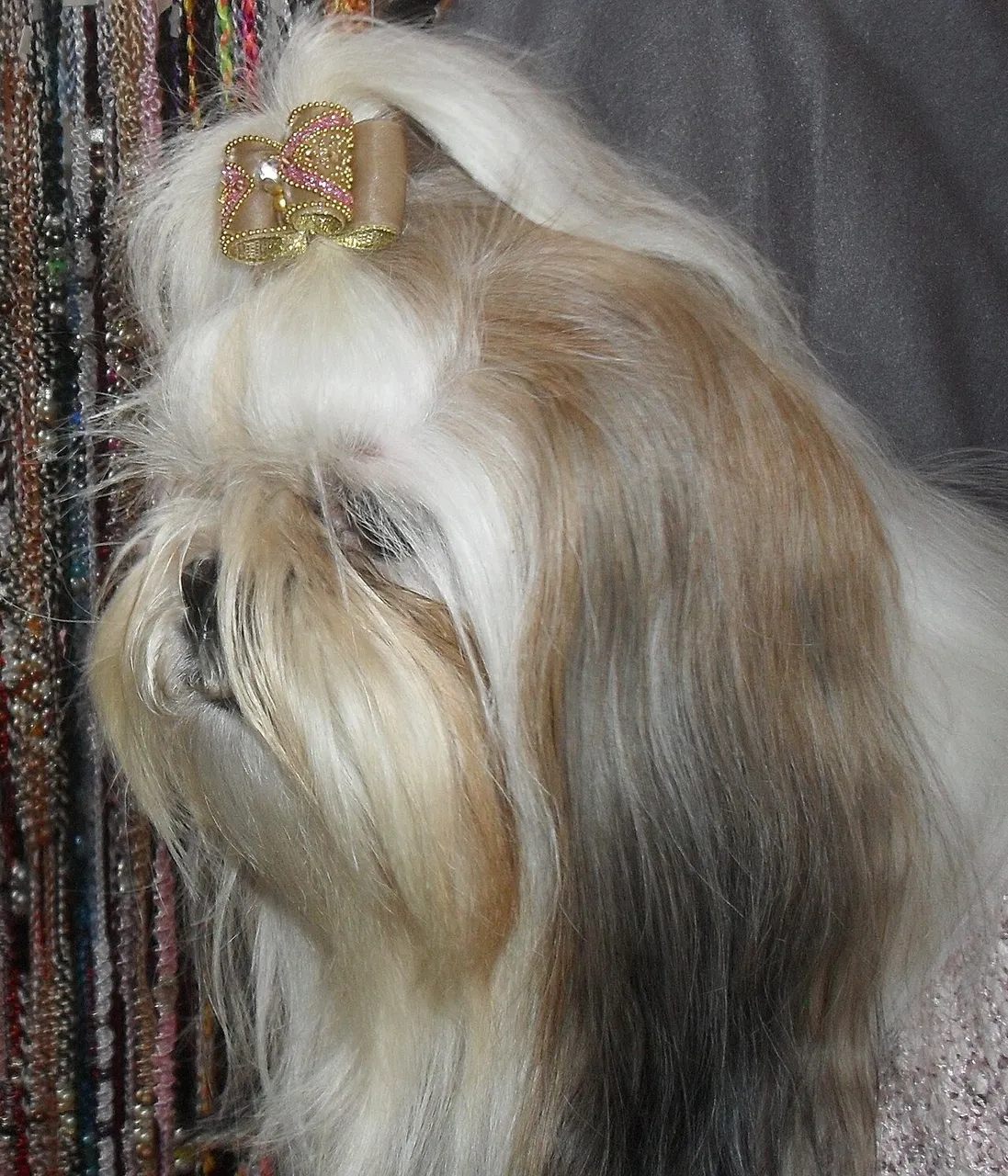
The name is usually traced to the Chinese word for lion, shizi. In Buddhism the lion guards the Buddha, and in East Asia, where real lions were almost never seen, small long-coated dogs were treasured as their living stand-ins. That is why the breed is also known in English as the lion dog or the chrysanthemum dog, a nod to the way its facial hair radiates like petals.
The usual account is that small dogs sent as gifts from Tibet to the Chinese court, related to the Lhasa Apso, were crossed in China with breeds such as the Pekingese to produce the Shih Tzu. The dogs are said to have been especially prized at the late Qing court, though specific dates and personalities in these stories are hard to separate from legend.
A few dogs travelled from China to Britain in the early twentieth century, and British fanciers established the Shih Tzu as a breed separate from the Lhasa Apso. The FCI lists the United Kingdom as responsible for the standard and places the breed in Group 9, Companion and Toy Dogs, while the American Kennel Club recognised it in 1969 in the Toy Group.
3. History and popularity in Korea
The Shih Tzu was one of the defining indoor breeds in Korea from the 1980s to the 2000s. Together with the Maltese and the Yorkshire Terrier it was counted among the big three small breeds, and its reputation for being gentle and quiet made it a standard recommendation for apartment life. Many Koreans remember a time when it seemed to be the most common dog at every neighbourhood vet and grooming salon.
Since the 2010s Poodles, Pomeranians and Bichons have overtaken it in fashion, but the Shih Tzu still appears near the top of registration data and surveys. Because it was once so common, many Shih Tzus in Korea today are middle-aged or older, and they turn up often in shelters. Prospective adopters should know that eye, skin and spinal disc problems are common in older Shih Tzus.
The officially recommended Korean spelling under national loanword rules is 시추, but 시츄 is far more common in everyday use.
4. Appearance and breed standard
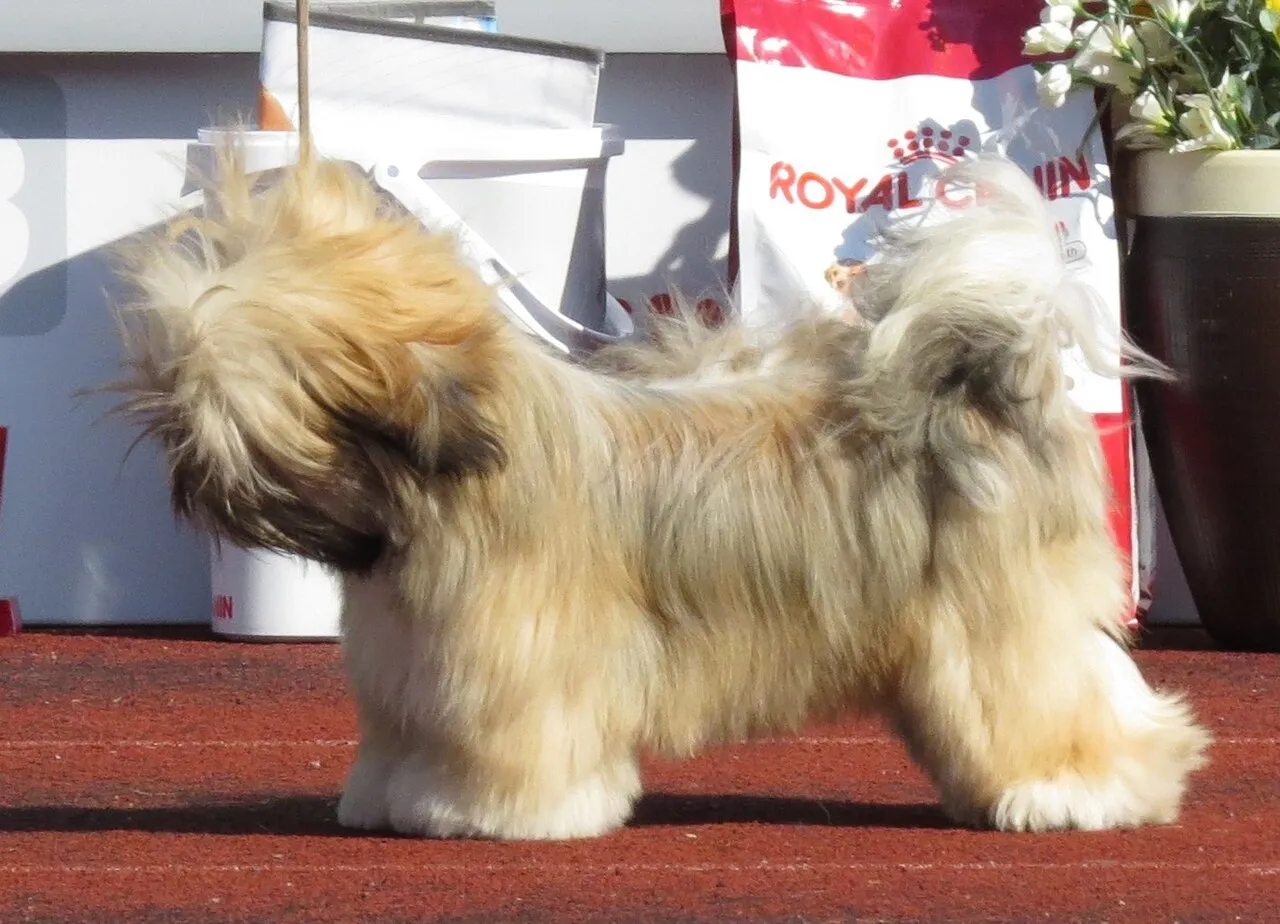
Томасина · CC BY-SA 3.0
The Shih Tzu is low-set and sturdy, longer than it is tall, with a round head and a short, square muzzle. The double coat is long and luxurious, with a slight wave permitted. The hair on top of the head is long enough to fall into the eyes, which is why show dogs wear it tied up in a topknot.
| Item | FCI standard (approx.) | AKC standard (approx.) | Notes |
|---|---|---|---|
| Height | up to 27 cm | ideally 9-10.5 in | body longer than tall |
| Weight | 4.5-8.1 kg, ideal 4.5-7.3 kg | 9-16 lb | Korean pets often 4-7 kg |
| Coat | long, dense double coat; curl is a fault | long, dense double coat | most pets kept clipped short |
| Colour | any colour | any colour | white blaze and tail tip often favoured |
All colours are accepted; in Korea the most common pattern is white with gold, brown or black patches. A slightly undershot bite is common and tolerated by the standard. The large, round, forward-facing eyes give the breed its gentle expression but also leave them exposed to injury. Most pet Shih Tzus are kept in a short puppy cut.
5. Temperament
Bred from the start as a companion to emperors and nobles, the Shih Tzu has little hunting or guarding drive and is happiest simply being near its people. Most are friendly with strangers and bark less than many toy breeds. Their even, relaxed temperament is why they are often recommended for older owners and first-time dog keepers.
That does not make them pushovers. Many are stubborn and will simply plant their feet when asked to do something they would rather not, and house training is often reported to take a while. Short, upbeat sessions built on praise and rewards work best; shouting tends to make a Shih Tzu shut down.
Shih Tzus usually get along with other dogs and cats and tolerate alone time somewhat better than many toy breeds, but they are still companion dogs and should not be left alone all day. Some develop coprophagia, eating their own or other dogs' faeces, which can stem from boredom, habit or other causes and needs patient management.
6. Who it suits and who it doesn't
- Good fit: small households, seniors and first-time owners wanting a calm, easygoing dog
- Good fit: lifestyles built around short walks and plenty of downtime at home
- Good fit: owners willing to clean around the eyes daily and keep up with grooming
- Poor fit: people who want a hiking or running partner
- Poor fit: homes without air conditioning in summer, or plans to leave the dog outdoors in heat
- Poor fit: anyone who could not cover vet bills for eye or spinal disc problems
Shih Tzus generally do well with children, but teach kids never to poke at the prominent eyes or press down hard on the dog's back.
7. Exercise and play
The Shih Tzu has low exercise needs even by toy-breed standards. Two slow walks of 15 to 30 minutes a day are plenty, and most prefer a leisurely, sniff-and-stop pace. Short games of fetch or scent work burn off energy indoors.
Heat management matters most. Brachycephalic dogs have short, narrow airways and cannot cool themselves by panting nearly as well as other dogs, so they suffer heatstroke much more easily. Once the temperature passes about 25 degrees Celsius, shorten walks and go early in the morning or late at night. If breathing becomes noisy, the tongue turns purplish or the dog wobbles, move it to shade, cool it with lukewarm water and call a vet straight away.
The long back is vulnerable, so repeated jumping from heights and frequent stair climbing load the spine. Put steps by the sofa and bed, and when lifting, support the chest and hindquarters together so the body stays level. A harness is easier on breathing than a collar.
8. Coat and hygiene
The Shih Tzu coat grows long and tangles easily, though it sheds little for a double coat. A long coat needs daily brushing, and even the short puppy cut most owners choose needs brushing two or three times a week. Professional grooming every six to eight weeks is usual, with face, feet and bottom tidied in between.
The eyes are the non-negotiable part of Shih Tzu care. Hair on the bridge of the nose grows upward into the eyes, and the prominent eyes catch dust and stray hairs. Gently wipe away discharge once or twice a day and keep the hair around the eyes trimmed short or tied up. Frequent blinking, rubbing or squinting with one eye can mean a corneal injury and calls for a prompt vet visit.
Food and saliva collect in the facial folds and around the mouth, causing odour and dermatitis, so a quick wipe after meals helps. The hairy drop ears are prone to infection and should be checked weekly. The short jaw often crowds the teeth, so tartar builds quickly and daily brushing is recommended.
9. Diet and weight
With modest exercise needs and a good appetite, Shih Tzus become overweight very easily. Extra weight worsens brachycephalic breathing problems and increases strain on the long spine, so it is particularly dangerous for this breed. A 6 kg adult needs roughly 300 to 350 kcal a day, and neutered indoor dogs often need less.
The short, flat muzzle makes it hard for some dogs to pick up kibble, and some swallow pieces whole. Kibble shaped for flat-faced breeds and shallow, wide bowls help. If your dog gulps, gags or vomits, try a slow feeder. Human food, especially salty and fatty scraps, contributes to obesity, pancreatitis and skin flare-ups. Recurrent skin or ear infections may point to food allergy, which is worth discussing with your vet. Wipe the face after drinking, since wet facial hair can lead to dermatitis.
10. Inherited conditions and health
Most Shih Tzu health issues trace back to its build: a short face, prominent eyes and a long back. They are, in a sense, the price of its looks, and owners who know them can prevent or catch many problems early.
10.1. Brachycephalic airway syndrome
A shortened muzzle brings a cluster of problems: narrow nostrils, an overlong soft palate that obstructs the airway, and sometimes a narrow windpipe. Snoring, noisy breathing, snorting or gagging when excited, and poor tolerance of heat and exercise are the signs. Shih Tzus are often less severely affected than Bulldogs or Pugs, but individuals can still be badly affected. Severe cases may benefit from surgery to widen the nostrils or shorten the soft palate, while weight control and avoiding heat are the everyday basics. Do not dismiss snoring as cute; ask your vet to assess breathing at check-ups.
10.2. Eye problems
- Corneal ulcers: prominent eyes are easily scratched by hair, debris or paws. Squinting and heavy tearing need prompt treatment; untreated ulcers can perforate.
- Proptosis: a knock to the head or a hard pull on the neck can push the eyeball out of its socket, an emergency needing immediate care.
- Dry eye (keratoconjunctivitis sicca): reduced tear production causes sticky discharge and redness. It is diagnosed with a tear test and often managed with lifelong eye drops.
- Abnormal eyelashes such as distichiasis, cataracts and progressive retinal atrophy are also reported.
10.3. Spinal discs and other conditions
- Intervertebral disc disease: short legs and a long back put the Shih Tzu among the chondrodystrophic breeds prone to disc problems. Yelping when picked up, a hunched back, reluctance to move or wobbly hind legs need urgent care.
- Renal dysplasia: an inherited failure of the kidneys to develop properly, which can show in young dogs as heavy drinking and poor growth.
- Ear infections and skin allergies: humid, hairy ears and dense coats make them common.
- Dental disease and malocclusion: an undershot bite and crowded teeth speed up tartar.
- Patellar luxation and umbilical hernias are also relatively common.
11. Life stages and lifespan
Shih Tzus typically live around 10 to 16 years, a wide range, and well-cared-for dogs commonly pass 15.
| Stage | Age | Key points |
|---|---|---|
| Puppy | 0-12 months | socialisation, house training, getting used to eye cleaning and grooming, check hernias and baby teeth |
| Young adult | 1-3 years | stubborn streak emerges; build good weight habits |
| Adult | 3-8 years | eyes, ears, skin and teeth, yearly check-up |
| Senior | 9+ years | discs, dry eye, kidneys and heart, check-ups twice a year |
Older Shih Tzus often develop uncomfortable eyes from dry eye and cataracts, and back pain may make them reluctant to climb stairs or walk far. Sleeping more and snoring louder are common too. Sudden breathlessness or a new cough should prompt checks of both heart and airways.
12. Costs
Rough 2026 Korean figures; purchase price excluded.
| Item | Approx. cost (KRW) | Notes |
|---|---|---|
| Initial supplies | 300,000-600,000 | crate, bed, harness, pet steps, brushes, shallow bowls |
| First vet visits, vaccines, registration | 200,000-500,000 | core shots, rabies, microchip |
| Food and treats | 40,000-80,000 per month | flat-face formulas vary in price |
| Grooming | 40,000-80,000 per session | every 6-8 weeks |
| Parasite prevention | 10,000-30,000 per month | heartworm, fleas and ticks |
| Eye drops and eye care | tens of thousands per visit and up | ulcers and dry eye can need long-term care |
| Disc surgery | 3-6 million or more | MRI often billed separately |
| Airway surgery (BOAS) | 1-3 million or more | depends on extent |
Grooming costs are moderate, but eye and back problems in later life can be expensive. When choosing insurance, check that disc disease and eye conditions are covered.
13. Before you get one
Because the Shih Tzu was so common for so long, a lot of breeding happened with little attention to health. Breeding for an ever flatter face and bigger eyes to look more doll-like can raise the risk of airway and eye disease.
- Listen to the parents' breathing and ask how much they snore; look at the size of their nostrils
- Check the parents' eyes for redness, tearing or corneal scars, and ask about eye exams
- Watch the puppy for very narrow nostrils or laboured breathing
- Confirm licensing, a contract, and vaccine and deworming records
- Avoid sellers offering puppies under two months or hiding auction origins
Shelters hold many older Shih Tzus. Senior dogs are often calm and settled and easy to live with, but some arrive needing eye, skin or dental treatment, so ask about their health first. Register your dog once it is home.
14. The Shih Tzu in culture
The guardian lion statues that stand outside East Asian temples and palaces, often called Foo dogs in English, are frequently linked to lion dogs like the Shih Tzu and Pekingese. With their curly manes and round faces, the carvings are often said to look more like little palace dogs than real lions, and long-haired small dogs also appear in Chinese court paintings and embroidery.
In Korea the Shih Tzu was the go-to family dog in dramas and adverts of the 1990s and 2000s and remains a familiar face on variety shows. Its slightly dazed, gentle expression has become a staple of memes and messenger stickers. In the West, too, it has been the companion of numerous celebrities.
15. Trivia
- The Shih Tzu and the Lhasa Apso are often confused, but the Apso has a longer muzzle, a slightly rangier body and a more independent, watchful temperament.
- The Shih Tzu is one of the breeds studied for genes linked to chondrodystrophy, which helps explain both its short legs and its higher risk of disc disease.
- A short nose is said to reduce scenting ability compared with long-nosed breeds, yet Shih Tzus still enjoy scent games.
- Many show the tip of the tongue, usually because of the short jaw and undershot bite; just make sure it does not dry out or get injured.
- Owners often joke that their Shih Tzu snores as loudly as a person, but snoring that suddenly gets worse can signal weight gain or an airway problem.
Health notes are general information. If something seems wrong, contact a vet who treats this species.
🍽️ Can my dog or cat eat this? →
FAQ
Is it Shih Tzu or Shitzu?
The official spelling is Shih Tzu. In Korean the recommended spelling is 시추, though 시츄 is far more common; both mean the same breed.
My Shih Tzu snores loudly. Is that okay?
It is common in flat-faced breeds but can signal narrowed airways. If heat or exercise tolerance is poor or snoring is getting worse, have your vet assess breathing.
My Shih Tzu has a lot of eye discharge.
Hair rubbing the eye or dry eye are common causes. Wipe daily and trim around the eyes, but see a vet for sticky yellow discharge, redness or squinting.
Photo credits
Photos are freely licensed images from Wikimedia Commons. Authors and licenses are listed below.
- Pebbles the unique alpha Shih Tzu.jpg — OrdinaryEngineer · CC BY-SA 4.0
- Shih Tzu - Brachycephalie - Qualzucht.jpg — Sciencia58 · CC BY-SA 4.0
- Shih Tzu in Tallinn.JPG — Томасина · CC BY-SA 3.0