TailVille
At a glance
Rough ranges for supplies, food and electricity in Korea (USD is approximate). Purchase or adoption fees are not included.
Detail-minded keepers who enjoy watching nocturnal behaviour and are happy to manage humidity carefully.
Anyone wanting a pet to handle often, or expecting it to live in a small plastic box.
1. Overview
Hermit crabs are crustaceans that protect their soft, curled abdomens inside empty snail shells. The species sold as pets are almost all land hermit crabs of the genus Coenobita, which live on tropical beaches and in coastal scrub. They are very different from the marine hermit crabs found in rock pools: land hermits cannot breathe underwater and instead use modified gills that must be kept moist by humid air.
In many countries they are sold as beach souvenirs in tiny plastic cages, often wearing painted shells, for the price of an ice cream. That has given them a reputation as throwaway pets that last a few weeks. In reality, a land hermit crab can live well over a decade. Short lives are the result of poor conditions, not of the animal's biology.
The appeal is in watching them. After dark, they climb branches and netting, forage, and investigate every new object. When a crab finds a promising shell, it checks the inside thoroughly with its claws and legs before switching in a split second. Groups touch antennae, jostle and squabble over shells. In return, they need steady warmth, high humidity, deep moist sand, fresh and salt water and a choice of spare shells. This article focuses on land hermit crabs.
2. Name and classification
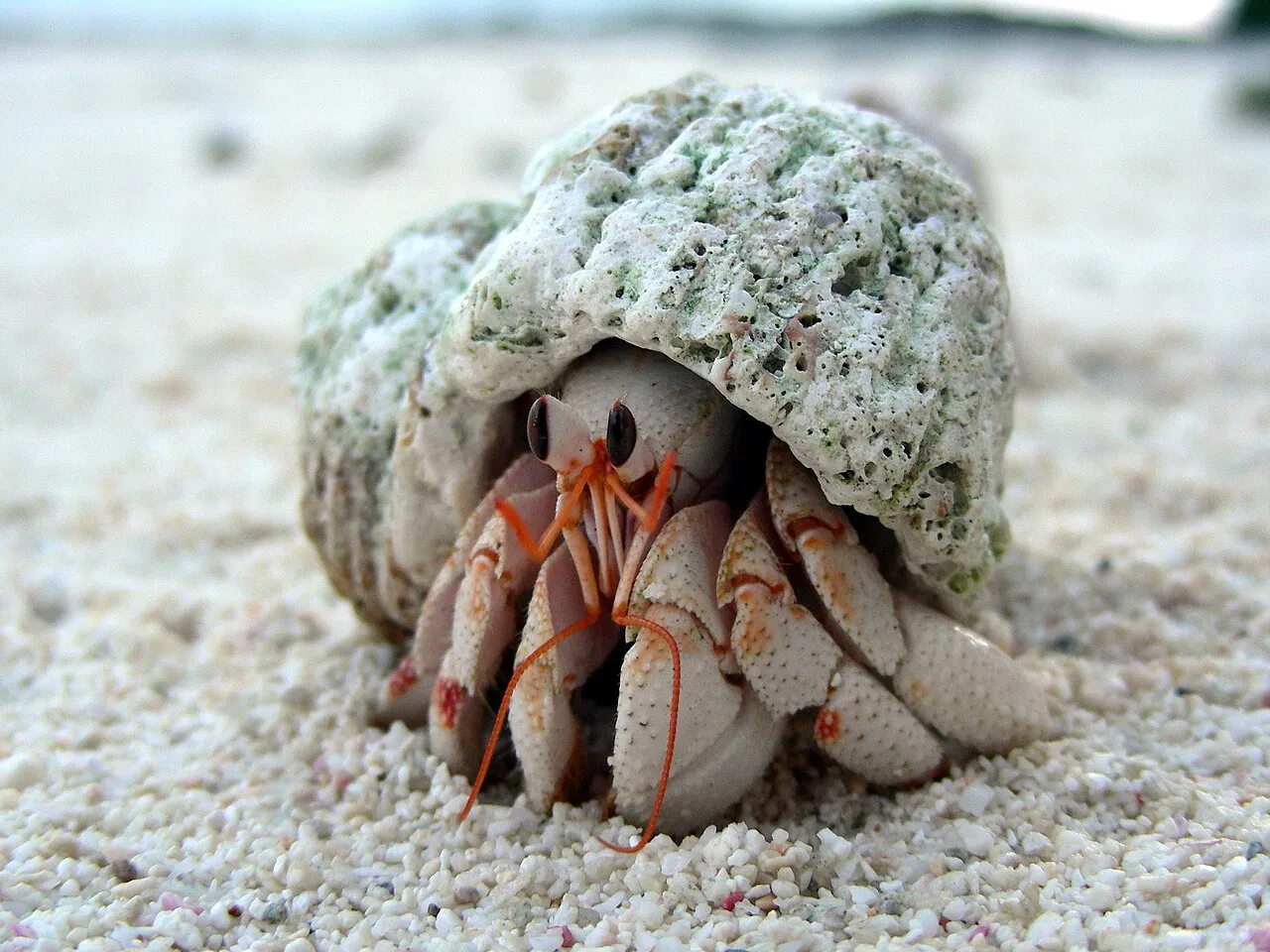
The English name evokes a recluse hiding in its shell, and the Japanese name, yadokari, means 'one who borrows lodgings'. The genus name Coenobita is more fitting: it comes from the Latin for a monk who lives in a religious community, and land hermit crabs are in fact highly social.
Despite the name, hermit crabs are not true crabs. True crabs belong to the infraorder Brachyura, while hermit crabs sit in Anomura, alongside porcelain crabs, squat lobsters and king crabs. King crabs are thought to have evolved from hermit crab ancestors, gradually abandoning the borrowed shell.
- Family: land hermit crabs belong to Coenobitidae.
- Genus: Coenobita contains all the pet species. The same family includes the coconut crab, Birgus latro, which abandons shells as it grows and is the largest land-living arthropod.
- Species: around 16 to 18 land hermit crab species are recognised.
Their abdomen is soft and twisted to fit right-handed spiral shells, and the left claw is much larger than the right. When the crab withdraws, that big claw seals the shell opening like a door.
3. History
Coastal peoples in the tropics have always known land hermit crabs, but the mass pet trade dates from the late twentieth century. In the United States, Caribbean hermit crabs became a staple of Florida beach souvenir shops from around the 1970s and later spread to shopping-mall pet stores. With them came the myth that a small cage, a sponge and a few pellets were enough.
From the 2000s, online keeper communities began to document how the animals really live and pushed for deep substrate, high humidity and salt water as standard. Much of today's husbandry guidance came from those enthusiasts rather than from the commercial trade.
In Korea and much of East Asia, hermit crabs spread through beach resorts, tourist stalls and shops near schools. Nearly all are wild-caught imports from Southeast Asia, the Pacific or Latin America. Specialist shops now sell them by species and size, but impulse sales at festivals and fairs remain common, and so do the old mistakes.
4. Body and anatomy
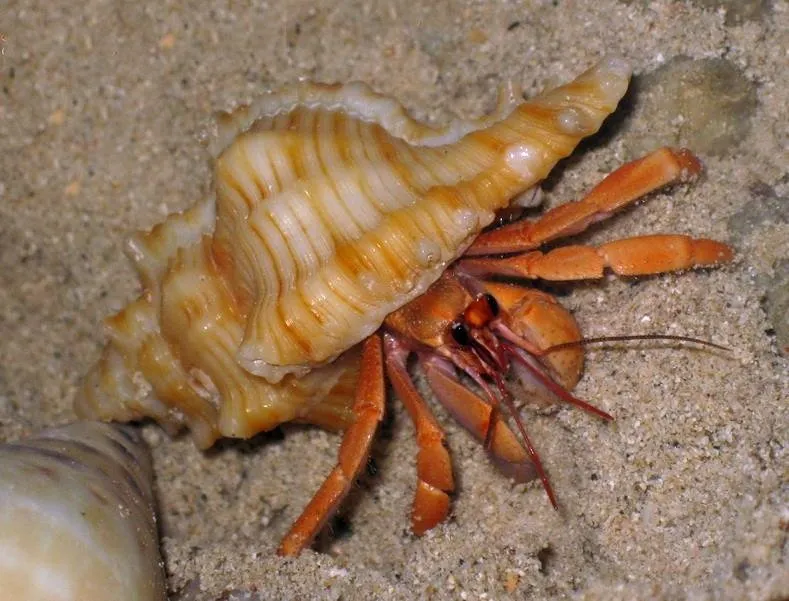
HappyCrabbie · Public domain
4.1. Body plan
The body has two parts: a hard, armoured front section, the cephalothorax, and a soft abdomen that lives inside the shell. At the tip of the abdomen, small hooked appendages grip the central column of the shell. Pulling a crab out by force can tear its body apart.
There are ten legs. The front pair are the claws, the next two pairs are walking legs, and the last two pairs are small and stay inside the shell, where they brace the crab and keep the shell interior clean. Pet crabs are usually 2–6 cm including the shell, and long-lived individuals can exceed 10 cm. Like all crustaceans, they grow by moulting their exoskeleton.
4.2. Breathing and senses
Land hermit crabs still have gills, but they cannot breathe underwater. They absorb oxygen from humid air through the gills and through tissue lining the shell cavity, so dry air leaves them struggling to breathe, which is why humidity of 70–80% is essential. They also carry a small reserve of water inside the shell to keep the abdomen moist, adjusting its saltiness by drinking and bathing in fresh and salt water.
Their compound eyes sit on movable stalks, giving wide vision that is highly sensitive to movement. They have two pairs of antennae: the long pair feel the surroundings, while the short pair flick rapidly to sample odours. Their sense of smell is remarkably acute, and in the wild crowds gather from far away at rotting fruit or carrion. They have no ears but respond to vibration.
4.3. Male or female
You can only sex a hermit crab when its body is out of the shell, so most keepers never know. Females have two small genital openings at the base of the last pair of walking legs, and feathery pleopods on the left side of the abdomen for carrying eggs. Males lack both. Care is the same for either sex, so there is no reason to disturb a crab just to check.
5. Species
These are the land hermit crabs most often seen in the trade.
| Species | Range | Notes | Preferred shells |
|---|---|---|---|
| Caribbean (C. clypeatus) | Caribbean, Florida | Purple left claw; most common in the West | Round openings |
| Ecuadorian (C. compressus) | Eastern Pacific coast | Small, very active, flattened eyestalks | Flattened, D-shaped openings |
| Indonesian (C. brevimanus) | Indo-Pacific | Grows large; rounded purple claws | Large, round openings |
| Rugosus (C. rugosus) | Indo-Pacific | Many colours; common in Asia | Varied |
| Strawberry (C. perlatus) | Indo-Pacific islands | Red body with white spots | Round openings |
| Cavipes (C. cavipes) | Indo-West Pacific | Shy, likes damp spots | Round openings |
| Australian (C. variabilis) | Northern Australia | Fairly tolerant of dryness | Varied |
Because species prefer different shell shapes, a mixed group needs both round-mouthed and flat-mouthed shells. Shops often sell crabs without a species name; photographs from keeper communities help, but even experienced hobbyists can find some species hard to separate.
The coconut crab belongs to the same family but is not a pet. It can weigh around 4 kg, span 90 cm across the legs and crack coconuts, and it is protected in parts of its range.
6. Behaviour
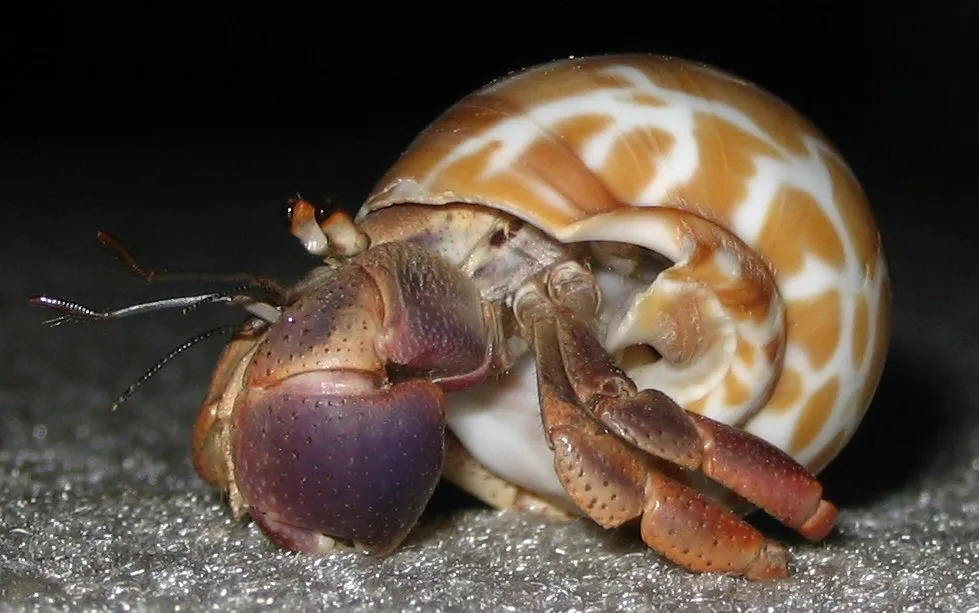
User AbsolutDan · CC BY-SA 2.5
6.1. In the wild
Wild land hermit crabs live in groups on beaches, in coastal forest and around mangroves, never far from the sea. By day they shelter from sun and dryness under rocks, leaf litter or sand. At dusk, hundreds or thousands emerge to eat almost anything: fallen fruit, seaweed, dead fish and even droppings. They are the cleaning crew of tropical shores.
Shells are everything to a hermit crab, and there are never enough. When a new, larger shell appears, crabs may gather around it and line up roughly in order of size. When the biggest crab moves in, the next takes its vacated shell, the next takes that one, and so on down the line. Researchers call this a vacancy chain, and it is one of the best-studied examples of resource sharing in invertebrates.
6.2. At home and reading the signs
Pet hermit crabs are nocturnal too. Shortly after lights-out they start exploring, climbing glass edges and netting, and sometimes falling, so arrange climbing structures at heights a crab can drop from safely.
- Shell switching: the crab turns a new shell with its claws, probes inside, then moves across in a flash, sometimes switching back. Constant switching suggests poor fit or stress.
- Chirping: a faint, croaking sound made when disturbed or when another crab tries to steal its shell, thought to be a warning.
- Antenna touching and shoving: social checking and minor disputes over space, usually harmless.
- Burying for days: almost certainly preparing to moult or moulting.
- Walking around naked: a sign of severe stress from a poorly fitting shell, heat or chemicals in the habitat.
- Sluggish with drooping legs: often low humidity or temperature.
- Rapping on another crab's shell and trying to pull it out: shell theft, a sign that spare shells are lacking.
7. Life cycle and moulting
A land hermit crab's life begins in the sea and continues on land.
| Stage | Duration | Notes |
|---|---|---|
| Egg | About a month | Carried by the female, released into the sea |
| Zoea larva | 1–2 months | Drifts as plankton, moulting several times |
| Megalopa | A few weeks | Finds a tiny shell and comes ashore |
| Juvenile | 1–3 years | Frequent moults, rapid growth |
| Adult | Years to decades | Longer intervals between moults |
In captivity, lifespans of 5 to 15 years are typical, and well-kept crabs have been reported living past 20. Wild crabs may live longer still.
Moulting is the most dangerous event in a hermit crab's life. Beforehand, the crab eats and drinks heavily to build fat and water reserves; its colours may dull and the tips of its legs may look pale. It then digs a burrow in damp sand and sheds its old exoskeleton underground. Large crabs may stay buried for four to eight weeks or more. Freshly moulted crabs are soft and helpless, and being dug up or attacked by tankmates at this stage can kill them.
The shed skin is rich in calcium and minerals, and the crab eats it. A pale, crab-shaped husk lying on the sand is easily mistaken for a dead crab, but if it is empty and odourless, it is a moult; leave it where it is. Lost legs regrow, small at first, returning to full size over several moults.
8. Housing
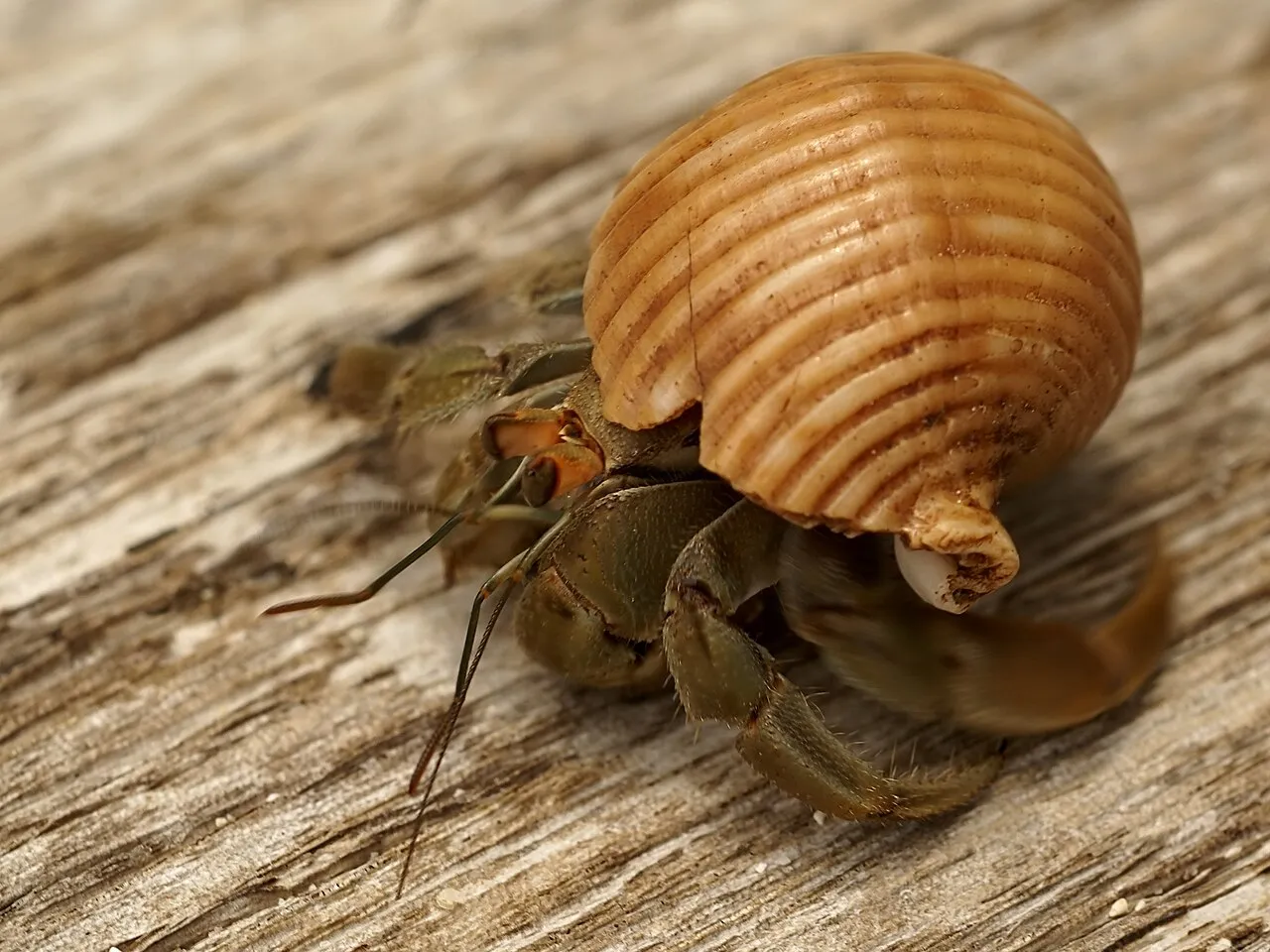
Hans Hillewaert · CC BY-SA 4.0
8.1. Tank and substrate
A glass aquarium with a lid that holds humidity is the standard home. Two or three small crabs need at least 40 litres, and larger groups or big crabs need 75–150 litres or more. Vented plastic carriers lose humidity far too quickly. Cover most of the top with glass or acrylic, leaving a small gap to balance humidity and fresh air.
Substrate is the heart of the set-up. Mix clean play sand with coconut fibre at roughly five to one, and moisten it with dechlorinated fresh or salt water until it holds the shape of a sandcastle. Make it at least three times as deep as your largest crab is tall, and never less than about 15 cm, so a moulting crab can bury itself completely in a burrow that will not collapse. It should be damp but not waterlogged; standing water at the bottom breeds mould and bacteria.
8.2. Heat, humidity and water
| Factor | Target | Notes |
|---|---|---|
| Temperature | 24–28°C | Never below about 22°C |
| Humidity | 70–80% | Use a digital hygrometer |
| Fresh water | Always available | Dechlorinated |
| Salt water | Always available | Aquarium marine salt, about 1.020–1.025 specific gravity |
Heat with a mat on the side or back of the tank, or a ceramic heater above, controlled by a thermostat. A mat under the substrate traps buried, moulting crabs above a heat source they cannot escape.
Provide two water dishes, one fresh and one salt. They should be deep enough for your largest crab to submerge completely, with stones or a ramp so small crabs can always climb out. Crabs use this water to refill the reserve in their shells and to wet their bodies. Change it daily.
Lighting only needs to create a day-night rhythm of about twelve hours each. Hot lamps dry the air and are best avoided.
8.3. Shells and equipment
Spare shells are the most important equipment of all. For each crab, keep at least three natural shells, some the same size as its current one and some slightly larger, with a mix of round and flattened openings. Turbo, babylon and nerite shells are popular. Avoid painted or lacquered shells and any that are cracked or holed, and sterilise new ones in boiling water, then cool them, before adding them to the tank.
- Glass tank with a lid
- Play sand and coconut fibre
- Side-mounted heat mat with thermostat
- Digital thermometer-hygrometer
- Two water dishes, fresh and salt
- Aquarium marine salt and dechlorinator
- Spare natural shells, three or more per crab
- Hides such as half coconut shells and cork bark
- Branches, cork and netting for climbing
- Calcium source: cuttlebone or sterilised crushed eggshell
- Mister
- An isolation tub for moulting crabs, optional
9. Diet
Land hermit crabs are omnivores, and variety is the key to long-term health. Commercial hermit crab pellets are convenient but not enough on their own, and some contain heavy preservatives, so offer plenty of fresh food alongside them.
- Protein: unsalted dried shrimp, krill, boiled egg, raw fish or shellfish, mealworms and other insects
- Fruit: apple, banana, mango, papaya, coconut, deseeded grapes, berries
- Vegetables: carrot, sweet potato, kale, squash, sweetcorn and a little spinach
- Extras: unsalted nuts, plain oats, a drop of honey, dried oak leaves, seaweed
- Calcium and chitin: cuttlebone, crushed eggshell, shrimp and crab shell
Offer food at dusk in a small dish and remove fresh leftovers the next morning. Crabs eat very little at a time, so a few thumbnail-sized portions of different foods is plenty. Changing the menu daily helps balance nutrition, and crabs approaching a moult need extra protein and calcium.
Avoid salted or seasoned food, onions, garlic and other alliums, and processed food with preservatives. Many keepers limit citrus because of its acidity. Wash produce well to remove pesticide residue, and collect leaves only from places you know are unsprayed.
10. Health
Hermit crabs hide illness well, and vets who treat them are rare. Prevention through good husbandry is almost the whole story.
- Failed moult: low humidity or shallow, dry sand that lets the burrow collapse can leave a crab trapped in its old exoskeleton, losing legs or dying. Being dug up or disturbed by tankmates mid-moult has the same effect.
- Stress moult: many crabs bury and moult soon after arriving in a new home. Already weakened by shipping and poor shop conditions, a high proportion die during this first moult. Keep conditions stable and leave new arrivals alone for the first weeks.
- Limb loss: stress, fights and dry air can cause crabs to drop legs. Keep the habitat clean while the stump heals.
- Mites and mould: replace substrate and stop leaving food out if mites appear. Some mites are reported to damage crab gills.
- Poisoning: insecticides, air fresheners, scented candles, cigarette smoke, painted shells and copper decorations can all be lethal.
- Dehydration and overheating: falling humidity or a heat mat under the sand can cause harm quickly.
Check the habitat at once, and seek advice from an exotic vet or experienced keeper, if a crab leaves its shell and will not return, if several crabs lose legs or go limp at the same time, or if dark patches spread over the body.
To tell whether a crab has died, trust your nose. A moulting crab can look limp and lifeless, but it does not smell. A dead crab smells strongly of rotting fish.
11. Breeding
Breeding land hermit crabs in captivity is extremely difficult. In the wild, they mate on humid summer nights, and the female carries hundreds or thousands of fertilised eggs on her abdomen for about a month. Then, often around a full moon, she walks down to the surf and releases them into the sea, where they hatch on contact with the water. The larvae pass through several planktonic stages before coming ashore as tiny crabs.
Recreating that requires a marine set-up, cultured microscopic food for the larvae, careful water management at each stage and the right conditions for the move from sea to land. A few hobbyists have reported success, but there is no large-scale captive breeding.
That is why nearly every pet hermit crab is wild-caught. You may see a captive female carrying eggs, and she may shake them off into the salt-water dish, which is natural, but they almost never develop. The most useful thing a keeper can do is help the crabs they already have live a long life, reducing demand for wild collection.
12. Costs
The crabs themselves are cheap, but a proper set-up costs many times their price. These are rough Korean figures for three small crabs in a 60-litre tank.
| Item | Typical cost | Notes |
|---|---|---|
| Three crabs | 10,000–50,000 won | Varies by species and size |
| 60 L glass tank and lid | 40,000–100,000 won | |
| Sand and coconut fibre | 10,000–30,000 won | Enough for 15 cm+ |
| Heat mat and thermostat | 20,000–50,000 won | |
| Digital hygrometer | 10,000–20,000 won | |
| Dishes, hides, decor | 20,000–50,000 won | |
| Spare shells (10+) | 20,000–50,000 won | Several sizes |
| Marine salt, dechlorinator | 10,000–20,000 won | |
| Setup total | about 100,000–250,000 won |
| Item | Monthly | Notes |
|---|---|---|
| Food | 5,000–10,000 won | Use household fruit and vegetables |
| Electricity | 3,000–10,000 won | Higher in winter |
| Consumables | 3,000–5,000 won | Salt, extra shells |
| Monthly total | about 10,000–25,000 won |
Plan for a full substrate change once or twice a year and for larger shells and tanks as the crabs grow. Vet bills are rarely large, mainly because so few vets treat hermit crabs, which also means help is hard to find when something goes wrong.
13. Before you get one
- Have you avoided an impulse buy? Before taking a crab home from a beach stall or fair, make sure you can set up a tank, deep sand and heating.
- Can you keep two or more? Hermit crabs are social and are far more active in a group.
- Are you ready for ten years or more?
- Can you check humidity and water every day?
- Will you enjoy watching more than handling? Frequent handling stresses them, and they can pinch hard.
- Does your household use insecticides, air fresheners or scented candles often? If so, think carefully about where the tank will go.
When choosing crabs, look for a full set of legs, an active crab that extends from its shell, and a quick retreat into the shell when lifted. If a crab is wearing a painted shell, offer several natural shells at home and let it switch on its own; never pull it out. Keep new crabs apart from an existing group for a few days to weeks while you watch their condition. If a new crab disappears underground for weeks soon after arrival, it is probably a stress moult, so be patient.
14. Laws and ethics
In most countries, keeping land hermit crabs requires no licence, and they are sold freely as pets. Rules can change, though, and some regions have specific restrictions, so check with your local wildlife authority if unsure.
Things to keep in mind:
- Collecting abroad: taking hermit crabs from a holiday beach may break that country's wildlife export rules and your own country's import and quarantine rules. In Japan, the land hermit crabs of the Ogasawara Islands and Okinawa are designated national natural monuments, and many national parks and reserves elsewhere also forbid collection.
- Release: tropical land hermit crabs cannot survive temperate winters and may spread disease. Never release a pet crab onto a beach or into the sea.
- Local marine species: the hermit crabs you find in temperate rock pools are marine animals that live underwater and cannot be kept like land hermits. Return any you pick up on a shore walk to where you found them.
There is also an ethical dimension. Almost all pet hermit crabs are taken from the wild, and many are reported to die during transport and in shops. Buying fewer of them as souvenirs eases the pressure on wild populations.
15. Hermit crabs in culture
Because they live in borrowed homes, hermit crabs are a natural metaphor for moving house, growing up and outgrowing old situations.
- Eric Carle's picture book A House for Hermit Crab follows a crab that leaves its outgrown shell and decorates a new one with the help of sea anemones, starfish and other neighbours, a gentle story about change.
- In Pokémon, Dwebble and Crustle are hermit-crab-like creatures that carry slabs of rock instead of shells.
- Tamatoa, the giant treasure-encrusted crab in Disney's Moana, is widely described as inspired by the coconut crab.
- In the Animal Crossing games, hermit crabs turn up on beaches as collectable creatures.
- The Japanese artist Aki Inomata made transparent 3D-printed shells topped with miniature cityscapes and offered them to hermit crabs, a work that raised questions about home, migration and borders.
Photographs of hermit crabs living in bottle caps, plastic pots and light-bulb fittings have also become familiar images in campaigns about marine litter.
16. Trivia
- A study published in 2019 estimated that hundreds of thousands of hermit crabs had died trapped in plastic debris on the beaches of the Cocos (Keeling) Islands in the Indian Ocean and Henderson Island in the South Pacific. The smell of dead crabs, which signals a newly available shell, may lure more crabs into the same traps.
- Hermit crabs are attracted to the smell of dead crabs for exactly that reason: a death means a vacant shell.
- Where shells are scarce, crabs make do with bamboo segments, coconut fragments and broken bottles.
- Coconut crabs use shells only when young and rely on their own hardened exoskeleton as adults. Research suggests their pinch is among the strongest of any land animal.
- When choosing shells, crabs weigh up more than size: weight, opening shape and internal volume all matter. A heavy shell is tiring to carry, while a thin one is easily crushed by predators.
- On tropical beaches, the overnight wanderings of hermit crab crowds leave dense tracks across the sand, visible as delicate patterns at dawn.
Health notes are general information. If something seems wrong, contact a vet who treats this species.
FAQ
My crab has left its shell. Is it okay?
This usually means the shell does not fit or the habitat is too hot or dry. Check conditions, add several spare shells of different sizes and leave it in peace.
Do they really need salt water?
Yes. Land hermit crabs use salt water to balance the fluid they carry in their shell. Provide both, and they will choose for themselves.
Can I breed hermit crabs at home?
It is extremely difficult because the larvae spend weeks in the ocean. Focus on giving the crabs you have a long, healthy life.
Further reading
Photo credits
Photos are freely licensed images from Wikimedia Commons. Authors and licenses are listed below.
- Caribbean hermit crab.JPG — ZooFari · CC BY-SA 3.0
- Bernardl'hermitedenis.JPG — Unknown · Public domain
- C.violascens Chicoreus microphyllus 1.jpg — HappyCrabbie · Public domain
- CoenobitaClypeatus.JPG — User AbsolutDan · CC BY-SA 2.5
- Coenobita compressus (habitus).jpg — Hans Hillewaert · CC BY-SA 4.0