TailVille
At a glance
Rough ranges for supplies, food and electricity in Korea (USD is approximate). Purchase or adoption fees are not included.
Night owls and small-space dwellers who enjoy observing an animal's natural behaviour more than handling it.
Young children expected to care for it alone, or anyone wanting a cuddly pet that is awake during the day.
1. Overview
Hamster is the common name for a group of small, stout, short-tailed rodents in the subfamily Cricetinae. The ones kept as pets fall into two broad camps: the comparatively large Syrian (golden) hamster and a handful of much smaller dwarf species. All of them share the trademark cheek pouches that can be packed with an astonishing amount of food.
In many countries the hamster is the classic starter pet, sold cheaply and housed in a small plastic cage on a child's desk. The reality is more demanding. Hamsters are nocturnal, territorial, built to dig and to run long distances every night, and most of the cages marketed for them are far too small.
This article covers where hamsters come from, how their bodies work, the differences between the species, how to read their behaviour, how to house and feed them, the illnesses that commonly affect them, breeding, costs, legal considerations and their place in popular culture. The aim is to help a hamster live its short two-to-three-year life as comfortably as possible.
2. Name and classification
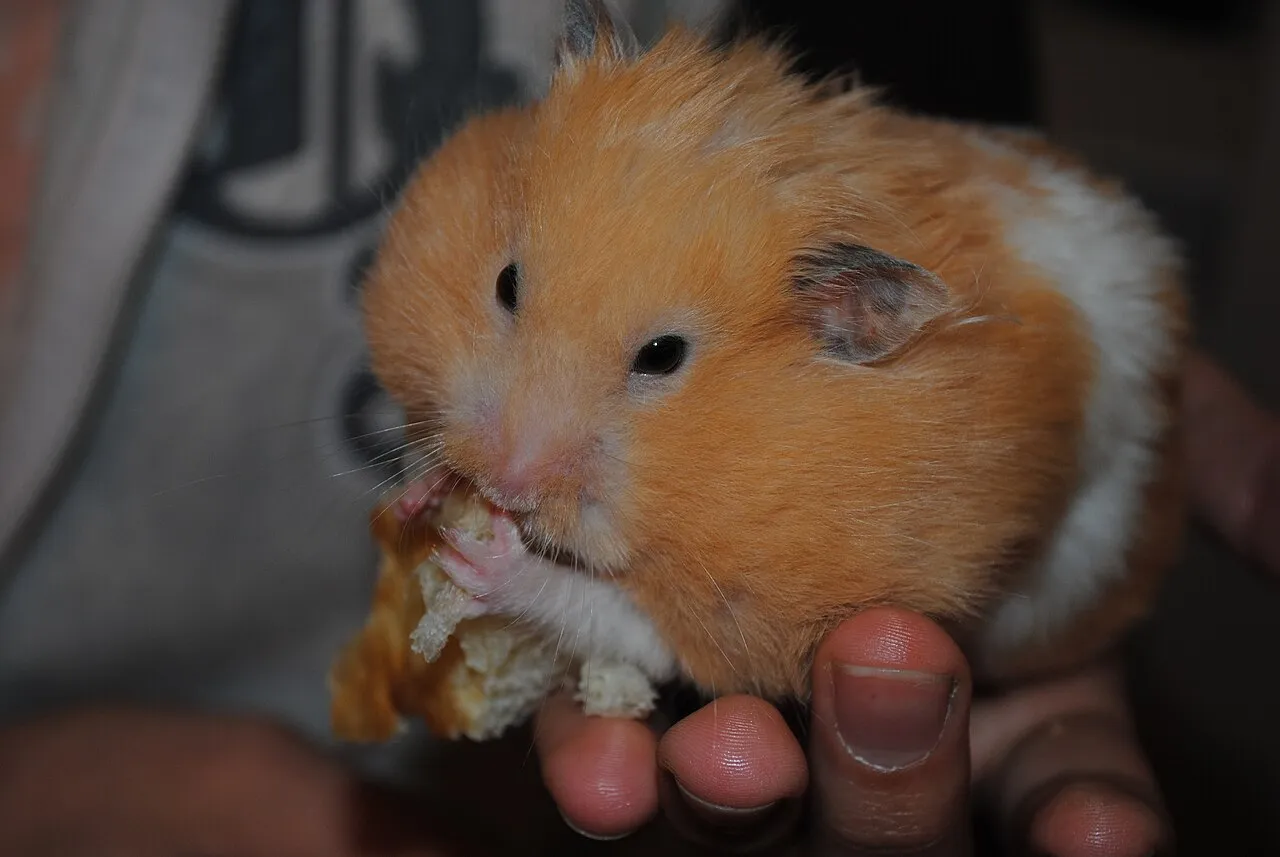
Raining128 · CC BY-SA 3.0
2.1. Scientific names and etymology
Hamsters belong to the order Rodentia, family Cricetidae, subfamily Cricetinae. The Syrian hamster is Mesocricetus auratus, the species name meaning golden in Latin. The three popular dwarf species sit in the genus Phodopus, while the Chinese hamster is Cricetulus griseus.
The English word comes straight from German Hamster, which traces back to Old High German hamustro. German still has the verb hamstern, meaning to stockpile or hoard, a nod to the animal's habit of carrying food home in its cheeks.
2.2. Names in Korean
Korean simply borrows the English word as haemseuteo, and online communities use cute nicknames such as haemjji. Species names are also loanwords: Djungarian refers to the Dzungaria region of Central Asia, Campbell's honours the collector W. C. Campbell, and Roborovski commemorates the Russian explorer Vsevolod Roborovski.
Pet shops in Korea often sell hamsters under colour names such as Pearl, Sapphire or Pudding as though they were separate species. In practice these are colour varieties of the Winter White (Djungarian) hamster or, very often, Winter White and Campbell's hybrids.
2.3. The five pet species and their relatives
Five species account for nearly all pet hamsters.
- Syrian hamster (Mesocricetus auratus): the largest and most strictly solitary.
- Winter White or Djungarian hamster (Phodopus sungorus): can turn white in winter in response to short days.
- Campbell's dwarf hamster (Phodopus campbelli): similar to the Winter White but with smaller ears and often a more nervous temperament.
- Roborovski hamster (Phodopus roborovskii): about 5 cm long, the smallest and fastest.
- Chinese hamster (Cricetulus griseus): slim, mouse-like and with a noticeably longer tail.
The wild European or common hamster (Cricetus cricetus) of the Eurasian steppes can approach 30 cm and has declined so steeply that it is now protected in much of its range. Gerbils and mice are often confused with hamsters but belong to different groups.
3. History
3.1. From the wild to the laboratory
The Syrian hamster was formally described in 1839 by the British zoologist George Waterhouse from a single specimen collected near Aleppo. Living animals then went largely unstudied for almost a century, until 1930, when the zoologist Israel Aharoni of the Hebrew University in Jerusalem dug a mother and her litter out of a burrow in a field near Aleppo.
Several animals died or escaped on the journey and only a few went on to breed, but that tiny colony flourished. Its descendants were shipped to research institutions in Britain, the United States and elsewhere, and the great majority of pet Syrians today are believed to descend from them. Accounts differ on the exact numbers, so the story is best treated as a well-documented anecdote rather than a precise record.
3.2. Becoming a pet
Easy to keep and quick to breed, the Syrian hamster became a staple of medical and biological research, and from the 1940s and 1950s it spread into homes in Britain and North America. Dwarf species followed in European pet circles from roughly the 1960s and 1970s, and Roborovskis only became widely available in the 1990s.
The Chinese hamster had an earlier research career, and cells derived from its ovaries, known as CHO cells, remain one of the most important tools for manufacturing biological medicines today.
3.3. Hamsters in Korea
There is no clear record of when hamsters first reached Korea, but they became common in aquarium and pet shops from around the 1990s. Their popularity jumped in the early 2000s when the Japanese anime Hamtaro aired, and cheap hamsters sold with tiny plastic cages became a familiar sight.
In recent years Korean online communities have pushed hard for welfare-focused care, popularising large storage-box enclosures, deep bedding and big wheels, and the old small-cage approach is gradually giving way.
4. Body and anatomy

HamsterHaver · CC BY-SA 4.0
4.1. Size and build
Syrians measure 13–18 cm and usually weigh 100–180 g, with females often a little heavier than males. Winter Whites and Campbell's are 7–10 cm and 25–50 g, while Roborovskis are only about 5 cm and 20–25 g. Chinese hamsters reach 8–12 cm and carry a 2–3 cm tail, which gives them a slimmer, mousier outline.
Hamsters have short legs and a rounded body, with four toes on each front foot and five on each hind foot. They use their front paws like hands to hold food and wash their faces.
4.2. Teeth and cheek pouches
A hamster has 16 teeth: four ever-growing incisors and twelve molars. Healthy incisors are yellow to orange on the front surface, and pale white incisors can actually signal a health or nutrition problem.
The cheek pouches are elastic sacs that start inside the mouth and run back as far as the shoulders. Because they contain no salivary glands, food stays dry inside them, and a Syrian can carry a surprisingly large load in one trip. Sticky or sharp foods can lodge in the pouches or injure them.
4.3. Senses
Hamsters are very short-sighted and appear to have limited colour vision. They make up for it with an excellent sense of smell, keen hearing that extends into ultrasonic ranges, and sensitive whiskers that map their surroundings in the dark.
Syrians have scent glands on each hip, and dwarfs have one in the middle of the belly. The dark spots on a male Syrian's flanks are these glands, and new owners often mistake them for sores. Hamsters rub them on surfaces to mark territory.
4.4. Telling males from females
Sex is determined by the distance between the genital opening and the anus. In males the gap is roughly a centimetre or more, and after maturity the testicles make the rear end look distinctly pointed and swollen. Females have the two openings close together and two rows of small nipples along the belly.
At three to four weeks old the difference is subtle, and shops get it wrong often. That is how many owners end up with an unexpected litter a month after bringing two youngsters home.
5. Species, colours and coat types
The five pet species compare as follows.
| Species | Body length | Weight | Lifespan | Temperament and notes |
|---|---|---|---|---|
| Syrian | 13–18 cm | 100–180 g | 2–3 years | Tames well, must live alone |
| Winter White | 7–10 cm | 25–45 g | 1.5–2.5 years | Usually gentle, winter coat may turn white |
| Campbell's | 7–10 cm | 30–50 g | 1.5–2.5 years | Can be nippy, prone to diabetes |
| Roborovski | about 5 cm | 20–25 g | 2–3.5 years | Extremely fast and shy, best for watching |
| Chinese | 8–12 cm | 30–45 g | 2–3 years | Long tail, agile climber |
Syrians come in an enormous range of colours beyond the wild-type golden agouti, including cream, black, sable, cinnamon, dominant spot and banded, where a white belt circles the middle. Coat type adds more variety. Long-haired males can grow skirts of fur close to 10 cm long and are sold as teddy bear hamsters, while the satin gene adds sheen and the rex gene adds curl.
Winter Whites come in normal (grey-brown with a dark dorsal stripe), sapphire (soft blue-grey), pearl (white with faint ticking) and mandarin-type yellowish shades. Campbell's offer an even wider palette, including argente, albino and black. Many dwarf hamsters sold in shops are Winter White and Campbell's hybrids, a cross that responsible breeders avoid because it is linked to diabetes and difficult births.
6. Behaviour
6.1. Life in the wild
Wild Syrian hamsters live on the dry plains and farmland of northern Syria and southern Turkey. Each digs a burrow that can reach close to a metre deep, with separate chambers for sleeping, food storage and toilet use. They emerge around dusk and dawn to gather seeds, greenery and insects, and may cover several kilometres in a night.
Outside the breeding season they avoid each other and react aggressively to intruders near their burrow. Because their habitat overlaps with crops they have long been treated as pests, and the IUCN currently lists the wild Syrian hamster as Vulnerable.
6.2. Behaviour at home
Pet hamsters keep their wild routine. They sleep through the day in a hide or a burrow in the bedding, wake around dusk, check their food and then run on the wheel for hours. Pouching food and carrying it to a hidden larder is perfectly normal.
Constant bar-chewing, repeatedly climbing the same corner, or frantic digging in one spot can be stereotypic behaviours caused by a cramped or boring enclosure. When you see them, look first at floor space, bedding depth and wheel size.
6.3. Reading the signals
Hamsters say most things with posture rather than sound.
- Stretching and yawning: relaxed and secure.
- Standing on the hind legs with a twitching nose: curious and checking things out.
- Freezing on the spot: startled and assessing a possible threat.
- Rolling back, showing the teeth and squeaking: frightened or angry, so withdraw your hand.
- Folded ears and half-closed eyes: just woken up or sleepy.
- Teeth chattering: annoyed or warning you off.
- Suddenly emptying the cheek pouches: sometimes a sign of alarm, lightening the load to flee.
A hamster that sniffs your palm and climbs on is beginning to trust you, and a gentle nibble is often just a test of whether your finger is food.
7. Life stages
A typical Syrian hamster's life runs roughly as follows. Dwarf species follow a similar pattern with slightly different timings.
| Stage | Age | What happens |
|---|---|---|
| Newborn | 0–1 week | Hairless, eyes and ears closed, milk only |
| Nestling | 1–2 weeks | Fur grows in, crawls around the nest |
| Eyes open | about 2 weeks | Starts nibbling solid food |
| Weaning | 3–4 weeks | Becomes independent, earliest age to rehome |
| Sexual maturity | 4–8 weeks | Can breed, Syrians must be separated |
| Young adult | 2 months–1 year | Peak activity, full adult size |
| Middle age | 1–1.5 years | Activity gradually declines |
| Senior | from 1.5 years | Weight loss, thinning coat, more illness |
Average lifespans are about two to three years for Syrians, 18 months to two and a half years for Winter Whites and Campbell's, and two to three and a half years for Roborovskis. The odd hamster approaches four, but that is unusual.
Signs of ageing include a thin, dull coat, crusty or cloudy eyes, less wheel time and more sleep, weaker back legs and lumps under the skin. For a senior hamster, lower or remove high platforms and ramps, keep food and water within easy reach, and soften pellets with a little water if chewing becomes difficult.
8. Housing
Wschlitz · CC BY 4.0
8.1. Enclosure size
The single most common mistake in hamster care is an enclosure that is too small. Aim for at least 80 × 50 cm of floor space, and 100 × 50 cm or more for a Syrian; several European welfare organisations recommend even larger minimums. One large, continuous floor matters far more than stacked levels.
Popular options include large glass tanks, purpose-built wooden or acrylic enclosures, and big plastic storage boxes of 100 litres or more fitted with mesh ventilation panels. Wire cages ventilate well but encourage bar-chewing and fling bedding everywhere. Small modular cages joined by plastic tubes are poorly ventilated, hard to clean and best avoided.
8.2. Bedding and hides
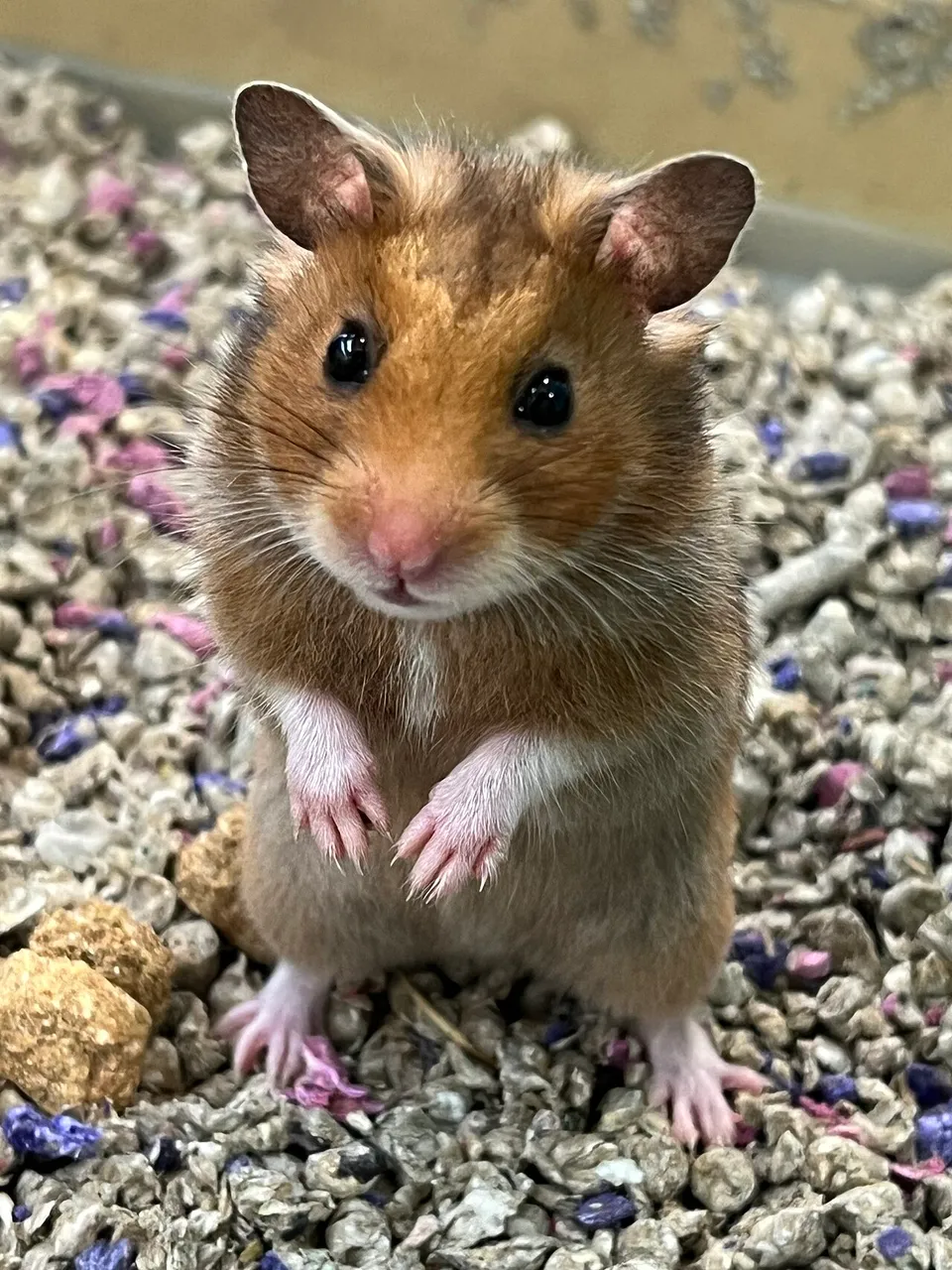
Digging is central to a hamster's sense of security. Provide at least 15–20 cm of paper bedding or aspen shavings, and ideally a deeper zone approaching 30 cm, so your hamster can build its own tunnels and chambers. Avoid cedar and pine shavings, whose aromatic oils can irritate the airways, and fluffy fibrous nesting material, which can wrap around limbs or block the gut if eaten.
Good hides include bottomless wooden houses and multi-chamber hides that mimic a burrow. Offer hay or plain paper strips as nesting material, and make sure the hide is roomy enough to hold both the hamster and its food stash.
8.3. The wheel
The wheel is one of the most important items in the enclosure. A wheel that is too small forces the hamster to run with an arched back, so choose at least 28 cm for a Syrian and 20 cm for a dwarf; a large Syrian may be more comfortable on 30 cm or more.
The running surface must be solid, because wire mesh or rungs can trap and break toes. Single-sided wheels with no crossbar reduce the risk of tails and bodies getting caught, and a bearing-mounted wheel runs quietly enough not to keep the household awake. Fix the wheel firmly so it does not wobble or tip.
8.4. Temperature, humidity and light
Keep hamsters at 20–24°C with humidity around 40–60%. Below about 10°C they can slip into torpor, and as temperatures approach 30°C heatstroke becomes a real danger. In summer keep the enclosure away from sunny windows and balconies, and a marble or ceramic cooling tile gives the hamster somewhere to lie. Direct air-conditioner drafts are also unwelcome.
No special lighting is needed, but a clear day-night cycle keeps the body clock steady. A quiet room that gets dark in the evening is better than a living room with lights and television on late into the night.
8.5. Shopping list
A basic setup includes:
- An enclosure with at least 80 × 50 cm of floor space
- Plenty of paper or aspen bedding
- A solid-surface wheel of 20–30 cm or more
- One or two hides plus nesting material such as hay or unbleached paper
- A heavy ceramic food bowl
- A water bottle or shallow water dish
- Dust-free sand and a sand bath
- Untreated wooden chews and cork tunnels
- A thermometer and hygrometer
- A small carrier for vet visits
- A kitchen scale for weekly weight checks
9. Diet
Hamsters are omnivores. Seeds and grains form the bulk of their diet, but they also eat insects and other animal protein. Use a hamster pellet or a varied mix of grains, seeds and pellets as the staple, and if you feed a mix, watch that your hamster is not picking out only its favourite pieces.
A Syrian needs roughly 10–15 g of staple food a day and a dwarf about 5–8 g. Because hamsters hoard, an empty bowl does not mean a hungry hamster: check the larder in the nest occasionally and adjust portions. Evening feeding matches their natural schedule.
| Category | Examples | How often |
|---|---|---|
| Staple | Hamster pellets, seed mix | Daily |
| Vegetables | Broccoli, cucumber, carrot, bok choy, courgette | 3–5 times a week, fingernail-sized |
| Protein | Boiled egg white, dried mealworms, plain cooked chicken | Once or twice a week, small amounts |
| Seed treats | Sunflower or pumpkin seeds | Occasionally, one or two |
| Fruit | Apple without seeds, banana | Rarely, a tiny piece |
Dwarf hamsters, especially Campbell's and hybrids, are prone to diabetes, so keep sugary foods such as fruit, carrot and sweetcorn to a minimum. Fresh foods spoil quickly once stashed, so offer only what will be eaten and remove leftovers the next day.
Change the water daily and press the spout of the bottle to make sure it flows. Foods to avoid include onions, garlic and leeks, chocolate and sweets, raw beans, apple seeds and stone-fruit pits, acidic citrus fruit, sticky foods that cling inside the cheek pouches, and salty or fatty human food.
10. Health and disease
Hamsters are small, hide illness well and deteriorate quickly once sick. Weighing your hamster weekly and keeping a record is one of the best early-warning tools you have. Treatment should come from a vet experienced with small exotic mammals.
10.1. Common conditions
| Condition | Cause | Main signs | Prevention and response |
|---|---|---|---|
| Wet tail (proliferative ileitis) | Bacterial infection such as Lawsonia, stress | Wet, smelly tail area, diarrhoea, hunched posture | Emergency vet care, minimise stress after purchase |
| Overgrown teeth | Lack of chewing material, genetics, injury | Long or curled incisors, drooling, weight loss | Wooden chews, professional trimming |
| Diabetes | Genetics in Campbell's and hybrids, sugary diet | Heavy drinking, large amounts of urine | Low-sugar diet, diagnosis by a vet |
| Cheek pouch problems | Sticky or sharp food | Persistent swelling, pouch protruding from the mouth | Avoid sticky foods, see a vet promptly |
| Mites and ringworm | Demodex mites, fungal infection, weak immunity | Hair loss, flaky skin, scratching | Clean housing, vet diagnosis and medication |
| Tumours | Age, genetics | Lumps under the skin, swollen belly | Regular checks in old age, early treatment |
| Respiratory infection | Drafts, dust, bacteria | Sneezing, discharge, clicking breathing | Low-dust bedding, stable temperature |
| Torpor | Temperatures below about 10°C | Cold body, barely moving | Warm gradually and see a vet, heat the room in winter |
Older Syrians are also prone to amyloidosis, in which abnormal protein builds up in the kidneys, as well as polycystic liver disease and heart problems.
10.2. Diseases that can pass to people
Infections that can pass from hamsters to people include ringworm, gut bacteria such as Salmonella and, rarely, lymphocytic choriomeningitis virus (LCMV). LCMV is mainly spread by wild house mice and infection from pet hamsters is uncommon, but it can be dangerous during pregnancy. Wash your hands after handling or cleaning, and if you are pregnant, let someone else clean the enclosure.
10.3. When to see a vet
Contact an exotic-animal vet promptly if you notice:
- A wet tail area or diarrhoea
- No eating or drinking for a day or more
- Weight loss of more than about 10% in a week
- Laboured, wheezing or clicking breathing
- A cold, limp body
- Broken or overgrown incisors
- A new lump, or one that is growing quickly
- A head tilt or loss of balance
- Bleeding or discharge from the genital area
11. Breeding
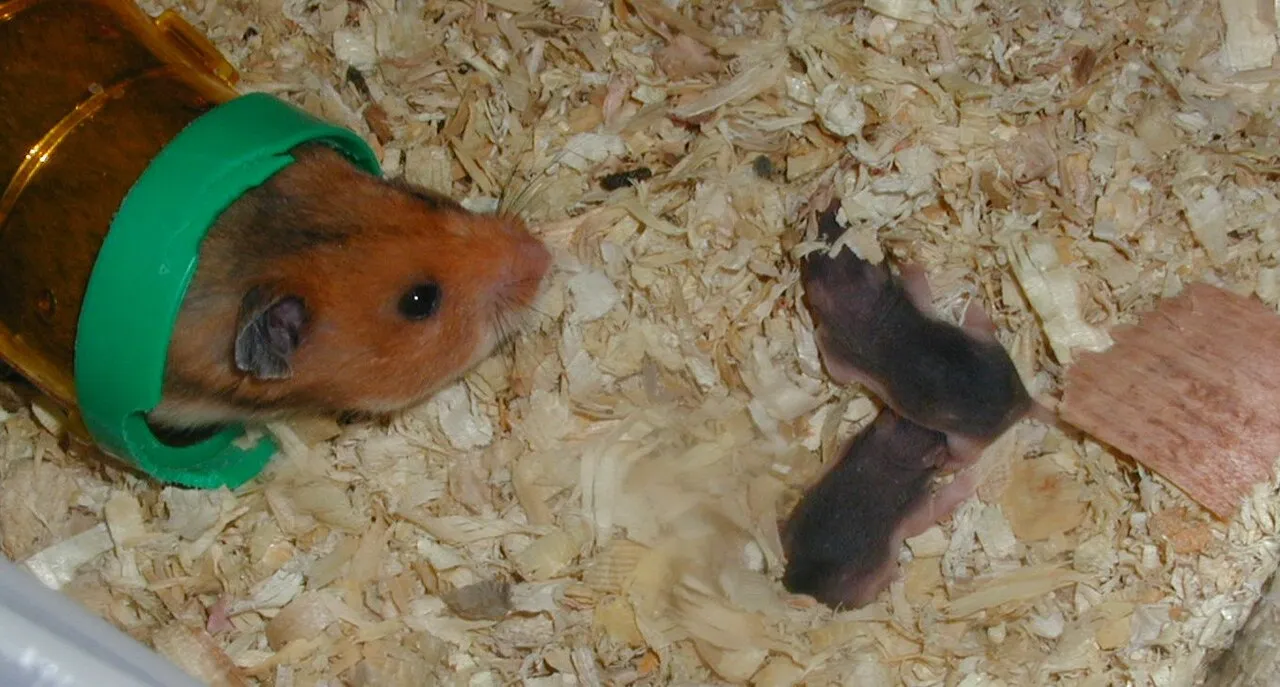
Hamsters are prolific breeders. Females come into season about every four days, and a Syrian's pregnancy lasts only around 16 days, one of the shortest of any mammal; dwarf species carry for about 18–22 days. Syrians typically have six to twelve pups and dwarfs four to six, and a female can conceive again almost immediately after giving birth.
The nest must be left completely undisturbed for the first two weeks, because a stressed mother may abandon or even eat her young. Pups wean at three to four weeks and can breed from four to five weeks, so they must be sexed and separated promptly. Syrian siblings will eventually injure each other and need individual enclosures.
Think very carefully before breeding at home. A single litter can mean ten or more hamsters, each needing its own enclosure and a responsible new home. Inbreeding and Winter White and Campbell's crosses increase the risk of inherited disease and difficult births. Selling animals can also bring licensing obligations, so check the rules where you live before planning a litter.
12. Costs
The hamster itself is cheap; a proper setup is not. The figures below are rough Korean prices and will vary by product and region; costs elsewhere are broadly similar in proportion.
| Item | Approximate cost (KRW) | Notes |
|---|---|---|
| Hamster | 5,000–50,000 | Depends on species, colour and source |
| Enclosure or large storage box | 40,000–150,000 | Including modifications |
| Wheel | 20,000–50,000 | Quiet bearing models recommended |
| Hides and chews | 20,000–50,000 | Wood, cork and similar |
| Initial bedding | 20,000–40,000 | Deep bedding takes a lot |
| Bowl, bottle and sand bath | 10,000–30,000 | |
| Setup total | about 150,000–350,000 | |
| Monthly food and treats | 5,000–15,000 | |
| Monthly bedding and sand | 10,000–20,000 | Depends on cleaning routine |
| Monthly total | about 15,000–35,000 |
Vet fees vary widely, but a consultation at an exotic clinic plus tests or medication commonly runs to tens of thousands of won, and surgery such as tumour removal can reach several hundred thousand. Expect vet care to cost far more than the hamster did, and set aside a small emergency fund. Over a two-to-three-year life, a total of 500,000 to 1,000,000 won or more is a realistic estimate.
13. Before you get one
Before bringing a hamster home, answer these honestly.
- Do you have room for an enclosure with at least 80 × 50 cm of floor space?
- Is there a room where night-time wheel running and digging will not disturb anyone's sleep?
- Are you hoping to watch an animal more than to cuddle one?
- Have you talked with your family, especially children, about saying goodbye in two or three years?
- Is there an exotic vet nearby who treats hamsters?
- Who will care for the hamster when you travel?
When choosing an individual, look for bright, round, clear eyes, no discharge from the eyes or nose, a clean and dry rear end, a glossy coat without bald patches, and evenly meeting incisors. Daytime sleepiness is normal, but avoid a hamster that seems sluggish or hunched when it is awake.
Good sources include licensed pet shops, breeders who track species and lineage, and rescue groups rehoming surrendered hamsters. Be wary of animals younger than four weeks or ones kept in mixed-sex groups, since females may already be pregnant.
14. Laws and regulations
Hamster ownership is legal in most countries without any licence, but there are notable exceptions. Australia prohibits keeping hamsters as pets to protect its ecosystems and agriculture, and the US state of Hawaii bans them for similar reasons. New Zealand is also understood not to permit hamster imports. If you are moving abroad with a hamster, contact the destination country's biosecurity or quarantine authority well in advance.
In South Korea, the enforcement rules of the Animal Protection Act list hamsters among the six kinds of companion animals, alongside dogs, cats, rabbits, ferrets and guinea pigs. Shops selling hamsters must meet pet-business licensing rules, and general protections against cruelty and abandonment apply. Unlike dogs, hamsters do not need to be registered with the local authority.
Releasing an unwanted hamster outdoors may count as abandonment and is almost certainly a death sentence for the animal. Rehoming through a rescue group is the responsible alternative. Rules change, so check your national agriculture or animal welfare authority for current requirements.
15. Hamsters in popular culture
The best-known hamster character is surely Hamtaro, the sunflower-seed-loving Syrian from Ritsuko Kawai's Japanese picture books, whose anime adaptation was broadcast around the world in the early 2000s. Disney's Bolt (2008) gave us Rhino, a fearless, television-obsessed hamster who rolls into action inside an exercise ball.
The internet has loved hamsters from the start. The Hamster Dance, a late-1990s web page of looping animated dancing hamsters, is often cited as one of the earliest viral memes, and videos of hamsters eating miniature meals or stuffing their cheeks still rack up enormous view counts.
In English, a hamster wheel is shorthand for a routine that keeps you busy without getting you anywhere, and to hamster away supplies echoes the German verb hamstern. The cheek-pouched hoarder has become a symbol, in several languages, of anyone who stockpiles.
16. Trivia
- In Korean, the word for a hamster wheel originally meant the round wooden rim of a flour sieve, borrowed because of the similar shape.
- Winter White hamsters can moult into a white coat as days shorten, but under indoor lighting the change is often partial or does not happen at all.
- To empty its cheek pouches, a hamster pushes its cheeks forward with its front paws in a distinctive squeezing motion.
- Burrows of the much larger European hamster have reportedly been found holding several kilograms of hoarded grain.
- Scaled to body size, the distance a Roborovski runs in one night has been compared to a person running several marathons.
- A hamster's tail is far too short to hold, and a hamster should never be lifted by it.
- During food shortages in Germany, foraging trips to the countryside to buy or barter food were nicknamed hamster journeys.
- Because Syrians can hibernate in cold conditions, they have long been used to study the physiology of hibernation.
Health notes are general information. If something seems wrong, contact a vet who treats this species.
FAQ
Can a hamster learn its name?
Not in the way a dog does, but hamsters do learn your voice, scent and routine. Saying the same word whenever you offer a treat often gets your hamster coming to the front of the enclosure.
How often should I clean the cage?
Spot-clean the toilet corner every few days and do a larger bedding change every two to four weeks. Stripping everything too often destroys the burrows and stresses your hamster.
Syrian or dwarf: which is better for beginners?
Syrians are larger and slower, so they are easier to handle for first-timers. Roborovskis are tiny and lightning fast, better suited to watching, while Winter Whites are gentle but need a low-sugar diet.
Further reading
- 🗳️ Hamster housing: store-bought cage or a big DIY bin setup?
- 🗳️ A child's first pet: hamster or guinea pig?
- 📋 Before You Get a Pet: An Honest Checklist
- 🏠 How to Adopt a Shelter or Rescue Animal
- 🐾 The First Week Home With a New Pet
- ☀️ Keeping Pets Safe in Summer Heat
Photo credits
Photos are freely licensed images from Wikimedia Commons. Authors and licenses are listed below.
- Golden hamster front 1.jpg — Adamjennison111 at English Wikipedia · CC BY 2.5
- Cheeks.JPG — Raining128 · CC BY-SA 3.0
- GoldenHamster.jpg — HamsterHaver · CC BY-SA 4.0
- Hamster with babies.jpg — Jaksmata at English Wikipedia · CC BY-SA 3.0
- Juvenile Female Mesocricetus auratus in Pet Store enclosure, Illinois, USA.jpg — Wschlitz · CC BY 4.0