TailVille
At a glance
Rough ranges for supplies, food and electricity in Korea (USD is approximate). Purchase or adoption fees are not included.
Experienced reptile keepers who can dedicate a room, daily time and a decade or more to one large lizard.
Not for small flats, homes with young children or first-time reptile keepers.
1. Overview
The green iguana is a large plant-eating lizard from the tropics of southern Mexico through central South America. Adults reach 1.2–1.8 m including the tail, big males approach 2 m, and weights run from 4 to 8 kg. A spiny crest runs down the back, a large dewlap hangs beneath the chin, and a big round scale sits on each cheek.
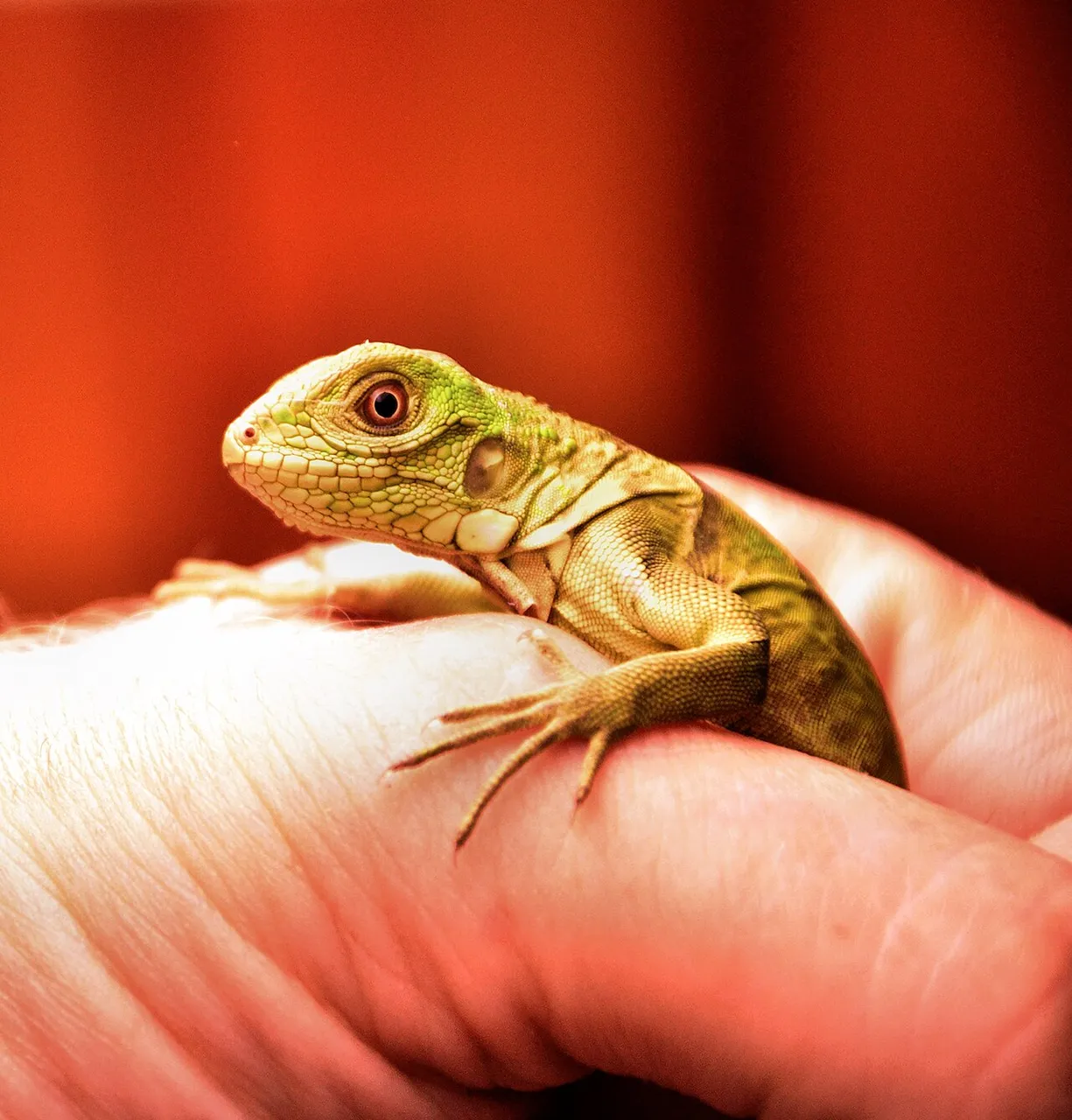
During the reptile boom of the 1990s it was one of the best-selling pet reptiles in the world, and also one of the most abandoned. Hatchlings are cheap and fit in a hand, but within a few years they are as long as a person is tall and need room-sized housing, powerful heat, UVB lighting and fresh greens every day. Mature males can also become aggressive in the breeding season, which challenges even experienced keepers.
This article covers classification, history, anatomy, regional forms and colours, behaviour, housing, diet, health, breeding, costs, what to weigh up before buying, laws and the invasive species problem. The short version: an iguana is only a good fit for someone with ample space, time and a plan that stretches beyond a decade.
2. Name and classification
HdeK · CC BY-SA 3.0
2.1. Scientific classification
The green iguana's scientific name is Iguana iguana, family Iguanidae. The family also includes the marine and land iguanas of the Galápagos, Caribbean rock iguanas such as the rhinoceros iguana, desert iguanas and spiny-tailed iguanas. Its only congener is the Lesser Antillean iguana (I. delicatissima), which is endangered partly because of hybridisation with introduced green iguanas.
Recent genetic work has shown that green iguanas across their huge range fall into several distinct lineages, and some researchers propose treating Central American or Caribbean island forms as separate species or subspecies. How widely this will be accepted is still being worked out, so the pet trade continues to use Iguana iguana for all of them.
2.2. Origin of the name
The word iguana comes from the language of the Taíno people of the Caribbean, passed into Spanish and then other languages. A scientific name that repeats the genus as the species name, like Iguana iguana, is called a tautonym and often marks the type species of a genus. In English it is the green or common iguana; in parts of Latin America it has local names such as garrobo or gallina de palo, chicken of the trees, a reference to the taste of its meat.
3. History
3.1. Iguanas in their native range
Iguanas have been eaten in Central and South America for thousands of years, both the meat and the eggs, and remain a traditional food in some areas. Where overhunting depleted populations, projects in countries such as Costa Rica and Panama tried farming iguanas for food and restocking. Such farms later became a major source of hatchlings for the global pet trade.
3.2. The pet boom and abandonment
In the 1980s and 1990s iguanas became hugely popular in the United States and Europe as exotic yet cheap pets. Estimates suggest hundreds of thousands were imported in some years, but the importance of UVB and calcium was poorly understood, and many died young of metabolic bone disease. Survivors grew too large to manage and were surrendered to shelters and reptile rescues or dumped outdoors.
Released and escaped iguanas established themselves in warm places including southern Florida, Puerto Rico, parts of Hawaii, many Caribbean islands, Singapore and Taiwan. In Florida they eat garden plants and dig burrows that undermine seawalls and canal banks. During cold snaps, news reports show chilled iguanas falling out of trees.
3.3. Iguanas in Korea
Iguanas reached Korea as the reptile hobby spread in the late 1990s and early 2000s. At the time hatchlings were sold even in supermarkets and aquarium shops, and celebrities keeping iguanas on television boosted interest. As adult size and care demands became better known, sales shifted to specialist reptile shops and demand fell far behind small reptiles such as leopard and crested geckos. Rescue groups and clubs still regularly post adult iguanas in need of new homes.
4. Body
4.1. Size and build
| Measure | Males | Females |
|---|---|---|
| Total length including tail | 1.4–1.8 m, rarely 2 m | 1.2–1.5 m |
| Snout-to-vent length | 35–45 cm | 30–40 cm |
| Weight | 5–8 kg | 3–5 kg |
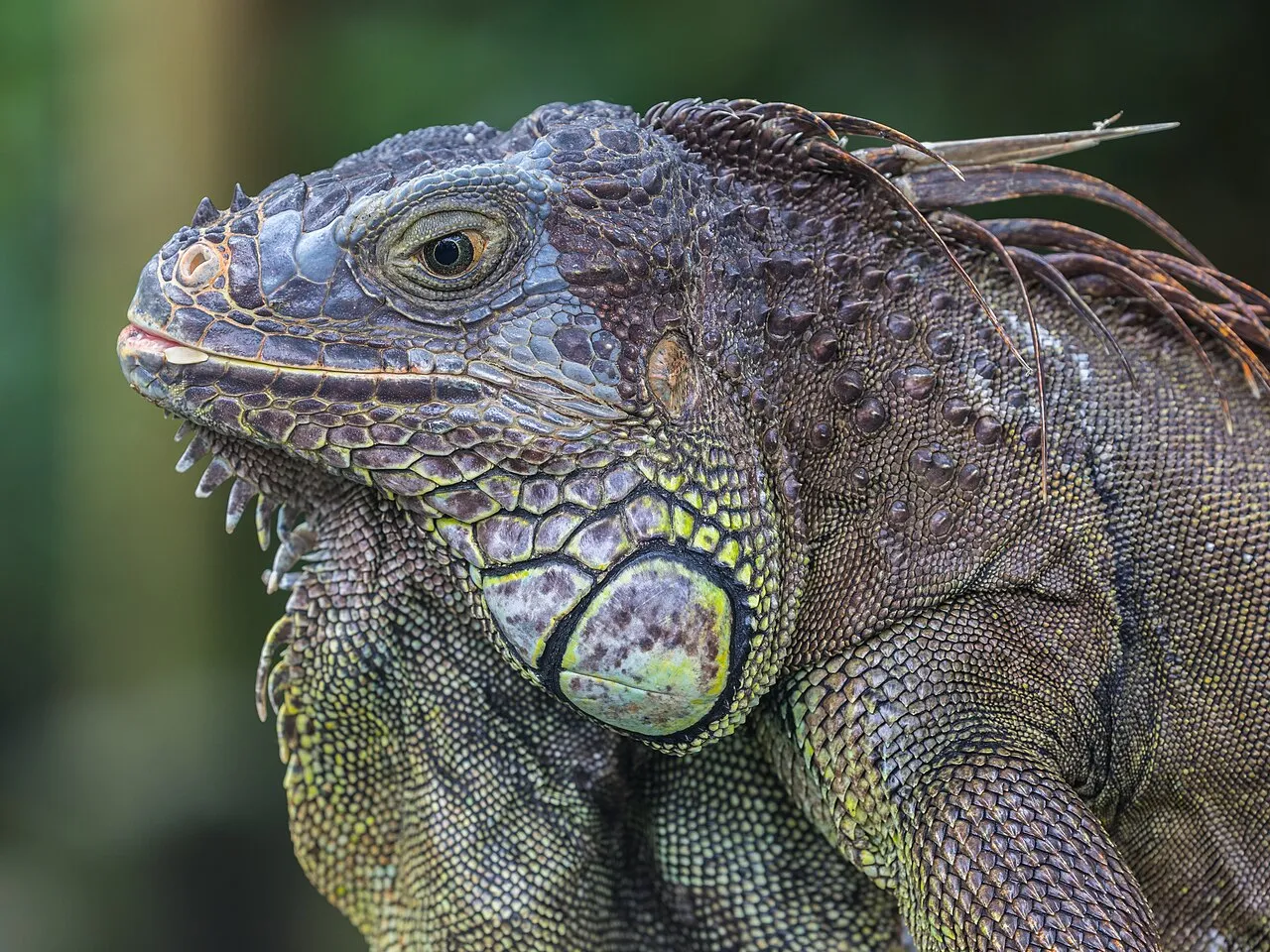
The tail makes up more than half the total length and is muscular enough to lash like a whip in defence. The legs are long and strong, with sharp claws for gripping bark. In an emergency the tail can be shed, but the regrown portion differs in colour and shape.
4.2. Crest, dewlap and senses
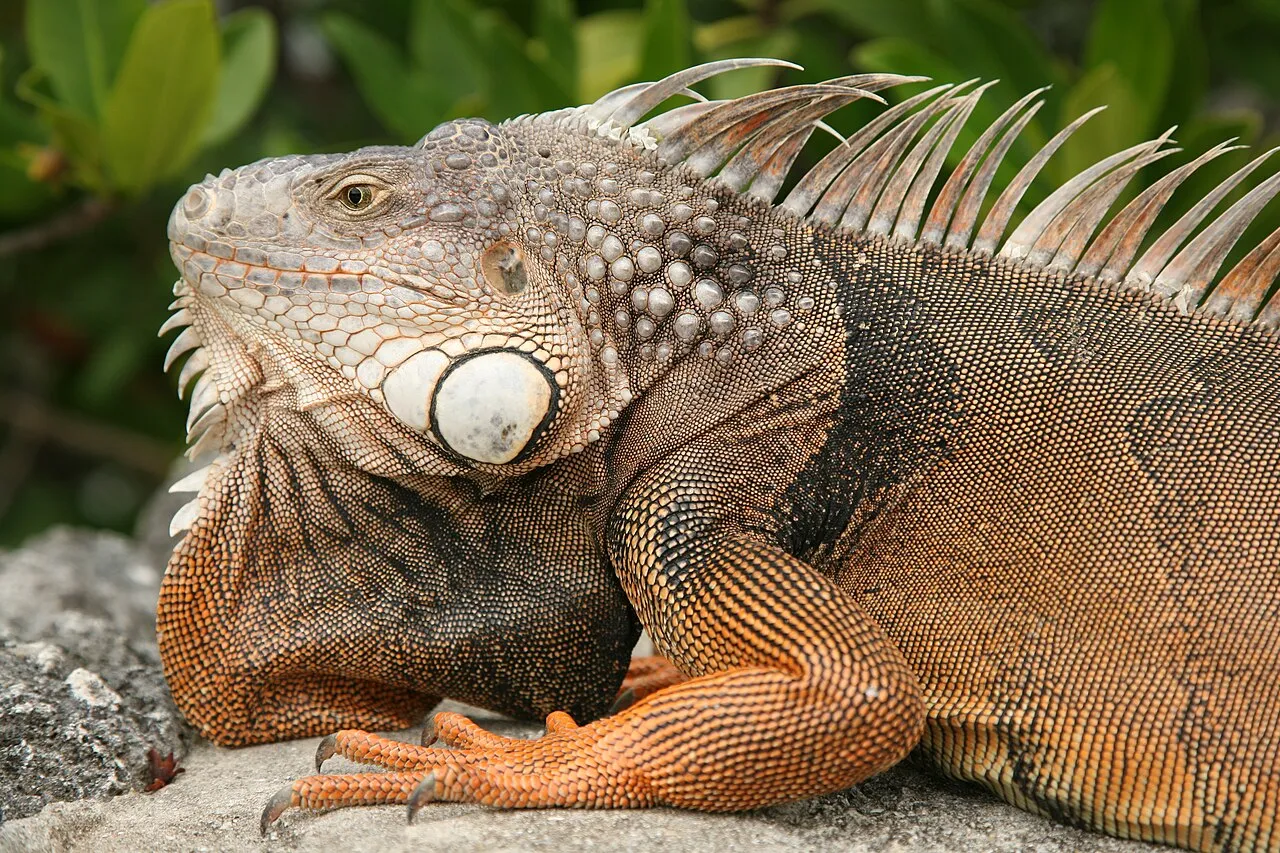
The spiny crest running from neck to tail is larger in males. The dewlap under the throat helps with temperature control and communication and is flared wide in territorial or threat displays. The big round scale on each cheek, below the eardrum, is called the subtympanic shield.
On top of the head is a pale spot called the parietal eye. It does not form images but senses changes in light, which is thought to help detect the shadows of birds overhead and regulate daily rhythms. Iguanas have good colour vision, and many respond especially well to red and orange foods.
4.3. Telling males from females
Mature males have larger heads, heavier jowls and bigger crests, dewlaps and cheek scales. The clearest difference is the row of femoral pores on the inner thighs, which are large and waxy in males. Males also have a slight bulge at the tail base where the hemipenes sit. These differences become clear only after one to two years, so hatchlings are hard to sex reliably.
5. Regional forms and colours
Despite the name, green iguanas are not always green. Hatchlings are bright lime, but adults are often grey-green, brown or orange, and breeding males can turn deep orange on the head and legs. Origin also affects colour and build.
| Name | Origin | Notes |
|---|---|---|
| Colombian / South American | Northern South America | Most common in the trade, adults grey-green to brown |
| Central American | Mexico to Panama | Often strongly orange or red, some develop small horn-like nose scales |
| Red iguana | Selectively bred | Turns strongly orange-red as an adult |
| Blue phase green iguana | Selectively bred | Bluish as juveniles, often fades with age |
| Albino and hypo | Captive-bred morphs | Reduced pigment, expensive, may be more light-sensitive |
| Axanthic and others | Captive-bred morphs | Reduced yellow pigment and other variations |
Most iguanas sold as blue iguanas are colour forms of the green iguana. The true blue iguana of Grand Cayman (Cyclura lewisi) is an entirely different, endangered species that is not part of the normal pet trade. Don't let the name confuse you.
6. Behaviour
Daniel Schwen · CC BY-SA 4.0
6.1. In the wild
Wild iguanas live high in trees near rivers and lakes. In the morning they move onto sunny branches to warm up and spend the day eating leaves, flowers and fruit. When threatened they drop straight from high branches into the water and swim away, and they are tough enough to survive falls of several metres. They swim by sweeping the tail and can stay underwater for some time.
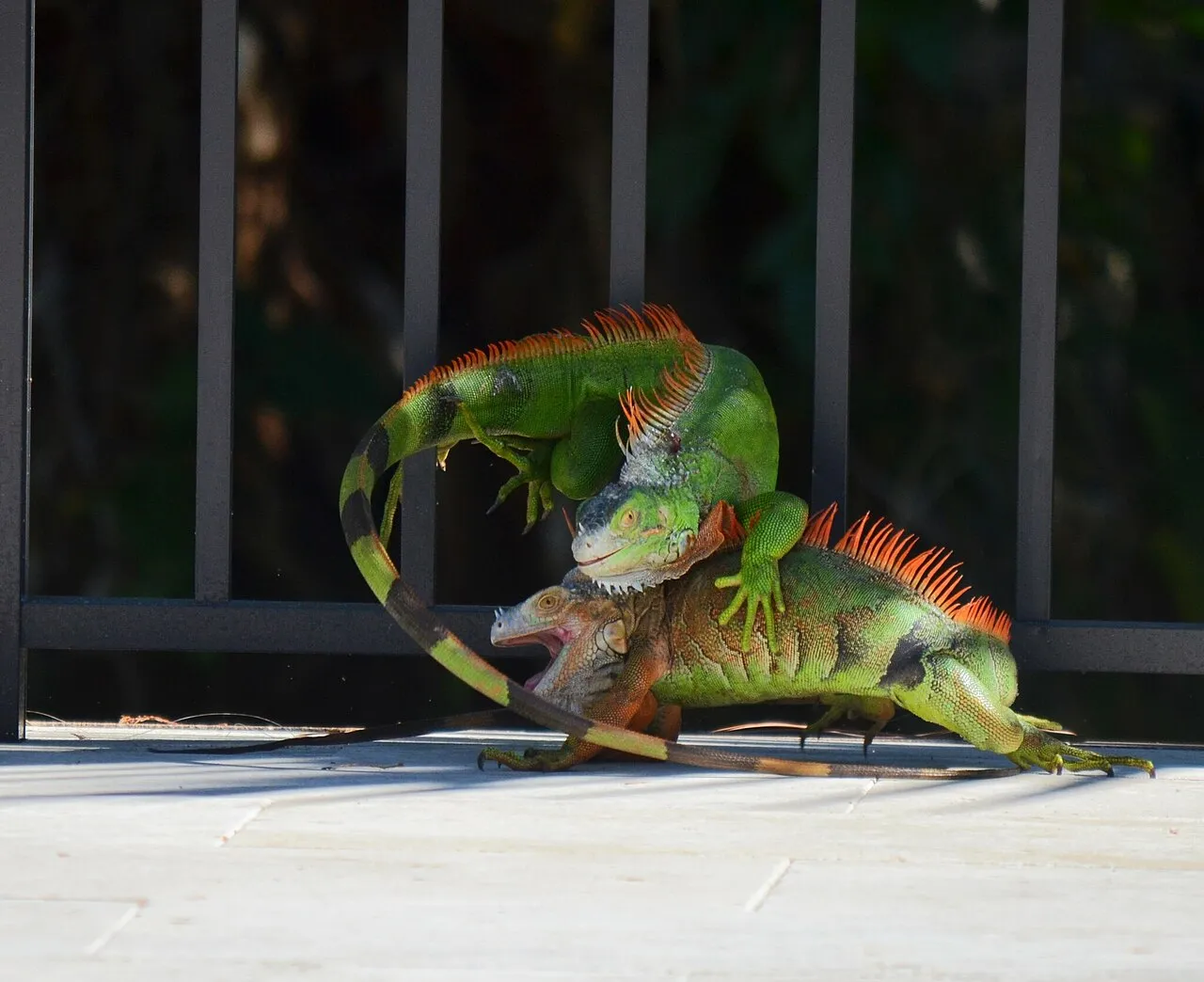
In the breeding season, males claim the tops of tall trees, bobbing their heads and chasing rivals away. Females mate within these territories and then dig burrows in sandy or earthy riverbanks to lay their eggs.
6.2. Reading body language
| Behaviour | Meaning |
|---|---|
| A few slow head bobs | Greeting or announcing presence |
| Fast, jerky head bobbing | Warning, excitement, territorial claim |
| Dewlap fully extended | Threat or territorial display |
| Body flattened sideways to look bigger | Strong threat; back off |
| Tail drawn back and cocked | About to tail-whip |
| Sneezing out fluid | Salt excretion, normal |
| Licking objects | Exploring scents |
| Eyes closed, body relaxed | Contentment, or possibly shutting out stress |
Iguanas expel excess salt through glands near the nostrils, so sneezing out fluid with white crystals is normal. Sticky discharge or noisy breathing, however, suggests a respiratory problem.
Many mature males change dramatically during the annual breeding season under the influence of hormones. A normally calm iguana may charge or bite its owner, and some fixate aggressively on particular people or even red clothing. Reduce handling at this time and wear gloves and long sleeves.
7. Life stages
Iguanas can live fifteen to twenty years or more in good conditions, but many die within a few years when husbandry is wrong.
| Stage | Age | Notes |
|---|---|---|
| Hatchling | 0–3 months | 6–8 cm body, 20–25 cm with tail, bright lime green |
| Juvenile | 3 months–1.5 years | Very rapid growth, skittish and flighty |
| Sub-adult | 1.5–3 years | Sexual maturity begins; males may show hormonal aggression |
| Adult | From 3–4 years | Over 1.2 m, growth slows, colour shifts to grey-green, brown or orange |
| Senior | After 12–15 years | Less active, more joint and kidney problems |
Hatchlings grow astonishingly fast, often doubling or tripling in length in the first year, so a starter enclosure is outgrown within months. The sub-adult stage is something like adolescence: taming is hardest and defensive reactions are most common.
8. Housing
(c) Josiah Londerée, some rights reserved (CC BY) · CC BY 4.0
8.1. Enclosure
As large tree-dwellers, iguanas need height as well as floor space. Commercial glass terrariums only work for hatchlings; adults need a custom-built enclosure or a converted room.
| Age | Minimum suggested size (L × D × H) | Notes |
|---|---|---|
| Hatchling (to 6 months) | 90 × 45 × 90 cm | Temporary |
| Juvenile (to 1.5 years) | 120 × 60 × 150 cm | |
| Adult | 180 × 90 × 180 cm or more | Bigger for large males; converting a room is common |
Fill the space with sturdy branches at least as thick as the iguana's body and several levels of shelves reaching high up, with the basking spot at the top. A large tub for full-body soaking doubles as a toilet, since many iguanas learn to defecate in water, which makes cleaning easier.
8.2. Heat, humidity and light
| Parameter | Target |
|---|---|
| Basking surface | 35–38°C, some keepers go to around 40°C |
| Daytime ambient | 27–32°C |
| Night | 24–27°C, never below 24°C |
| Humidity | 60–80% |
| UVB | High-output UVB reaching the whole body, 12 hours a day |
| Photoperiod | 12–14 hours of light, fully dark at night |
The basking area must be large enough to warm the whole body. Guard every lamp with a mesh cage and run heat through a thermostat. Iguanas often rest against hot lamps without moving away and suffer severe burns, and heat rocks cause localised burns and should not be used.
UVB is a lifeline. Without it iguanas cannot make vitamin D3, cannot absorb calcium, and develop metabolic bone disease. Use high-output tubes or metal halide UV lamps that cover the large enclosure and replace them on schedule. Supervised time in a secure outdoor cage in natural sunlight on warm days helps too, as long as shade and water are provided.
8.3. Free-roaming and safety
Some keepers give an iguana a whole room or let it roam the house. If you do, check for cables, hot appliances, open windows and loose screens, toxic houseplants such as dieffenbachia, pothos and lilies, and other pets. Dogs and cats can injure iguanas, and an iguana's tail and claws can hurt other animals. Most homes are too cool for iguanas, so long periods out of the enclosure can chill them.
- Equipment: large custom enclosure, guarded basking lamps and thermostat, high-output UVB, digital thermo-hygrometers and infrared thermometer, sturdy branches and shelves, large water tub, food dishes, calcium supplement, humidifier or misting system, protective gloves
9. Diet
Green iguanas are strict herbivores. Wild iguanas eat leaves, flowers and fruit and rely on gut microbes to ferment tough plant fibre. Feeding insects or meat was once common advice, but animal protein strains the kidneys and can cause gout and kidney failure, so it is firmly discouraged today.
| Group | Share | Examples |
|---|---|---|
| Calcium-rich greens | 60–70% | Dandelion, collards, mustard greens, turnip greens, bok choy, kale, chicory, endive |
| Other vegetables | 20–30% | Butternut squash, courgette, green beans, peppers, grated carrot and sweet potato |
| Fruit and flowers | 10% or less | Figs, papaya, mango, berries, hibiscus and dandelion flowers |
Prepare a fresh, finely chopped or grated salad every day. The calcium-to-phosphorus balance matters; vegetables with more phosphorus than calcium weaken bones if fed alone. Dust the salad with calcium at nearly every meal and with a multivitamin about once a week.
Spinach, chard and other high-oxalate greens block calcium absorption and should be rare treats, not staples. Cabbage, broccoli and other brassicas can affect the thyroid in large amounts, so use them only as part of the mix. Never feed avocado, onion, rhubarb, mushrooms, insects, meat, dog or cat food, or dairy. Iguanas need to be warm to digest, so feed after they have basked in the morning.
10. Health
Most iguana illness traces back to husbandry. Have a new iguana checked by an exotic vet, including a faecal test, and arrange yearly check-ups after that.
| Disease | Cause | Signs | Prevention and response |
|---|---|---|---|
| Metabolic bone disease | Lack of UVB or calcium, excess phosphorus | Soft, swollen jaw, swollen limbs, tremors, fractures | Manage UVB and calcium, see a vet at once |
| Kidney failure and gout | Animal protein, chronic dehydration | Poor appetite, lethargy, swollen joints, heavy drinking | Plant-only diet, hydration, blood tests |
| Egg binding | No nest site, low calcium, dehydration | Swollen belly, restless digging that stops, straining | Provide a nest box, emergency vet |
| Burns | Unguarded lamps, heat rocks | Discoloured skin, blisters, necrosis | Guards and thermostats |
| Tail-tip necrosis | Injury, retained shed, poor circulation | Tail tip turns black and dry | Early vet care, amputation if needed |
| Respiratory infection | Low temperature, wrong humidity | Discharge, gaping, noisy breathing | Correct temperatures, vet |
| Parasites | Wild or farm origin | Diarrhoea, weight loss | Faecal test, deworming |
| Retained shed | Low humidity | Skin stuck on toes, crest or tail | Raise humidity, soaks |
See an exotic vet right away for a swollen or soft lower jaw, limping or tremors, more than a week without eating plus weight loss, a female who shows nesting behaviour but cannot lay for days, or blackening of the tail or toes.
Iguanas can carry salmonella. Take extra care in homes with children under five, pregnant women, older people or anyone immunocompromised, and always wash your hands after handling or cleaning. Bites, tail whips and claw scratches from adults can also be serious, and deep wounds may need medical treatment.
11. Breeding
Green iguanas lay eggs. Many mature females produce infertile clutches every year even without a male, so anyone keeping a female must plan for egg-laying. As the time approaches, females refuse food, swell visibly and roam the enclosure trying to dig.
Provide a nest box large enough for her whole body, filled at least 40 cm deep with a moist mix of soil and sand. Without a suitable site she may retain the eggs, a condition called egg binding that can become a surgical emergency. Clutches usually contain 20 to 50 eggs, sometimes more in large females.
Fertile eggs hatch after two to three months in an incubator at around 30°C. Yet baby iguanas already flood shops and rescues, and finding responsible homes for dozens of hatchlings is almost impossible, so most vets and rescue organisations advise against breeding at home. If repeated egg-laying is harming a female's health, spaying may be discussed with a vet.
12. Costs
With iguanas, space, equipment and daily food cost far more than the animal itself. The figures below exclude the purchase price.
| Item | Estimated cost (KRW) | Notes |
|---|---|---|
| Temporary hatchling enclosure | 100,000–250,000 | Outgrown within a year |
| Custom adult enclosure or room conversion | 500,000–1,500,000+ | Varies hugely with size and materials |
| Basking lamps, guards, thermostat | 100,000–250,000 | |
| High-output UVB | 100,000–300,000 | Replaced regularly |
| Humidifier, thermo-hygrometers, infrared thermometer | 50,000–150,000 | |
| Branches, shelves, water tub | 50,000–150,000 | |
| First check-up and faecal test | 50,000–150,000 | |
| Total setup | About 1,000,000–2,500,000 | |
| Monthly greens and fruit | 40,000–80,000 | Fresh leafy greens daily |
| Monthly electricity | 30,000–60,000 | Large lamps, winter heating |
| Monthly supplements and supplies | 10,000–20,000 | |
| Monthly total | About 80,000–150,000 | |
| Yearly UVB replacement | 50,000–200,000 | |
| Yearly check-up and bloodwork | 100,000–300,000 |
Major treatment for metabolic bone disease, egg-binding surgery or burns can cost from several hundred thousand to over a million won. Few clinics see iguanas in some regions, so find one in advance and keep an emergency fund.
13. Before you get one
- Can you give a whole room's worth of space to an animal that will exceed 1.5 m within a few years?
- Can you buy and prepare fresh greens every day?
- Can you cope with breeding-season aggression, tail whips and claws?
- Will you keep it for fifteen to twenty years through moves, marriage, children and other life changes?
- Is there a vet nearby who treats iguanas?
If any answer is uncertain, consider a different reptile, or adopt an adult iguana from a rescue or club rather than buying a hatchling. With an adult you already know the size and temperament, which makes things more predictable.
When choosing, look for clear eyes, a well-filled body, a firm jaw and legs, and intact tail tip and toes. A thin iguana with a soft jaw, bowed legs or tremors may have metabolic bone disease. Ask about its origin, whether farm-raised or locally bred, and its diet so far.
14. Laws
Green iguanas are listed in CITES Appendix II, so international trade requires export permits from the country of origin and the relevant import procedures. Korea's wildlife act imposes duties for internationally endangered species such as import permits, reports of transfer or death, and facility registration for certain species; which of these apply to iguanas depends on the listing, the enforcement rules and when they were last amended. Ask for legal import and transfer paperwork when you buy, and confirm current requirements with the Ministry of Environment or a regional environmental office.
Korea is also phasing in licensing for wildlife sellers and importers and a system specifying which species may be imported and sold, which may affect private sales too.
Abroad, rules are strictest where iguanas have become invasive. Florida, for example, has classed green iguanas as a prohibited invasive species and restricted private keeping and sale. Wherever you are, never release an iguana.
15. Iguanas in culture
With their dinosaur-like looks, iguanas are a go-to animal for lending a primeval or exotic feel to films and adverts. Early monster films sometimes glued crests and horns onto iguanas and similar lizards and filmed them up close to pass them off as dinosaurs. Tourist brochures for tropical resorts routinely feature iguanas basking on beach rocks.
Iguanas appear in the art of ancient Central and South American cultures, and iguana dishes remain traditional fare in parts of Mexico and Central America. In Florida, cold-morning warnings about iguanas falling from trees have become an annual news story. In Korea, variety shows and documentaries featuring iguana owners have sparked waves of interest.
16. Trivia
- Iguanas are famously tough when falling, with reports of them surviving drops of nearly 15 m from treetops unharmed.
- Hatchlings are thought to eat adult droppings to acquire the gut microbes they need to digest plants.
- Thanks to the parietal eye, an iguana can react to a shadow passing overhead even with its eyes closed.
- Iguanas recognise individual people and may be friendly to one person and hostile to another.
- The marine iguana of the Galápagos, the only lizard that feeds on seaweed in the sea, belongs to the same family.
- Iguanas are strong swimmers, tucking their legs against the body and propelling themselves with the tail.
Health notes are general information. If something seems wrong, contact a vet who treats this species.
FAQ
How big do iguanas get?
Usually 1.2–1.8 m including the tail, with big males nearing 2 m, and 4–8 kg in weight.
Why does my iguana bob its head?
Head bobs can mean territory, greeting or warning. Fast, jerky bobbing with the dewlap extended usually signals agitation.
My female laid eggs without a male.
Mature females lay infertile eggs. Without a suitable nest box of damp soil they can become egg-bound, so provide one and see a vet if she looks gravid but cannot lay.
Photo credits
Photos are freely licensed images from Wikimedia Commons. Authors and licenses are listed below.
- Iguana iguana (male resting).jpg — Hans Hillewaert · CC BY-SA 4.0
- Baby Iguana in Curacao.jpg — HdeK · CC BY-SA 3.0
- Close-up photograph of an Iguana iguana.jpg — Basile Morin · CC BY-SA 4.0
- FL Iguana.jpg — Daniel Schwen · CC BY-SA 4.0
- Green Iguana, Parkland, FL, USA imported from iNaturalist photo 254713151.jpg — (c) Josiah Londerée, some rights reserved (CC BY) · CC BY 4.0