TailVille
At a glance
Rough ranges for supplies, food and electricity in Korea (USD is approximate). Purchase or adoption fees are not included.
Adults ready for a long-term commitment who can guarantee a cool home in summer and enjoy a playful but hands-off pet.
Homes without reliable cooling, or families wanting a pet young children can cuddle.
1. Overview
Chinchillas are rodents from the high, dry, rocky slopes of the Andes in South America. Their fur is among the densest of any land mammal, so soft that sinking your fingers into it feels more like touching a cloud than an animal. Add round ears, large dark eyes, a bushy tail and powerful hind legs that can launch them more than a metre straight up, and you have one of the most distinctive small pets around.
At 400–800 g they are mid-sized as rodents go, but they are remarkably long-lived: 10–15 years is normal in captivity, and some pass 20. That puts a chinchilla closer to a dog or cat in commitment than to a hamster. They are most active at dusk and dawn, naturally cautious, yet many become confident enough to hop onto a lap for a treat or follow their person around a chinchilla-proofed room.
Two words shape chinchilla care: cool and dry. That thick coat traps heat, so warm weather is genuinely dangerous, and wet fur dries so slowly that it invites skin infections. Instead of water baths, chinchillas roll in fine dust. This article walks through classification, history, anatomy, colours, behaviour, housing, diet, health, breeding, costs, law and culture.
2. Name and classification
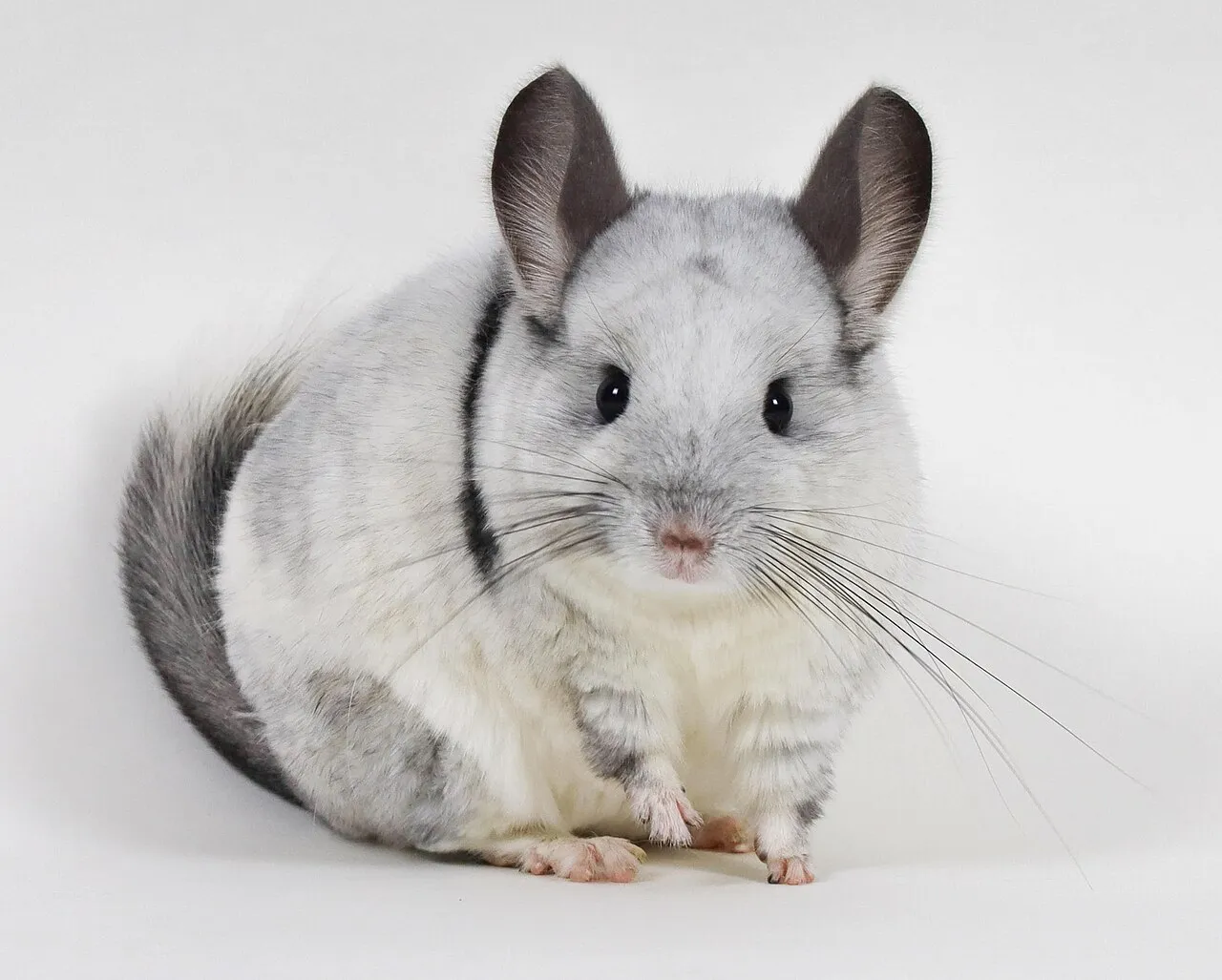
Maxunbanned · CC BY-SA 4.0
2.1. Taxonomy
Chinchillas belong to the rodent suborder Hystricomorpha, the same broad group as guinea pigs, degus and porcupines. Their family, Chinchillidae, also includes the viscachas.
| Rank | Name |
|---|---|
| Order | Rodentia |
| Family | Chinchillidae |
| Genus | Chinchilla |
| Main ancestor of pets | Long-tailed chinchilla, Chinchilla lanigera |
| Other wild species | Short-tailed chinchilla, Chinchilla chinchilla |
| Close relatives | Mountain and plains viscachas |
Pet chinchillas are domesticated animals descended mainly from the long-tailed species and selectively bred for decades, first for fur and later as companions. Some short-tailed blood may have entered the population, but how much is unclear.
2.2. Origin of the name
The name comes through Spanish and is most often linked to the Chincha people of the Peruvian coast, who are said to have worn chinchilla fur; Spanish speakers supposedly called the animal little Chincha. That etymology is widely repeated but not firmly proven. The species name lanigera is Latin for wool-bearing, a fitting nod to the coat. The word has since been borrowed for a silver-tipped Persian cat colour, a rabbit breed with similar fur, and even a town in Queensland, Australia.
3. History
3.1. The fur trade and near extinction
Andean peoples prized chinchilla fur long before Europeans arrived. In the nineteenth century, however, chinchilla pelts became a luxury fashion item in Europe and North America, and hunting exploded. A single coat could take dozens to over a hundred animals, millions were killed, and by the early twentieth century wild populations had nearly vanished. South American governments banned hunting and export, but wild chinchillas remain scarce to this day.
3.2. Domestication and the pet trade
The modern pet chinchilla story usually starts in 1923, when American mining engineer Mathias F. Chapman obtained permission to bring around a dozen wild chinchillas from Chile to California. He is said to have acclimatised them slowly on the way down from the mountains, and his ranch stock became the foundation of most chinchillas alive today. Early breeding focused on fur farming, but from the mid-twentieth century the animals' gentle nature and long life made them increasingly popular as pets in North America and Europe.
Chinchillas reached Korea through exotic pet shops in the 2000s and gained wider attention in the 2010s, when videos of dust baths and spectacular leaps spread on social media. Korean summers, though, are hot and humid, and many first-time owners discover that keeping a chinchilla means running the air conditioner for much of the summer.
4. Body
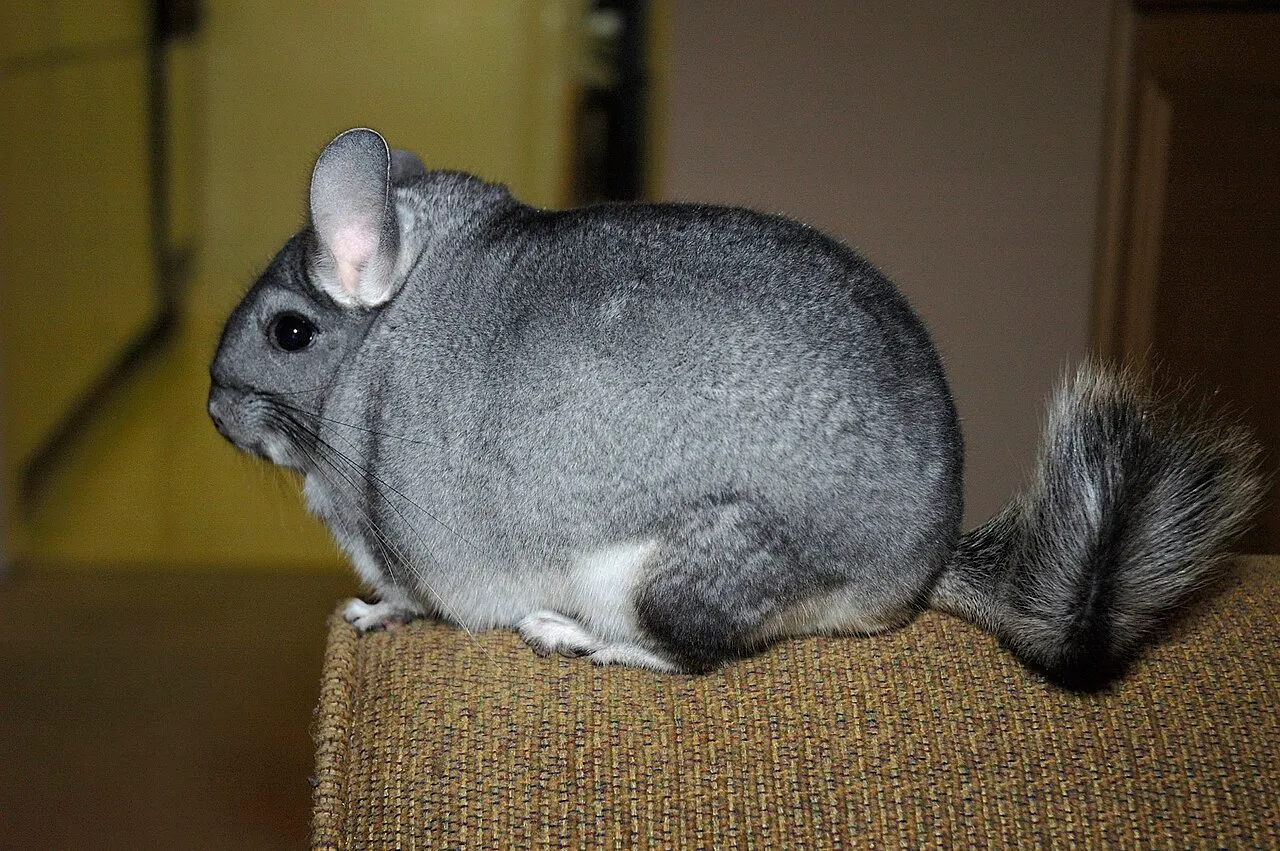
Trurl66 · Public domain
4.1. Size and skeleton
Chinchillas measure 25–35 cm in the body with a tail of roughly 13–15 cm, and usually weigh 400–800 g, females often a little more than males. Much of the apparent bulk is fur; press it down and the body underneath is surprisingly slim. The hind legs are much longer and stronger than the forelegs, perfect for bounding from rock to rock, and the front paws are dexterous enough to hold food like a squirrel.
Their rib cage is fairly flexible, which is thought to help them squeeze into crevices, but it also means a tight grip can injure them. Lift a chinchilla with one hand under the chest and the other supporting the hindquarters.
4.2. Fur
The secret of the coat is that dozens of hairs grow from each follicle. Humans usually manage one or two per follicle; figures of 50 to 80 are often quoted for chinchillas. The result is excellent insulation against mountain cold and a coat so thick that fleas struggle to reach the skin.
The downside is that wet fur stays wet. Water soaks deep into the coat and dries very slowly, and damp skin is a breeding ground for fungi. Chinchillas also have a defence called fur slip: if grabbed roughly or caught by a predator, they release a patch of fur and escape. The hair grows back over weeks to months, but the bald patch is obvious for a while.
4.3. Teeth and senses
All of a chinchilla's teeth, incisors and cheek teeth alike, are open-rooted and grow throughout life, reportedly several centimetres a year. Long hours spent chewing tough hay keep them worn down. Healthy adult incisors are a deep orange; pale or white incisors can indicate a nutritional problem.
The large, thin ears catch sound well and also shed heat through their blood vessels. Bright red ears on a warm day are a sign the animal is already struggling to cool down. Whiskers are as long as the body is wide and help measure gaps in the dark. The eyes are excellent at spotting movement in dim light but poor at close range straight ahead, so a hand thrust suddenly toward the face is startling.
4.4. Sexing
Female chinchillas have a raised genital cone just in front of the anus that is easy to mistake for a penis, which confuses many new owners. The reliable clue is distance: in males there is a clear gap between the genitals and the anus, while in females the two almost touch. Males have no obvious external scrotum, so ask a breeder or vet to confirm if in doubt.
5. Colours
There are no body-type breeds of chinchilla. Instead, keepers distinguish colour mutations that have been fixed during decades of captive breeding. The wild type is the standard grey, blue-grey above with a white belly.
| Colour | Appearance | Genetics note |
|---|---|---|
| Standard grey | Blue-grey back, white belly | Wild type, most common |
| Black velvet | Deep black back and face, white belly | Pairing two velvets is avoided because of a suspected lethal factor |
| Beige | Pale tan to cream, pinkish ears | Dominant |
| White (Wilson white and others) | White, sometimes with grey patches | Pairing two whites is avoided because of a lethal factor |
| Pink white | White fur, pink ears, red eyes | White combined with beige |
| Ebony | Dark charcoal extending onto the belly | Graded from medium to extra dark |
| Violet | Lavender-tinged grey | Recessive |
| Sapphire | Grey with a blue cast | Recessive |
| Mosaic | White with irregular grey markings | White family |
Some white and velvet genes are believed to be lethal when an embryo inherits two copies, so experienced breeders never pair white to white or velvet to velvet. There is no good evidence that colour affects personality or lifespan. Choose on health and temperament first.
6. Behaviour
6.1. In the wild
Wild chinchillas live in colonies of dozens to hundreds on dry, rocky Andean slopes at roughly 3,000–5,000 m. They rest in crevices during the day and feed at dusk and dawn on grasses, mosses, succulents and the bark of small shrubs. Foxes and birds of prey are constant threats, so they stay alert, and one alarm call sends the whole colony diving for cover. Life in thin, dry mountain air with cold nights has left them well equipped for cold and dryness and very poorly equipped for heat and humidity.
6.2. Behaviour at home
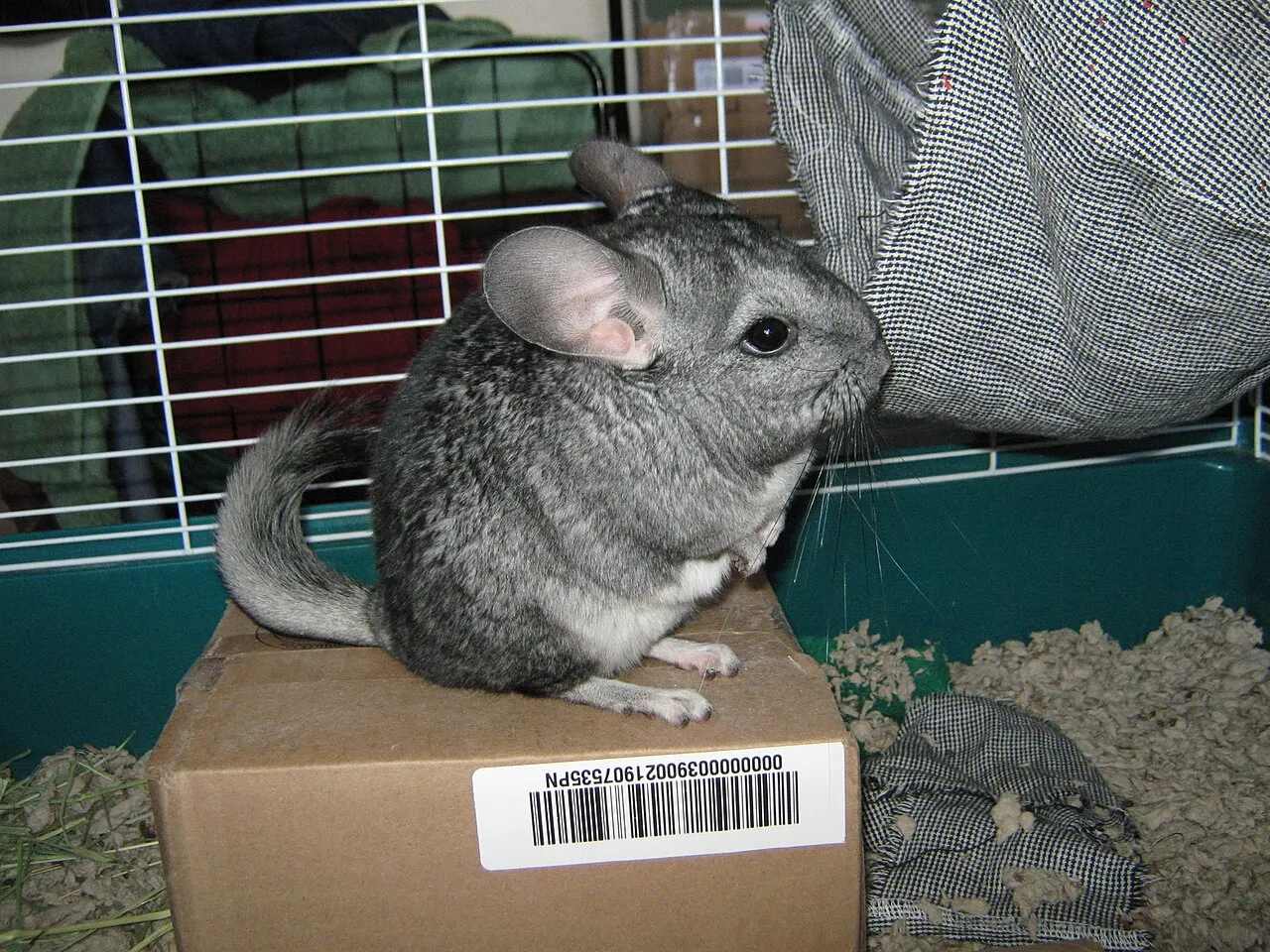
Pet chinchillas also sleep by day and wake in the evening. They bounce between shelves, kick off walls to change direction, a move owners call wall surfing, and when happy they leap and twist in mid-air, a display known as popcorning. Their urge to chew is relentless, and plastic, cables, wallpaper and skirting boards are all fair game.
Dust bathing is essential. Offer a container of fine chinchilla bathing dust and the animal will roll, flip and wriggle until oil and moisture are worked out of the coat. Most keepers provide it two to four times a week for ten to fifteen minutes, then remove it. Leaving dust in all day can irritate the eyes and the bath often turns into a toilet.
Chinchillas are social. Same-sex pairs raised together, or a neutered male with a female, often live happily. Introducing adults is riskier and can lead to serious fights, so place cages side by side for a few weeks to swap scents before short, supervised meetings on neutral ground. A single chinchilla can thrive too if its person spends real time with it every day.
6.3. Reading the signals
- Short barks or squeaks: alarm at an unfamiliar sound or movement.
- Soft cooing or chirping: contentment, or a friendly approach to another chinchilla.
- Rapid teeth chattering: can mean either contentment or annoyance depending on context.
- Standing on the hind legs and spraying urine: mostly females, a defensive warning.
- Ears flattened, body hunched: anxious or possibly unwell.
- Popcorning and wall surfing: high spirits.
- Gentle nibbling on fingers: often grooming or exploring; a hard bite means stop.
Chinchillas mask illness. A normally lively animal that sits hunched in a corner, has a scruffy coat or stops popcorning should be watched closely and taken to a vet if it continues.
7. Life stages
Chinchillas are unusually long-lived for rodents, which also means they mature slowly and age late.
| Stage | Age | What happens |
|---|---|---|
| Newborn kit | 0–1 week | Born fully furred with eyes open, walking within hours |
| Nursing | 1–8 weeks | Nibbles hay and pellets alongside milk |
| Weaning | 8–12 weeks | Ready to leave the mother; separate by sex |
| Juvenile | 3–8 months | Sexual maturity, peak curiosity and energy |
| Adult | 1–8 years | Settled weight and temperament; teeth need ongoing attention |
| Senior | 10 years on | Weight loss, more dental problems, cataracts, stiff joints |
Typical lifespan is 10–15 years, and well-kept chinchillas have reached nearly 20. Seniors are prone to injury from jumping off high ledges, so lower the shelf spacing and add ramps. Tooth wear becomes less efficient with age and malocclusion more common, which makes dental checks every six to twelve months and regular weigh-ins especially valuable.
8. Housing
8.1. The cage
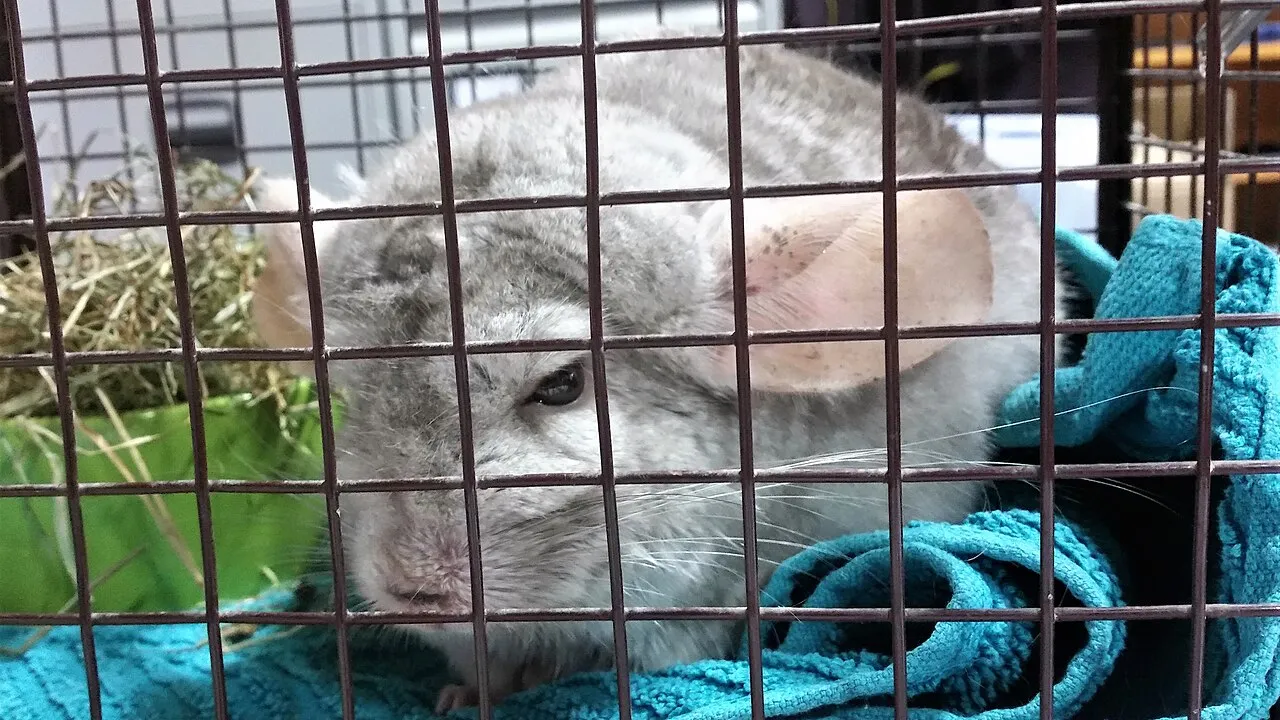
Chinchillas jump vertically, so height matters as much as floor space. For one animal, aim for at least 90 × 60 cm of floor and 120 cm of height in a multi-level cage; give a pair more. Wooden ledges staggered at different heights let them bounce up and down. Bar spacing of 2.5 cm or less is the usual guideline, and 1.3 cm or less if there are kits.
Wire floors and shelves cause sore, calloused feet, so cover them with wood or fleece. Avoid plastic shelves and toys, which get chewed and swallowed. Kiln-dried pine, apple and willow are common choices for safe wood. Some chinchillas chew fabric hammocks, so inspect them regularly.
8.2. Temperature, humidity and placement
Temperature is the core of chinchilla care. The comfort zone is about 15–21 °C. Above 24 °C they start to struggle, and from roughly 25–27 °C the risk of heatstroke climbs fast, especially with humidity above about 50%. In hot climates that means air conditioning set around 22 °C through the summer, left running while you are out. Prepare for power cuts with frozen water bottles and a cool slab of marble, granite or ceramic tile.
In winter an ordinary heated home is fine, and extra heating is rarely needed unless the room drops below about 10 °C. Keep the cage out of direct sunlight, away from damp outside walls and windows, and away from loud speakers or televisions. A thermo-hygrometer next to the cage, checked often, is one of the best investments you can make.
8.3. Equipment and playtime
- Multi-level wire cage with several wooden ledges
- Hides: wooden houses or tunnels, at least one per animal
- Hay rack to keep hay off the floor
- Heavy ceramic pellet bowl and a water bottle
- Chinchilla dust and a covered bath house
- Bedding: aspen shavings, paper bedding or fleece liners
- Chews: apple sticks, pumice, untreated wooden blocks
- Wheel: solid metal, at least 38 cm across; small wheels bend the spine
- Thermo-hygrometer, scale, carrier and a cooling tile for summer
Thirty minutes to an hour a day in a chinchilla-proofed room makes a big difference to fitness and mood. Cover or remove cables, block gaps behind furniture and clear away plants and medicines. A cardboard box on the floor gives a nervous chinchilla somewhere to retreat while it explores.
9. Diet
9.1. Hay and pellets
Hay should make up more than 80% of what a chinchilla eats. Offer unlimited timothy, orchard grass or brome hay and refresh it at least once a day. Alfalfa is rich in calcium and protein, useful for growing kits and pregnant or nursing females, but as a staple for adults it is often linked to bladder stones, so most keepers mix in only a little.
Limit chinchilla pellets to one to two tablespoons, about 20–30 g, per day. Avoid colourful muesli mixes with seeds, dried fruit and dyes; chinchillas pick out the tasty bits and end up with an unbalanced diet. Switch foods gradually over one to two weeks to protect the gut. Give water in a bottle, change it daily and check the nozzle is flowing.
9.2. Treats
A chinchilla's gut is built for coarse mountain vegetation and reacts badly to moisture and sugar, so fresh fruit and vegetables are generally left out altogether. Suitable treats include a dried rose hip or two, a pinch of dried hibiscus or chamomile flowers, apple or willow sticks and a few plain rolled oats. Keep it to one or two small treats a day. Hand-feeding builds trust, but every extra treat means less hay eaten, which hurts both teeth and digestion.
9.3. Foods to avoid
- Watery produce such as watermelon, lettuce and cucumber: diarrhoea and bloat
- Sugary dried fruit like raisins, banana chips and dried mango
- Nuts, sunflower seeds and peanuts: too fatty
- Chocolate, crisps, bread and other human food
- Dairy and meat
- Branches from stone-fruit trees such as cherry, apricot and peach, which may contain toxic compounds
- Cedar and strongly scented pine shavings
Check that any new treat or wood is chinchilla-safe before offering it, and start with a tiny amount.
10. Health
Chinchillas look robust, but their teeth, gut and heat tolerance are all vulnerable. As prey animals they hide sickness, so knowing your animal's normal habits is the best early warning system you have. The table below is a guide only; see an exotic vet who treats chinchillas whenever something seems wrong.
10.1. Common conditions
| Condition | Cause | Signs | Prevention or response |
|---|---|---|---|
| Malocclusion | Too little hay, genetics, age | Drooling and a wet chin, eating less, watery eyes, weight loss | Unlimited hay, regular dental checks |
| GI stasis | Low fibre, stress, pain | Small or no droppings, poor appetite, hunching | Emergency vet visit, hay-based diet |
| Bloat | Watery or sugary food, abrupt diet change | Tight, swollen belly, pain, lethargy | Emergency vet visit, limit treats |
| Heatstroke | Heat above about 25 °C, humidity | Red ears, panting, limpness | Air conditioning, move somewhere cool and call a vet |
| Ringworm | Fungus in damp conditions | Hair loss around nose and ears, scaling | Control humidity, antifungal treatment |
| Fur ring | Hair wrapped around a male's penis | Genital licking, straining to urinate, protruding penis | Check males regularly, see a vet |
| Giardia and other gut parasites | Contaminated water or food | Soft droppings, weight loss | Faecal tests, clean water bottles |
| Conjunctivitis | Dust irritation, bacteria, tooth-root problems | Tearing, discharge, half-closed eye | Limit bath time, vet check |
| Fractures | Wire floors, falls, poor handling | Holding a leg up | Safe ledge layout, correct handling |
Malocclusion is the most common and most stubborn problem. It often cannot be seen from the front teeth alone, because the roots of the cheek teeth may grow down into the jaw or up toward the eyes, so X-rays are frequently needed. Once established it usually needs lifelong management, which is why plenty of hay from a young age matters so much.
10.2. When to see a vet
- Eating little or no hay and pellets for more than about 12 hours
- Far fewer droppings, or droppings that are small and thin
- A wet chin or wet fur on the front paws
- A hard, swollen or tender belly
- Red ears, fast breathing and limpness
- Persistent tears or pus from one eye
- Limping or no longer jumping to ledges
When a chinchilla's gut slows down, its condition can collapse within hours. Not eating is reason enough to call a vet the same day; do not wait until tomorrow.
11. Breeding
Female chinchillas can breed from about eight months of age, though waiting until they are fully grown is wiser. Gestation is unusually long for a rodent at roughly 111 days, and a typical litter is one to three kits, most often two. The kits arrive fully furred with their eyes open, walk within hours and start nibbling hay at about a week old. Weaning takes place at six to eight weeks, and young should be separated by sex by around twelve weeks. Females come back into season right after giving birth, so a male left in the cage can make her pregnant again immediately.
Breeding is harder than it looks. Difficult births with large kits, poor milk supply and mastitis all happen, and an owner may find themselves hand-feeding kits every two hours. Pairing carriers of lethal colour genes such as white or velvet can cause losses or sick babies, and breeding animals with unknown dental history risks passing on malocclusion.
Because chinchillas live 10–15 years, every kit you produce needs a home prepared to care for it for well over a decade. If you cannot promise that, keep same-sex pairs or have the male neutered.
12. Costs
Figures below are rough Korean prices, excluding the purchase price, which varies with colour and lineage. Costs elsewhere will differ, but the balance of spending is similar.
| Item | Approximate cost (KRW) | Notes |
|---|---|---|
| Multi-level cage and wooden ledges | 200,000–400,000 | 120 cm tall or more |
| Hides, hay rack, bowl, bottle | 40,000–80,000 | Wood and ceramic |
| Bath house and first dust | 20,000–40,000 | |
| Wheel, 38 cm or larger | 60,000–150,000 | Metal, optional |
| Cooling tile, thermo-hygrometer, carrier | 40,000–80,000 | |
| First vet check | 30,000–80,000 | Including a dental look |
| Starting total | about 400,000–800,000 | |
| Monthly hay, pellets, dust and bedding | 40,000–90,000 | Hay is the big item |
| Summer air conditioning | can add tens of thousands a month | Depends on the home |
| Annual check-ups | 50,000–150,000 | More with dental work |
Dental care is the largest medical expense. Trimming the cheek teeth under anaesthesia can cost hundreds of thousands of won per session, and a chinchilla with malocclusion may need it every few months. Plan for veterinary costs over a decade or more.
13. Before you get one
- Summer plan: before anything else, make sure you can keep a room around 22 °C through the hottest months.
- Time: chinchillas come alive in the evening and need daily out-of-cage exercise and company.
- Lifespan: think about moves, relationships, children and jobs over the next 10–15 years.
- Dust: bathing dust drifts around the room, which matters if anyone at home has asthma or dust allergies.
- Chewing: accept that cables and furniture will be at risk.
- Vet access: confirm there is an exotic vet nearby who can do chinchilla dental work.
- Seller: choose one who can tell you about the parents' teeth, birth date, sex and the food used. Avoid kits younger than about 10–12 weeks.
- Healthy animal: clear eyes without crust, a dry chin and dry front paws, even fur with no bald patches, and firm, long droppings.
For the first two weeks keep the same hay and pellets the animal is used to. Move slowly around the cage, rest a treat on your open palm and let the chinchilla come to you.
14. Laws
Wild chinchillas are listed on CITES Appendix I, the strictest level of protection under the international wildlife trade convention. The listing carries a note excluding the domesticated form, so captive-bred pet chinchillas are not covered and in most countries need no special permit. Owners typically do not have to register them either.
Things change when animals cross borders. Taking a chinchilla abroad or importing one can trigger the destination country's import and quarantine rules, and you may be asked for evidence that the animal is domesticated stock. Local rules on exotic pets also differ by country, state and city. In South Korea, licensing for businesses that sell or import wild animals was tightened from December 2025, so buyers there should check the current position with the environment ministry. Wherever you are, cruelty and abandonment are offences under animal welfare law.
15. Chinchillas in culture
The word chinchilla is often used for a colour as much as an animal. Silver-tipped Persian cats are called chinchilla silvers, and there are chinchilla rabbits, both named after the grey and white ticking of chinchilla fur.
In games, the Pokémon Minccino is widely seen as chinchilla-inspired, and its obsession with cleaning neatly echoes the real animal's fastidious grooming. On video platforms, clips of chinchillas twisting and flipping in their dust baths have been reliably popular for years and are how many people first meet the species.
Chinchilla fur also features in conservation history. The fact that one of the world's most expensive furs drove a species to the brink is a standard example in discussions of fashion and wildlife, and it is part of why fur farming of chinchillas has faced growing criticism and bans in some countries.
16. Trivia
- Chinchillas have very few sweat glands and cannot cool off by sweating. Their big ears are the main radiators.
- The coat is often said to be too dense for fleas, which reflects its thickness, but it does not make them immune to parasites.
- Their droppings are dry pellets slightly larger than a grain of rice and fairly odourless, though urine can smell strong if the cage is not cleaned.
- Like rabbits, chinchillas eat a special soft dropping straight from the body to absorb vitamins made in the gut. It is normal.
- Excited individuals can leap close to 1.5 m, so low-roofed carriers can lead to bumped heads.
- Grabbing a handful of fur pulls it out easily. Most chinchillas prefer gentle scratches under the chin and behind the ears.
- No baths, but plenty of drinking water: good hydration is important for gut health.
Health notes are general information. If something seems wrong, contact a vet who treats this species.
FAQ
Should chinchillas be kept in pairs?
They live in colonies in the wild, so a compatible same-sex pair often does well. Adults can fight when introduced, however, so littermates or a slow side-by-side introduction across a cage divider is the safest route.
Can I keep a chinchilla without air conditioning?
Not where summers regularly exceed about 25°C. Fans only move warm air and do little to cool a chinchilla, which has no effective way to shed heat through its thick coat.
Why do chinchillas need dust baths?
The fine volcanic dust absorbs oils and moisture from deep in the coat, keeping the fur fluffy and preventing fungal problems. Two or three short sessions a week are enough; daily baths can dry out the skin.
Further reading
- 🗳️ Chinchilla dust baths: daily or a few times a week?
- ☀️ Keeping Pets Safe in Summer Heat
- 🦎 Finding an Exotic Pet Vet and Planning Checkups
Photo credits
Photos are freely licensed images from Wikimedia Commons. Authors and licenses are listed below.
- Chinchilla lanigera (Wroclaw zoo)-2.JPG — Guérin Nicolas (messages) · CC BY-SA 3.0
- YukiTheChinchilla crop.jpg — Maxunbanned · CC BY-SA 4.0
- Chinchilla lanigera1.jpg — Trurl66 · Public domain
- Chinchilla lanigera reared.jpg — Yabopomonofonomopo bay · CC BY-SA 3.0
- Em - Chinchilla lanigera - 2.jpg — Emőke Dénes · CC BY-SA 4.0