TailVille
At a glance
Rough ranges for supplies, food and electricity in Korea (USD is approximate). Purchase or adoption fees are not included.
Families with space, time and energy who want an affectionate, child-friendly companion.
People in small homes who are out all day, or who can't absorb heavy shedding and big-dog vet bills.
1. Overview
The Golden Retriever is a large gundog developed in Scotland to retrieve birds shot by hunters. Its flowing coat in shades from rich gold to cream, soft expression and irrepressible friendliness have made it the archetypal family dog around the world. Intelligent and eager to please, it also works as a guide dog, therapy dog, detection dog and search-and-rescue dog.
A Golden is a lot more dog than its photographs suggest, though. Adults weigh around 30 kg, need one to two hours of exercise a day, shed year-round and stay puppyish for a long time. The breed is also well known for high cancer rates, which makes preventive care and financial planning especially important. This article leaves general dog care to the main dog article and focuses on what is particular to Goldens: history, temperament, coat care and breed-related health problems.
2. Name and origin
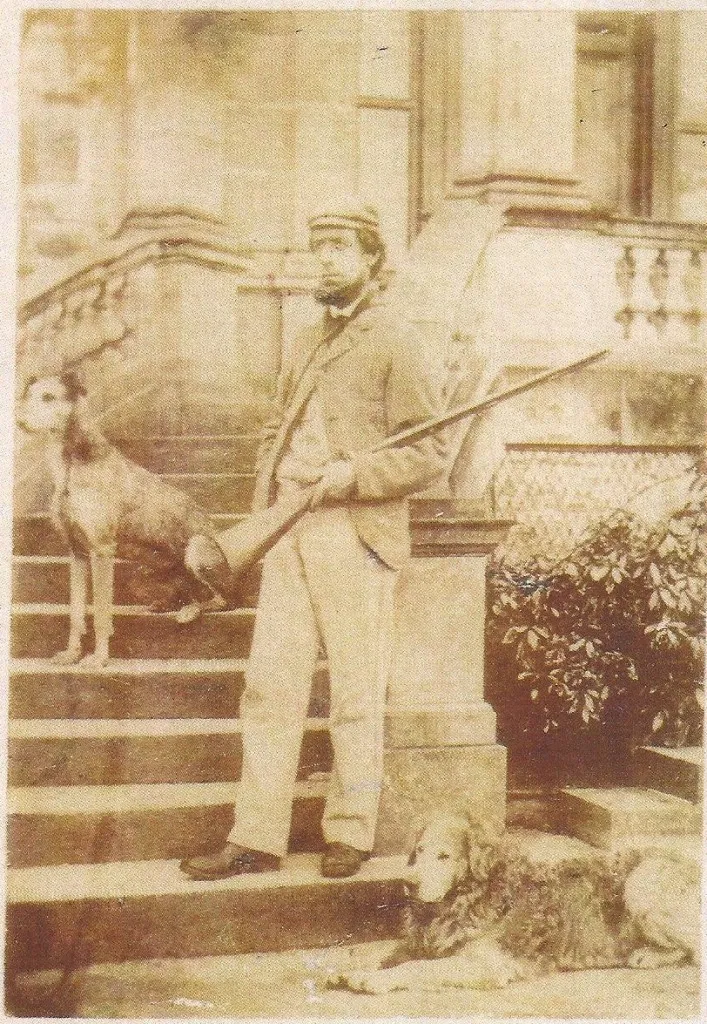
Unknown authorUnknown author · Public domain
2.1. Lord Tweedmouth and Guisachan
The Golden's origins are unusually well documented. In the mid-1800s Dudley Marjoribanks, later Baron Tweedmouth, owned the Guisachan estate in the Scottish Highlands and wanted a dog that could retrieve game from both land and water in that wet, rugged country of lochs and rivers. His breeding records show that he mated a yellow wavy-coated retriever named Nous with a Tweed Water Spaniel named Belle, a type now extinct, producing puppies in the late 1860s that founded the breed.
Over following decades, small amounts of other retriever, Irish Setter and Bloodhound blood were reportedly added. Guisachan House is now a ruin, but Golden enthusiasts from around the world hold commemorative gatherings there.
2.2. Name changes and recognition
Early Kennel Club registrations treated Goldens as a variety of Flat-coated Retriever. They gained separate status in the 1910s as 'Yellow or Golden Retrievers', and the name Golden Retriever settled around 1920. The American Kennel Club recognised the breed in the mid-1920s.
The FCI places Goldens in Group 8 (retrievers, flushing dogs and water dogs), the AKC in the Sporting Group. British and European standards differ slightly from the American standard in colour and build.
3. Goldens in Korea
Goldens became widely known in Korea from the 1990s onward. Their gentle nature despite their size, and their ease with children, made them frequent stars of TV shows and adverts and a perennial answer to 'which big dog would you most like to own?' In practice, in a market dominated by small dogs, relatively few households keep one; they are most common in houses, larger apartments and active dog-loving families.
Social attitudes towards large dogs are a recurring challenge for Korean Golden owners. Shared lifts, weight limits at cafés and lodgings, and people who are simply afraid of big dogs mean fewer places to go together than many expect, although large-dog-friendly spaces and dog runs are gradually increasing.
Like other popular breeds, Goldens also suffer from puppies bred without parental health testing and sold in pet shops, and from surrenders when the cute puppy grows into a 30 kg adult.
4. Appearance and breed standard
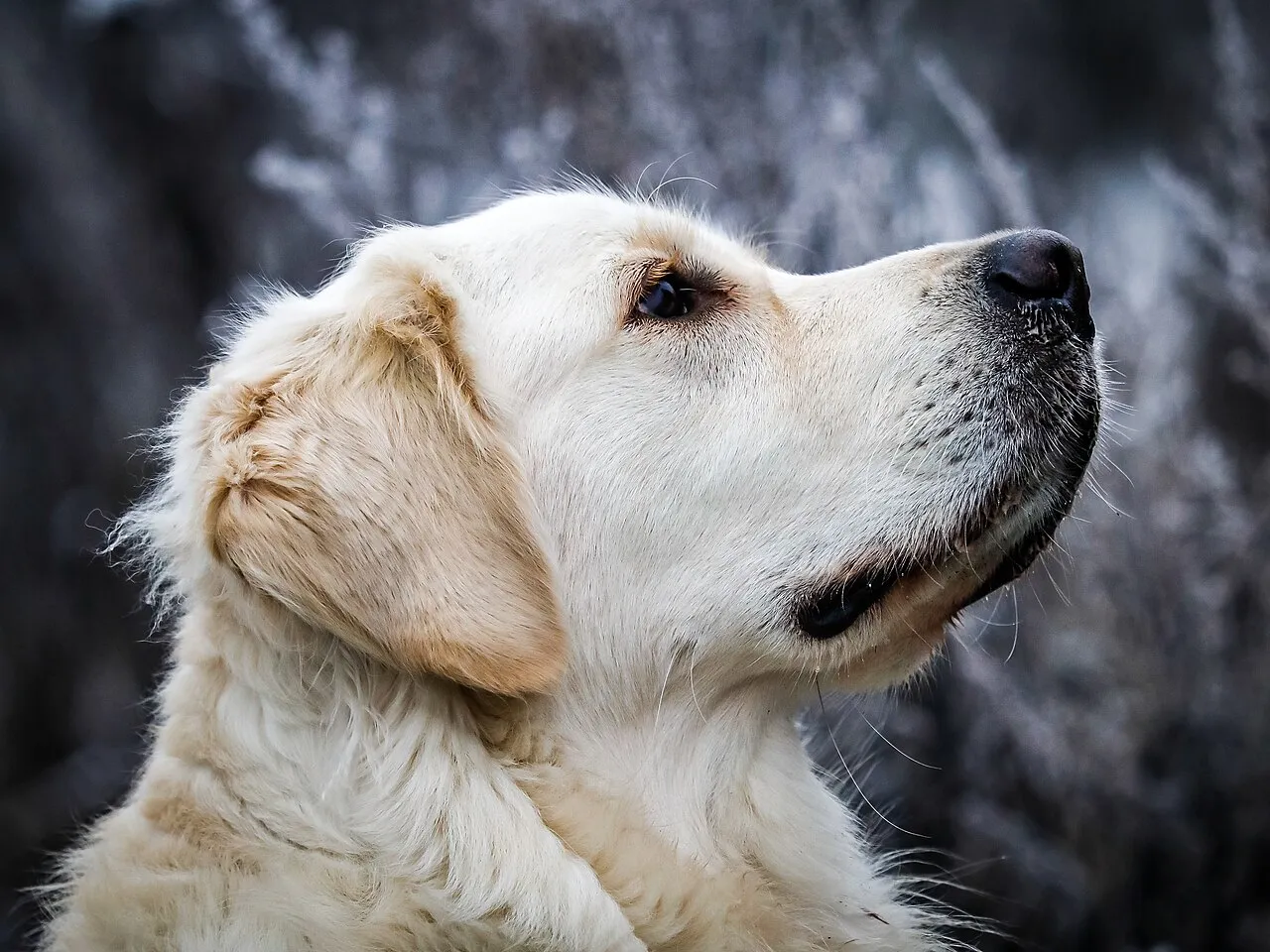
Goldens are balanced and muscular, with a broad skull, dark, kindly eyes and drop ears. The double coat combines a water-repellent outer layer with a dense undercoat, with generous feathering on the neck, chest, backs of the legs and tail.
| Trait | UK/FCI standard (approx.) | AKC standard (approx.) |
|---|---|---|
| Height | Males 56–61 cm, females 51–56 cm | Males about 58–61 cm, females about 55–57 cm |
| Weight | Males about 29–34 kg, females about 25–29 kg | Similar |
| Colour | Any shade of gold or cream | Rich, lustrous gold of various shades; very pale or very dark is faulted |
| Type | Broader head, stockier body | Slightly leaner and more angular |
Pale British and European-type Goldens are sometimes marketed as 'English Cream Goldens'. They are the same breed, and sales pitches about rarity or superior health deserve scepticism: colour and country of origin guarantee nothing.
Field-bred Goldens are lighter, shorter-coated, often deep red and much more energetic. Show lines carry heavier coats and more substance.
5. Temperament
The Golden's great charm is its goodwill towards almost everyone. It greets strangers with a wagging tail, tolerates clumsy children better than most dogs and often gets on well with other dogs and cats, which is why it has a reputation as a hopeless guard dog.
- Trainability: a strong desire to please plus strong food motivation make Goldens quick learners. They shine in obedience, agility, scent work and many other dog sports.
- Retrieving instinct: Goldens love to carry things; greeting you at the door with a shoe or toy in the mouth is classic behaviour. Bred to carry game without damaging it, they have a famously soft mouth.
- Long adolescence: they reach adult size in about a year, but mental maturity often takes two or three. Expect chewing, jumping up and over-excitement in the meantime.
- People dependence: Goldens want to be with their family above all, and long hours alone readily lead to separation distress.
Their friendliness makes Goldens a common recommendation for first-time large-dog owners, but energy and size can become problems without steady training.
6. Who it suits and who it doesn't

Grendelkhan · CC BY-SA 3.0
- Good fit: active families with children
- Good fit: people with time for one to two hours of walking daily and weekend outings
- Good fit: anyone interested in dog sports, training or therapy-dog volunteering
- Good fit: homes where someone is around most of the day
- Poor fit: single people in small flats who are out most of the day
- Poor fit: anyone who can't live with heavy shedding
- Poor fit: households unable to sustain big-dog food and vet costs for a decade or more
- Poor fit: people looking for a guard dog
A 30 kg senior who can no longer walk is hard to lift and carry, so consider whether your home and your own strength will still suit a Golden in its final years.
7. Exercise and play
Adult Goldens need one to two hours of walks and play daily. Mixing in activities that satisfy retriever instincts makes a much bigger difference than mileage alone.
- Fetch: retrieving balls or training dummies is a favourite. Rather than endless throws, ask for a wait before sending the dog, which builds focus too.
- Swimming: most Goldens adore water, and it is low-impact exercise ideal for heavier or older dogs. Dry the ears afterwards.
- Scent work and tracking: searching for objects or people tires the mind.
- Dog sports: agility, dock diving, obedience and more.
During growth, up to about 12–18 months, avoid long runs, high jumps and rough play on slick floors, and favour short, frequent sessions. Goldens feel the heat, so skip midday walks in summer and test pavement with the back of your hand to protect their paws.
8. Coat and grooming
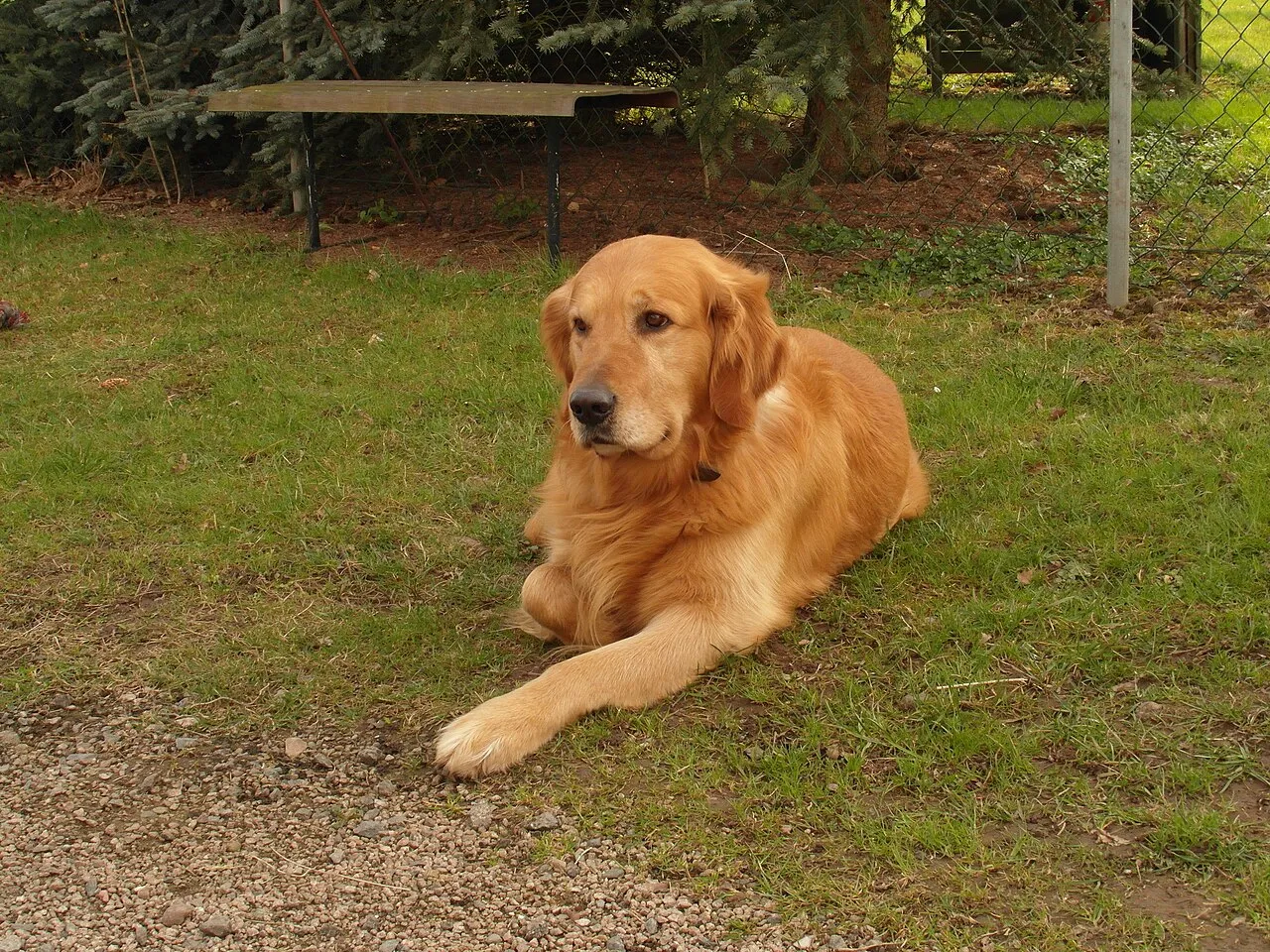
Barras · CC BY 3.0
That beautiful coat takes steady work. Goldens shed all year and drop large amounts of undercoat in spring and autumn.
- Brushing: three or four times a week, daily during moults, with a slicker brush, an undercoat rake and a comb for the feathering. Behind the ears, the armpits and the 'trousers' tangle easily.
- Bathing: every four to six weeks. The thick, long coat takes ages to dry, so use a high-velocity dryer down to the skin to prevent hot spots.
- Trimming: a tidy of the feet, ears and rear is ideal. Shaving isn't recommended.
- Ears: drop ears trap moisture, so ear infections are common. Check weekly for smell and discharge, and clean and dry the ears after swimming or bathing.
- Teeth and nails: brush daily if possible and check nails every two to four weeks.
A robot vacuum, air purifier and car seat cover make life with Golden hair much easier.
9. Diet and weight
Goldens love food and gain weight easily. In a large dog, obesity brings arthritis forward and shortens life, so weight management is a lifelong task.
- Growth: feed a large-breed puppy food until about 12–18 months. Its calcium and calorie levels are tuned to large-breed growth and help reduce joint risk. Extra calcium supplements can do harm.
- Adults: two meals a day, starting from the bag's chart and adjusting for activity. Aim for a visible waist and easily felt ribs.
- Bloat (GDV): in deep-chested dogs the stomach can fill with gas and twist, a life-threatening emergency. Split food into meals and avoid vigorous exercise straight after eating. Unproductive retching with a swelling belly means go to a vet immediately.
- Food choice: in 2018 the US FDA began investigating a possible link between some grain-free, legume-rich diets and dilated cardiomyopathy, and Goldens were heavily represented among reported cases. Causation remains uncertain, but choose a diet that meets recognised nutritional standards with your vet rather than following trends.
10. Inherited conditions and health
Because Goldens are so loved, their health has been studied intensively; in the United States a lifetime study following more than 3,000 Goldens began in 2012, reflecting deep concern about cancer and inherited disease. This is background only; diagnosis and treatment are for your vet.
10.1. Cancer
Goldens are among the breeds most affected by cancer. A past health survey by the Golden Retriever Club of America found cancer accounted for around 60% of deaths, while some studies suggest European lines are affected less.
| Cancer | Features | Warning signs |
|---|---|---|
| Haemangiosarcoma | Arises in blood vessels of the spleen or heart and can rupture suddenly | Sudden weakness, pale gums, swollen belly, collapse |
| Lymphoma | Cancer of the lymphatic system | Lumps under the jaw, in front of the shoulders or behind the knees; weight loss |
| Mast cell tumour | Common skin tumour | A skin lump that changes size |
| Osteosarcoma | Malignant bone tumour in the legs | Unexplained lameness, limb swelling |
Early detection matters most. Feel your dog all over monthly for new lumps, and from age six or seven consider six-monthly check-ups with bloodwork and abdominal ultrasound. Some studies link very early neutering to higher risks of certain cancers and joint disorders, so discuss timing with your vet.
10.2. Hip and elbow dysplasia
Cause: inherited malformation of the joint, worsened by rapid growth, obesity and over-exercise in puppyhood.
Signs: stiffness on rising, front or hind lameness, bunny-hopping, reluctance to climb stairs or jump into the car.
Tests: X-rays; schemes such as BVA/KC, OFA and PennHIP grade breeding dogs.
Management: weight control, sensible exercise, joint supplements and pain relief, physiotherapy and surgery in severe cases. Choosing parents with good scores is the best prevention.
10.3. Other conditions
| Condition | What happens | How it's checked |
|---|---|---|
| Subaortic stenosis | Congenital narrowing below the aortic valve; severe cases risk sudden death | Auscultation, echocardiogram |
| Golden Retriever uveitis | Pigmentary uveitis that can lead to glaucoma and blindness | Regular eye exams |
| Progressive retinal atrophy | Retinal degeneration causing blindness | Eye exams; DNA tests for several forms |
| Ichthyosis | Excessive flaky scale on the skin | DNA test |
| Hypothyroidism | Lethargy, weight gain, hair loss | Blood test |
| Atopy and ear infections | Itching, paw licking, smelly ears | Skin and ear exams |
| Dilated cardiomyopathy | Heart muscle stretches and weakens | Echocardiogram, taurine levels |
Ask to see parental hip and elbow scores, heart screening, annual eye exam records and DNA results for PRA and ichthyosis.
11. Life stages and lifespan
Goldens typically live 10 to 12 years, shorter than small breeds. Lean dogs whose illnesses are caught early sometimes reach 14 or 15.
| Stage | Age | Focus |
|---|---|---|
| Puppy | 0–6 months | Rapid weekly growth; socialisation, manners, bite inhibition |
| Adolescent | 6 months–2/3 years | Peak energy, chewing and jumping; moderate exercise to protect joints |
| Adult | 3–7 years | Calmer and easiest to live with; weight control |
| Senior | 8+ years | Arthritis, tumours, thyroid and heart checks; non-slip floors and help with steps |
Many older Goldens struggle to get up because of arthritis. Rugs throughout the home, a ramp for the car and a rear-support harness ease the load on both dog and owner. A whitening face is the classic sign of an ageing Golden.
12. Costs
Rough 2026 ranges in Korean won. Food, medication, anaesthesia and surgery all scale with body weight.
| Item | Approximate cost | Notes |
|---|---|---|
| Initial supplies, vaccines, registration | 1,000,000–2,000,000 | Excluding purchase; large crate, bed, car gear |
| Food | 80,000–150,000 a month | Premium large-breed diet |
| Treats and supplies | 30,000–60,000 a month | |
| Parasite prevention | 30,000–50,000 a month | Depends on weight |
| Grooming and bathing | 80,000–150,000 per visit | Long-coated large dogs cost more |
| Pet insurance | 40,000–90,000 a month | Higher for large breeds |
| Annual check-up | 200,000–600,000 | More with imaging in old age |
| Tumour surgery or chemotherapy | Millions to tens of millions | Varies hugely by type and treatment |
| Hip or cruciate surgery | Several million or more |
Budget roughly 200,000–400,000 won a month for basics. Many Golden owners take out insurance young or keep a dedicated medical fund because of cancer and joint risks.
13. Before you get one
- Parental health screening: ask for hip and elbow scores, heart screening, eye exams and DNA results for PRA and ichthyosis. Few breeders in Korea provide all of these yet, but with a large dog this makes a lifelong difference to health and vet bills.
- Parental temperament: the Golden's sweetness is partly inherited. Meet the parents and check that they are calm and friendly.
- 'Rare colour' and 'imported bloodline' pitches: if a seller charges extra for cream or British lines, question health testing even harder.
- Pet shops and puppy farms: selling puppies under two months is illegal in Korea. Shops displaying many breeds rarely provide parental information, and puppies face higher infection and socialisation risks.
- Shelters and rescues: Goldens and Golden mixes are sometimes surrendered simply for being big. Adults come with known size and temperament, and many already have basic manners.
- Lifestyle check: if you live in an apartment, check building rules about large dogs and plan for meeting neighbours in lifts and corridors. Renting with a large dog can also be harder if you expect to move.
- Plan for old age: budget time, space and money for a 30 kg senior who may one day struggle to walk.
14. Goldens in popular culture
Goldens have appeared countless times on screen as the quintessential good family dog. Air Bud, the 1990s film about a basketball-playing Golden, was a big hit, Shadow in Homeward Bound is a Golden, and so is Comet, the family dog in the American sitcom Full House. Politicians' dogs have included Goldens too, such as Liberty, belonging to US President Gerald Ford.
In the social media era, Golden influencer accounts gather millions of followers, and videos of Goldens gently holding raw eggs without breaking them went viral as a demonstration of the soft mouth. In Korea, Goldens are a staple of variety shows, adverts and dramas as the affectionate big dog, and clips of 30 kg dogs acting like lapdogs are perennially popular.
15. Trivia
- A Golden's coat often changes texture with age and after neutering, becoming fluffier or frizzier.
- Breeders say the colour of a puppy's ear tips hints at its adult coat colour, though it is folk wisdom rather than science.
- An American Golden that passed age 20 was reported as one of the oldest of its breed, a remarkable outlier given the typical lifespan.
- Goldens drool at the sight of food and, when happy, wag with their whole back end.
- International gatherings at Guisachan to celebrate the breed's origins have brought together hundreds of Goldens at once.
- Their habit of bringing a toy or leaning against a sad-looking person is one reason they are so widely used as therapy dogs.
Health notes are general information. If something seems wrong, contact a vet who treats this species.
🍽️ Can my dog or cat eat this? →
FAQ
Golden or Labrador: what's the difference?
Goldens have a longer feathered coat that needs more grooming; Labs have a short, dense coat. Both are friendly, though Labs are often described as bouncier and even more food-driven. Both are large, energetic dogs.
Is an 'English Cream' Golden a different breed?
No. The UK and FCI standards allow pale cream and the type tends to be stockier, but it is the same breed. Ignore 'rare colour' pricing and focus on health testing.
Does a Golden make a good guard dog?
Not really; most greet strangers with a wagging tail. Their friendliness is exactly what makes them superb family, therapy and assistance dogs.
Photo credits
Photos are freely licensed images from Wikimedia Commons. Authors and licenses are listed below.
- At Sticker Lumis Golden.JPG — Marlies Kloet · CC BY-SA 3.0
- Nous sitting with keeper.jpg — Unknown authorUnknown author · Public domain
- Dülmen, Hausdülmen, Golden Retriever -- 2022 -- 5945.jpg — Dietmar Rabich · CC BY-SA 4.0
- Golden retriever gnawing at the farmer's market.jpg — Grendelkhan · CC BY-SA 3.0
- A Golden Retriever-9 (Barras).JPG — Barras · CC BY 3.0