TailVille
1. Overview
The whale shark is the largest living fish on Earth. Despite the name, it has nothing to do with whales: it is a true shark, breathing through gills and built on a skeleton of cartilage rather than bone. It can grow longer than a city bus, yet it feeds on some of the smallest food in the ocean, gulping or sucking in seawater and straining out plankton, fish eggs and small schooling fish.
Whale sharks roam tropical and warm-temperate seas worldwide. Most of the time they are solitary and hard to find, but at certain places and seasons, when food blooms, dozens or even hundreds gather in the same patch of water. Ningaloo Reef in Western Australia, the waters off Mexico's Yucatán Peninsula, parts of the Philippines, the Maldives, Djibouti and the Arabian Gulf off Qatar are among the best-known aggregation sites, and whale shark tourism has become an important source of income in many of them.
The animal's back is dark blue-grey, scattered with pale spots and thin stripes in a checkerboard-like pattern. That pattern is unique to each individual, which lets researchers identify sharks from photographs, much like fingerprints, and piece together their movements across oceans.
For all its size, the whale shark is vulnerable. It grows slowly, matures late and produces young infrequently, and populations have declined sharply because of fishing, accidental capture and collisions with ships. The IUCN lists it as Endangered.
2. Name and classification
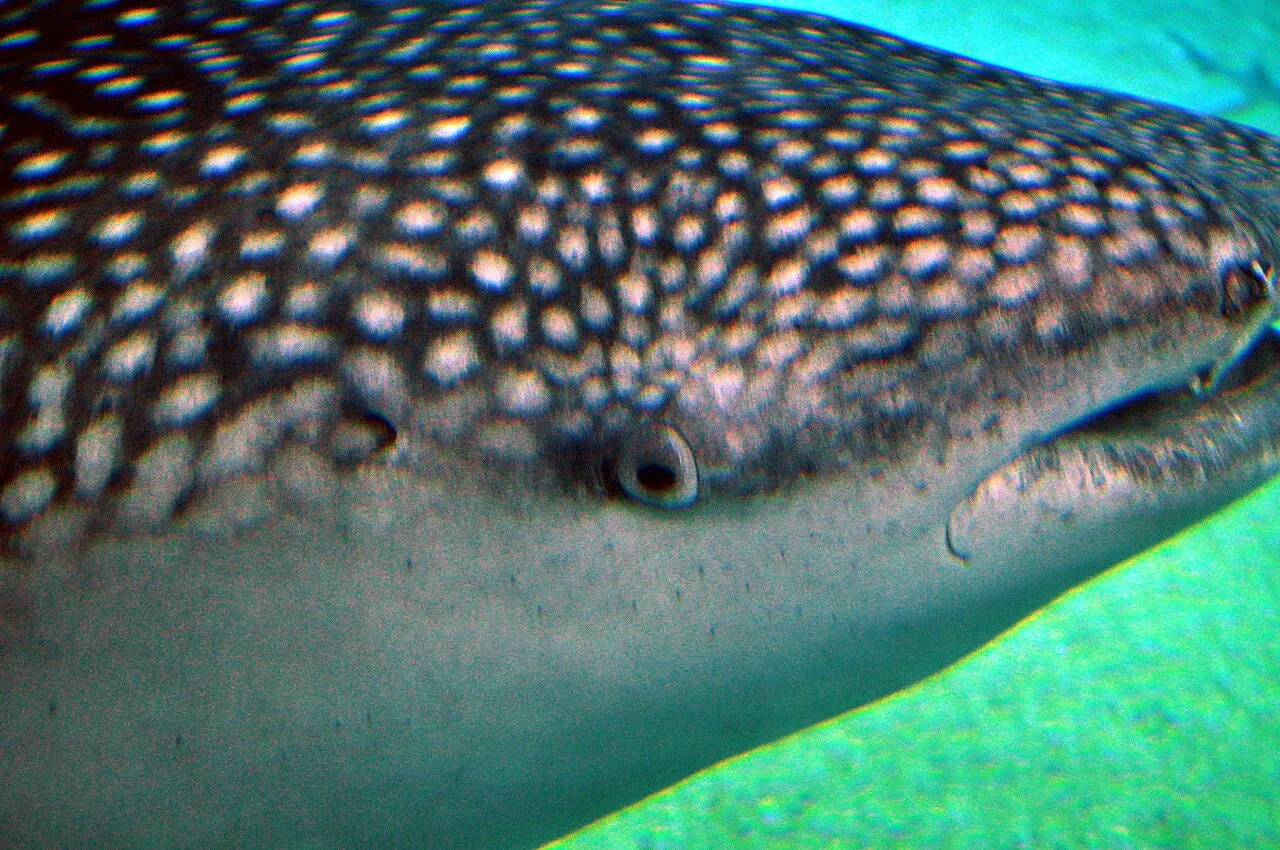
Glaoadare · CC BY-SA 3.0
The scientific name is Rhincodon typus. The species was first described in 1828 from an animal harpooned in Table Bay near Cape Town, South Africa. The genus name is usually read as combining Greek words for 'rasp' and 'tooth', a nod to the rows of tiny, file-like teeth, while typus is Latin for 'type' or 'model'. For a while the spelling Rhiniodon competed with Rhincodon, but Rhincodon is now the standard.
The whale shark belongs to the carpet shark order, Orectolobiformes, and is the only living member of its family, Rhincodontidae. Its relatives include wobbegongs, the zebra shark and nurse sharks, mostly modest-sized fish that live near the sea floor. The whale shark is the odd one out: a giant filter feeder that took to the open ocean.
Common names around the world often reflect awe. In Mexico it is sometimes nicknamed 'domino' for its spots; in Japan it is called jinbei-zame, after a pattern resembling a traditional summer garment; and Vietnamese fishing communities have long treated it with reverence, calling it something like 'lord fish'. In Korean it is gorae-sangeo, a direct rendering of 'whale shark'.
No subspecies are recognised. Genetic studies suggest some differentiation between Atlantic and Indo-Pacific populations, hinting that mixing between the two ocean basins may be limited.
3. Evolution
Sharks have a history stretching back more than 400 million years, but giant filter-feeding sharks like the whale shark are thought to be comparatively recent arrivals. The carpet shark order appears in the fossil record around the Jurassic, and fossil teeth attributed to the whale shark's lineage turn up in Cenozoic rocks.
What makes the story interesting is that giant filter feeding evolved several times independently. The whale shark (a carpet shark), the basking shark and the megamouth shark (both mackerel sharks), and the manta and devil rays all descend from different ancestors, yet each arrived at the same solution: a huge mouth, a fine sieve and a large body that cruises between rich patches of plankton. This is a textbook example of convergent evolution.
One widely discussed idea is that as ocean productivity rose during the Cenozoic and seasonal plankton blooms became more pronounced, it paid to be big. A large body stores energy efficiently and can travel long distances between feeding hot spots, riding out lean periods in between.
Because cartilage rarely fossilises, the whale shark's past is known mostly from small teeth. Exactly when it reached its present size and lifestyle remains uncertain, and estimates differ between researchers.
4. Range and habitat
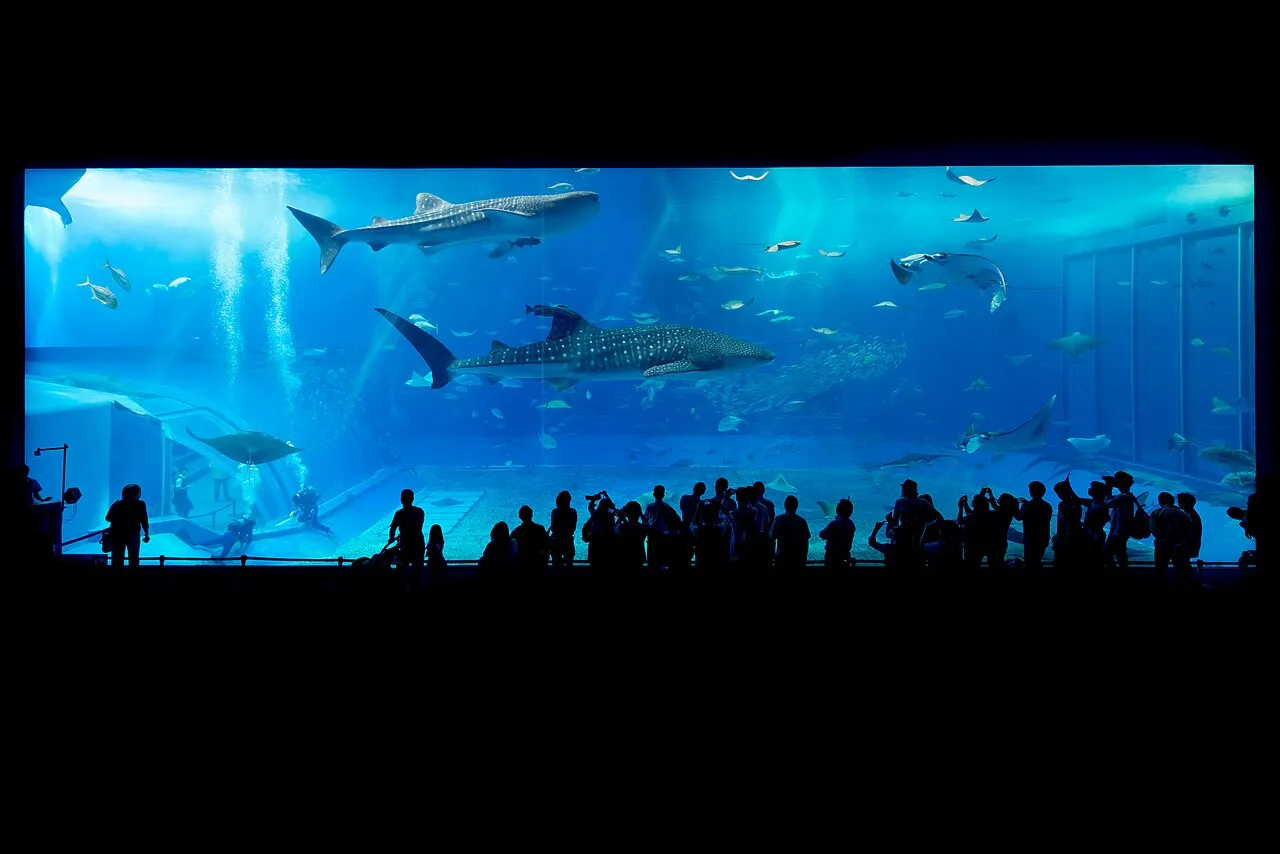
Jordy Meow · CC BY-SA 3.0
Whale sharks live in all tropical and subtropical seas except the Mediterranean, mostly between about 30 degrees north and 35 degrees south, in water of roughly 21 to 30 degrees Celsius. They visit coastlines and coral reefs but also cross the open ocean far from land.
Satellite tags have revealed remarkable journeys. Individuals have been tracked for thousands of kilometres, and at least one shark tagged in the eastern Pacific travelled close to 20,000 kilometres over more than a year. They are also capable divers: tagged sharks have plunged below 1,000 metres, with records approaching 1,900 metres. These deep dives tend to be brief, and the sharks return to warm surface water afterwards, apparently to rewarm.
Well-known aggregation sites include:
| Site | Main season | Notes |
|---|---|---|
| Ningaloo Reef, Western Australia | March to July | Plankton boost after coral spawning; mostly young males |
| Yucatán coast, Mexico | June to September | Hundreds gather to eat tuna spawn |
| Donsol and other Philippine sites | November to May | Krill and small crustaceans |
| South Ari Atoll, Maldives | Year-round | Many juveniles |
| Gulf of Tadjoura, Djibouti | October to February | Mostly juveniles |
| Al Shaheen area, Qatar | May to September | Large groups feeding on tuna eggs |
At most of these places the visitors are overwhelmingly juvenile males 4 to 8 metres long. Where adult females spend their time, and where they give birth, remains one of the big open questions about the species. Around Darwin Island in the Galápagos, large females that appear pregnant are seen regularly, leading some researchers to suspect the area plays a role in reproduction.
Whale sharks occasionally reach Korean waters in summer and autumn, carried north with the warm Tsushima Current. Fishermen off Jeju and the south coast sometimes find one in their set nets, and the animals are usually released.
5. Body
A whale shark has a broad, flattened head, a wide mouth set right at the front of the snout rather than underneath, and three prominent ridges running along each side of the body. In a large adult the mouth can be around 1.5 metres wide.
5.1. Size and weight
Maximum size is hard to pin down. Older accounts claim lengths above 18 metres, but many of those measurements are unreliable. Scientifically measured animals of around 12 metres are well documented, and individuals over 14 metres have been reported.
| Stage | Length | Weight (estimated) |
|---|---|---|
| Newborn | About 40 to 60 cm | A few kg |
| Juvenile at aggregations | 4 to 8 m | Several tonnes |
| Mature male | About 8 to 9 m or more | Roughly 9 tonnes |
| Large female | 10 to 12 m or more | Likely over 15 tonnes |
Weights are mostly calculated from length because weighing a live whale shark is practically impossible. Females tend to grow larger than males.
5.2. Skin and pattern
The skin is thick and tough, more than 10 centimetres in places, and covered in tooth-like scales called dermal denticles that make it feel like sandpaper. Research published around 2020 showed that even the surface of the eyeball is armoured with tiny denticles. Whale sharks have no eyelids, but they can pull their eyes back into their sockets for protection.
The pale spots and stripes may help break up the animal's outline in dappled sunlight. Researchers identify individuals using pattern-matching software originally inspired by methods astronomers use to match star fields.
5.3. Mouth and filter
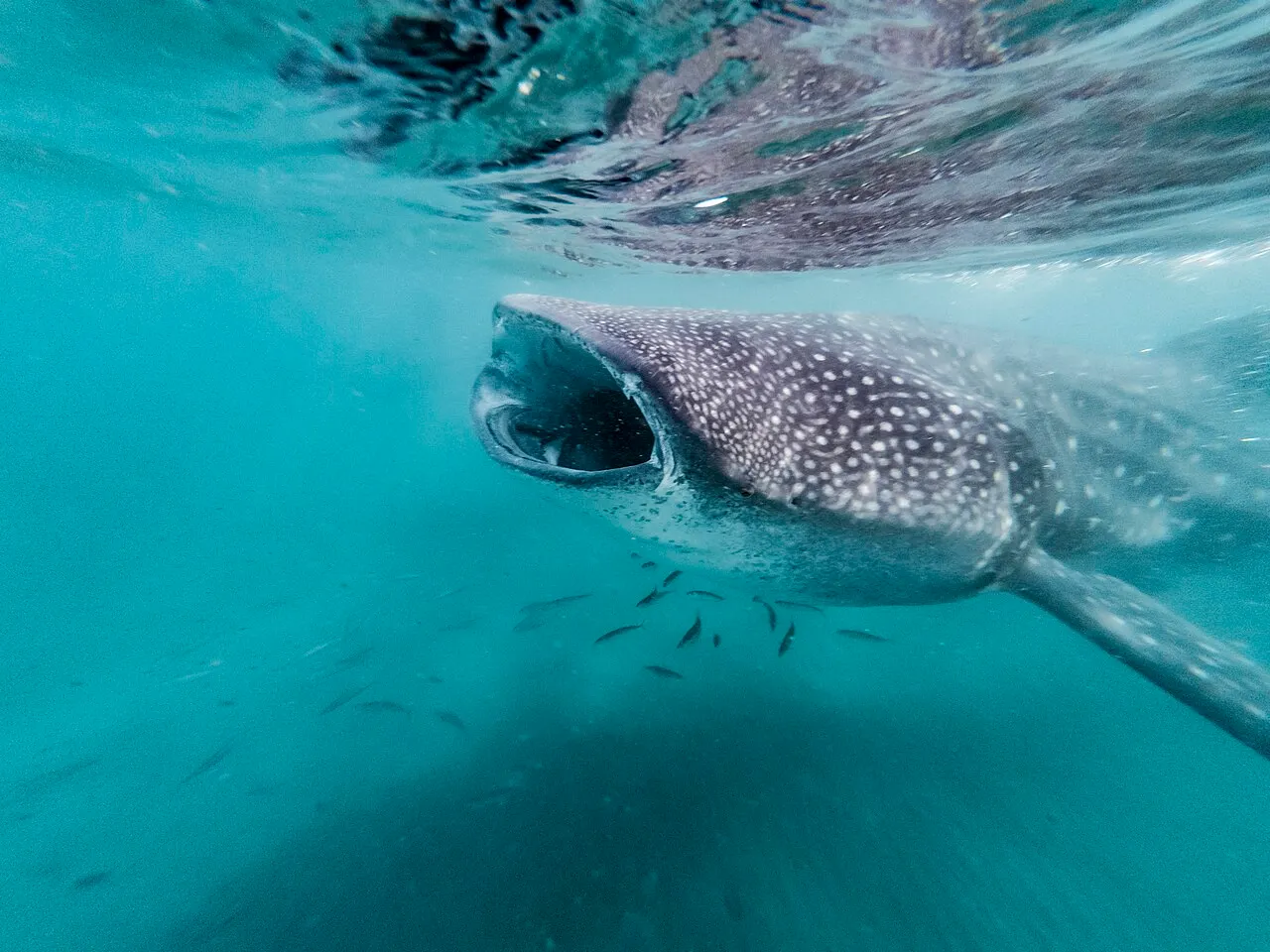
The mouth holds around 300 rows of tiny teeth, each only a few millimetres long, which do not appear to play a real role in feeding. The actual straining is done by spongy filter pads inside the gills. These mesh-like pads can catch prey only a millimetre or so across, and water flows across them at an angle rather than straight into them, which helps keep the sieve from clogging.
The eyes are small for the animal's size and sit on the sides of the head. Smell and the lateral line system are thought to matter more than eyesight when it comes to finding food.
6. Behaviour and ecology
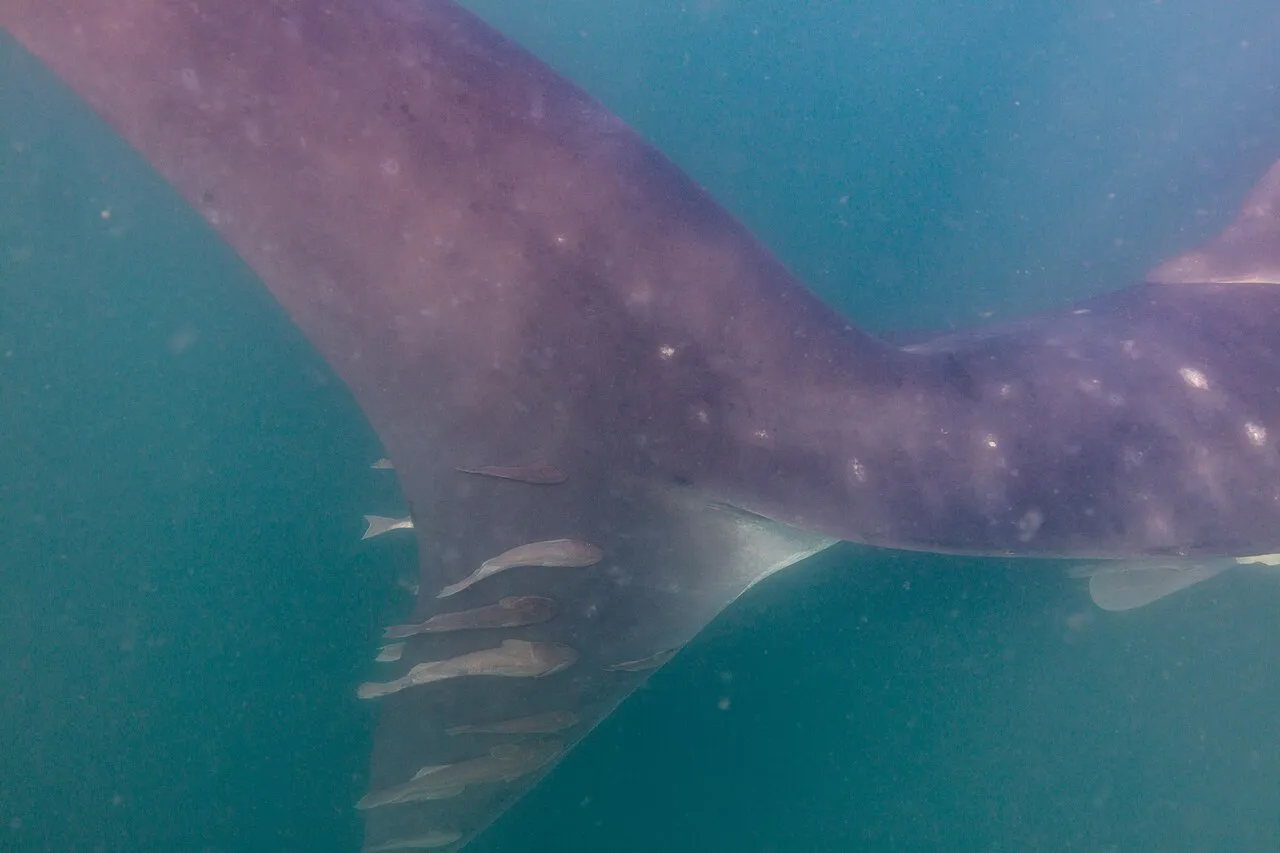
Whale sharks usually travel alone at a leisurely pace of around 5 kilometres per hour, sweeping the tail from side to side in a slow, energy-efficient stroke. Like other sharks they lack a gas-filled swim bladder, so a large, oil-rich liver provides much of their buoyancy. Some studies suggest they save energy by gliding down with little tail movement, using their slight negative buoyancy, and then swimming actively back up.
Even when many gather at one feeding site, they do not cooperate as a group. It is closer to a crowd of individuals that each showed up for the same buffet. Many of them return to the same site year after year, however, suggesting they may remember where and when food becomes plentiful.
Depth changes over the day are striking. Many sharks feed near the surface by day and move deeper at night, while others do the reverse, most likely tracking the daily vertical migration of plankton.
Remoras and small jacks often travel alongside whale sharks, sheltering from predators near the giant body and picking up scraps of food.
7. Diet and feeding
Whale sharks are filter feeders. They eat krill, copepods and other zooplankton, crab and shrimp larvae, fish eggs, small squid and little schooling fish such as sardines and anchovies. The menu varies by place: at Ningaloo they exploit plankton booms after coral spawning, while off Mexico and Qatar they gorge on eggs released by spawning tuna.
They use two main techniques:
- Ram filtration: swimming slowly with the mouth wide open so water is pushed through the gills. This works when food is spread out.
- Suction feeding: holding nearly still, sometimes hanging vertically at the surface, and opening and closing the mouth to pull water in forcefully. This works best when prey is densely packed, and sharks may bob up and down in the water as they do it.
By some estimates a large whale shark can process thousands of tonnes of water an hour. When something too large gets caught, it can flare its gills and expel it with a kind of cough.
More recent studies have found that whale sharks also take in a surprising amount of plant material. Chemical analysis of tissue samples suggested a sizeable share of their diet comes from algae and other plant matter, leading some scientists to describe them as effectively omnivorous. Whether they seek it out or simply swallow it along with plankton is still debated.
8. Reproduction and life cycle
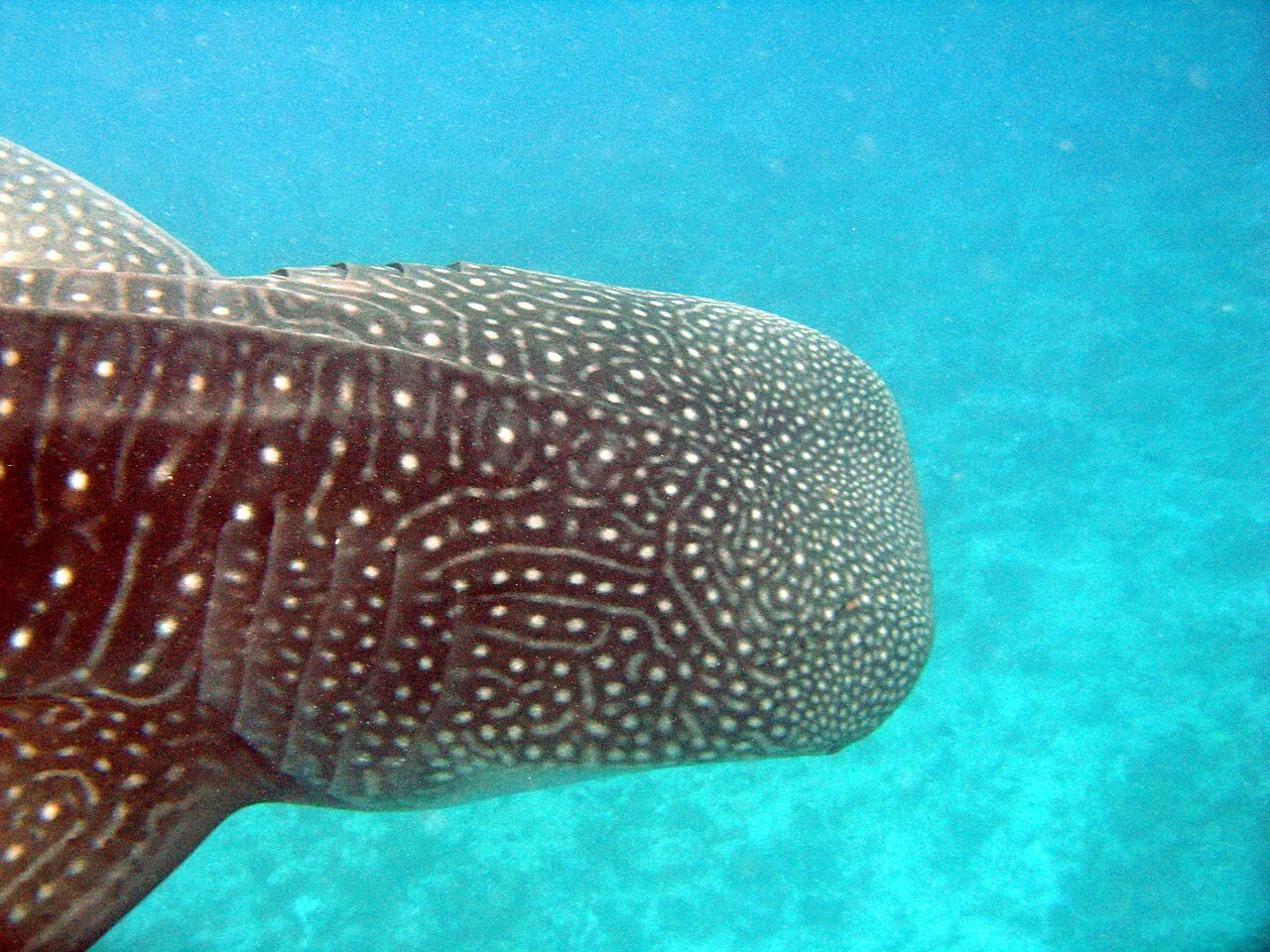
Dapaan · CC BY-SA 3.0
For a long time whale shark reproduction was almost a complete mystery. A key clue came in 1995, when a large female caught off Taiwan was found to be carrying more than 300 embryos at different stages of development. This confirmed that whale sharks are live-bearers: eggs hatch inside the mother, and she gives birth to fully formed young. Later genetic work indicated that all the embryos shared a single father, raising the possibility that females can store sperm and fertilise eggs over an extended period.
Mating has almost never been observed. Gestation length, pupping grounds and how often females give birth are still unknown. Newborns are estimated at about 40 to 60 centimetres, and very small whale sharks are rarely found.
| Stage | Approximate length | Notes |
|---|---|---|
| Embryo | Tens of cm | Hatches from the egg inside the mother |
| Newborn | About 0.5 to 1 m | Rarely seen; early life largely unknown |
| Juvenile | 3 to 8 m | Common at coastal aggregations |
| Adult male | About 8 to 9 m or more | Claspers become rigid when mature |
| Adult female | About 9 m or more | Thought to spend much time offshore |
Growth is extremely slow; males are estimated to mature at roughly 25 to 30 years old. Lifespan is uncertain, but studies of growth bands in vertebrae, calibrated using radiocarbon left by Cold War nuclear tests, have confirmed individuals over 50 years old. Some researchers suggest the maximum lifespan could be 80 to 100 years or more.
9. Senses and special abilities
Very little is known about whale shark intelligence or communication. There is no evidence that they cooperate or signal to one another with sounds. What stands out instead is their ability to find food: they turn up at the right place and the right time, for example when tuna spawn off Mexico or Qatar, which suggests they integrate chemical cues, water temperature and current patterns over long distances.
They also heal remarkably well. Photo-identification records show deep propeller cuts and partially severed fins closing up substantially within weeks to months, and there are reports of some regrowth of tissue on damaged dorsal fins.
Their deep dives are another surprising talent. Below 1,000 metres the water may be only 4 to 5 degrees Celsius and almost completely dark. A whale shark's sheer bulk means it loses heat slowly, letting it make brief visits to these cold depths. Why it goes there, whether to search for food, navigate or shake off parasites, is not yet clear.
10. Predators and survival
Matthew T Rader · CC BY-SA 4.0
Few animals can threaten an adult whale shark. Orcas have been seen hunting them, for instance in the Gulf of California, and large sharks such as tiger sharks and makos are thought to take young ones. Some scars on whale sharks are believed to come from shark or orca bites.
Survival in early life is essentially unknown. Even if a female gives birth to hundreds of pups, many are presumably eaten while small, but very young whale sharks are so rarely seen that there is little hard data.
Today the biggest dangers come from people rather than predators: ship strikes, entanglement and accidental capture in nets, and targeted fishing for fins, meat and oil. Because whale sharks spend long periods near the surface, they are especially exposed in busy shipping lanes. A large international study published around 2022 found that much of the area whale sharks use overlaps heavily with the routes of big ships.
11. Relationship with humans
Whale sharks show virtually no aggression toward people, and most simply cruise past divers and snorkellers. Their size still demands respect, though: a swipe of the tail can injure a swimmer, so keeping a distance is the rule.
Historically, whale sharks were hunted in several regions. Fisheries in Taiwan, the Philippines and the Gujarat coast of India took them for meat, fins and liver oil, which was used to waterproof wooden boats. From the late 1990s into the 2000s, country after country banned whale shark fishing. On the Gujarat coast, communities that once hunted them have become involved in releasing whale sharks caught accidentally in nets.
Tourism has transformed the relationship. Studies in several regions estimate that a living whale shark generates far more income through tourism over its lifetime than it would fetch dead. Tourism has its problems, however. At some sites in the Philippines, sharks are hand-fed to keep them in one place for visitors, a practice criticised for disrupting natural movements and making the sharks comfortable around boats, which increases the risk of propeller injuries.
Commonly recommended guidelines for swimming with whale sharks include:
- Stay at least 3 metres from the head and 4 metres from the tail
- Never touch or ride the shark
- Do not block its path or chase it
- Avoid flash photography and underwater scooters
- Limit the number of swimmers around one animal
In Korea, there have been several reports of whale sharks being freed from fixed nets off Jeju and the south coast. As seas warm, researchers are watching to see whether sightings in Korean waters become more frequent.
12. Conservation
In 2016 the IUCN moved the whale shark from Vulnerable to Endangered, based on assessments that the Indo-Pacific population had more than halved over recent generations and that the Atlantic population had also declined substantially. The global population is hard to estimate. Photo-identification databases include several thousand individuals, and total population estimates are often given in the tens of thousands, but figures vary widely and should be treated with caution.
Main threats include:
- Fishing for fins, meat and oil, with illegal catches continuing in some areas
- Bycatch, for example in tuna purse-seine fisheries
- Collisions with large ships
- Ingestion of plastic and microplastics, a particular risk for a filter feeder
- Poorly managed tourism and feeding
- Climate-driven shifts in where food is found
International trade has been regulated since the species was added to CITES Appendix II in 2002, and it is listed under the Convention on Migratory Species. The Philippines, the Maldives, India, Australia, Mexico and many other countries ban catching whale sharks under national law.
Researchers emphasise that protecting whale sharks requires international cooperation, since a single animal may pass through the waters of many countries in a year. Citizen science, with divers uploading photographs to shared databases, has become a major source of data.
13. In aquariums
A handful of very large aquariums around the world have displayed whale sharks. Doing so requires tanks holding thousands to more than ten thousand tonnes of water, large daily food supplies and precise control of water quality and temperature, so only a few facilities have attempted it.
Supporters argue that seeing a whale shark in person inspires visitors and builds support for conservation, and aquarium observations have contributed data on feeding and growth.
Critics counter that an animal which travels tens of kilometres a day and dives beyond 1,000 metres cannot have its needs met in any tank, however large. Several captive whale sharks have died, and capturing wild animals for display is itself highly stressful. In Korea, a whale shark taken from a set net was once put on display and later released back to the sea amid public criticism.
Increasingly, conservationists favour responsible viewing in the wild under strict rules, or experiences through film and virtual reality, over keeping these giants in captivity.
14. In culture
Thanks to its combination of enormous size and placid nature, the whale shark is often called the 'gentle giant' of the sea. It features in countless ocean documentaries, and many divers list swimming with one as a lifetime goal.
Coastal communities have their own traditions. Vietnamese fishermen historically regarded the whale shark as a guardian spirit and would hold funerals for animals that washed ashore. In parts of Indonesian Papua, fishermen on lift-net platforms consider a whale shark's visit to be good luck and share small fish with it, a relationship that later became a tourist draw. In the Philippines it is known as butanding and has become a symbol of local identity.
In Japan, whale sharks are associated with good fortune from the sea and are hugely popular as plush toys and character goods. They appear in animation and video games as the archetypal huge, laid-back sea creature. The Maldives, the Philippines and other countries have featured whale sharks on stamps, banknotes and tourism campaigns.
International Whale Shark Day is marked on 30 August, with events worldwide to raise awareness about conserving the species.
15. Trivia
- The whale shark is the largest fish alive; the second largest, the basking shark, is also a filter feeder. The largest predatory fish is generally considered to be the great white shark.
- The mouth is huge, but the throat is surprisingly narrow, only a few centimetres across. A whale shark could not swallow a person.
- The pattern-matching software used to identify individuals adapted an algorithm developed for matching star patterns in astronomical images, so researchers are, in a sense, reading constellations on the sharks' backs.
- Whale sharks generally ignore divers, but sudden approaches or flashes can make them dive out of sight.
- Many individuals return to the same aggregation site year after year, and long-term projects give them names and follow them for decades.
- Tens of thousands of photos from recreational divers sit in international databases, so a holiday snapshot can become valuable scientific data.
- The liver is enormous and makes up a large share of body weight, providing both buoyancy and an energy store.
- When feeding vertically at the surface, a whale shark looks as if it is standing up to drink, one of the most photographed poses in the ocean.
Wild animals are not pets. Catching, trading or keeping them is illegal in most places. If you find an injured wild animal, call your local wildlife rescue centre.
FAQ
Do whale sharks attack people?
No. Their teeth are tiny and not used for feeding, and the throat is far too narrow to swallow a person. A tail strike can still injure a swimmer, so keep at least 3 metres from the head and 4 metres from the tail.
Is a whale shark a whale?
No. It is a true shark that breathes through gills and has a cartilage skeleton. The name simply reflects its whale-like size.
Can whale sharks be seen in Korean waters?
Rarely. In summer and autumn one occasionally ends up in set nets off Jeju or the south coast after following warm currents north, and it is usually released.
Photo credits
Photos are freely licensed images from Wikimedia Commons. Authors and licenses are listed below.
- Male whale shark at Georgia Aquarium.jpg — Zac Wolf · CC BY-SA 2.5
- Oeil et spiracle requin-baleine.JPG — Glaoadare · CC BY-SA 3.0
- Okinawa Aquarium.jpg — Jordy Meow · CC BY-SA 3.0
- Rémoras blancas (Remora albescens) en un tiburón ballena (Rhincodon typus), La Paz, Baja California, México, 2024-12-20, DD 07.jpg — Diego Delso · CC BY-SA 4.0
- Walhai 3.jpg — Dapaan · CC BY-SA 3.0
- Whale Shark (Rhincodon typus) with open mouth in La Paz, Mexico.jpg — Matthew T Rader · CC BY-SA 4.0