TailVille
At a glance
Rough ranges for supplies, food and electricity in Korea (USD is approximate). Purchase or adoption fees are not included.
People who want a planted aquarium with a shimmering school of fish, and households looking for a quiet indoor pet.
Anyone hoping for an interactive fish, who tends to skip water changes, or who wants to keep just one or two.
1. Overview
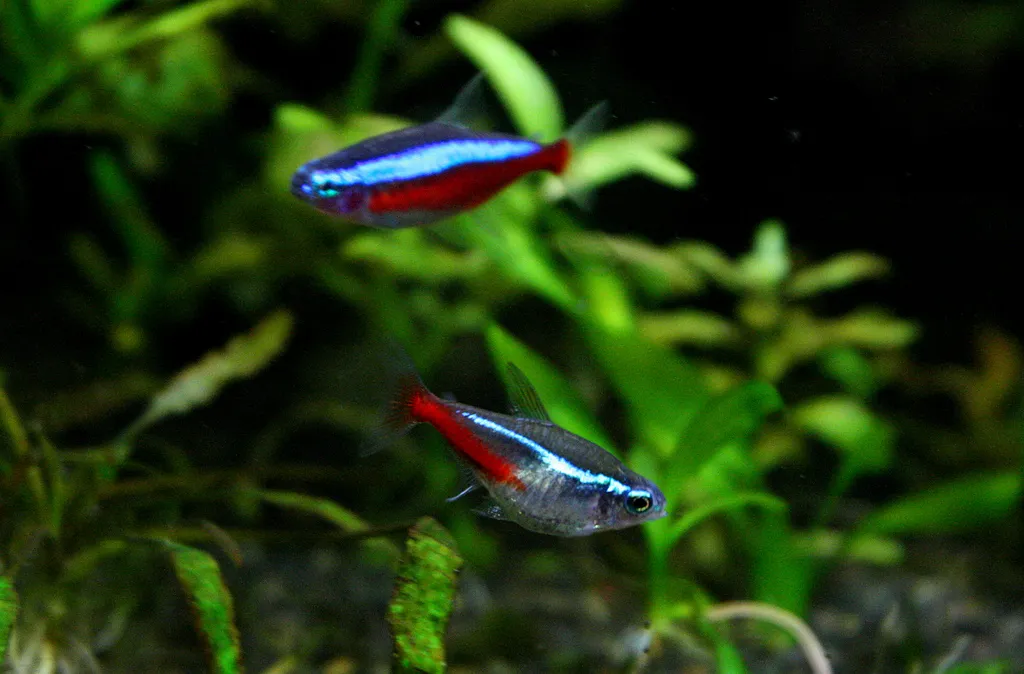
The neon tetra is a small freshwater fish, three to four centimetres long, from the upper reaches of the Amazon. A glowing blue stripe runs from the eye to the base of the tail, and the rear half of the belly is a vivid red. When dozens swim together, the effect is of a band of light flowing through the water. It is one of the best-selling aquarium fish of all time and the classic schooling fish for planted tanks.
Because neons are cheap and tiny, they are often sold as beginner fish. In reality they react badly to unstable water and frequently die in tanks that have not finished cycling. In a mature aquarium with established bacteria and healthy plants, however, they need very little attention. This article covers classification and history, anatomy, how to tell neons from similar species, housing and diet, common diseases, breeding, costs and what to check before you buy.
If there is one idea to take away, it is that a neon tetra does not shine alone. A school of ten or more, a slightly dim planted tank and stable water are what bring out its real colours.
2. Name and classification
2.1. Scientific name and family
The neon tetra's scientific name is Paracheirodon innesi, and it belongs to the family Characidae in the order Characiformes. Characins are a huge group that includes piranhas, blind cave tetras and hundreds of small tetras, many of which have a tiny adipose fin behind the dorsal fin. Neons have one too, just in front of the tail on the back.
The species was first placed in a different genus and later moved to Paracheirodon. Its two closest relatives are the cardinal tetra (P. axelrodi) and the green neon tetra (P. simulans). All three carry an iridescent blue stripe, which makes them easy to confuse at first glance.
2.2. Origin of the name
The species name innesi honours William T. Innes, a Philadelphia publisher and writer whose books and magazine did a great deal to popularise tropical fish keeping in the first half of the twentieth century. The common name refers to the neon-sign glow of the stripe, while tetra is a shortening of Tetragonopterus, an old genus that once held many of these fish.
In Korea the English name is simply transliterated, and hobbyists often shorten it to neon. Shops frequently label tanks just neon or cardinal to keep the two apart.
2.3. Relatives and how to tell them apart
| Species | Red area | Size | Preferred temperature |
|---|---|---|---|
| Neon tetra | Lower rear half only | 3–4 cm | 22–26°C |
| Cardinal tetra | Whole lower body from gills to tail | 4–5 cm | 25–29°C |
| Green neon tetra | Very faint or short red, greenish stripe | 2–3 cm | 24–28°C |
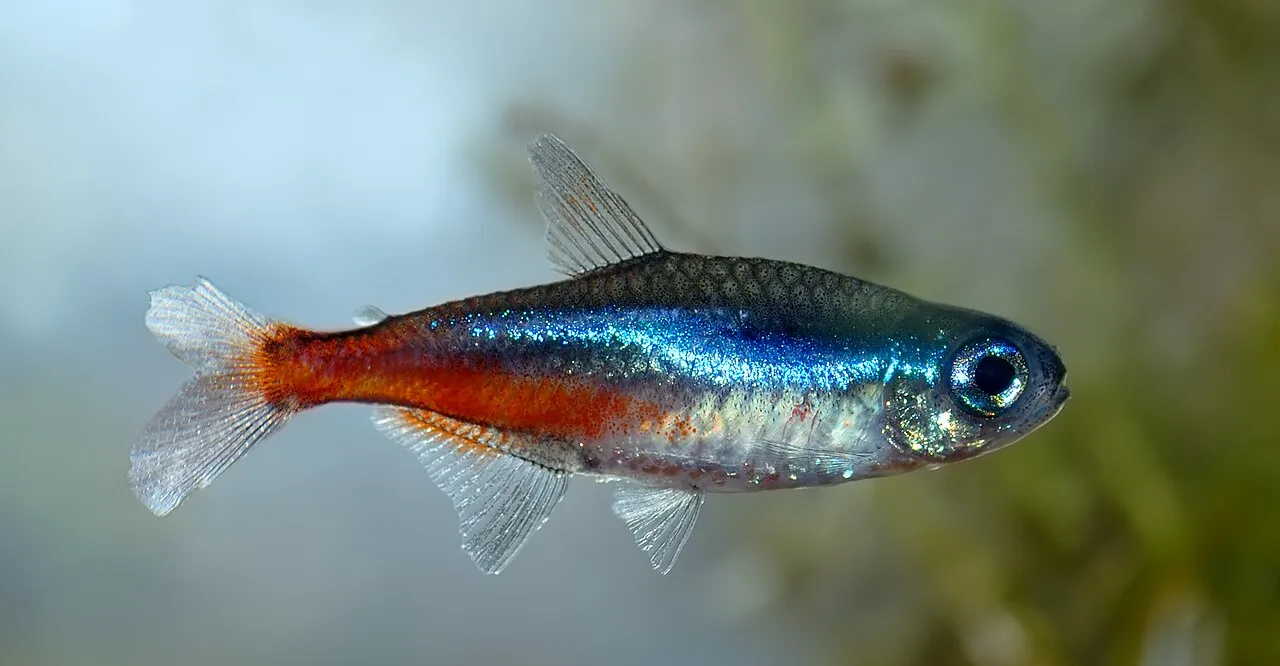
The quickest test is to see where the red begins. On a neon it starts around mid-body; on a cardinal it runs all the way from just behind the gills. Another difference is supply: many cardinals are still wild-caught, whereas almost all neons are farmed.
3. History
3.1. Discovery and arrival in Europe
Neon tetras were collected in the upper Amazon and shipped to Europe in the mid-1930s. Moving live fish across the Atlantic was a feat in itself, and the idea that such a tiny fish could glow so intensely caused a stir in the hobby. Stories circulate about shipments by airship and steamer and about astronomical early prices, though the details vary from source to source.
The species soon reached the United States, received its scientific name, and became famous among American hobbyists through the books and magazine Innes published.
3.2. Mass farming and global spread
Early on, neons would only spawn in very soft, acidic water and were hard to breed. Over decades, farmers in Southeast Asia and Eastern Europe developed reliable techniques, and today enormous numbers are produced each year in places such as Hong Kong, Singapore, Thailand and the Czech Republic. Nearly every neon in a shop comes from one of these farms.
Mass production pushed the price down to small change, but long-term line breeding and high-density rearing also produce some weaker fish. Experienced keepers therefore suggest buying neons that have already settled in the shop for a week or two rather than fish fresh off the shipment.
3.3. Neon tetras in Korea
In Korea, neons became one of the most common aquarium fish alongside guppies and angelfish as the tropical fish hobby spread in the 1980s and 1990s. When planted tanks and the nature aquarium style took off in the 2000s, a school of neons gliding between green plants became almost an emblem of the hobby. They are still sold in nearly every aquarium shop and supermarket fish section.
4. Body
Corpse89 · CC BY-SA 3.0
4.1. Size and shape
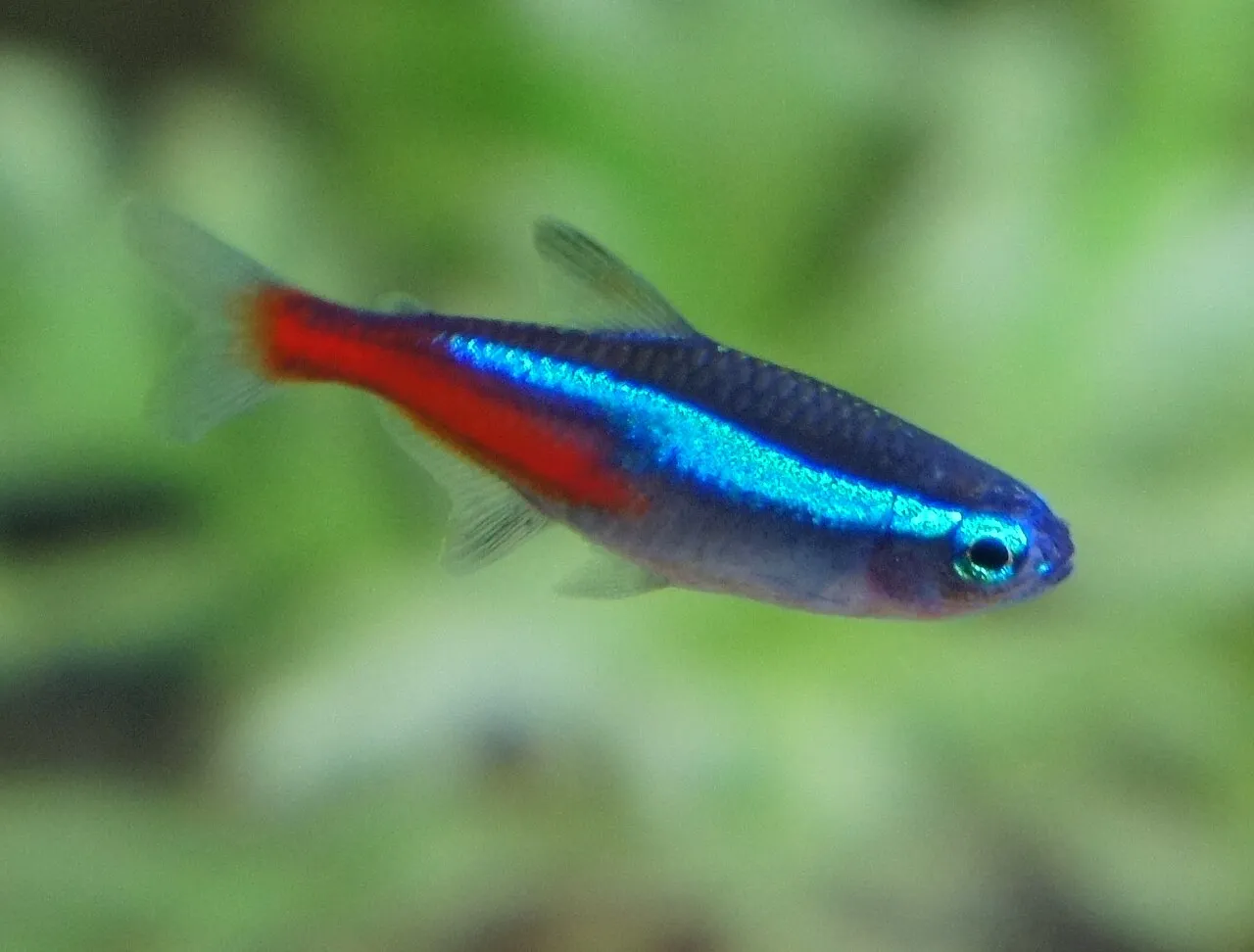
Adults are three to four centimetres long with a slightly compressed, spindle-shaped body. The fins are clear and the tail is forked. The mouth sits at the tip of the head and angles slightly upward, suited to picking small food from the middle and upper water. A small adipose fin sits between the dorsal fin and the tail, a typical characin feature.
4.2. How the stripe glows
The blue stripe is not pigment but structural colour, produced by stacks of microscopic reflective plates inside skin cells called iridophores. The spacing between the plates determines which wavelengths are reflected, and the fish can adjust that spacing, so the stripe shifts from bright turquoise by day to violet or dull at night or under stress.
Researchers think the glow helps school members keep track of one another in the dark, tea-coloured water of Amazon tributaries. The red patch, by contrast, comes from ordinary pigment.
4.3. Telling males from females
Adults are easiest to sex from above or the side. Females have a rounder belly, which makes the blue stripe look slightly bent, while males are slimmer with a straight stripe. Juveniles and thin, newly imported fish are hard to tell apart, so if you want to breed them, raise a group and let pairs sort themselves out.
5. Varieties
Unlike guppies, neon tetras do not come in hundreds of strains, but farms have fixed a handful of variants. These are often less robust or produced in smaller numbers than standard neons, so the wild-type form is the best choice for a first school.
| Name | Description |
|---|---|
| Standard neon | Close to the wild form, hardiest and cheapest |
| Gold neon | Faded stripe, golden body, reduced pigment |
| Albino neon | Red eyes, pale body, weak stripe |
| Diamond head neon | Silvery, sparkling head |
| Longfin neon | Elongated fins, prone to fin nipping |
| Blue diamond neon | Blue sheen spread over the whole body |
Trade names vary between importers and shops, so the same fish may carry several labels. These selectively bred variants are not the same as dyed or genetically modified fish; be wary of unnaturally bright fish with no clear origin.
6. Behaviour
Tan Meng Yoe at English Wikipedia · CC BY 4.0
6.1. Life in the wild
Wild neons live in small forest streams and in flooded forest during the rainy season. The water is stained tea-brown by tannins from fallen leaves, extremely soft and acidic, with leaf litter and branches on the bottom. In this dim water they move in large schools, feeding on tiny invertebrates, insect larvae and algae. Schooling is their main defence against predators.
6.2. Behaviour in the tank and what it means
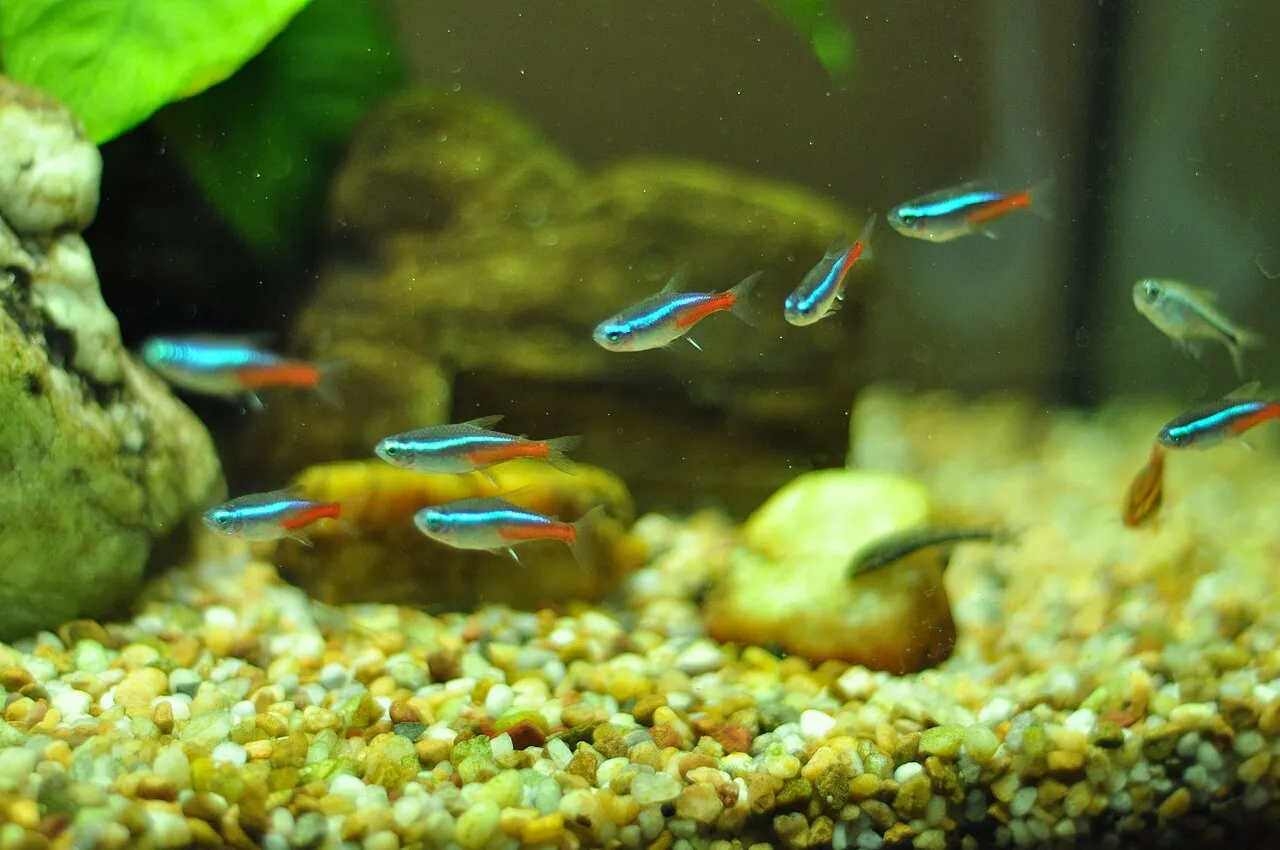
A healthy school drifts loosely through the middle of the tank and snaps into a tight cluster when someone approaches suddenly or a larger fish passes. The table below shows common behaviours and what they usually mean.
| Behaviour | Meaning |
|---|---|
| Group swimming evenly in mid-water | Settled and healthy |
| Faded stripe and resting near the bottom at night | Normal sleep |
| Pale and hiding during the day | Stress, poor water or too few companions |
| One fish staying apart | Possible early illness |
| Flashing against rocks or substrate | Parasites such as ich, or water problems |
| Gasping at the surface | Low oxygen |
Males chase each other a little when in breeding condition, but neons are among the least aggressive fish in the hobby and rarely bother tankmates.
7. Life stages
In excellent conditions neons live five to eight years, though three to five is more typical in home aquariums. Mass-farmed fish have high losses in their first weeks; those that settle in tend to live much longer.
| Stage | Age | Notes |
|---|---|---|
| Egg | 0–1 day | Tiny non-sticky eggs, light-sensitive |
| Fry | 1 day–1 month | Live on yolk for 3–4 days, then need microscopic food |
| Juvenile | 1–3 months | Blue stripe appears, schooling begins |
| Adult | 4 months on | 3 cm or more, able to breed, brightest colour |
| Old age | After 4–5 years | Slight curve to the back, paler colour, slower swimming |
Older fish look a little duller and feed more slowly. A strongly bent spine or white patches, though, point to neon tetra disease rather than ordinary ageing.
8. Housing
André Karwath aka Aka · CC BY-SA 2.5
8.1. Tank size and group size
They may be tiny, but schooling fish need swimming length. Ten neons suit a 45 cm tank of about 35–40 L; for fifteen to twenty, or a community tank, choose 60 cm and 55–65 L or more. Larger groups behave more naturally and colour up better. With five or fewer they become nervous and scatter to hide.
8.2. Water chemistry and cycling
| Parameter | Target |
|---|---|
| Temperature | 22–26°C |
| pH | 6.0–7.0 (farmed fish adapt up to 7.5) |
| General hardness | Soft to moderate |
| Ammonia and nitrite | 0 |
| Nitrate | Below 20 mg/L |
A new aquarium must be cycled for at least three to four weeks so that bacteria which break down ammonia and nitrite can establish. Neons are among the first fish to die in tanks where this has not happened. Confirm with a test kit that ammonia and nitrite read zero, then add fish in stages. Most municipal tap water is fine once dechlorinated.
8.3. Plants, light and layout
Neons prefer shade and stay on edge in a bright, bare tank. Leave open swimming space at the front, plant densely at the back and sides, and add floating plants or driftwood for cover. Dark substrate and a dark background make the stripe pop. Dried leaves such as Indian almond leaves tint the water slightly brown and recreate their native conditions. About eight hours of light a day is plenty, and avoid strong currents.
8.4. Equipment and tankmates
- Tank with lid, adjustable heater and thermometer
- Sponge, hang-on or canister filter with gentle outflow
- Substrate, live plants and driftwood
- Dechlorinator and test kits for ammonia, nitrite and pH
- Siphon and a container or airline for acclimatisation
Good companions are peaceful small fish such as rasboras, other small tetras, corydoras, otocinclus, cherry shrimp and small gouramis. Angelfish, large cichlids and big barbs may see neons as food, and fin nippers like tiger barbs are best avoided.
9. Diet
Wild neons are omnivores that eat tiny crustaceans, insect larvae and algae. In the aquarium, small flakes or micro granules make a good staple, topped up with frozen foods.
| Food | How often | Notes |
|---|---|---|
| Small flakes or granules | Once or twice daily | Crush flakes between your fingers |
| Frozen brine shrimp | 2–3 times a week | Thaw and drain before feeding |
| Frozen daphnia | 1–2 times a week | Aids digestion and prevents constipation |
| Frozen bloodworms | Once a week | Rich, so small amounts only |
| Newly hatched brine shrimp | Optional | Conditioning before breeding, food for fry |
Give only what they finish in two minutes. Food that falls to the bottom can be cleaned up by corydoras or siphoned out. Healthy adults easily cope with three or four days without food, which is safer than an overgenerous automatic feeder while you travel. Never feed bread or table scraps.
10. Health
Because neons are so small, illness moves fast once it starts. Most problems follow a drop in immunity caused by poor water or sudden changes, so prevention matters most.
| Disease | Cause | Signs | Response |
|---|---|---|---|
| Neon tetra disease | Microsporidian Pleistophora hyphessobryconis | Muscle near the stripe turns white, bent spine, fish leaves the school | No cure; isolate immediately and consider euthanasia |
| Ich | Ciliate parasite | Salt-like white spots on body and fins | Raise temperature gradually, use an ich treatment |
| Columnaris | Bacteria | Cottony white patches on mouth or back, fast progression | Isolate, antibacterial treatment, improve water |
| Fin rot | Bacteria, poor water | Fin edges whiten and fray | Water changes, medication |
| False neon disease | Bacterial infection | Fading similar to neon tetra disease | Sometimes responds to antibacterials |
Neon tetra disease is thought to spread when healthy fish eat the bodies or droppings of infected ones, which is why dead fish should be removed the moment you see them. Quarantine new arrivals for about two weeks, and avoid sharing nets and tools between tanks.
If several fish die in one day, or you cannot find a cause despite normal test results, ask a fish vet or an experienced shop for help. Medications can harm small fish when overdosed, so follow the label carefully.
11. Breeding
Neons occasionally spawn in community tanks, but the eggs and fry are eaten almost immediately. Raising babies takes a dedicated setup; they are not fish that multiply by themselves like guppies.
A breeding tank of 20–40 L should be kept at 24–25°C with very soft water at pH 5.5–6.5, often achieved with reverse-osmosis or deionised water and peat. Eggs and fry are light-sensitive, so keep the tank dark and cover the bottom with mesh or java moss so the adults cannot reach the eggs.
A well-conditioned pair or small group usually spawns around dawn, scattering dozens to more than a hundred eggs. Remove the adults straight afterwards. Eggs hatch in about a day; after three or four days the fry need infusoria or liquid fry food, and after one to two weeks they can take newly hatched brine shrimp.
Breeding is a rewarding project, but think about where the young fish will go before you start. Avoid repeated spawning without homes lined up, and never release surplus fish into rivers or ponds.
12. Costs
Individual neons are cheap, so the tank and equipment make up most of the cost. The figures below are rough Korean prices for about fifteen neons in a 60 cm tank and vary widely with brand, shop and planting.
| Item | Estimated cost (KRW) | Notes |
|---|---|---|
| 15 neon tetras | 15,000–40,000 | Around 1,000–2,000 each |
| 60 cm tank and lid | 30,000–100,000 | |
| Heater and thermometer | 15,000–40,000 | |
| Filter | 15,000–60,000 | Sponge, hang-on or canister |
| Substrate, plants, driftwood | 20,000–80,000 | More for a full planted tank |
| Dechlorinator, test kits, siphon | 15,000–30,000 | |
| Total setup | About 80,000–200,000 | Plant lights and CO2 extra |
| Monthly food and consumables | 3,000–10,000 | |
| Monthly electricity | 5,000–10,000 | Higher with winter heating |
| Monthly total | About 8,000–20,000 | |
| Yearly | About 100,000–250,000 | Equipment replacement extra |
A serious planted aquarium with dedicated lighting, nutrient substrate and CO2 can add hundreds of thousands of won. Few clinics treat fish, so it is sensible to budget for a small quarantine tank and basic medications.
13. Before you get one
- Have you confirmed with a test kit that the tank is cycled, with zero ammonia and nitrite?
- Is the tank big enough for at least ten fish?
- Do you already keep angelfish or other fish that could eat neons?
- Can you commit to a weekly water change?
In the shop, look at the whole group rather than single fish. Choose a tank where stripes are bright, bellies are gently rounded and the school swims together. Avoid any tank with dead fish, bent backs or white, faded patches. Fish that have settled in the shop for a few days are a safer bet than a fresh delivery.
At home, float the bag for 20–30 minutes to equalise temperature, add tank water to the bag in small amounts over the next half hour, then net the fish across without adding shop water. Feed lightly and keep lights low for the first few days.
14. Laws
Neon tetras are not listed under CITES, and in Korea and most other countries no permit or registration is needed to keep them. Releasing any non-native fish into rivers, lakes or reservoirs, however, can harm ecosystems and may be illegal, so rehome unwanted fish through shops or clubs.
Exporting countries have their own rules for collecting wild aquarium fish, but since nearly all neons are farmed, this rarely affects hobbyists. If you plan to import or sell fish commercially, check the current rules with the relevant authorities.
15. Neon tetras in culture
Neon tetras are a visual shorthand for the aquarium itself, turning up in adverts, videos and stock photos. Screensavers and relaxing aquarium videos almost always include a school of small blue-striped fish, and they are a staple of planted displays in public aquariums. Aquascaping contest photos featuring huge schools of neons or cardinals sweeping between plants are among the hobby's most iconic images.
Small tropical fish characters in cartoons and games often borrow the neon's blue stripe and red tail, so plenty of people know the look without knowing the name. The fish's glow has even lent its name to colour terms in product design and fashion.
16. Trivia
- The stripe looks green, blue or violet depending on viewing angle, so the same fish changes colour as you move around the tank.
- Scientists studying colour-changing materials have looked at how neons adjust the spacing of the reflective plates in their skin.
- Thanks to farming, the trade in neons barely touches wild populations. Cardinal tetras, by contrast, support collectors in Amazon communities, and sustainable harvesting of them has become a research topic.
- At night neons hang almost motionless among the plants. Switch on the room light before the tank light to avoid panicked collisions.
- In very large schools the whole group turns as one, and some aquascapers keep a hundred or more just for that effect.
- Innes, whose name the species bears, was honoured not for collecting the fish but for popularising the hobby, an unusual reason for a scientific name.
Health notes are general information. If something seems wrong, contact a vet who treats this species.
FAQ
My neons look pale at night. Are they sick?
Fading at night is normal resting colour. If they stay pale for hours after the lights come on, check water quality and stress.
What is the difference between neon and cardinal tetras?
Neons have red only on the rear half of the body; cardinals are red along the whole lower body, grow slightly bigger and prefer warmer, softer water.
Can they live with guppies?
Temperament-wise, yes. Guppies prefer harder, alkaline water and neons softer, acidic water, so aim for a middle ground around pH 7.0.
Photo credits
Photos are freely licensed images from Wikimedia Commons. Authors and licenses are listed below.
- Neonsalmler Paracheirodon innesi.jpg — Holger Krisp · CC BY 3.0
- Cardinal tetra & neon tetra.jpg — úlfhams_víkingur · CC BY 2.0
- NeonTetra.JPG — Corpse89 · CC BY-SA 3.0
- Neontetra tmy.JPG — Tan Meng Yoe at English Wikipedia · CC BY 4.0
- Paracheirodon innesi (aka).jpg — André Karwath aka Aka · CC BY-SA 2.5