TailVille
At a glance
Rough ranges for supplies, food and electricity in Korea (USD is approximate). Purchase or adoption fees are not included.
People with little space or time who are fascinated by an odd-looking predator and happy to watch rather than handle.
Anyone wanting a cuddly pet, or families planning to leave water changes and hygiene entirely to a young child.
1. Overview
Horned frogs are the members of the South American genus Ceratophrys. The one you are most likely to meet in a pet shop is Cranwell's horned frog (Ceratophrys cranwelli), a native of the Gran Chaco, the hot, seasonally flooded scrubland that spans northern Argentina, western Paraguay and southeastern Bolivia. Alongside it, the trade carries a range of hybrids built from Cranwell's, the Argentine horned frog (C. ornata) and the Amazonian horned frog (C. cornuta). The body is nearly as wide as it is long, the head takes up close to half of the animal, and the mouth opens across the full width of the skull. That silhouette reminded English-speaking keepers of a certain 1980 arcade hero, hence the nickname Pacman frog.
Everything about this frog revolves around ambush. It wriggles backward into soil or leaf litter until only its eyes and the top of its head show, then sits still for hours or even days. When something moves within reach, it launches forward and engulfs it. Insects, other frogs, small rodents, lizards and members of its own species are all fair game, which is why horned frogs must always live alone.
As pets they are low effort in some ways and demanding in others. An adult needs only about 40 liters of floor-focused space, and lighting or powerful heaters are not essential, so running costs are tiny. On the other hand, amphibian skin absorbs almost anything it touches, so water quality, substrate hygiene and clean hands matter a great deal. The frog's bottomless appetite also makes obesity the single most common way keepers go wrong. It is best enjoyed as a strange and charismatic animal to watch rather than a companion to handle.
This article covers classification, history, anatomy, morphs and hybrids, behavior, housing, feeding, disease, breeding, costs, legal issues and the horned frog's place in culture. A shorter summary lives on the main animal profile page.
2. Name and classification
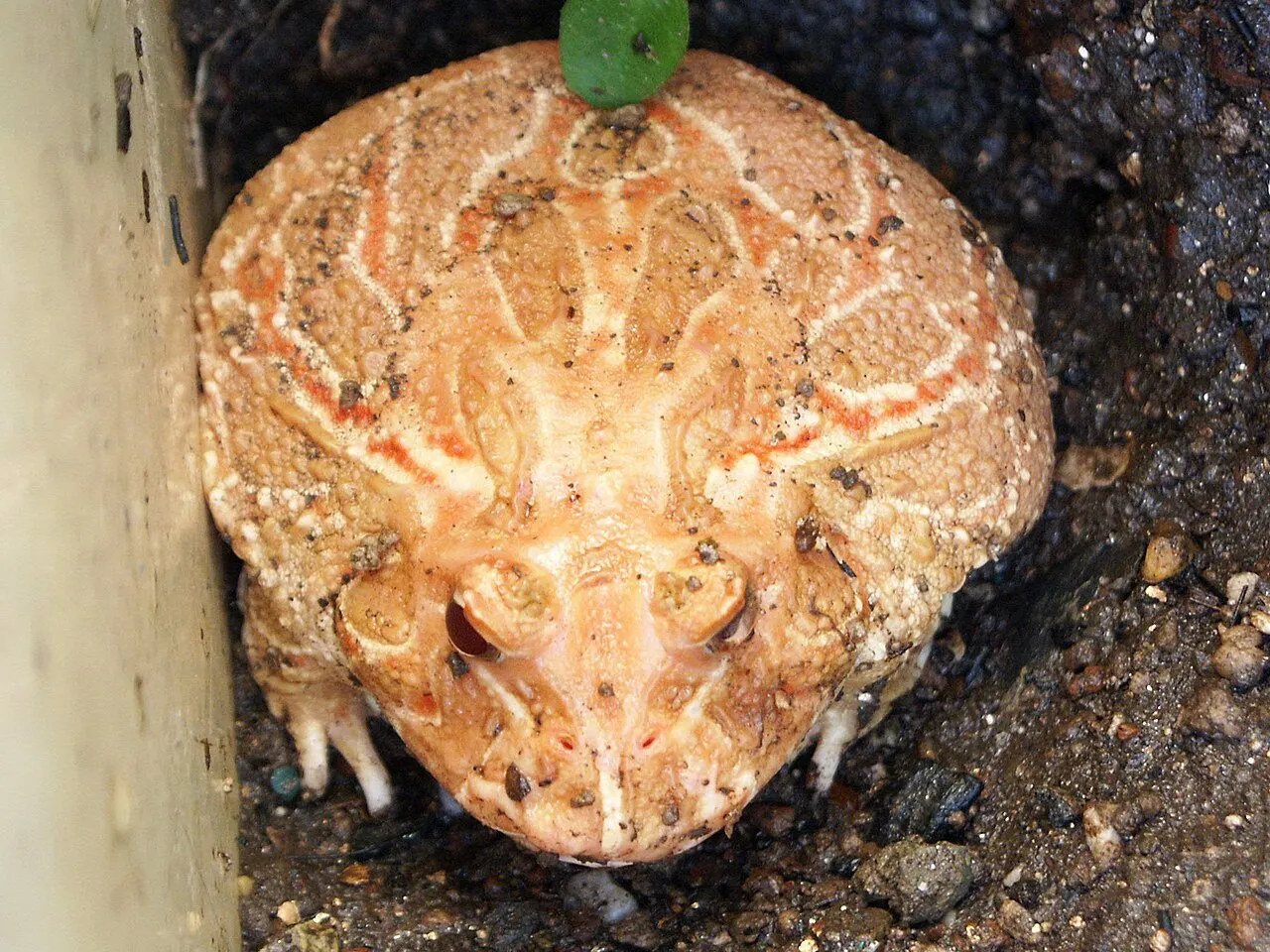
lienyuan lee · CC BY 3.0
2.1. Scientific name and taxonomy
| Rank | Name |
|---|---|
| Class | Amphibia |
| Order | Anura (frogs and toads) |
| Family | Ceratophryidae |
| Genus | Ceratophrys |
| Main pet species | Cranwell's horned frog (C. cranwelli) |
Horned frogs used to sit inside Leptodactylidae, a once sprawling family of South American frogs, but molecular studies have led most authorities to treat Ceratophryidae as a family of its own. Besides Ceratophrys, it includes the largely aquatic Budgett's frogs (Lepidobatrachus) and the small Chacoan horned frog (Chacophrys). Arrangements differ slightly between sources, so check an up-to-date amphibian taxonomy database if precise placement matters to you.
2.2. Where the names come from
The genus name Ceratophrys joins the Greek keras (horn) and ophrys (eyebrow). It refers to the pointed flaps of skin above each eye that look like little horns. They are not bony at all, just extended upper eyelids that feel soft to the touch. The Korean name, which literally means horn frog, describes the same feature. The species name cranwelli is a patronym honoring a person.
Beyond Pacman frog, English speakers use names such as Cranwell's horned frog, ornate horned frog and Surinam horned frog depending on the species. C. ornata is also called Bell's horned frog, and Japanese hobbyists know it by a direct transliteration of that name. Hybrids are usually sold under trade names like Fantasy and Ultraman, which keepers worldwide have adopted.
2.3. Related species
Around eight species are generally recognized. The ones you might see in the trade are summarized below.
| Species | Common name | Range | Notes |
|---|---|---|---|
| C. cranwelli | Cranwell's horned frog | Gran Chaco | Most common pet, many morphs |
| C. ornata | Argentine or Bell's horned frog | Argentine pampas and nearby | Vivid green pattern, habitat loss a concern |
| C. cornuta | Surinam or Amazonian horned frog | Amazon basin | Long, pointed horns, more nervous |
| C. aurita | Brazilian horned frog | Atlantic Forest of Brazil | Large, rarely traded |
| C. calcarata | Colombian horned frog | Colombia and Venezuela | Small, rarely traded |
| C. stolzmanni | Pacific horned frog | Coastal Ecuador and Peru | Small dry-forest species |
Budgett's frogs (Lepidobatrachus), from the same family, are imported now and then, but they spend nearly all their time in water and need a completely different setup.
3. History
In its homeland the horned frog was long feared. Rural communities in Argentina and Uruguay call it escuerzo and tell stories of frogs that poison livestock or clamp on and refuse to let go. Horned frogs have no venom capable of harming people or large animals; the legends almost certainly grew from their readiness to bite and their oversized mouths.
The pet trade picked them up in the second half of the twentieth century, when European and American amphibian enthusiasts began importing wild-caught animals. Cranwell's horned frog turned out to breed fairly reliably with hormone assistance, so through the 1980s and 1990s captive-bred stock took over. Breeders fixed color mutations such as albino and crossed species to create lines like Fantasy and Ultraman, producing today's wide palette. Nearly all Cranwell's and hybrids on sale now come from farms in North America, Europe and Asia rather than the wild.
In Korea, horned frogs reportedly became widely available through specialist reptile shops and online communities from around the 2000s, although there is no clear official record of the first imports. Compact housing, a comical face and an explosive feeding response made them a staple beginner recommendation alongside crested and leopard geckos, and they are now a regular sight at reptile expos and hands-on exhibits.
4. Body
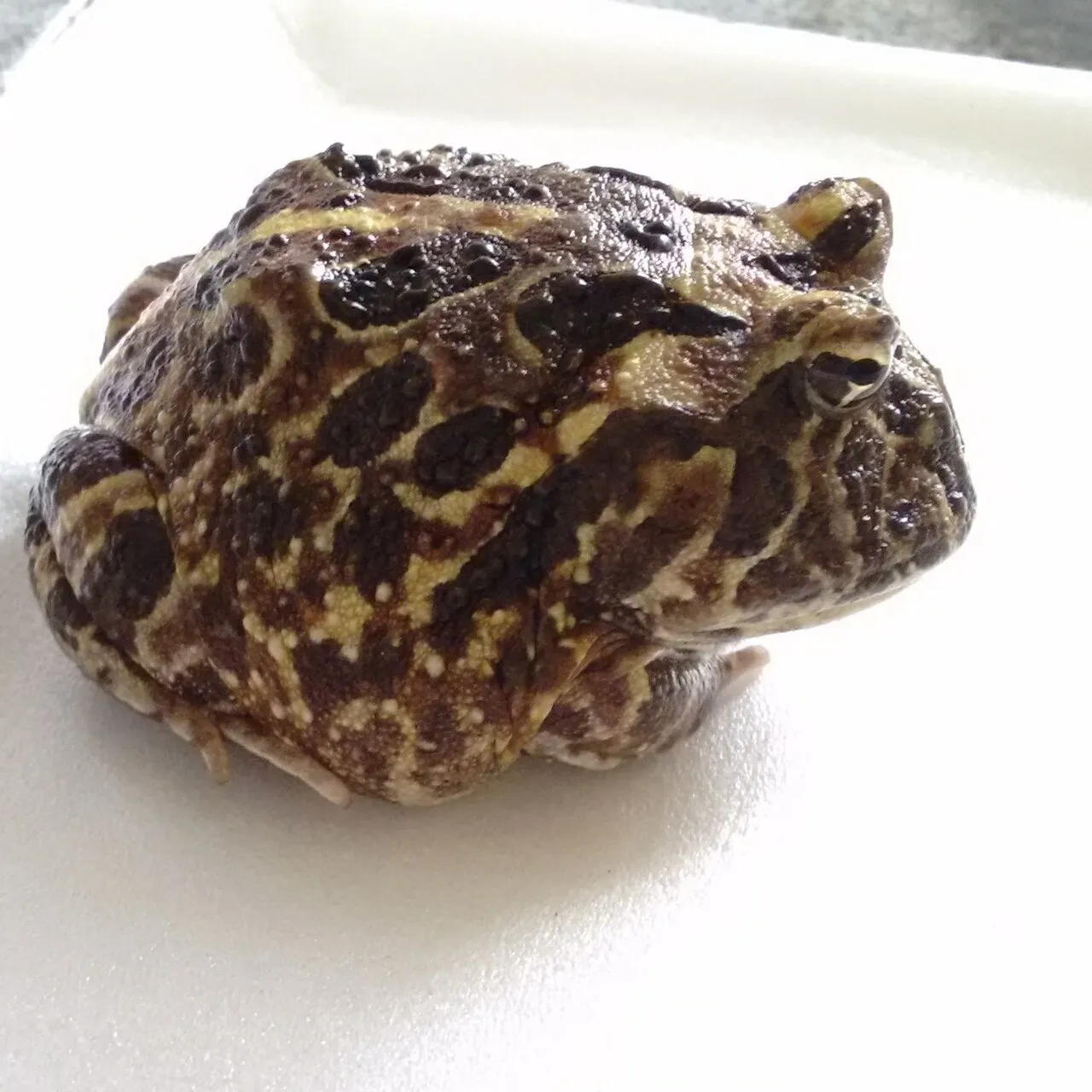
Thomaz Ricardo Favreto Sinani · CC BY 4.0
4.1. Size and build
Horned frogs show striking sexual size dimorphism. A female Cranwell's typically reaches 10–13 cm snout-to-vent length (SVL) and 200–450 g when well fed, while males often stop growing at 6–8 cm, so a male can look half the size of a female of the same age. Argentine horned frogs and some hybrids grow a little larger still.
The body is almost spherical, with short, thick limbs. Each hind foot carries a hard, spade-like metatarsal tubercle that lets the frog shuffle backward into soil. The toes are barely webbed, so horned frogs are weak swimmers and can drown in deep water.
4.2. Mouth and teeth
The trademark feature is a mouth that opens across the entire head. The upper jaw carries a row of small teeth, while the lower jaw has bony, tooth-like projections called odontoids instead of true teeth. Together they make it very hard for prey to escape and allow a bite that can draw blood from a human finger. Research has described horned frogs as having an unusually powerful bite for their size.
The tongue is broad and sticky, used to snag small prey; larger items are simply engulfed. To swallow, the frog retracts its eyeballs into the skull, using them to push food down the throat, which produces the endearing eyes-closed gulp keepers love to film.
4.3. Skin and senses
The skin is thin and highly permeable, taking up water, oxygen and chemicals alike. Horned frogs do not drink through the mouth; they absorb water through a specialized patch of skin on the lower belly, so a frog sitting in its dish is effectively drinking. The back is covered in small warts and ridges, and wild-type Cranwell's are dark green or brown with scattered darker blotches.
The eyes sit high on the head, giving a wide view even when the body is buried. Horned frogs react instantly to movement but largely ignore still objects, which is why pre-killed food usually needs to be wiggled on tongs before it is accepted. The eardrum sits behind the eye and is used mainly to hear calling males.
4.4. Telling males from females
Juveniles are hard to sex by eye. Differences usually appear between six months and a year, and keepers look at several clues together.
- Size: raised under the same conditions, females are clearly larger.
- Throat: mature males develop a darker throat over the vocal sac.
- Front feet: males in breeding condition grow dark nuptial pads on the inner first finger to grip the female.
- Voice: males give a deep, croaking advertisement call when conditions are right. Females may scream when threatened but do not call to attract mates.
5. Morphs and hybrids
Horned frogs come in more colors than most amphibians, though trade names vary from seller to seller. Judge by the actual animal and its parentage rather than the label. Commonly used names include the following.
| Name | Background | Appearance |
|---|---|---|
| Green (normal) | Wild-type Cranwell's | Dark green with brown and black blotches |
| Brown or chocolate | Cranwell's | Mostly brown with little green |
| Albino | Cranwell's | No black pigment, yellow to orange with red eyes |
| Strawberry | Albino Cranwell's line | Albino base with heavy red markings |
| Fantasy | Cranwell's × Amazonian horned frog | Longer horns, green and orange pattern |
| Ultraman | Hybrid line | Bright green with red to orange markings |
Albino lines may be somewhat light-sensitive, so avoid bright lighting and give them plenty of substrate to hide in. Hybrids are often described as colorful and hardy, but their exact ancestry is usually uncertain and they do nothing for conservation of the pure species. If you want pure Cranwell's or Argentine horned frogs, buy from a breeder who documents the lineage.
Color also shifts with age. Fingernail-sized babies often look pale or blurry and deepen as they grow, while some bright red markings fade a little in adulthood.
6. Behavior
6.1. Life in the wild
The Gran Chaco gets torrential summer rain and long, nearly rainless winters. When storms fill temporary pools, horned frogs emerge to feed and breed, burying themselves in mud or grass at the water's edge and ambushing insects, other frogs and small rodents.
When the dry season arrives they dig down and build a cocoon from successive layers of shed outer skin. The cocoon greatly reduces water loss, and the frog lowers its metabolism and survives for months without food. When the next rains soak the ground, it splits the cocoon, often eats it, and resumes hunting. This dry-season dormancy is called estivation.
6.2. Behavior at home
In captivity, too, a horned frog spends most of its life buried. Days when it moves only a few centimeters are normal, and it may sit in the water dish for hours. This is not illness or boredom; it is simply how the species lives, and it will ignore most of a large enclosure.
The feeding response is the opposite: explosive. Many frogs lunge at tongs or even a passing hand shadow, so use long tongs and don't hover your hand over the tank. Horned frogs shed often too. The skin turns dull and loose, the frog twists and pulls it off, then eats it, so many owners rarely witness a shed.
6.3. Reading the signals
Horned frog body language is simple, but a few signals are worth knowing.
- Inflating the body and gaping: a defensive warning. Keep coming and it may bite.
- A loud scream: a distress call when grabbed or badly startled. Stop handling immediately.
- A low, repeated croak: a mature male's breeding call, often heard when humidity rises.
- Dull, cloudy skin: a shed is coming. Perfectly normal.
- A dry, papery white coat: the frog is forming an estivation cocoon. Check temperature and moisture.
- Sitting on top of the substrate and refusing to bury: the substrate may be too wet or dirty, or the frog may be unwell.
- Refusing to leave the water dish: common when it is too hot or dry, or just before a shed. If it lasts several days, review the setup.
7. Life stages
Horned frogs follow the classic frog life cycle from egg to tadpole to frog, with the unusual twist that the tadpoles are carnivorous and cannibalistic from the start. Typical stages look like this.
| Stage | Timing | Notes |
|---|---|---|
| Egg | Hatch in 1–3 days | Scattered on plants or the surface |
| Tadpole | About 2–4 weeks | Carnivorous, cannibalistic, grows fast |
| Froglet | Metamorphosis to 2 months | 1–2 cm, fed every day or two |
| Juvenile | 2–6 months | Rapid growth, peak cannibalism risk |
| Sub-adult | 6 months to 1.5 years | Sexes start to differ, meals spaced out |
| Adult | From about 1.5 years | Growth slows to a stop, fed every 5–7 days |
Captive lifespan is usually quoted as 8–12 years, and well-kept individuals have been reported to live longer. Females are often said to outlive males, though solid comparative data are limited. Obese frogs carry extra strain on the liver and joints and may die younger.
Older frogs can become a little slower to strike, even less active and slightly duller in color. White films or spots on the surface of the eye may indicate lipid deposits or other disease, so have them checked rather than writing them off as old age.
8. Housing
8.1. Enclosure
Floor area matters far more than height. Start babies in a small plastic tub so they can find their food easily, then size up as they grow. A huge tank too early lets feeder insects hide, leaving the frog hungry or pestered by leftover crickets.
| Size | Suggested enclosure |
|---|---|
| Baby (under 3 cm) | About 20 × 15 cm tub |
| Juvenile (3–6 cm) | About 30 × 20 cm |
| Adult male | 40 × 25 cm or more |
| Adult female | 45 × 30 × 30 cm (about 40 L) or more |
Always use a secure lid. Horned frogs aren't climbers, but they can jump when startled, and the lid also keeps feeders and household pets out. Strong ventilation dries the tank quickly, so partially cover a mesh lid to hold humidity.
8.2. Temperature, humidity and lighting
| Factor | Target |
|---|---|
| Daytime temperature | 24–28 °C |
| Night temperature | 21–24 °C |
| Humidity | 60–80 % |
| Danger zone | Long periods below 20 °C, or above 32 °C |
Many homes fall in range for most of the year, but in cold seasons night temperatures often slip below 20 °C. Add a heat mat to part of the floor or one side of the enclosure and always run it through a thermostat. Heating the whole floor leaves no escape and dries the substrate, so warm about a third of the footprint. In summer, a room without air conditioning can pass 30 °C, so keep the tank out of sunny windows.
Lighting is optional. Ambient daylight is enough to set a day–night rhythm; if you want a display light, use a low-heat LED. Some keepers believe low-level UVB (2–5 %) benefits health, and it is a reasonable optional extra as long as the frog has shade and deep substrate to retreat into.
8.3. Substrate and water
Choose a substrate that holds moisture and is low-risk if swallowed. Coco fiber, or coco fiber mixed with fertilizer-free topsoil, is the standard. Give an adult at least 5–8 cm, ideally close to 10 cm, so it can bury fully. The right moisture level clumps when squeezed without dripping. A layer of live moss or leaf litter on top helps hold humidity and gives cover.
The water dish should be wide enough for the whole frog but shallow enough that the water reaches only its chin. Let tap water stand for a day or use an amphibian-safe dechlorinator. Some keepers use plain damp paper towels changed daily instead of loose substrate, which is especially handy for quarantine or frogs under treatment.
8.4. Checklist
- Enclosure (plastic tub or front-opening glass terrarium) with a secure lid
- Coco fiber or a soil and coco mix
- Shallow, wide water dish
- Heat mat and thermostat for cool seasons
- Digital thermometer and hygrometer
- Spray bottle
- Long feeding tongs (25 cm or more)
- Calcium powder and an amphibian multivitamin
- Water dechlorinator
- Nitrile gloves
- Container for keeping feeder insects
9. Diet
Horned frogs are strict carnivores that respond to movement. The key is a varied insect diet with disciplined portions.
| Food | Rating | Notes |
|---|---|---|
| Earthworms (nightcrawlers) | Excellent | Well balanced, a top adult staple |
| Dubia roaches | Excellent | High protein, easy to breed |
| Crickets | Good | Always dust with calcium |
| Superworms, mealworms | Occasional | Fatty with tough exoskeletons |
| Silkworms, hornworms | Occasional | Juicy treat |
| Frozen mice (pinkies) | Rare | Once a month or less, very fatty |
| Feeder fish | Not recommended | Some species contain thiaminase, which destroys vitamin B1 |
| Other frogs | Never | Parasite and chytrid risk |
Juveniles eat every day or two, sub-adults every two to three days and adults every five to seven days. Each meal is a few items smaller than the width of the head, or one to three large earthworms for an adult. The frog will always want more; stopping is your job. Viewed from above, a healthy frog is round without the flanks bulging outward, and its back legs remain visible rather than sinking into fat.
Lightly dust insects with calcium at most feedings and use an amphibian multivitamin containing vitamins D3 and A about once a week. Gut-loading feeders with vegetables and grain-based chow for a day or two beforehand improves their value. Feed on a dish or paper towel so the frog doesn't swallow substrate with its prey. Human meats, ham and cat or dog food are unsuitable.
10. Health
Amphibians hide illness well, and by the time symptoms show, disease is often advanced. They also react to medications very differently from mammals, so dog or cat drugs and internet home remedies can be dangerous. The notes below are for understanding only; if something looks wrong, contact a vet experienced with amphibians.
10.1. Common problems
| Condition | Main cause | Signs | Prevention |
|---|---|---|---|
| Obesity | Overfeeding, fatty prey | Bulging flanks, legs buried in fat, inactivity | Space out meals, limit mice |
| Impaction | Swallowed gravel, bark or oversized prey | No appetite, swollen belly, no droppings | Fine substrate, dish feeding |
| Red leg (bacterial) | Dirty water or substrate, stress | Red belly and thighs, lethargy | Daily water changes, clean substrate |
| Metabolic bone disease | Lack of calcium and D3 | Soft jaw, bent legs, twitching | Regular supplement dusting |
| Chytridiomycosis | Fungal infection | Excess skin shedding, lethargy, odd posture | Captive-bred stock, quarantine |
| Ammonia burn | Fouled water left standing | Red eyes, irritated skin, lethargy | Remove waste promptly |
| Edema | Kidney problems, water quality and more | Swollen like a water balloon | Clean water, early vet care |
| Lipid keratopathy | High-fat diet and other factors | White spots or film on the eye | Balanced diet |
Chytrid in particular is a fungal disease blamed for amphibian declines worldwide. Keep any new frog separate from other amphibians for at least 30 days and use dedicated tools for its enclosure.
10.2. When to see a vet
- No food for more than two weeks with weight loss, when cold or estivation isn't the explanation
- Reddening of the belly or inner thighs
- Abnormal swelling or skin that keeps sloughing
- A soft jaw, bent limbs or trembling
- Tissue protruding from the vent (prolapse)
- Eyes kept shut, or inability to right itself when on its back
- Wounds or ulcers on the skin
For the trip, use a small container lined with damp paper towel and keep the car comfortable. Bring notes on enclosure temperatures and humidity, recent meals and droppings to help the vet.
11. Breeding
Breeding horned frogs is not a casual home project. In the wild, dry-season estivation followed by heavy rain triggers breeding, so captive breeders cool and dry the frogs for weeks to months, then simulate a storm in a rain chamber. Even then results are inconsistent, and many professional breeders rely on hormone injections given with veterinary guidance.
After a successful amplexus, the female lays several hundred to more than a thousand eggs in shallow water. They hatch in one to three days, and the tadpoles are carnivorous and cannibalistic from day one. Preventing losses means raising each tadpole in its own cup, which translates into hundreds of daily water changes and feedings. Froglets eat each other too, so individual housing continues after metamorphosis.
Before breeding, ask yourself the following.
- Do you have the space, time and feeder supply to raise hundreds of babies individually?
- Do you have responsible homes or outlets lined up for them?
- Are both parents fully mature and healthy? Young females can be badly depleted by egg laying.
- Can you guarantee hybrids will never be sold as pure species?
Never release spare tadpoles or froglets into ponds or streams. Beyond the invasive-species risk, it can spread amphibian disease.
12. Costs
The figures below are rough Korean price ranges in won and vary widely by season, seller and morph. Confirm actual prices with breeders and shops.
| Item | Approximate cost (KRW) | Notes |
|---|---|---|
| The frog | 30,000–150,000 | Normals are cheap, rare morphs and hybrids cost more |
| Enclosure | 20,000–100,000 | Plastic tubs are cheaper |
| Heat mat and thermostat | 30,000–70,000 | Nearly essential in winter |
| Thermo-hygrometer, sprayer, tongs | 20,000–40,000 | - |
| Substrate and water dish | 10,000–30,000 | - |
| Total start-up | About 150,000–350,000 | - |
| Feeder insects | 10,000–25,000 a month | Less if you breed your own |
| Substrate and supplements | 5,000–10,000 a month | - |
| Electricity | A few thousand won a month | With a heat mat |
| Monthly total | About 15,000–35,000 | - |
| Yearly total | About 200,000–450,000 | Excluding equipment replacement |
Budget separately for vet care. Clinics that treat amphibians are few, and fees are not necessarily lower than for cats and dogs. A basic exam may cost tens of thousands of won, and with fecal tests, X-rays or hospitalization the bill can reach hundreds of thousands, so set aside a small emergency fund.
13. Before you get one
Horned frogs are an easy impulse buy: tiny, cute babies sell cheaply and the tanks look small. Remember that you could be caring for this animal for close to a decade.
- Is anyone in the household unwilling to deal with frogs or live insects such as crickets, roaches and worms?
- Can you source and store live food at least once a week?
- If your home drops below 20 °C in winter, can you provide heating?
- Is there an exotic vet nearby who sees amphibians?
- Who will change the water when you travel?
- Can you resist the urge to handle it?
When choosing a frog, check these points.
- Is it captive-bred, and can the seller explain where it came from?
- Are the eyes clear and bright, with no wounds or red patches on the skin?
- Is the body nicely rounded, not thin or bloated only in the belly?
- Does it feed eagerly? Ask the seller to show you.
- If several frogs share a tub at the shop, inspect closely for bite wounds.
Starting with a frog of 3 cm or more, rather than a just-morphed baby, lowers the risk of early losses.
14. Laws
Cranwell's horned frogs, Argentine horned frogs and their hybrids, which make up nearly all of the pet trade, are not currently listed under the Convention on International Trade in Endangered Species (CITES). Listings change at each Conference of the Parties, so anyone importing or selling in volume should check the current appendices.
National rules vary. Some countries and states restrict or require permits for exotic amphibians, partly because of disease concerns, and import paperwork or health certificates may be required when moving animals across borders. Check with your national wildlife or agriculture authority and local government before buying or traveling with a frog. Animal welfare laws in many places cover amphibians, making abandonment or cruelty an offense.
The rule that applies everywhere is never release a horned frog. Even where the climate would kill it, a released frog can spread pathogens such as chytrid and ranavirus to native amphibians. Dispose of used tank water and substrate in household waste rather than in drains, streams or garden beds.
15. In culture
Nothing has done more for the horned frog's fame than its nickname. The round body and huge mouth so closely echo the hero of Namco's 1980 arcade game that, in the English-speaking pet trade, Pacman frog is used more often than any official name. Even people who have never played the game recognize the reference.
Online, horned frogs are reliable viral material. The permanently grumpy mouth line, the intense stare before a strike and the eyes-squeezed-shut gulp have spawned countless clips and memes. Many of the famous videos of a furious-looking frog screaming feature horned frogs or their cousins, Budgett's frogs. In parts of South America, by contrast, the escuerzo legends cast the animal as something to fear.
The simple, round shape also makes them a natural for merchandise. Plush toys, figurines and stationery featuring horned frogs are common, and Japan in particular has produced a steady stream of capsule toys modeled on the Argentine horned frog. Horned frog goods are a fixture at reptile expos.
16. Trivia
- Horned frog tadpoles have been reported to make sounds. A study on Argentine horned frog tadpoles found that they produce short underwater calls, a rare example of a vocalizing vertebrate larva.
- The estivation cocoon is built from layer upon layer of shed skin. When the frog wakes, it peels off the cocoon and eats it, recycling the nutrients.
- Texas Christian University's mascot is the Horned Frog, but the animal behind it is a horned lizard (Phrynosoma), not a frog at all.
- Horned frogs will attack prey more than half their own length, and swallowing something too big can lead to choking or impaction. Keep food smaller than the width of the head.
- The horn-like eyelid flaps help with camouflage, breaking up the round outline of the eye when the frog lies buried in leaf litter.
- Their head and mouth are so outsized relative to the body that some writers describe them as a mouth with legs.
- Cranwell's horned frog looks so much like the Argentine horned frog that the two were confused for a long time; it was only formally described as a separate species in 1980.
Health notes are general information. If something seems wrong, contact a vet who treats this species.
FAQ
My horned frog hasn't moved or eaten for weeks.
It is likely too cool (below about 22 °C) or too dry and is starting to estivate. Restore proper temperature and humidity, and if a papery cocoon has formed, soften it with a shallow lukewarm soak. If it still refuses food after two weeks and is losing weight, see a vet.
How can I tell males from females?
Adult females are much larger, often over 10 cm, while males stay around 8 cm, develop a darker throat and may call in breeding condition. Juveniles are hard to sex.
Can I keep it in water?
No. It is a poor swimmer and can drown in deep water. Moist substrate plus a shallow dish no deeper than its chin is the right setup.
Further reading
Photo credits
Photos are freely licensed images from Wikimedia Commons. Authors and licenses are listed below.
- Pacman frog.jpg — Grosscha · Public domain
- 黃金角蛙 Ceratophrys cranwelli albino - panoramio.jpg — lienyuan lee · CC BY 3.0
- Ceratophrys cranwelli 362518335.jpg — Thomaz Ricardo Favreto Sinani · CC BY 4.0